
In this article
The question comes up regularly in citizen preparedness: have I done enough? It seems simple. In reality, it may be the wrong question. Here is why, and how to approach the problem differently.
A personal approach, not a universal list
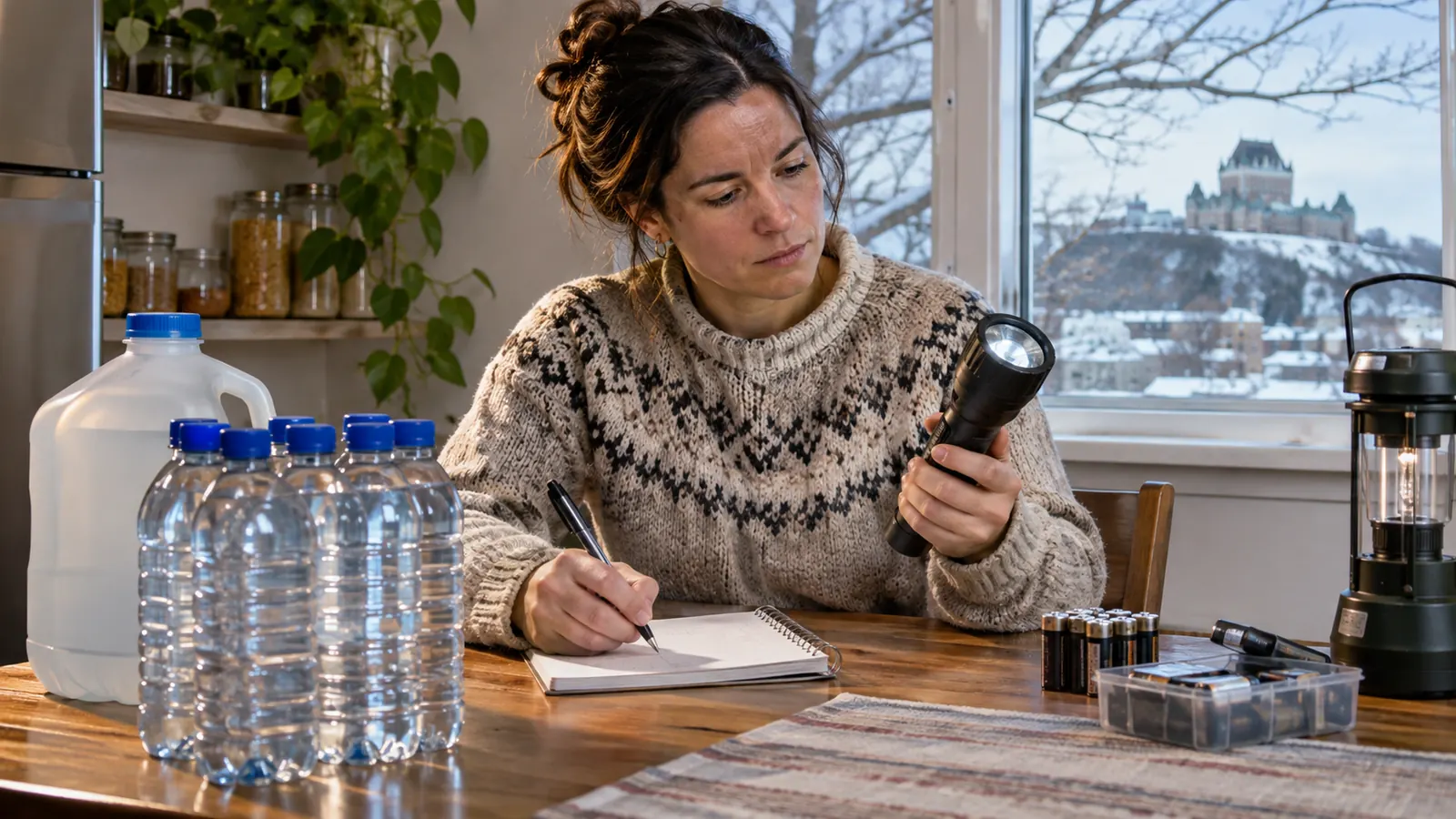
Citizen preparedness often starts the same way: an online search, a moment of realization, a list of equipment to gather. These lists exist for good reason — they structure action and help you not forget the essentials. But they don’t answer the underlying question: prepared for what, in what context, for how many people and for how long?
The answer cannot be given entirely by someone else. It depends on where you live, your immediate surroundings, the make-up of your household, your resources and the most likely scenarios in your region. What you need to build is preparedness that fits you — not a generic standard.
One thing many people who have been at this for a few years end up noticing: lists evolve. What seemed essential at first becomes secondary. Quantities change. Priorities shift. That is normal, and even a sign that your thinking is progressing.
The limits of the scenarios we plan for
Imagine a concrete scenario: an exceptional storm causes flooding, prolonged outages and impassable roads for several weeks in a mid-sized city. In that case, someone with solid reserves, access to water and an alternative energy source will cope reasonably well.
But what if the crisis lasts not a few weeks but a year or two? What if you are away from home at the very moment things deteriorate? What if extended family members arrive unexpectedly, multiplying the number of people to feed and house?
Twelve months of supplies for one person can become two months if six more people join. A well-stocked basement is vulnerable if you are not there to access or secure it. These variables are not exceptions: they are part of the reality of crises.
This is not meant to discourage, but to highlight a real limit: plans are built under ideal conditions. Crises happen under real conditions, with their share of surprises, bad timing and unforeseen human factors.
Preparedness is a provisional measure, a base from which to act — not an absolute guarantee.
You may be asking the wrong question
Taking stock of your supplies is useful. Checking expiry dates, making sure quantities match estimated needs, identifying gaps — all of that makes sense. But this approach has a trap: it can create an illusion of security.
Having six months of stored food, a few thousand litres of water (several hundred gallons) and first-aid supplies does not guarantee you are better prepared than a neighbour who has stored nothing, if that neighbour has a strong network, practical skills and great adaptability. Supplies can be lost, stolen, inaccessible or unsuited to the actual situation. They are a base — not an end in themselves.
Preparedness is not a goal you reach. It is a stance you maintain. It involves regular reassessment, adapting to changing circumstances and constant attention to the environment you live in.
That is why the question “do I have enough?” deserves rephrasing. A better question might be: does my preparedness give me enough time and margin to face the unexpected, make good decisions and avoid depending solely on outside help in the first hours or days of a crisis?
Four dimensions to consider beyond supplies
Practical skills
Knowing how to purify water, give first aid, cook without electricity, navigate without GPS or light a fire in difficult conditions — these skills have an operational value that supplies alone cannot replace. A crisis calls on know-how as much as on material resources.
The human network
The ability to cooperate with neighbours, organize as a community or ask for targeted help is often more decisive than the size of your food reserve. An isolated person with lots of resources is more vulnerable than a coordinated group with modest ones.
Mental adaptability
Managing stress, making decisions under uncertainty and staying functional despite chaos are often-underestimated dimensions. Plans drawn up calmly don’t always survive first contact with reality.
Flexible plans
A rigid plan that ignores unforeseen variables — whether a loved one is present or absent, reduced mobility, being cut off from your home — is less useful than a flexible plan designed with several variants depending on possible scenarios.
Quick self-assessment
| Dimension | Question to ask | Sign it is in place |
|---|---|---|
| Resources | How many days could I last without running water, power or stores? | At least 72 hours for the whole household, ideally two weeks |
| Skills | Who at home can purify water, give first aid, shut off water and gas? | At least two adults, practised within the past year |
| Network | Who could I help, and who could help me, on my street? | Contact details exchanged with a few neighbours |
| Adaptability | What would I do if I were not home when the crisis hit? | A plan B and a meeting point everyone knows |
| Flexibility | Does my plan hold if two more people arrive? | Supplies and a plan built with a margin |
Preparedness as an ongoing process
It is often said that citizen preparedness is a journey, not a destination. However abstract that may sound, it points to something concrete: risks evolve, family situations change, knowledge deepens. What was a priority three years ago may not be today, and vice versa.
This does not mean you must constantly be acquiring things or feeling anxious. It means that periodic reassessment — say once or twice a year — keeps your efforts aligned with the risks actually present in your context.
A useful approach is to ask yourself a few simple questions regularly: what are the most likely risks in my region right now? Does my current preparedness give me a reasonable margin against them? Have I shared the essential information with the people in my household?
Complacency is the main pitfall to avoid. Not because a crisis is necessarily imminent, but because preparedness left unmaintained — expired supplies, outdated plans, unpractised skills — gradually loses its operational value.
What preparedness can reasonably offer
It would be dishonest to claim that citizen preparedness eliminates all risks or guarantees a good outcome in every scenario. It does not. What it can offer is room to manoeuvre in the first hours and days of a degraded situation.
That margin is valuable. It avoids immediately overloading emergency services that are already stretched. It leaves time to assess the situation before acting. It reduces panic and favours more rational decisions. It protects the most vulnerable members of the household — children, older people, people with special needs — while collective resources mobilize.
It is in that space — between the event and stabilization — that preparedness proves its worth. Not as armour against every scenario, but as a net that cushions the initial shock.
So, are you prepared enough?
The honest answer: you probably won’t know for sure until you face a real situation. And that is acceptable. The goal is not absolute certainty — it is to reduce blind spots, have a solid base and stay able to adapt.
If your current preparations give you a margin of a few days to a few weeks for the most likely scenarios in your context, if you have thought about the human side of a crisis — the people in your care, your network, your skills — and if you reassess your situation regularly, then you are on the right track.
Preparedness is not a finish line. It is a way of approaching uncertainty with a little more calm, discernment and ability to act.
Frequently asked questions
When can you consider yourself prepared “enough”?
There is no universal threshold. A reasonable level of preparedness in North America is often associated with self-reliance of 72 hours to several weeks depending on local risks. But beyond duration, what matters is the fit between the risks you have identified and the measures you have taken. Periodic reassessment is more useful than a fixed list.
Is food storage the top priority?
Food reserves are important, but they are only one dimension of preparedness. Access to drinking water, first aid, communication, heat and the ability to evacuate are just as decisive depending on the type of crisis. A balanced approach across these areas is generally more effective than focusing too heavily on one.
How do I get my family involved in preparedness?
Starting with simple conversations about local risks — power outages, winter storms, floods — is usually more approachable than discussing extreme scenarios. Making sure everyone in the household knows where the essential supplies are, the emergency numbers and the basic evacuation plan is already a concrete, realistic starting point.
Does preparedness have to cost a lot?
No. Many basic preparedness measures are cheap or free: knowing local risks, setting up a family communication plan, knowing where to shut off water or gas, having a first-aid kit. Equipment can be acquired gradually, by priority, without a large initial outlay.