

Human-caused · Risk index 6/9 (Quebec) · 6/9 (France)
Kidnapping and hostage-taking
Stranger abductions are very rare; most child abductions are committed by a parent. But when a child goes missing, the first minutes matter. You need to know what to do immediately, and how to react if you are caught in a hostage situation.
Quebec / Canada
France
If you only do three things
- 1Call 911 (or 17/112) immediately if a child goes missing
- 2Keep a recent photo and key information for each child
- 3If you are taken hostage: stay calm, comply and do not try to intervene
Lasting collapse?
Key figures
A rare risk, an absolute emergency.
Understanding the risk
The facts, not the fears.
Most children reported missing are runaways. Among abductions, most are committed by a parent, often during a custody dispute, sometimes abroad. Stranger abductions are rare but remain the most dangerous.
The AMBER Alert in Canada and Alerte enlèvement in France broadcast the description of an abducted child whose life is in danger. Hostage-takings mostly affect stores, banks or public places, and are handled by specialized units.
Severity
The risk to life is real in the rare stranger abductions and in hostage-takings. A parental abduction can also last for years and leave deep scars on the child.
Speed of reporting is the factor that matters most.
In detail
What to do depending on the situation.
| Situation | What to do | Avoid |
|---|---|---|
| A child does not come home | Check nearby places and friends’ homes, then call 911 (or 17/112) | Waiting until the next day |
| Fear of a parental abduction | See a lawyer, inform the school, keep the child’s documents | Taking matters into your own hands |
| AMBER Alert or Alerte enlèvement | Read the description, call the number given if you see something | Intervening alone |
| Taken hostage | Stay calm, comply, keep a low profile | Trying to negotiate or flee without a safe opportunity |
| Police intervention | Lie on the floor, hands visible, follow orders | Running toward the officers |
Assess your exposure
Are you more exposed than average?
Tick what applies to your situation.
Get prepared
Your preparedness checklist
Tick items as you go: your progress is saved on this device.
Suggested kits and plans
Before, during, after
The right actions, before, during and after.
Before
- Profile and photo of each child
- Children know address and number
- Family password
- School knows authorized people
- Emergency numbers saved
During
- Quickly search nearby places
- Call 911 (or 17/112) without delay
- Provide a photo and description
- Stay reachable
- Follow police instructions
After
- Have the child supported by a professional
- Inform the school and relatives
- Review safety measures
- Find support for the family
- Keep all investigation documents
In Quebec, Canada and France
What changes depending on where you live.
Quebec / Canada
In Canada, police issue an AMBER Alert when a child has been abducted and their life is in danger. The RCMP’s National Centre for Missing Persons and Unidentified Remains supports investigations, including international abductions.
- Emergency
- 911
- Missing children
- Missing Children’s Network: 1-888-692-4673
- Abduction abroad
- Global Affairs Canada
- Support
- Info-Social 811
France
In France, the public prosecutor issues an Alerte enlèvement when four criteria are met, including a confirmed abduction of a minor whose life is in danger. The 116 000 line supports families of missing children.
- Emergency
- 17 or 112
- Missing children
- 116 000
- Victim support
- 116 006
- Alert
- alerte-enlevement.gouv.fr
Domino effect
This risk often triggers others
Frequently asked questions
Frequently asked questions
Should I wait 24 hours before reporting a disappearance?
No. That is a myth. Call immediately, especially for a child.
Should children be taught to distrust all strangers?
It is better to teach them who to ask for help (a police officer, a parent with children, a store clerk) and never to go with anyone without your permission.
What if I fear the other parent will leave the country?
See a lawyer quickly; legal measures can restrict a child’s departure from the country.
What should I do after a hostage situation?
Accept the psychological support offered, even if you feel fine. Reactions can appear later.
365 Program
Prepare for this risk, week by week
Data checked on November 23, 2026. Figures come from the organizations cited; consult them for updates.
Sources
Data checked on November 18, 2026. Figures come from the organizations cited; consult them for updates.
- RCMP Gazette, Helping reunite abducted children with their families
- RCMP Gazette, The facts: missing and abducted children
- French Ministry of Justice, Alerte enlèvement turns 20 (in French)
- Government of Canada, International child abduction
This page provides general preparedness information. It does not replace instructions from the authorities: in an emergency, call 911 in Canada or 112 in France.
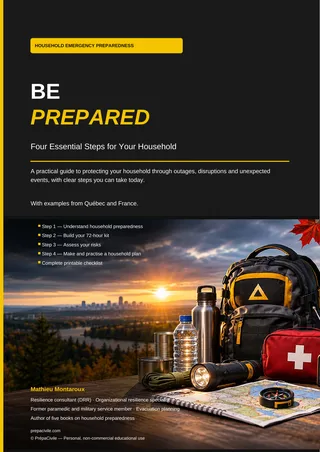
Start with the basics.
Our free “Be Prepared” guide: 72-hour kit, family plan and your own risk assessment.
Kidnapping and hostage-taking
Index Quebec/Canada 6/9 · France 6/9
If you only do three things
- Call 911 (or 17/112) immediately if a child goes missing
- Keep a recent photo and key information for each child
- If you are taken hostage: stay calm, comply and do not try to intervene
During
- Quickly search nearby places
- Call 911 (or 17/112) without delay
- Provide a photo and description
- Stay reachable
- Follow police instructions
After
- Have the child supported by a professional
- Inform the school and relatives
- Review safety measures
- Find support for the family
- Keep all investigation documents
Emergency numbers: 911 (Canada) · 112 (France)
prepacivile.com/en/risks/kidnapping-hostage/