
In this article
A storm, a major outage or an evacuation can happen while you are travelling, far from your supplies, your bearings and sometimes your language. A few simple habits, at the hotel and in your luggage, make you much more self-reliant if something happens away from home.
In short
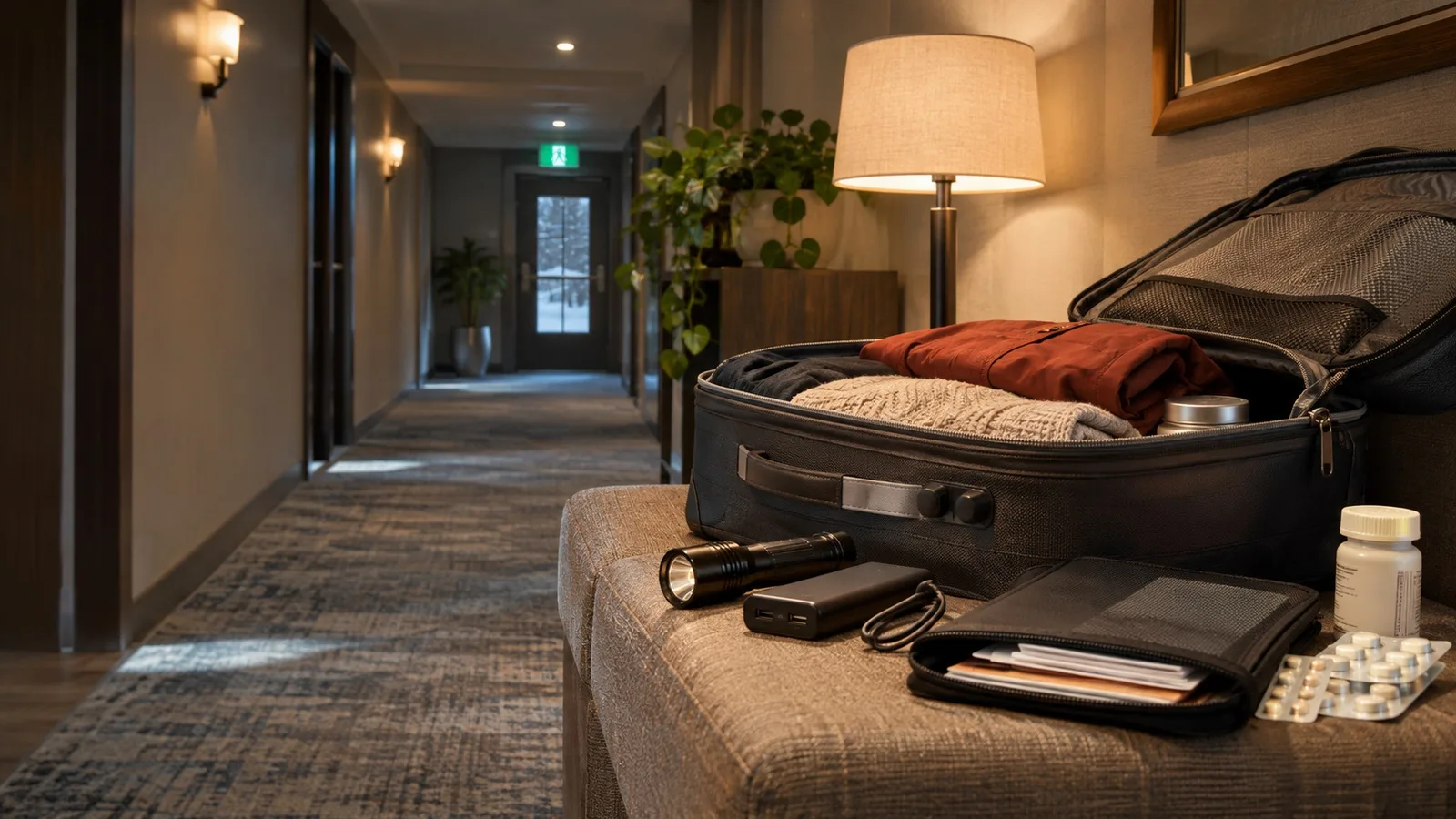
In short. Before leaving: register with the Registration of Canadians Abroad service if you leave the country, leave your itinerary with someone, and keep copies of your documents. At the hotel: find two emergency exits and count the doors. In your carry-on: medication, a flashlight, a power bank, document copies and some cash.
Before you leave
- Check the Government of Canada’s travel advisories for your destination.
- Register with Registration of Canadians Abroad to receive emergency notices.
- Leave your itinerary and accommodation details with someone close.
- Keep encrypted digital copies and photocopies of your passport, prescriptions and travel insurance.
- Check what your travel insurance covers for evacuation or cancellation.
At the hotel
- Read the evacuation plan posted behind the door.
- Find two emergency stairwells and count the doors to each: in smoke, you may have to feel your way.
- Keep a flashlight, your shoes, the room key and your phone by the bed.
- If the fire alarm sounds, touch the door with the back of your hand before opening; if it is hot, stay in the room, seal the bottom of the door and signal at the window and to 9-1-1 (or the local emergency number).
- Never use the elevator during a fire.
- Use the deadbolt and door guard, and do not open without checking who is knocking.
The travel carry-on
| Item | Why |
|---|---|
| Medication for a few extra days, in original containers | Delays, lost luggage |
| Compact flashlight and power bank (in the cabin, per airline rules) | Outages, night evacuation |
| Document copies, emergency contacts on paper | Lost or dead phone |
| Some cash | Payment terminals down |
| Empty water bottle, snack | Long waits |
| Mask, hand sanitizer | Crowded places |
When flying, follow CATSA rules: no knives in the cabin, limited liquids, lithium batteries in the cabin only.
If a crisis happens where you are
- Follow local authorities’ and your accommodation’s instructions.
- Contact family quickly by text, then save battery.
- Abroad, Global Affairs Canada’s emergency service can help.
See also surviving a plane crash and charging your phone without power.
Key points
- BeforeAdvisories, registration, itinerary left with someone.
- HotelTwo exits found, doors counted, no elevator in a fire.
- Carry-onMedication, flashlight, power bank, copies, cash.
Sources
- Government of Canada (travel.gc.ca), travel advice and Registration of Canadians Abroad.
- Canadian Air Transport Security Authority (CATSA), items allowed in the cabin.