
In this article
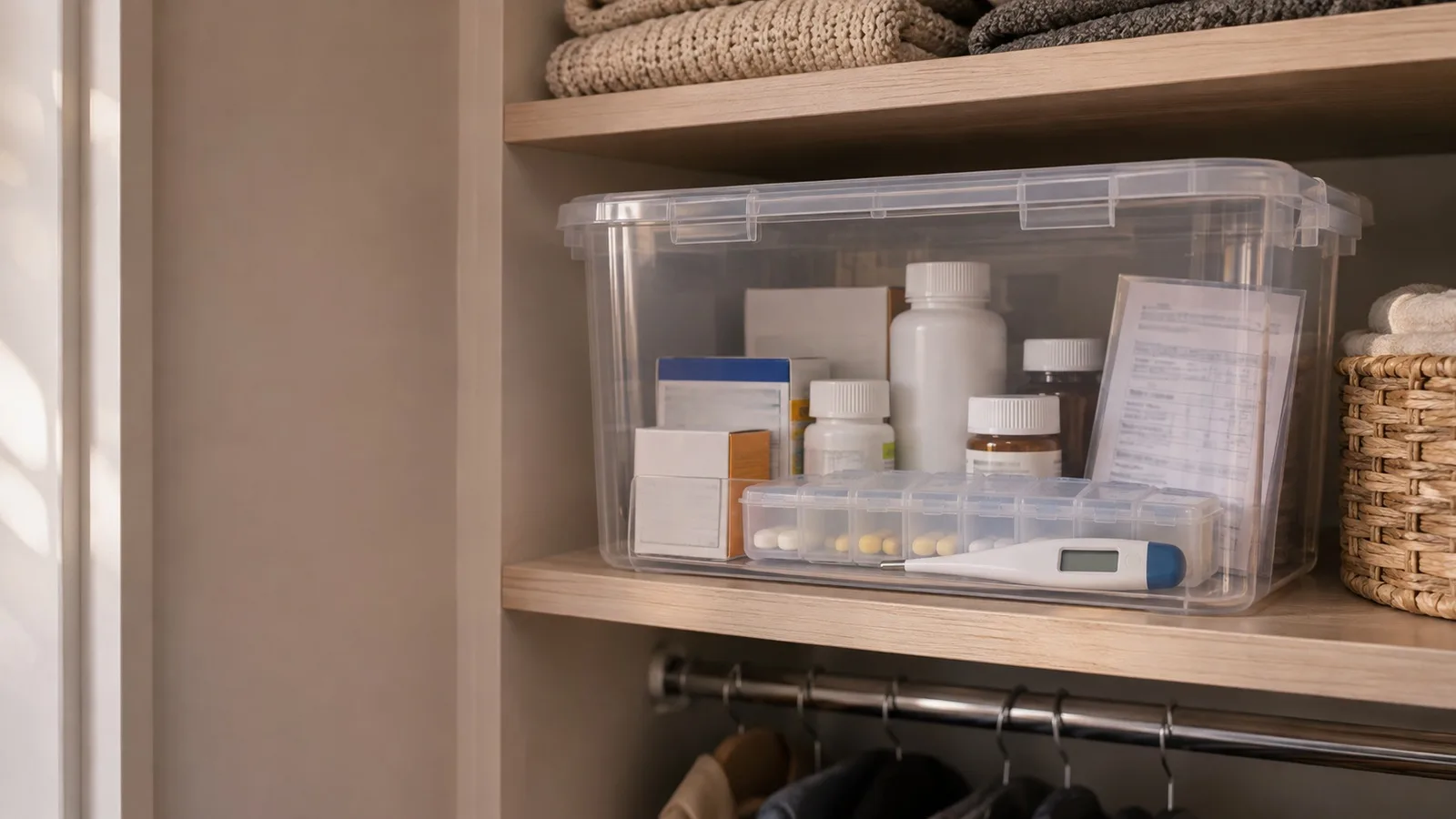
Having a few days of medication on hand is part of any emergency kit. But it also has to stay effective. Heat, humidity, light and freezing can degrade some medications, and a power outage puts refrigerated ones at risk. Here is how to store, rotate and carry your medications so they are ready the day you need them.
In short
In short. Keep medications in their original containers, dry and at room temperature, out of the bathroom and out of children’s reach. Follow the conditions on the label or from your pharmacist. Rotate your supply and return expired medications to the pharmacy. For refrigerated medications, plan a solution for outages.
Proper storage conditions
| Factor | Risk | Good practice |
|---|---|---|
| Heat | Active ingredient degrades | Room temperature, away from the oven, heaters and a car in the sun |
| Humidity | Tablets swell or crumble | Not in the bathroom; container tightly closed |
| Light | Some products are sensitive | Original container, often opaque |
| Freezing | Liquids and insulins damaged | Do not leave in a cold vehicle or against the freezer wall |
Each medication has its own conditions: read the label and ask your pharmacist when in doubt.
Building a small supply
- Talk to your pharmacist about essential medications: depending on your situation, it may be possible to refill a little early to keep a few days ahead. See medication continuity with your pharmacist.
- Keep an up-to-date list of your medications, doses and allergies, on paper and on your phone.
- For over-the-counter products, see our list of over-the-counter medicines to plan for.
Rotation
Put the newest boxes at the back and use the oldest first. Check dates twice a year, for example when the clocks change. An expired medication may have lost effectiveness: do not count on it in an emergency.
Refrigerated medications during an outage
- Keep the fridge closed: it stays cold for several hours.
- Have a cooler or insulated pouch with cold packs, without direct contact with ice.
- Ask your pharmacist how long each medication tolerates room temperature, and write it down.
- If in doubt after a long outage, check with your pharmacist before using the medication.
During an evacuation
Keep a medication pouch in your go-bag, with the list of treatments. Never leave it in a car in the sun or the cold.
Disposing of expired medications
Do not flush them or put them in the garbage. In Quebec, and in most provinces, pharmacies take back expired or unused medications.
Key points
- StoreOriginal container, dry, room temperature, out of children’s reach.
- RotateOldest first, dates checked twice a year.
- PlanA cold solution for refrigerated medications.
Frequently asked questions
Can I prepare a pill organizer for the kit?
For a few days, yes, but also keep the original containers or a copy of the label, useful for responders and to avoid mistakes.
Is an expired medication dangerous?
Mostly it may be less effective. Ask your pharmacist rather than using it.
Disclaimer. General information. Follow your pharmacist’s and the label’s directions. For advice, call your provincial health line (8-1-1 in Quebec); in an emergency, 9-1-1.
Sources
- Health Canada, safe storage and disposal of medications.
- Ordre des pharmaciens du Québec, medication take-back.
Go further: when access to care is disrupted and our guide to diabetes and emergencies.