
In this article
- Why plan for a backup power supply?
- What is a solar power bank?
- Models compared
- Solar power bank or a true solar panel?
- Why solar surface area matters so much
- Fold-out panels change the situation.
- Understanding mAh: beware of marketing figures
- Watt-hours are often more useful.
- How many times can a phone be recharged?
- Fast charging matters more today
- Wireless charging: convenient, but not a priority
- Weight: consider the energy being carried
- Durability and water protection
- The solar power bank paradox: sunlight for the panel, but heat is bad for the battery
- How can you expose the panel to the sun without overheating the battery?
- How to orient a portable solar panel
- Attaching it to the outside of your backpack while hiking?
- Does a new power bank necessarily need to be charged twice before being used with a solar panel?
- Should a power bank always be kept fully charged?
- What kind of system is best for a bug-out bag?
- What kind of system is needed for a multi-day power outage at home?
- Older BLAVOR models
- How should you choose a power bank in 2026?
- Solar power capacity should be stated in watts.
- Safety of lithium-ion power banks
- The best system depends on the scenario
- Before buying: also focus on reducing consumption
- Conclusion: a small solar panel isn’t useless, but it must be assigned the right role.
- Frequently Asked Questions
- Sources and references
- Related resources
- Equipment to compare for your needs
A solar power bank might seem like the ideal solution for a prolonged power outage: a portable battery, an integrated solar panel, and the theoretical ability to generate your own electricity while off-grid. The reality is more nuanced. While the energy storage may be excellent, the small panel built into most of these devices generally produces too little power to serve as a truly autonomous solar energy source.
In the context of individual or household preparedness, these devices can still have their place—provided you have a clear understanding of exactly what they can (and cannot) do.
The rule to remember: a solar power bank is, first and foremost, a power bank. Its small, integrated panel should generally be viewed as a supplementary or last-resort charging option, rather than a primary energy source.
Why plan for a backup power supply?
Beyond the essential needs—such as safety, water, food, and temperature control—electricity can quickly become a critical resource during a power outage.
A phone, for instance, allows you to:
- communicate with family;
- receive certain alerts;
- to consult available information;
- to use maps saved for offline use;
- to access documents;
- to take photos;
- to store certain forms of digital authentication.
Other devices may also require recharging:
- GPS;
- rechargeable headlamp;
- radio;
- GPS watch;
- portable medical devices;
- tablet;
- small communication systems.
Furthermore, a power outage does not automatically mean the loss of the cellular network. Some infrastructure has its own backup systems, but their operational capacity and availability may decline depending on the duration or scale of the event.
A phone is no substitute for a formal communication plan. However, when it is still functional, preserving its battery life provides an additional option.
What is a solar power bank?
A solar power bank generally combines:
- a lithium-ion or lithium-polymer battery;
- a charging circuit;
- one or more USB ports;
- a small photovoltaic panel attached to the casing.
Some models use multiple foldable panels to increase the surface area for energy collection.
The following power-bank families illustrate the main design differences:
Model family: BLAVOR
See the product on Amazon
Model family: BLAVOR (multi-panel version)
See the product on Amazon
Why no longer automatically label them as "top picks"? Models, capacities, USB ports, and charging standards evolve rapidly. A product that was a great choice several years ago is not necessarily the best purchase today. Technical specifications matter more than historical rankings.
Models compared
The original table has been retained to preserve the products and images featured on the page. The specifications correspond to the versions available at the time of the initial writing and should be verified before making a purchase.
| Previous model | Image | Stated weight | Stated capacity |
|---|---|---|---|
| BLAVOR Power Bank – A versatile, previously featured model. | 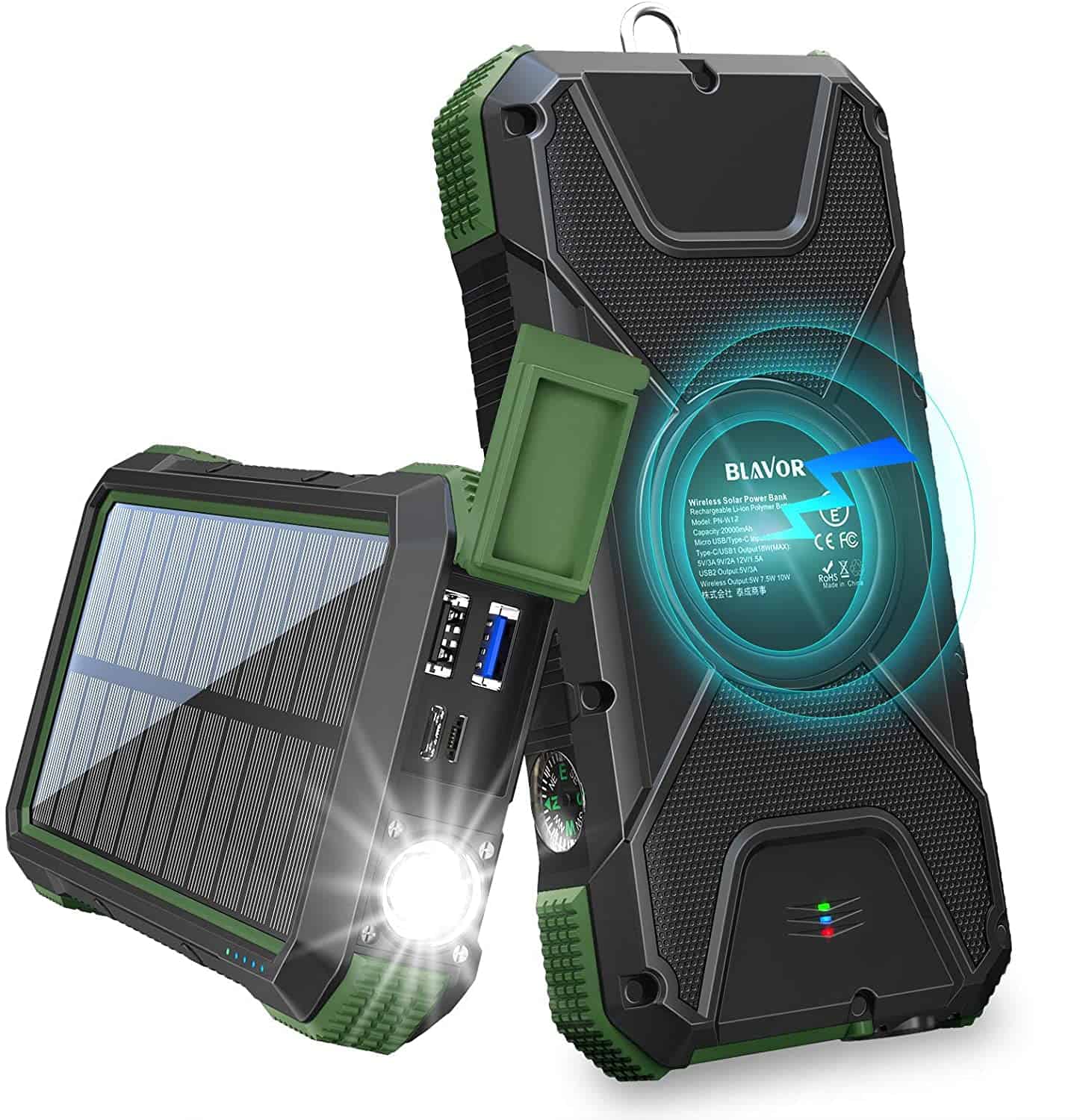 |
685 g (1.51 lb) | 20,000 mAh |
| BLAVOR Five-Panel – A previously featured model with additional panels. | 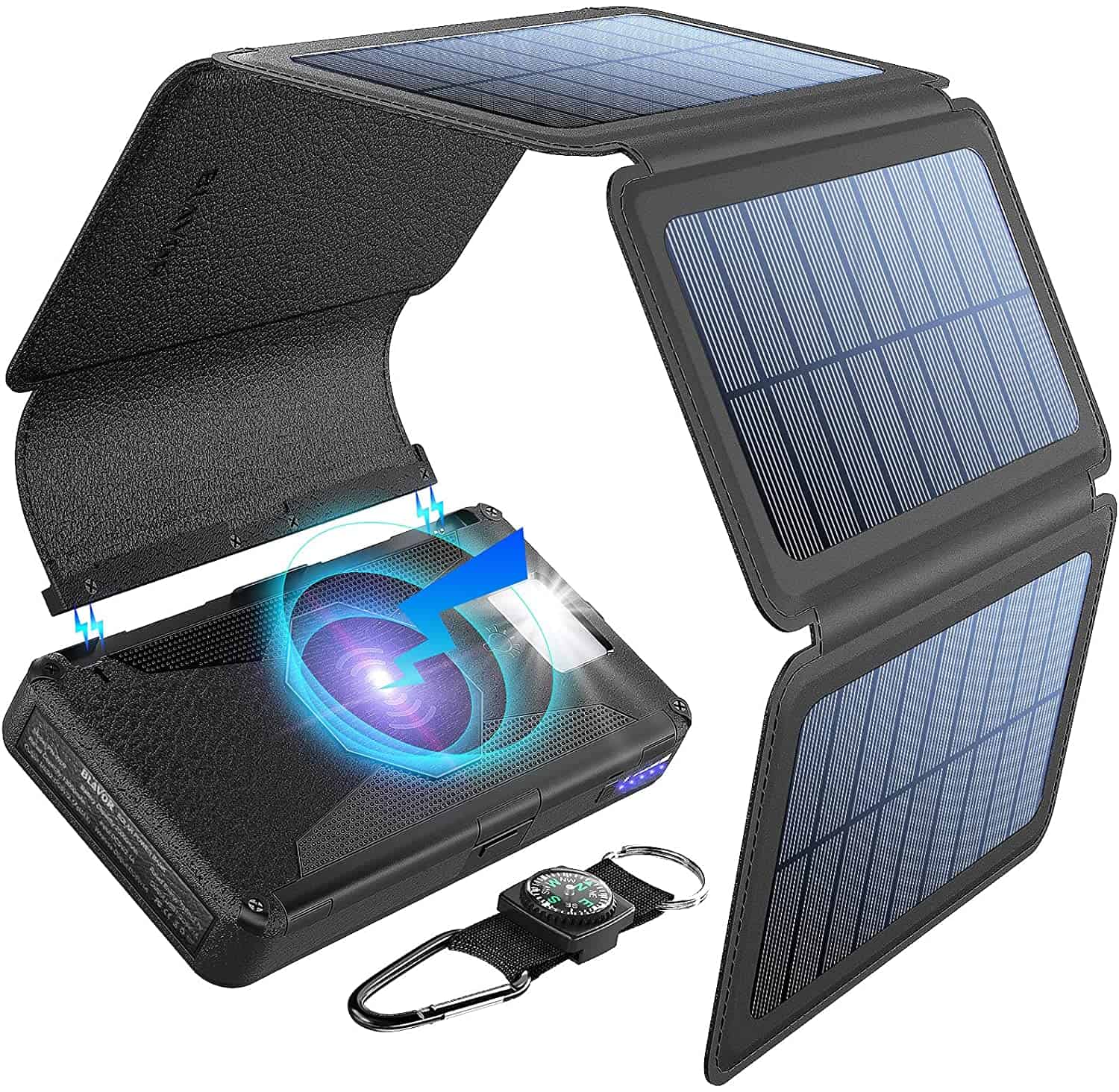 |
612 g (1.35 lb) | 20,000 mAh |
| BEARTWO Portable – A compact, previously featured model. | 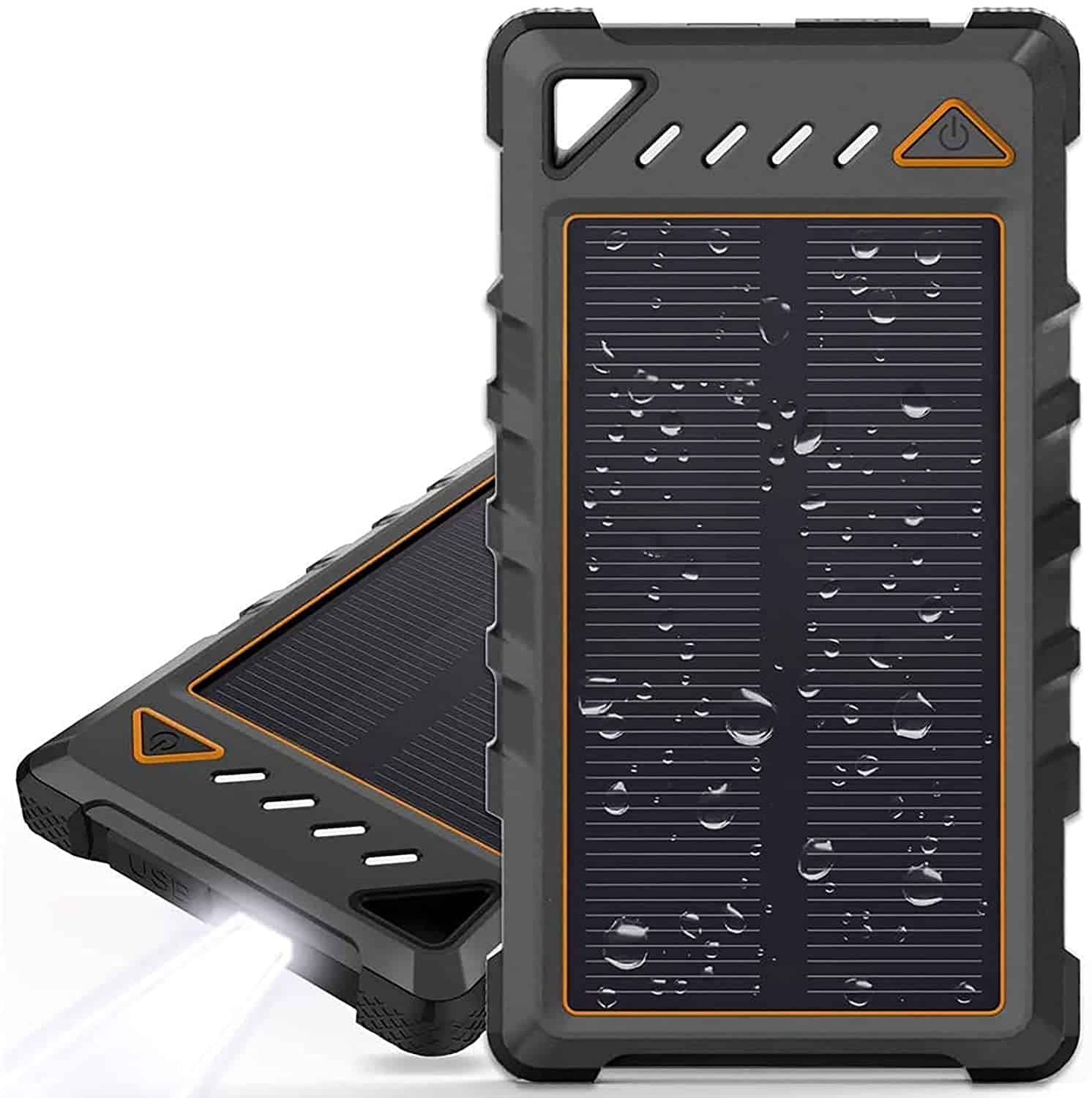 |
210 g (7.4 oz) | 10,000 mAh |
Solar power bank or a true solar panel?
This is the most important distinction in this entire article.
Solar power bank
A battery with a small, integrated solar panel. Very easy to carry, but with a limited photovoltaic surface area, meaning solar charging is generally slow.
Deployable solar panel
A much larger surface area. Heavier and bulkier, but capable of generating a truly useful amount of power for recharging a power bank.
A proper portable solar panel generally does not store energy itself. Instead, it produces electricity that can power:
- a power bank;
- a compatible phone;
- a power station;
- a battery charger;
- other suitable equipment.
A modern system can therefore be represented simply as follows:
Sun → solar panel → USB regulation → power bank → devices.
Why solar surface area matters so much
A solar panel does not generate energy simply by being exposed to light.
Its power output depends on several factors, including:
- its surface area;
- its efficiency;
- the intensity of solar radiation;
- its orientation;
- shading;
- temperature;
- system losses.
The surface area available on the back of a power bank—which is typically the size of a phone—is inevitably very small.
This is why manufacturers of certain single-panel devices state that solar charging should primarily be viewed as an emergency feature rather than the main method for recharging.
A large battery paired with a very small panel creates an imbalance. As the battery capacity increases without a proportional increase in the photovoltaic surface area, the time required to fully charge it using only solar power grows significantly.
Fold-out panels change the situation.
Some devices incorporate multiple foldable panels.
The logic is sound: increasing the total solar surface area boosts the available power.
Today, there are portable systems—for instance, those featuring 15W or 25W deployable panels—paired with one or more 10,000 mAh power banks. While these systems take up more space, the solar energy generated is far more substantial than what can be produced by the small panel found on a standard power bank.
The trade-off, therefore, becomes:
| Solution | Portability | Solar generation |
|---|---|---|
| Power bank + tiny panel | Excellent | Very low |
| Power bank with unfoldable panels | Good | Low to moderate |
| 15–30 W USB panel + power bank | Moderate | Much more useful |
| Large panel + power station | Low | Suited for greater autonomy |
Understanding mAh: beware of marketing figures
The capacity of a power bank is almost always advertised in mAh, or milliampere-hours.
A device rated at 20,000 mAh might therefore seem capable of charging a 5,000 mAh phone four times.
In reality, this calculation is too simplistic.
Some energy is lost during:
- voltage conversion;
- transfer via cable;
- the charging of the phone’s battery;
- the generation of heat;
- the electronic operation of the charger.
Furthermore, the mAh rating indicated for the internal battery is measured at its nominal voltage, whereas the USB output operates at a different voltage.
Watt-hours are often more useful.
When comparing energy reserves, watt-hours (Wh) are often a more meaningful metric.
As a rough estimate, a lithium-ion battery rated at:
- 10,000 mAh at 3.7 V theoretically contains approximately 37 Wh;
- 20,000 mAh at 3.7 V theoretically contains approximately 74 Wh.
The amount actually available via the USB port will be less than this figure.
When planning for battery life, watts and watt-hours generally provide a more accurate picture than mAh alone.
How many times can a phone be recharged?
This depends entirely on:
- the phone's capacity;
- the actual capacity of the power bank;
- its condition;
- its efficiency;
- ...using the phone while it is charging.
A simple calculation might suggest that a 20,000 mAh battery would provide "at least four charges" for a mid-range phone.
This might have been plausible with some older phones under certain conditions, but it is not a reliable rule today.
Since modern phones often feature large batteries, it is better to think in terms of actual battery life and to test your own equipment.
A simple test: fully charge your power bank, use your phone as you normally would, and measure how many actual charges your specific setup provides. This figure is more valuable than the theoretical rating printed on the box.
Fast charging matters more today
A 5 V / 2.1 A USB port is no longer enough to define fast charging: check the protocol supported by the power bank, cable and phone.
That was relevant at the time it was written.
In 2026, USB-C and power protocols like USB Power Delivery play a much more significant role.
For a new purchase, I would prioritize:
- at least one USB-C port;
- USB Power Delivery, when supported by the devices in question;
- a high enough input power rating to recharge the power bank quickly;
- an output power rating suited to your phone or other devices;
- USB-A, only if your existing equipment still requires it.
High capacity is of little use if the power bank itself requires an entire day plugged into a wall outlet to fully recharge.
Wireless charging: convenient, but not a priority
Some models feature built-in Qi wireless charging.
This can be handy if your phone’s charging port is damaged or if you don’t have the right cable on hand.
However, wireless charging generally results in greater energy loss compared to a wired connection.
In situations where every watt-hour counts, a wired connection is usually the better choice.
Weight: consider the energy being carried
In a bug-out bag—where weight is a critical factor—a larger battery is not necessarily a better one.
Instead, you should determine:
- how many days of autonomy you need;
- which devices are truly the highest priority;
- whether solar charging is a viable option;
- whether you might encounter an electrical outlet along your route;
- whether multiple people will be sharing the same battery.
Carrying a 20,000 or 30,000 mAh battery just for a phone that is used sparingly can be unnecessarily heavy.
Conversely, for a family with several phones and other devices, a higher-capacity battery may be entirely justified.
Durability and water protection
For outdoor equipment, an actual IP rating provides more value than a simple "water-resistant" label.
The IP code distinguishes between different levels of protection against:
- dust;
- splashing;
- immersion under specific conditions.
The BEARTWO model in this product family was rated IP67.
Compare this BEARTWO model family
A product sheet from that time listed it as having a capacity of approximately 10,000 mAh, a weight of 210 g (7.4 oz), two USB outputs, and an IP67 rating.
However, when an older model is no longer clearly documented by its manufacturer, I would not base a new purchase solely on these outdated specifications.
The solar power bank paradox: sunlight for the panel, but heat is bad for the battery
This is arguably the most important safety-related point to address.
A power bank typically contains a lithium-ion battery.
Health Canada recommends keeping these batteries:
- at room temperature;
- in a dry place;
- out of direct sunlight when stored;
- away from extreme temperatures;
- and not left inside a vehicle that is very hot or very cold.
Batteries that are swollen, damaged, very hot, or show other signs of wear should not continue to be used.
Do not leave a power bank to bake for hours on a car’s dashboard or hood. The extra solar energy gained does not justify the heating of a lithium-ion battery.
How can you expose the panel to the sun without overheating the battery?
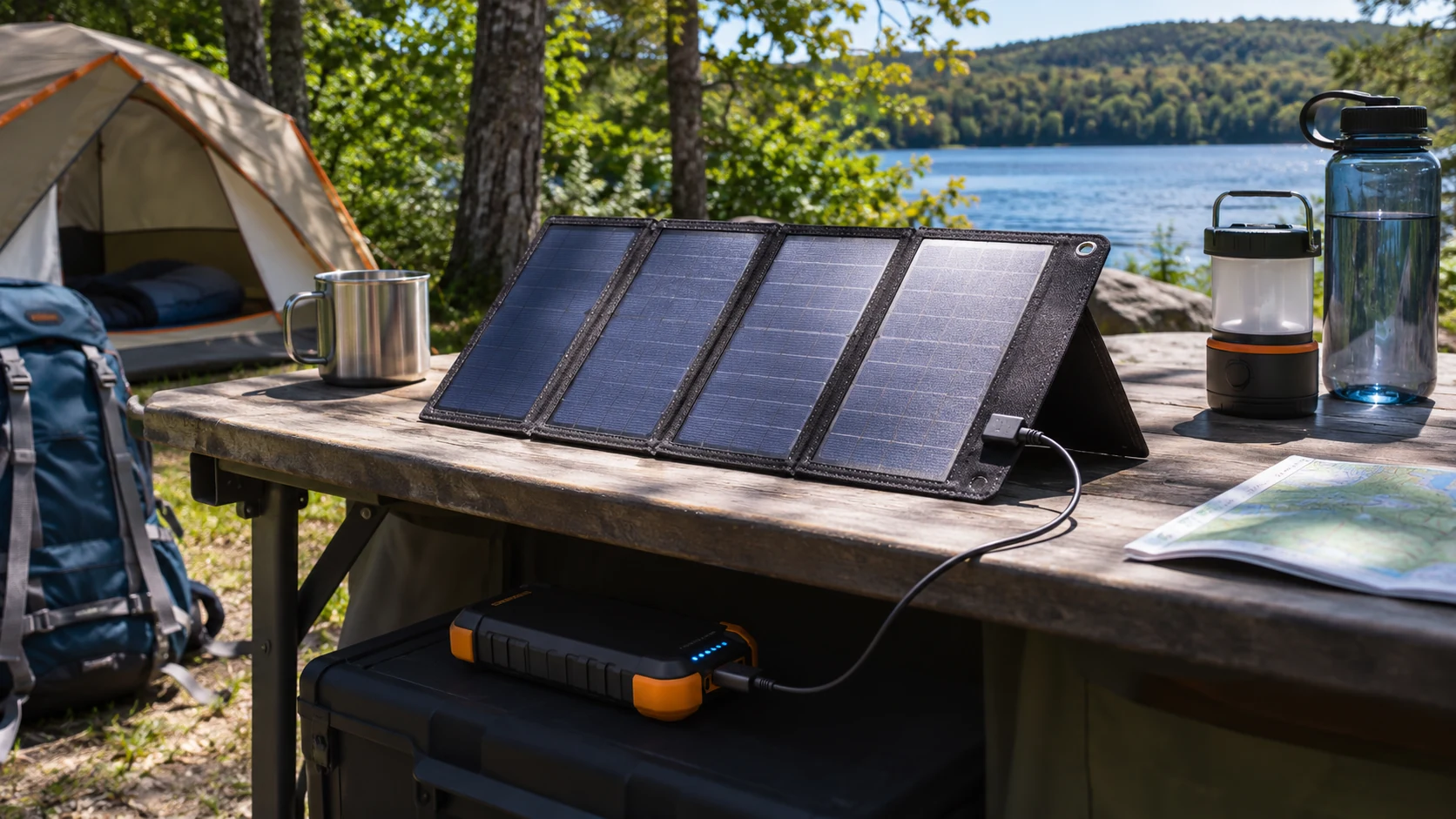
With a separate solar panel, the solution is simple:
the panel can remain in the sun, while the battery is placed in a shaded, well-ventilated spot—within the limits specified by the manufacturer.
If the panel is attached directly to the battery, this separation is not possible.
This is another reason why a truly deployable panel paired with an independent power bank often makes for a better energy setup.
How to orient a portable solar panel
A panel will generate more power when it receives direct sunlight.
Performance drops significantly when:
- the panel is in the shade;
- only part of it is illuminated;
- it is positioned at a sharp angle away from the sun;
- the sky is overcast;
- the panel becomes excessively hot.
With a small, portable device, aiming for a reasonably good orientation toward the sun is generally more practical than constantly trying to calculate a theoretically perfect angle.
Attaching it to the outside of your backpack while hiking?
That is a very popular marketing image.
In practice, a small panel attached vertically to a moving backpack is constantly subjected to a changing solar angle, shifts between shadow and light, and may even be partially covered.
It can generate some energy.
However, this is not necessarily the most efficient way to charge.
During a break, a panel that is properly deployed and oriented generally benefits from better conditions.
Does a new power bank necessarily need to be charged twice before being used with a solar panel?
A fixed number of initial charging cycles is sometimes presented as a universal requirement, but the product instructions should guide use.
I would remove it.
Modern lithium-ion batteries do not universally require two full charge cycles to be "activated."
Instead, it is a good idea to:
- Read the manual for your specific model.
- Charge it before adding it to your gear kit.
- Test all the ports.
- Verify that it can charge each of the devices you intend to use.
- Also, test the solar charging function.
- Measure its actual capacity/runtime.
Equipment that hasn't been tested cannot yet be considered a reliable resource.
Should a power bank always be kept fully charged?
For a kit that is used regularly, it can be convenient to maintain a high charge level so that it is ready for immediate use.
For long-term storage, the logic is different.
Health Canada currently recommends keeping a lithium-ion battery at approximately 50% charge when stored for long periods without use, with a check-up roughly every three months.
There is, therefore, a trade-off between:
- immediate availability;
- battery aging;
- the frequency of kit inspections.
For an emergency bag, choose a policy and stick to it. A fully charged battery that is regularly inspected and refreshed is a sound approach. A battery left forgotten at the bottom of a bag for five years is not.
What kind of system is best for a bug-out bag?
When traveling to a planned destination, energy requirements may be relatively limited.
I would generally prioritize:
A charged phone
The primary energy reserve is already inside the device itself.
A USB-C power bank
Sized according to the duration of the trip and the number of devices in the household.
Solar power, if necessary
A small, foldable solar panel becomes useful when the required runtime exceeds the capacity you can physically carry.
A solar panel integrated into a power bank can be a nice bonus, but I wouldn’t build an energy strategy around it.
What kind of system is needed for a multi-day power outage at home?
In a home setting, weight becomes much less important.
It then becomes possible to separate the functions:
Production → storage → distribution.
For example:
- A solar panel of reasonable power generates energy;
- a station or one or more power banks store it;
- USB ports or other suitable outputs power essential devices.
This architecture also allows for the independent replacement of any faulty component.
Our guide on energy and solar panels explores this concept in greater detail.
Older BLAVOR models
BLAVOR 20,000 mAh Power Bank
This model is considered the best all-rounder, thanks to its capacity and charging options.
See the product on Amazon
The version reviewed featured several USB options as well as Qi wireless charging.
This type of product remains a good choice when the primary need is a power bank; the integrated solar panel should be viewed as an additional, supplementary feature.
Notable features
- High capacity for its time
- Multiple charging methods
- Built for outdoor use
- Additional functions
Limitations
- Heavy weight
- Small solar panel
- Older generation of connectors (depending on the version)
- Specifications should be verified before purchase in 2026
BLAVOR with five panels
This version was specifically designed to address the main drawback of solar power banks: the size of the photovoltaic surface area.
See the product on Amazon
The concept remains relevant today: adding more panels increases solar energy generation.
However, once a system grows large enough to include multiple panels, it becomes worth comparing its weight, power output, and price against those of a dedicated, standalone USB solar panel.
Notable features
- Larger solar surface area than a single-panel unit
- Integrated battery
- All-in-one system
- Still portable
Limitations
- Added weight
- Power generation remains limited compared to a large solar panel
- Battery and panels are inseparable
- Older model for comparison with current offerings
BEARTWO 10,000 mAh
The BEARTWO model represented the opposite approach: low weight, compact size, and an IP67 ingress protection rating.
See the product on Amazon
The marketing materials at the time explicitly stated that solar charging was slow and that the panel should not be considered the primary energy source.
This point effectively summarizes the entire category.
An integrated panel provides an extra layer of resilience, but the battery remains the product’s primary energy capacity.
How should you choose a power bank in 2026?
I would rank the criteria as follows:
- Actual energy capacity. Sized according to your devices and the duration of use you require.
- USB-C and charging speed. This ensures the battery itself can be recharged quickly.
- Power output. Must be suited to the devices you intend to power.
- Quality and safety. The product should come from a reliable source and include an appropriate charger.
- Weight. Particularly important for evacuation on foot.
- Environmental protection. IP rating, where applicable.
- Solar generation. Look at the panel’s actual wattage, not just the presence of the word "solar."
Solar power capacity should be stated in watts.
If a manufacturer heavily promotes solar charging without clearly specifying the panel’s wattage, a key piece of information is missing.
Compare:
"built-in solar panel"
and:
"20 W solar panel"
—these do not provide the same level of information.
The wattage provides a much better estimate of generation capacity.
For storage, look at Wh (watt-hours). For solar generation, look at W (watts). These two values offer a much faster understanding of an energy system than marketing claims do.
Safety of lithium-ion power banks
Health Canada notes that lithium-ion batteries are common and generally safe when used correctly; however, they can pose risks of overheating, fire, or explosion if they are damaged, poorly manufactured, or subjected to improper conditions.
A few principles are particularly important:
- purchase from a reliable source;
- use a compatible power supply and charger;
- look for relevant Canadian certification marks on electrical equipment;
- do not charge on a bed or sofa;
- do not use a swollen or damaged battery;
- avoid extreme temperatures;
- do not leave a battery in direct sunlight or in a very hot vehicle;
- follow the manufacturer’s instructions.
For long-term storage, Health Canada recommends maintaining a charge level of approximately 50% and checking the battery periodically.
The best system depends on the scenario
| Scenario | Appropriate approach |
|---|---|
| Power outage lasting a few hours | Charged phones + a small power bank. |
| Power outage lasting 1 to 3 days | One or more power banks, sized according to the devices being used. |
| Short-term evacuation | Compact power bank, short cables, and devices set to power-saving mode. |
| Multi-day relocation | Power bank + deployable solar panel for situations where access to power outlets is uncertain. |
| Extended autonomy at home | Dedicated solar panel + energy storage tailored to your needs. |
Before buying: also focus on reducing consumption
Every watt-hour you don’t use is one that doesn’t need to be generated or transmitted.
During an outage:
- reduce screen brightness;
- enable power-saving mode;
- disable unnecessary services;
- use airplane mode when communication isn’t required;
- opt for short messages rather than long communications when the network signal is weak;
- keep maps and important documents available offline;
- turn off certain devices completely between uses.
Energy autonomy comes as much from managing consumption as it does from increasing storage capacity.
Conclusion: a small solar panel isn’t useless, but it must be assigned the right role.
A solar-powered energy bank can be a valuable piece of equipment.
However, one must avoid attributing a capability to it that it does not actually possess.
With its small, built-in panel, it remains primarily a portable battery that can slowly recover a certain amount of energy when conditions are favorable.
For a few days, this additional feature can provide a useful margin of flexibility.
For true solar autonomy, the logic changes: you need enough photovoltaic surface area to generate the energy being consumed.
This generally leads to separating the functions:
a panel powerful enough to generate energy, a battery large enough to store it, and devices efficient enough to limit consumption.
In the context of citizen preparedness, this distinction prevents one from purchasing a product marketed as a solution for total autonomy when, in reality, it only provides a small, additional layer of resilience.
Frequently Asked Questions
Can a solar power bank be fully recharged using only sunlight?
Technically, some models do allow for this. However, with only a small, integrated panel, the time required can be very long and depends heavily on sunlight levels, orientation, temperature, and the capacity of the battery. This feature is best viewed as a supplementary or "top-up" charging method.
Can a 20,000 mAh power bank charge any phone four times over?
No. The actual number of charges depends on the phone’s battery capacity and energy conversion losses. The advertised mAh (milliamp-hours) are not transferred 100% into the phone’s battery.
What kind of solar panel is needed to charge a phone?
While a small panel can generate enough energy under good conditions, a deployable panel with a clearly specified power rating generally offers a much more practical charging solution than a miniature panel built into a power bank.
Is it okay to leave a solar power bank on a car’s dashboard?
This is not a good strategy. Health Canada recommends protecting lithium-ion batteries from direct sunlight and extreme temperatures, and advises against leaving them in a vehicle that is very hot or very cold.
Solar power bank or separate solar panel: which is better?
For serious solar-powered independence, a separate, sufficiently powerful solar panel paired with a power bank is generally more effective. A power bank with an integrated panel prioritizes simplicity and compactness above all else.
What capacity should you choose for a bug-out bag?
There is no universal capacity. The right size depends on the number of devices, their power consumption, the expected duration of an evacuation, and the opportunities for recharging along the way. Testing your own system provides a much more reliable answer than a generic figure.
Sources and references
- Health Canada — lithium-ion battery safety, charging, and storage.
- Health Canada — safety of electrical products and chargers.
- Health Canada, Consumer Product Safety — work regarding the safety of portable power banks.
- Technical documentation from manufacturers of portable solar panels and power banks.
Related resources
Equipment to compare for your needs
Some links below are affiliate links: we may receive a commission at no additional cost to you. Products are examples by function, to choose according to your needs; buying the entire selection is unnecessary.