
In this article
- Why cities can be vulnerable
- P.U.I.: another way to approach preparedness
- The principles of Integrated Urban Preparedness
- What an urban household can actually do
- Apartment, condominium or townhouse: prepare without filling every space
- The myth of complete self-sufficiency
- The overlooked strength of cities: human networks
- The limits of Integrated Urban Preparedness
- Where should you start?
- Conclusion
- Frequently asked questions
- Your next action with PrépaCivile
- Guidance and sources for further reading
A PrépaCivile editorial approach · updated 2026
Integrated Urban Preparedness: a realistic approach to resilience in cities
Many people across the French-speaking world live in cities or suburbs. Yet many historical preparedness models remain associated with rural settings: an isolated property, complete self-sufficiency, extensive food production or moving away from urban centres.
For most households, that approach is not realistic. Apartments, condominiums, townhouses, dense suburbs, limited space, reliance on transport and centralised infrastructure: modern everyday life is often urban.
Integrated Urban Preparedness, or P.U.I. from its French name, rests on a simple idea: gradually strengthen a household’s resilience in its actual surroundings, without copying self-sufficiency models designed for different circumstances.
P.U.I. does not seek to turn people into survivalists living apart from society. It offers a practical approach: reduce immediate vulnerabilities, maintain essential household functions and improve decision-making when usual systems become fragile.
Why cities can be vulnerable
Urban areas offer many advantages: nearby services, healthcare, transport, shops, schools, community networks and developed infrastructure. That concentration also creates strong dependencies.
In a city, drinking water, electricity, heating, communications, electronic payments, food supply and travel rely on interconnected systems. When everything works, that dependence is almost invisible. When one system fails, consequences can appear quickly.
Dependence on networks
Water, electricity, heating, telecommunications and digital payments are essential to everyday life.
Population density
A concentration of people can complicate evacuation, access to resources and the circulation of reliable information.
Limited space
Apartments, condominiums and townhouses call for compact, versatile and well-prioritised preparedness.
Ice storms, extended power failures, floods, wildfires, supply disruptions, pandemics and overloaded mobile networks remind us that citizen preparedness is not just a rural concern. It directly affects cities and suburbs.
P.U.I.: another way to approach preparedness
Integrated Urban Preparedness starts from a practical situation: when a disruption does not make the home dangerous, some households will need to manage where they are rather than leave immediately. They must be able to work with their actual surroundings, while reassessing safety and following official instructions.
The central question is therefore:
How can an urban household become more resilient without completely changing its way of life?
The answer is neither disorganised equipment accumulation nor absolute self-sufficiency. It is gradual preparedness integrated into everyday life and adapted to the home, budget, family responsibilities and most relevant risks.
The principles of Integrated Urban Preparedness
1. Reduce immediate dependence
The goal is not complete self-sufficiency. It is the ability to absorb a temporary interruption to water, power, heating, communications or supplies.
2. Adapt preparedness to the actual space
In a city, every square metre matters. Preparedness should be compact, discreet, well organised and compatible with everyday living.
3. Develop skills
Skills can be more important than equipment: first aid, understanding water filtration, preparing food without mains electricity, household planning, communication and stress management.
4. Strengthen human networks
Urban proximity can become an asset when built on trust: neighbours, relatives, extended family, colleagues and local networks.
What an urban household can actually do
P.U.I. favours simple, realistic actions with a useful impact. The aim is not to do everything at once, but to build a margin gradually.
Plan a suitable reserve
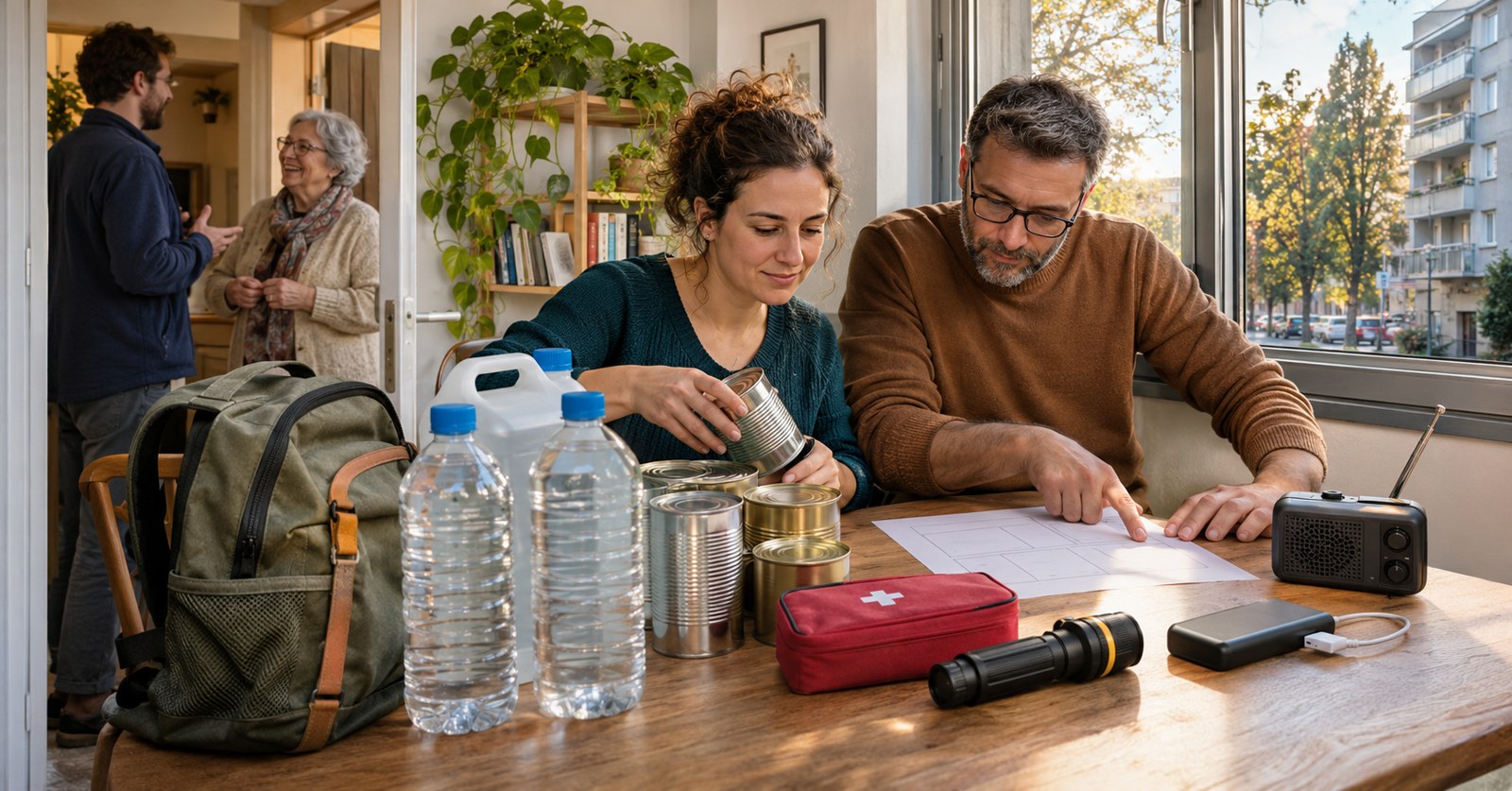
Plan a drinking-water reserve, easy-to-store containers and an appropriate filtration or treatment option. Even a few days of resources can change how a disruption is managed.
Build a rotating food reserve
Choose foods the household regularly eats, that are easy to prepare and compatible with simple cooking arrangements. Rotation limits waste and keeps the reserve useful.
Maintain essential functions
Lights, power banks, a radio, USB charging, safe food-preparation options and heating arrangements suited to the setting can reduce immediate vulnerability.
Prepare for disrupted networks
Printed contacts, meeting places, short messages, a radio and simple household agreements help people stay coordinated when networks are unreliable.
Consider travelling on foot
In an urban setting, evacuation by vehicle is not always possible. A ready bag, suitable shoes, alternate routes and a realistic destination are important.
Clarify household roles
Who collects the children? Who takes the documents? Where do we meet? Who contacts whom? These answers should be simple, known and reviewed periodically.
Apartment, condominium or townhouse: prepare without filling every space
Limited space is a common urban constraint. It does not make preparedness impossible; it requires better choices.
The useful question is not: ‘How much can I store?’
It is: ‘Which essential functions must I be able to maintain for a few days or weeks?’
- Use flat containers under beds or suitable storage above cupboards.
- Prioritise foods the household actually eats.
- Choose versatile equipment.
- Avoid impulsive or overly specialised purchases.
- Create a compact emergency module for each need: water, light, first aid, documents and communication.
- Review the reserve twice a year rather than letting equipment sit forgotten.
Storage: keep heavy loads low, exits clear and sensitive products out of children’s reach. Adapt checks to instructions and household changes as well as the proposed periodic review.
The myth of complete self-sufficiency
Some preparedness models have long presented complete self-sufficiency as the ultimate objective. That idea may be inspiring, but it remains difficult for most households to achieve.
Even rural households depend on many systems: fuel, mechanical parts, medicines, specialist care, communications, roads, trade and supply networks.
Modern resilience does not rest on absolute independence. It depends on alternatives, adaptation, skills, human connections and the ability to maintain essential functions during disruption.
P.U.I. is not opposed to rural or more self-reliant approaches. It simply emphasises starting from a person’s real situation rather than an idealised model.
The overlooked strength of cities: human networks
Cities are often portrayed only as vulnerable places. Yet they also have a substantial asset: people living close to one another.
During a crisis, a reliable neighbour, someone trained in first aid, a relative able to host a family temporarily, an organised building or a small local network can make a major difference.
What a network can offer
- Timely local information
- Shared resources
- Support for vulnerable people
- Basic coordination
- Complementary skills
What to avoid
- Depending entirely on other people
- Improvising contacts in the middle of a crisis
- Confusing mutual aid with a lack of personal preparation
- Overlooking isolated people
- Overloading a single contact person
Urban resilience is therefore not solely individual. It also relies on simple connections maintained before a crisis.
The limits of Integrated Urban Preparedness
P.U.I. does not claim to remove every risk. Some urban vulnerabilities remain structural.
- Buildings often depend heavily on electricity for lifts, pumps, doors, ventilation and safety systems.
- Space limits water and food reserves.
- Congestion, weather, population density or road conditions can complicate evacuation.
- Vulnerable people may need help sooner than a household alone can provide.
- Some crises exceed individual or household capabilities.
The aim is not to promise perfect safety. It is to reduce immediate vulnerability, gain time, limit disruption and improve decisions.
Where should you start?
A P.U.I. approach can start simply. You do not need to change everything in a single weekend.
- Identify relevant risks: power failure, water interruption, storm, flooding, evacuation or temporary sheltering.
- Prepare essential resources: water, food, lighting, medicines, hygiene and communication.
- Clarify the household plan: contacts, roles, meeting place and important documents.
- Prepare a realistic evacuation bag suited to travelling on foot, the climate and household needs.
- Strengthen preparedness gradually over time instead of seeking immediate perfection.
Progress in layers: first prepare essential resources for the initial disruptions. A 72-hour scenario is an initial reference used in several jurisdictions. Extending to seven to fourteen days, or one to three weeks, can then be a further goal according to risks, space, means and care needs. These longer durations are planning choices, not a universal official requirement or a guarantee of safety.
Conclusion
Urban resilience is not mainly about bunkers, extreme scenarios or absolute self-sufficiency. It rests on a household’s ability to absorb disruptions, retain options and maintain essential functions when usual systems become fragile.
In this sense, Integrated Urban Preparedness is less a form of survivalism than a modern citizen-preparedness approach suited to cities, suburbs, buildings, families and everyday constraints.
For many people, this is a realistic approach: rather than leave your world behind, learn to make it more resilient.
Frequently asked questions
Does Integrated Urban Preparedness replace a 72-hour kit?
No. A 72-hour kit can be a starting point. P.U.I. goes further by connecting water, food, energy, communications, evacuation, human networks and household organisation within a gradual approach.
Can you really prepare in an apartment?
Yes, with an adapted method. In an apartment, prioritise compact storage, versatile equipment, resource rotation and clear priorities.
Is P.U.I. a form of urban survivalism?
The approach emphasises resilience, reduced vulnerability, skills and preparedness integrated into everyday life rather than fear, isolation or absolute self-sufficiency.
How long should urban preparedness resources last?
A few days of essential resources is a useful initial objective. Gradually considering one to three weeks can provide a further margin for prolonged disruption, according to the household’s situation. This is an adaptable learning objective, not a universal official requirement, and it does not imply complete self-sufficiency.
Your next action with PrépaCivile
Choose one priority need. Calculating a need does not by itself validate real household preparedness.
Follow the ten preparedness stagesCalculate my water reservePlan reserve mealsCheck my evacuation bagChoose a reference missionOpen My planGuidance and sources for further reading
The guidance below applies within its jurisdiction. Further preparedness goals in this article remain adaptable to each household.