
In this article
In a disaster, our first instinct is to reach a safe place as quickly as possible, or the closest thing to one. For many of us, that place is home. It’s where our supplies, our gear and, above all, our family are. In most preparedness plans, home is therefore the first rallying point: whatever happens, we’ll try to get back there, unless something stops us or the authorities ask people to shelter where they are.
That’s not a problem when the whole family is together. But in reality, most of us spend a large part of the day away from home, each in a different place: at work, at school, at daycare, on the road. Those are exactly the hours a get-home plan is for.
In short
In short. A get-home plan answers four questions: how will I get home if the car or transit isn’t available, with what gear (a get home bag and everyday items), by which routes (at least two), and how will my family know what I’m doing? Dress for the weather outside, keep your keys and phone on you, and agree in advance on what everyone does if you’re late getting home.
The ideal retreat… and reality
Preparedness culture loves to talk about the ideal retreat: an isolated property of several hectares at the end of a dirt road, with a water source, a vegetable garden and endless firewood. It may be an ideal, but almost nobody lives that way. Of course some people live in remote areas, but for most of us the “retreat” is a suburban house, a city apartment or a semi-rural property reachable by many roads and a few minutes from a hardware store. Many live in cities, with neighbours a few metres away.
Most people who prepare don’t live off-grid year-round in the mountains, tending livestock and building furniture with hand tools. They work for an employer, in an area that’s far from remote, but almost always some distance from home. A dedicated retreat can be a long-term project (see our guide to choosing and preparing a fallback location), but in the meantime it’s more useful to make the most of where you already live, and make sure you can get back to it.
There are many emergency travel strategies, and the variables multiply when you consider every combination of emergency type and where you happen to be. This article focuses on one specific and very common case: you’re at work, something happens, and your goal is to get back to your family, your gear and your supplies.
The first plan, of course, is to get in your car or on the subway and go home. But what if the roads are blocked? What if transit is shut down? What if you can’t even reach your vehicle? Then you need a plan for getting home another way, in less-than-ideal conditions.
How will you get home?
Before talking about means, you need to know the distance. For this article, take a typical workday: you leave home in the morning, go to work and come back in the evening. We’ll assume you’re not across the country but at your usual workplace. For longer trips, see our article on preparedness when travelling.
Then list the possible ways home, from most to least likely: car, a ride with a colleague who lives near you, public transit, bike (one left at work or a bike-share), and finally walking. For each, ask yourself: what could make it impossible? A snowstorm, a closed bridge, a subway outage, an inaccessible parking garage. To work out a realistic walking time, see our method for working out your walk home: at a cautious 3 km/h, 15 km takes about 5 hours.
For each, note what could make it impossible.
- CarBlocked roads, inaccessible garage, no fuel
- Ride with a colleagueAgree in advance who to travel with by area
- Public transitService stopped, crowded platforms
- BikeBike left at work or bike-share; impractical in snow
- On footAbout 3 km/h cautiously: 15 km ≈ 5 hours
The get home bag
For anyone who works more than a few kilometres from home, a get home bag is a good investment. It holds the basic supplies you might need to walk home. It isn’t the same as a go-bag, but the two ideas are related: both are simply containers for essential items in an emergency.
There’s no universal bag. Yours won’t necessarily look like your neighbour’s: it all depends on your route, your job and your habits. Some people prefer a medium-sized backpack that goes everywhere with them (work, activities, hiking), others a small bag kept in the car trunk or in a locker at work. What matters is that it’s where you’ll need it.
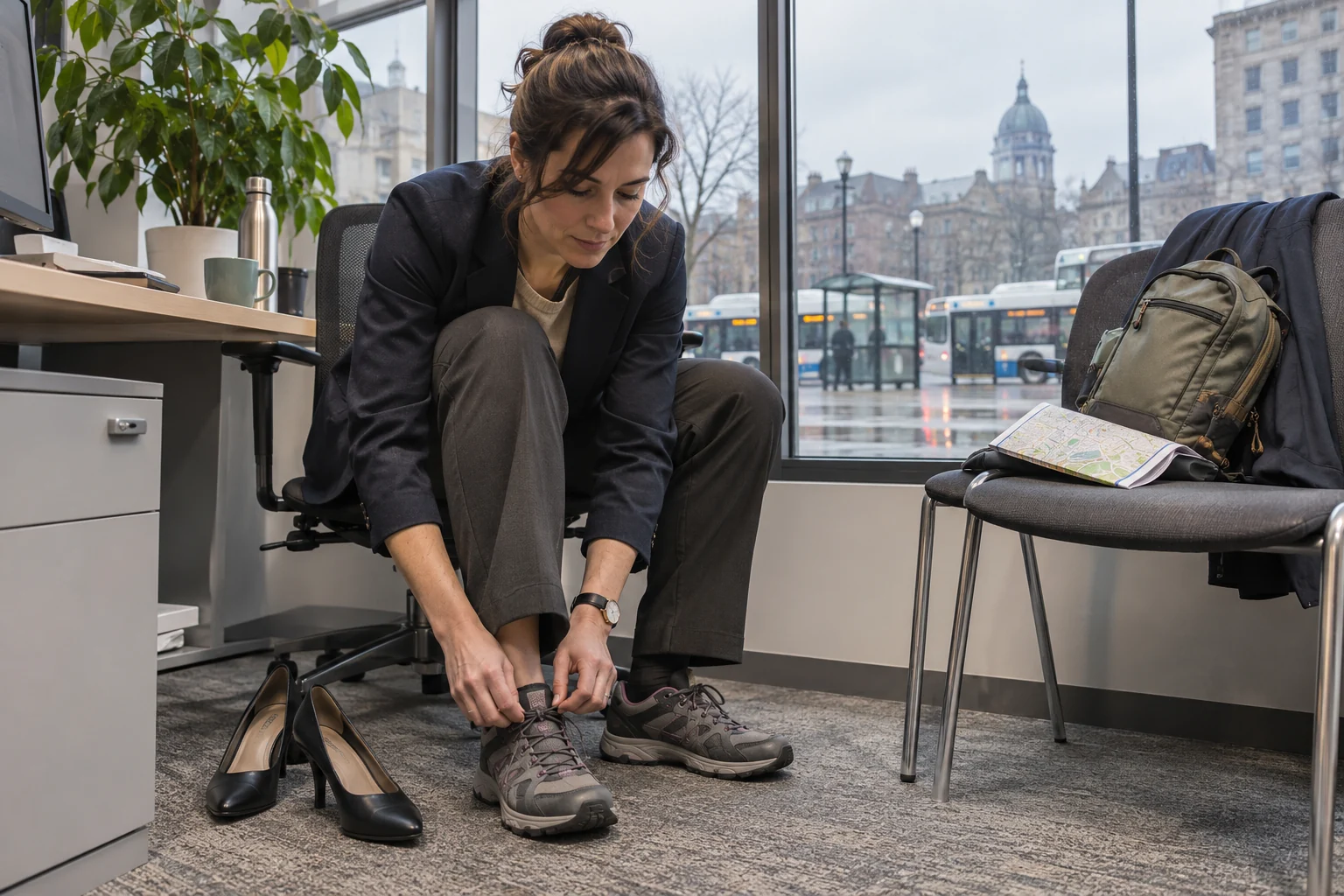
For a trip of about fifteen kilometres, a basic kit is enough: water, a few rations or energy bars, work gloves, a lighter, some cord, a multi-tool, a light, a dust mask and a small first aid kit with pressure dressings. You could always add more, but it’s better to stay minimal and focus on what you really need rather than what would be “nice to have.” If you know your city well, a compass is less useful than a paper map of the area; a radio is handy for a long trip, but your car already has one.
What if you can’t reach your car?
What happens if your car is stuck in a parking garage damaged by an earthquake, closed by firefighters or buried under snow? That’s when a bag kept at the office, or carried on you, really earns its place. Some people keep their bag with them at all times; others have one in the car and a second, lighter one at work. Both approaches make sense; the key is not to depend on a single location.
Dress for the weather outside
It’s easy to leave in the morning thinking you’ll only be somewhere warm, in the car and then the office. But if you have to walk, or wait in a stranded vehicle, outdoor conditions are what count. Carry rain gear on days when rain is possible, even if you don’t plan to go outside. In winter, in Quebec as in the rest of Canada, always have a toque, mittens, a warm coat and boots, even for a short drive.
The Highway 13 episode in Montreal in March 2017 was a reminder: during a major snowstorm, hundreds of drivers were stuck overnight on the highway, some for around twelve hours. The inquiry that followed, led by Florent Gagné, mainly faulted organizational and communication failures between the Ministry of Transport and the Sûreté du Québec. But for the people stranded, the difference between an unpleasant night and a dangerous one often came down to simple things: enough fuel in the tank, warm clothing, water, a snack, a charged phone.
Footwear that’s up to the job
Another essential is shoes that can actually get you home. Many people wear sandals, dress shoes or heels every day. Imagine walking 10 or 15 km in them over debris, snow or ice. Keep a pair of walking shoes or sturdy boots in the car or at the office, with spare wool socks.
Everyday items
Alongside the get home bag, what you carry on you every day (often called everyday carry, or EDC) plays a big role. A simple, legal set does the job: a charged phone, a small flashlight, a multi-tool or small knife that complies with local laws, a handkerchief or bandana, water, some cash and a paper list of important numbers. See our guide to everyday carry suited to each person.
These items complement the get home bag and stay with you even when you step away from your desk. How often have you gone to the washroom or the corner store without your phone or keys? Imagine an incident prevents you from returning to your workstation, and your coat, keys and bag are several floors up in an evacuated building. Get into the habit of keeping your keys, phone and wallet on you every time you leave your desk: it’s the foundation for every other option.
Plan more than one route
Most people always take the same route to work because it’s the fastest. But in an emergency that road could be blocked: an accident, a closed bridge, flooding, fallen trees, massive gridlock. Identify at least one alternate route, and ideally a third, by car and on foot. Travel them at least once in normal times so you know where they go, how long they take and where the useful stops are (gas stations, pharmacies, parks, community centres).
On foot, it can be tempting to cut across private land, wooded lots or railway tracks. It’s rarely faster, often dangerous, and crossing someone’s yard can lead to a needless confrontation. Stick to public streets and paths. Also avoid areas you know to be dangerous: flood zones, the edges of a fire, damaged bridges, tense gatherings. On your paper map, note natural barriers (a river, a highway, a railway) and the few places where you can cross them on foot: they often determine your actual route.
A communication plan with your family
In a disaster, the cell network may be overloaded or down, few households still have a landline, and payphones have all but disappeared. A communication plan exists precisely to make up for that predictable gap: everyone knows in advance what the others will do, even if they can’t talk.
In practice, your family should know:
- what your priority is (getting home, unless authorities say otherwise) and how long it could take, sometimes several hours or even a day;
- what they should do meanwhile: stay home if they’re not in danger, or go to the agreed meeting point if they have to leave;
- who picks up the children at school or daycare, and what the school’s emergency plan provides;
- which out-of-area contact to call or text to pass on news, since a long-distance call sometimes gets through better than a local one when the network is jammed;
- where to leave a message if someone has to leave home (a note inside the door, in an agreed spot).
Above all: what if you don’t arrive? Set a reasonable deadline after which the family moves to the next step (contact the out-of-area person, go to a relative’s, alert emergency services if the situation warrants). Talking about it calmly in advance spares a lot of anxiety on the day. To test your backup means of communication, see our week on backup communications.
What if going home isn’t the best option?
A get-home plan shouldn’t become an obligation. During a severe storm, a heat wave, a wildfire smoke episode or a shelter-in-place order, it’s often safer to wait at work, at a reception centre or at a colleague’s place than to walk for hours in dangerous conditions. Your family should know this too: “I’ll come home as soon as it’s safe” is just as valid a plan. See our article on a disrupted journey home and safe options.
Your get-home plan on one page
Finally, write your plan on a single page to keep in your get home bag and share with your family:
- Distance from work to home, and estimated walking time.
- Ways home, from most to least likely.
- Main route and two alternates, with crossing points.
- Where your get home bag and walking shoes are (car, office, on you).
- Instructions for the family: stay put, meet up, pick up the children.
- Out-of-area contact and the deadline for moving to the next step.
- Conditions under which you’ll shelter where you are instead.
Does your family know your plans? Do they know what to do if you’re not home on time? How would you get home if your car weren’t available? Answering these questions today, with a clear head, is one of the simplest and most useful preparedness steps there is.
Frequently asked questions
Should you keep one bag at the office and one in the car?
Ideally, yes, if you depend on your car. The office bag can be lighter. Otherwise, a single bag that goes everywhere with you works well.
How many routes should you plan?
At least two, ideally three, by car and on foot, taking into account the bridges, railways and highways that limit where you can cross.
What should my family do if I don’t arrive?
Follow the agreed plan: wait until the set deadline, reach the out-of-area contact, then move to the next step. What matters most is having talked about it beforehand.