
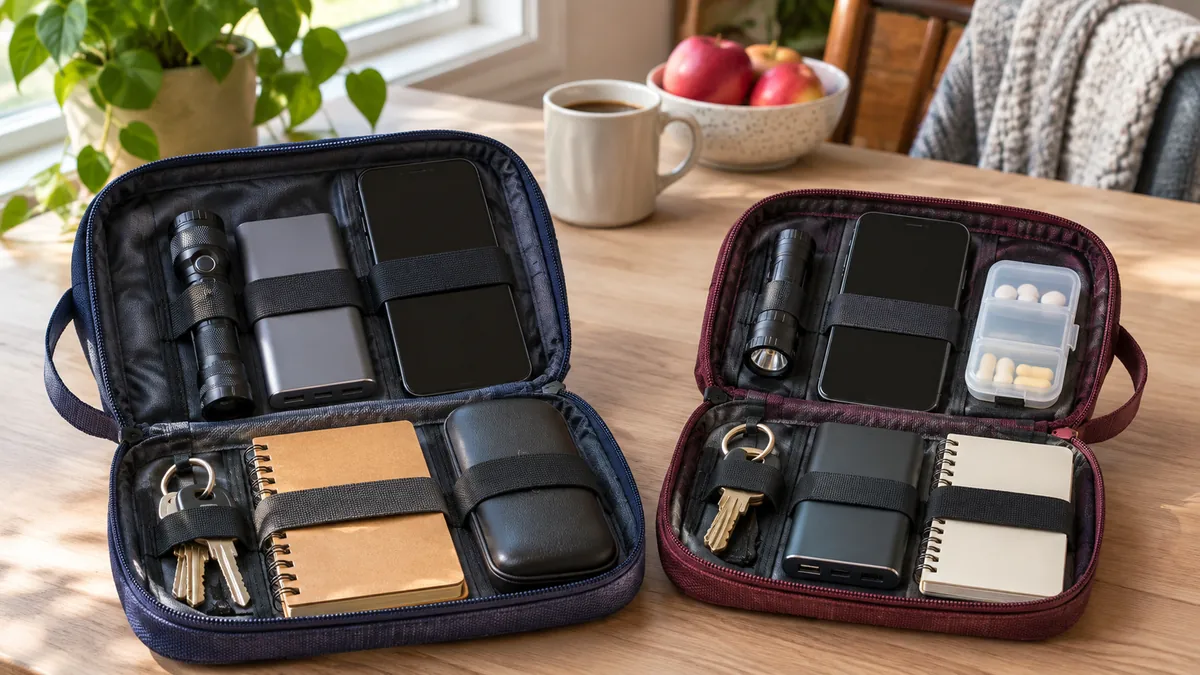
Contingencies are part of everyday life: a delayed journey, a power outage, changing weather or a personal need away from home. Everyday equipment gathers what is carried to respond to these situations. Work bag, student backpack, purse or small pouch: each container can fulfill this role. A compartmentalized model such as the Maxpedition Jumbo illustrates a possibility of organization, not a purchase obligation or a guarantee of adaptation to all situations.
These bags reflect needs, habits and preferences. Color and appearance can count to feel comfortable at work, in the city or outdoors. Ordinary appearance and space-saving objects sometimes favour regular use. A camouflage does not offer a guarantee of discretion or security; choose a container adapted to the busy environment.
Creating the “perfect” everyday gear is a personal quest, as each bag is as unique as its wearer. It’s not just about choosing objects at random, but carefully selecting tools and equipment that match daily skills and activities and preparation for the unexpected.
Size, strength and portability are the cornerstones of good everyday equipment. It must be compact enough to be carried easily, whether on the shoulder, back or hip, while offering the robustness and lightness necessary for daily use. Its design must be discreet, both in the choice of colors and in the minimization of noise, thus allowing a harmonious integration in different environments. Quick and easy access to its content is essential, because in an emergency, every second counts.
Whether you are in urban or rural areas, your bag for everyday equipment is not only an accessory; it is an extension of your identity, a vital tool that blends into the decor of your life, ready to assist you at any time. It symbolizes your preparation to face the world, with style, functionality and efficiency.
Setting the scene
Visualize a workday interrupted by a power outage. Normal lighting can turn off and elevators become unavailable. Observe the security lighting and personnel instructions; don’t assume the whole city is messy. Depending on the cause, the building and the instructions received, it may be better to wait, reach a designated place or evacuate. This example is used to think about your lighting, communication and travel needs, without confusing equipment and evacuation decision.
In this power outage scenario, start by listening to the building’s instructions, getting away from a clear danger and checking the available information. Your everyday equipment can be used to enlighten, communicate or wait. If a departure is necessary and the journey is safe, it can make it easier for you to get to your home or your evacuation bag. It does not replace site procedures or an evaluation of the itinerary. A breakdown does not automatically require you to leave the building or walk away.
Imagine also having to join a friend who hasn’t planned any supplies for an extended wait. Your equipment can facilitate a small help - lighting, calling, charging or snacking - within the limits of what you carry and the needs of each. This situation illustrates the complementarity between personal preparation and mutual aid. It does not allow to judge the value of a person from the contents of his bag.
Moving around can require endurance, breaks and suitable shoes. Don’t assume that you will have to run, cross a crowd, or get around dangerous obstacles. A comfortable pair of shoes, suitable for the season and already worn, can make a trip more bearable. If you are usually in shoes that are not suitable for walking, consider a realistic alternative in your work or transportation environment.
This situation perfectly illustrates the importance of a well-thought-out everyday equipment. Anticipating a few simple needs helps to better manage an unexpected wait or trip. Your bag contributes to your preparation, within the limits of its content and your skills.
The Essential, a Minimum
In the constitution of your bag for everyday equipment, the selection of objects must combine functionality and minimalism. Each element chosen must meet a practical need while being compact and light. Here is an overview of the essentials that should find their place in any bag for well-prepared everyday equipment :
- Lighter or matches: a possibility of ignition can be useful for an authorized stove or a permitted fire in a suitable context. Choose a way that is protected from moisture and controlled. It is not an essential equipment for every trip: respect fire restrictions, do not make a fire in a building and do not use a combustion device in an enclosed space. For a daily snack, a consumable food without cooking is simpler.
- Water and means of treatment: first take drinking water. Depending on the route, a portable filter or tablets can complete this reserve, provided that they know their limits, their instructions and the contaminants targeted. They do not automatically make unknown water drinkable and do not remove all chemical pollutants. Also identify reliable restocking opportunities.
- Extra food: cereal bars, energy snacks or dried fruits can help with a delay. Choose foods that are compatible with your needs and allergies, easy to transport and consume. Check the actual storage, date and effects of heat in the bag; not all products are stored for long in all conditions.
- Multifunction Knife or Versatile Tool : A good knife or multi-tool can be used in a multitude of scenarios, from cutting ropes to emergency repair of equipment.
- Basic Sewing Kit : A button that drops or a hitch can be more than just an inconvenience. A small sewing kit with needle, thread and a few spare buttons can make a big difference.
- Notebook and Pen : Taking notes, drawing a route or leaving a message can be crucial. A notebook and a water-resistant pen are useful additions.
- Paracord : Paracord is remarkably versatile, useful for everything from building an emergency shelter to repairing equipment.
Now it’s up to you: what do you consider essential in your bag for everyday equipment? How do you prepare your bag to meet the unique challenges of your daily life and to be ready for the unexpected?
Your everyday equipment remains a practical companion: it helps to manage some unforeseen events, without promising to master them all. Review it after a change of route, season or need.
Sources and benchmarks
The Government of Canada’s official emergency kit list complements the needs of the home. The equipment carried every day remains a personal selection, separate from a domestic reserve of several days.