
In this article
Few tools are as versatile as a good knife. Cutting cord, opening packaging, preparing a meal outdoors, carving kindling, making a small repair: it holds a central place in a go bag, a vehicle kit or everyday gear. You still need to choose the right one, for the right use, and within the law.
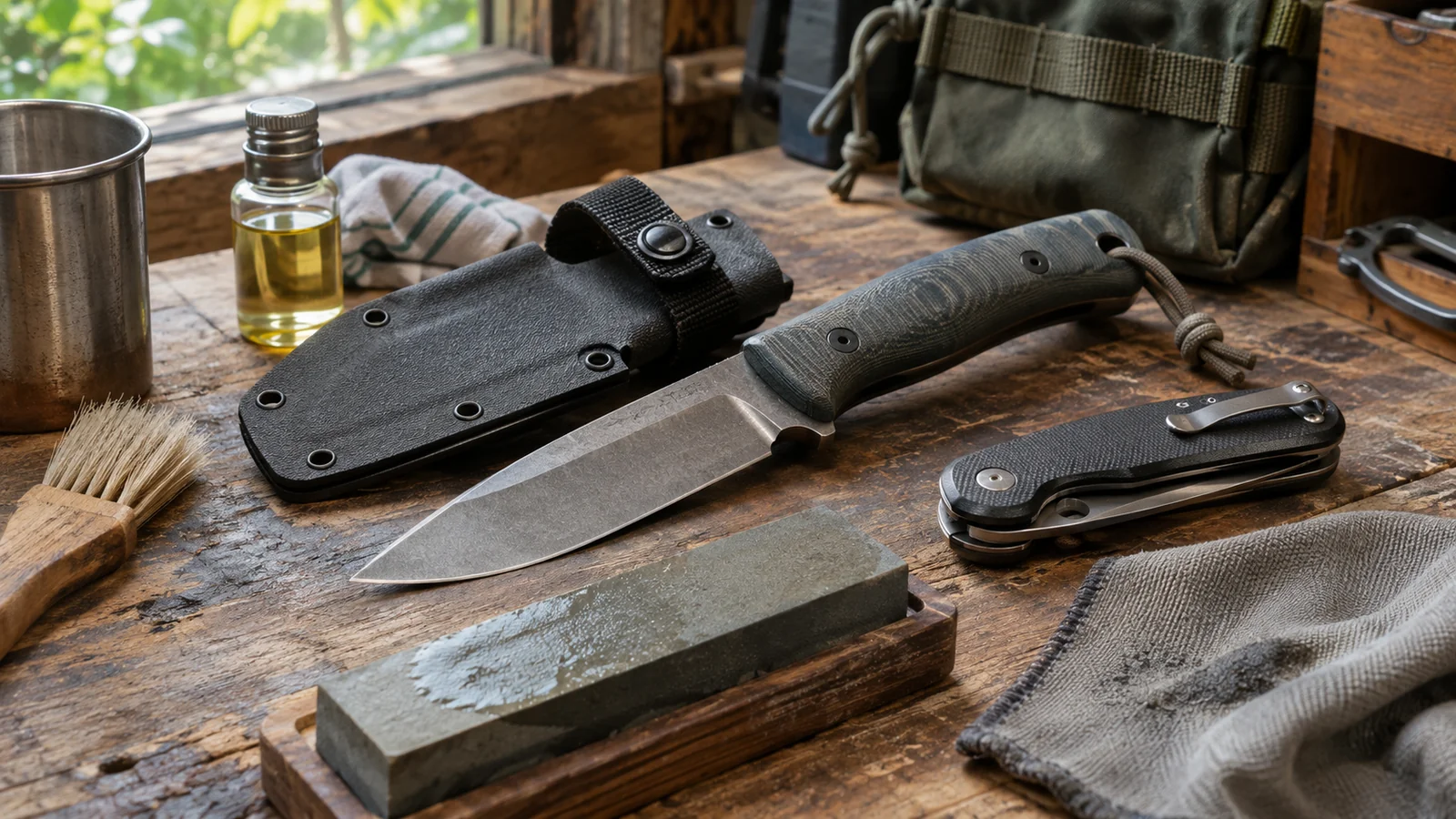
This guide covers the two main families: the fixed-blade knife, for the go bag and the outdoors, and the everyday carry (EDC) knife, usually a folder. It presents the selection criteria (structure, blade, steel, handle, sheath), a few representative models, maintenance and the Canadian legal framework, which is the most important thing to check before buying.
A tool, not a weapon. In preparedness, a knife is a utility tool. In Canada, carrying a knife with the intention of using it as a weapon is illegal, whatever the blade length. This guide deals only with practical uses.
In brief
In brief. For a go bag or the outdoors, a full-tang fixed-blade knife of about 23 to 30 cm (9 to 12 in) overall, with a drop-point blade and a good sheath, is the most versatile choice. For everyday use in the city, a manual folding knife with a blade of about 7 to 10 cm (3 to 4 in) is more practical and discreet. Automatic or gravity-opening knives and butterfly knives are prohibited in Canada. Also check municipal bylaws and restricted places (schools, courthouses, airports). A maintained, sharp knife is safer than a dull one.
Fixed blade or folding knife?
This question comes up often. The two types are complementary rather than competing: the fixed blade for demanding tasks, the folder for everyday use and as a backup blade.
| Criterion | Fixed blade | Folding knife |
|---|---|---|
| Strength | Superior: no hinge, no lock | The hinge is the weak point under stress |
| Leverage and length | Better leverage for heavy tasks | Shorter, for fine cuts |
| Maintenance | Simple, little affected by dirt and sand | The mechanism needs cleaning and lubrication |
| Ready to use | Immediately | After opening |
| Everyday city carry | Bulky, draws attention | Compact and discreet in a pocket |
| Ideal use | Go bag, camping, bushcraft | Urban EDC, secondary blade |
Realistic uses in degraded conditions
| Outdoors | Urban or mixed settings |
|---|---|
| Preparing kindling, shavings and tinder | Cutting straps, cord, synthetic materials |
| Cutting cord and branches for a shelter | Opening packaging, bags, containers |
| Preparing food, cleaning fish or game | Preparing meals without a kitchen |
| Splitting small logs by batoning | Small repairs, cutting tape, fabric |
| Making stakes or simple tools | Freeing a jammed seatbelt (with a dedicated belt cutter) |
For prying, leverage or breaking a window, a tool designed for it (pry bar, window breaker) is safer and more effective: a knife that snaps under stress can cause serious injury.
Part 1: the fixed-blade knife
The tang: full, partial or hollow
The tang is the extension of the blade into the handle; it largely determines the tool’s strength.
- Full tang: the steel runs from the guard to the end of the handle in one piece. This is the strongest configuration, recommended for heavy use: batoning, woodworking, harsh conditions.
- Partial tang: the steel extends only partway into the handle. Common on entry-level knives; avoid for heavy work.
- Hollow handle: lets you store a small kit (fire starter, fish hooks), but is much weaker. Suitable for light use only.
The grip: materials and ergonomics
- Micarta: canvas or linen impregnated with resin, very tough, good grip even when wet.
- G-10: laminated fibreglass, light, nearly indestructible, good grip with or without gloves.
- Glass-filled nylon: shock- and weather-resistant, economical.
- Wood or rubber: pleasant, but more sensitive to moisture or wear.
Ergonomics matter as much as material: the knife should stay controllable bare-handed or gloved, dry or in the rain, and your hand should not be able to slide onto the blade. A guard or pronounced shoulder helps.
Size and weight
| Overall length | Advantages | Limits |
|---|---|---|
| Under 23 cm (9 in) | Handy, light, precise | Less effective for force |
| 23 to 30 cm (9 to 12 in) | The best balance of versatility, weight and power | A little heavier to carry |
| Over 30 cm (12 in) | Chopping, batoning, woodwork | Heavy, bulky, close to a machete |
As for weight, a knife under 350 g (12 oz) suits varied tasks; beyond that, the mass helps for splitting and carving but weighs down a pack carried for long periods.
Blade shapes
| Shape | Features | Use |
|---|---|---|
| Drop point | Spine slopes down to the tip, wide belly, easy to control | The most versatile: survival, bushcraft, cooking |
| Clip point | Concave section toward a fine tip | Hunting, precise work |
| Tanto | Reinforced angular tip | Tip strength, less good at slicing |
| Partial serration | Serrated section near the handle | Synthetic cords and straps; harder to sharpen |
| Gut hook | Hook on the spine | Specific to field dressing |
| Rounded or chisel tip | Wide, reinforced tip | Rescue tools, less risk of puncture |
Three representative models
These models illustrate three use profiles. Specifications are those announced by the manufacturers and may change: check the current product sheet before buying.
- General versatility, KA-BAR Becker BK22: a mid-sized utility knife, about 27 cm (10.5 in) overall, full tang, drop-point blade, nylon sheath with a pouch for a sharpener or fire starter. A good balance of toughness and handling for the go bag.
- Heavy bushcraft, TOPS Tom Brown Tracker: an imposing knife, about 30 cm (12 in) and heavy, designed for splitting, carving and field dressing. Multi-function blade with a serrated section, Micarta handle, Kydex sheath. Excellent in the woods, too heavy for a light go bag.
- Rugged tool, KA-BAR Becker BK3: about 32 cm (12.5 in), heavy, designed as a work and rescue tool, with a serrated section and a glass-filled nylon handle. It suits those looking for a heavy-duty tool rather than a precision knife.
These examples are not exclusive recommendations: many reputable makers offer knives of equivalent quality, including compact, affordable models popular for camping, such as Swedish carbon or stainless steel blades.
The sheath, often overlooked
People choose the knife carefully and accept the sheath without a thought. Yet how you carry and reach the knife matters a lot.
- Attachment: belt, pack, modular MOLLE system, horizontal or vertical carry. Choose to suit your gear.
- Kydex: thermoformed plastic, light, nearly indestructible, very secure, one-handed resheathing.
- Nylon: light, economical, often with a pouch, less rigid.
- Leather: classic and durable, heavier, sensitive to prolonged moisture, needs care.
- Secondary pouch: handy for a sharpener, a ferro rod or a small folder.
A good sheath holds the knife firmly, even upside down, and protects the wearer. In a pack, always store the knife in its sheath, in a specific, known spot.
Part 2: the everyday carry (EDC) knife
EDC refers to the items you regularly carry to deal with small surprises: light, pen, multitool, knife. In the vast majority of cases, an EDC knife is used for mundane tasks: opening a parcel, cutting string, peeling fruit, making a small repair. An ordinary knife always on you is worth more than a high-end one left at home.
The four selection criteria
- Size: a blade of about 7 to 10 cm (3 to 4 in) strikes a good balance between usefulness and discretion. The closed knife should sit comfortably in a pocket.
- Mechanism: manual folder (most common), assisted opening (a spring finishes an opening started by hand), or automatic (prohibited in Canada, see below). A reliable lock (lockback, liner lock, frame lock) keeps the blade from closing on your fingers.
- Carry: pocket or belt clip for easy access.
- The legal framework, to check above all.
Blade steel
| Family | Examples | Strengths | Limits |
|---|---|---|---|
| Common stainless | 420HC, 440A, 8Cr13MoV | Affordable, rust-resistant, easy to sharpen | Holds an edge less long |
| Semi-stainless, tool steel | D2 | Good edge retention | Can oxidize, harder to sharpen |
| Carbon steel | 1095 | Tough, very easy to sharpen, ideal with a ferro rod | Rusts without care |
| Premium stainless | S30V, S35VN, M390 | Excellent performance | More expensive, more demanding to sharpen |
For everyday use, a well-maintained mid-range steel is more than enough. G-10, glass-filled nylon, aluminum or titanium handles all suit EDC; wood and bone are more attractive than practical for daily use.
Matching your choice to daily life
- Define your real uses: parcels, cord, outdoor meals, small jobs.
- Assess your surroundings: office, worksite, public transit, outdoors.
- Choose your carry method: pocket, belt, bag.
- Test the grip if possible: the same blade feels different depending on hand size.
- For many people, a small multitool with a blade, pliers and screwdriver is even more useful than a knife alone.
For other folding models, see our guide to lockback folding knives.
The legal framework in Canada and Quebec
This is the most important thing to check. The information below is general and is not legal advice; the law changes and its interpretation depends on the situation. Consult the current text of the Criminal Code, your police service or a legal professional if in doubt.
| Element | What to know |
|---|---|
| Intent | Carrying a knife for the purpose of using it as a weapon, or in a way that threatens or alarms, is an offence, whatever the knife. |
| Automatic-opening knives | Knives whose blade opens by a button, a spring in the handle, gravity or centrifugal force are prohibited weapons: possession, sale and import are banned. |
| Butterfly knives | Prohibited by regulation. |
| Assisted opening | Generally distinct from automatic opening, but the line can be interpreted differently; look into it before buying. |
| Concealed carry | Concealing a weapon is an offence. Discreetly carrying a utility tool is not the same thing, but everything depends on context and intent. |
| Blade length | There is no universal length limit in Canada for a utility knife; type, context and intent come first. |
| Special places | Schools, courthouses, government buildings, airports and aircraft, some events have their own bans. |
| Municipal bylaws | Some municipalities regulate carrying sharp objects in public spaces: check locally. |
What this means in practice
- Favour a manual folding knife for daily carry.
- Avoid automatic, butterfly and double-edged knives.
- Keep your fixed-blade knife in your pack or outdoor gear, not on your belt in the city without reason.
- Be able to explain the tool’s utility use simply if asked.
- Leave it at home or in the car when going somewhere it is prohibited.
- If travelling outside the province or country, check the rules at your destination and with your carrier.
Maintenance and safety
A well-maintained knife is safer: a dull blade forces you to push harder, and that is when you cut yourself.
- CleanWarm water and soap after use, especially with food.
- DryCompletely, including the mechanism and sheath.
- OilA drop of food-safe or mineral oil on carbon blades and the pivot.
- SharpenStone, ceramic rod or pocket sharpener, regularly.
- CheckLock, blade play, sheath condition.
- Cut away from yourself, never toward the hand holding the object or your thigh.
- Keep a safety zone around you, especially with children.
- Close or sheathe the knife as soon as you stop using it.
- Never try to catch a falling knife.
- Teach children the basic rules before giving them an age-appropriate knife, under supervision.
- Keep a first aid kit within reach for cuts; see the first aid kit.
How to choose: the summary
| Question | Direction |
|---|---|
| What is your main context? | Outdoors: fixed blade. City: manual folder. Both: one of each. |
| What tasks? | Precision: short blade. Force: full-tang fixed blade. |
| What weight can you accept? | Light pack: under 350 g (12 oz). |
| What carry? | A sheath compatible with your pack or belt; a clip for EDC. |
| What maintenance? | Stainless for simplicity, carbon for easy sharpening. |
| Is it legal where you will carry it? | Check before buying. |
A well-chosen knife can last decades. For the whole go bag, see the complete 72-hour go bag list, and for fire-starting, wilderness survival skills.
Frequently asked questions
Is it legal to carry a fixed-blade knife in Quebec?
A utility knife is not illegal in itself, but its legality depends on context, how it is carried and intent. Packed in a bag for a camping trip is a different situation from wearing it on your belt in the city. Check the laws in force or ask your police service.
What blade length is allowed in Canada?
There is no universal limit for a utility knife. The type of mechanism, the carrying context and intent are what matter most. Some places have their own bans.
Are assisted-opening knives legal?
They are generally distinct from automatic knives, which are prohibited, but the distinction can be interpreted differently depending on the model. Check before buying.
Do you need a different knife for the woods and the city?
Ideally, yes: a tough fixed blade for the outdoors, a compact folder for the city. A mid-sized versatile knife can cover both with compromises.
Is a folding knife enough in a go bag?
It complements a bag well as a secondary blade, but a fixed blade is more reliable for demanding tasks.
What maintenance should you plan for?
Clean, dry, lightly oil the blade and mechanism, and sharpen regularly. A maintained knife keeps performing for a very long time.