
In this article
When thinking about your family’s preparedness, many questions come first: do you have enough food and water, a plan to replenish and treat that water, a security plan for your home? But what happens if those plans fall through and you have to leave? If your plan involves reaching a fallback location, the vehicle becomes an essential link.
Some manufacturers offer spectacular armoured vehicles designed for extreme situations, at prices that are not even published. That is obviously not realistic for most families. This guide compares accessible options, pickup truck, SUV, motorcycle, horse, bicycle, and explains fuel choices, safe fuel management and useful modifications, without excessive spending.
In brief
In brief. The best evacuation vehicle is often the one you already own, well maintained, with a tank never below half and a kit ready. A four-wheel-drive pickup or SUV offers versatility; motorcycles and bicycles are backup options. Store fuel in small quantities, in approved containers and in compliance with the fire code, and favour useful modifications: suitable tires, tow straps, a roof rack, a well-maintained trailer.
| Option | Advantages | Limitations |
|---|---|---|
| Pickup truck | Sturdy, easy-to-find parts, large cargo capacity, often 4x4 | Cargo exposed to weather and theft, fuel consumption |
| SUV | Enclosed space, possible to sleep in, often affordable used | Fuel consumption, sometimes limited off-road ability |
| Motorcycle | Economical, agile in traffic, possible off-road | Little cargo, exposure to weather, high risk in a fall or on snow |
| Horse | Independent of fuel, trails inaccessible to vehicles | Slow, limited load, care and feed, skills required |
| Bicycle with panniers | Discreet, no fuel, gets through anywhere | Limited load, exposure, poorly suited to families with young children |
More affordable vehicles
For most of us, it pays to be realistic. The first criterion is not the type of vehicle but its mechanical condition and your ability to maintain it. Here are the main options.
The pickup truck
A pickup is a solid choice. It is very common, which makes spare parts easy to find, and its bed can carry equipment to your fallback location, your emergency kit or even bulky items. Four-wheel drive is an asset for getting off a snowy road or onto a forest road. A crew or extended cab offers more room for passengers or storage.
A used pickup costs less than a new one, freeing part of the budget for reconditioning: it is better to invest in the mechanics, engine, transmission, brakes, suspension, tires, than in paint or trim. Have any used vehicle inspected by a mechanic before buying, and avoid very high mileage without a maintenance history.
Some guides recommend older models without electronics in case an electromagnetic pulse damages modern vehicles. That scenario remains very unlikely, and available studies suggest most modern vehicles would not all be disabled. An old vehicle also has drawbacks: less crash safety, reliability, scarcer parts. The right choice remains a reliable vehicle you know how to maintain.
The SUV
Used SUVs are often easier to find and cheaper than pickups, partly because they are rarely used for work and because their fuel consumption puts some buyers off. Yet they have advantages: the cabin is fully enclosed, better protecting gear from weather and theft, and you can often sleep in them by folding or removing the rear seats, which also frees up storage space.
Most SUVs offer all-wheel or four-wheel drive, but their off-road abilities are often more modest than people think. As with pickups, a well-maintained older model, with budget set aside for the mechanics, is often a good compromise.
The motorcycle
A motorcycle has advantages: it uses little fuel, is easy to store, can go off-road if properly equipped and can move through stopped traffic, within the rules of the road. But it offers no shelter, carries neither many people nor much gear, exposes you to heat and cold, and becomes dangerous on snow, ice or rain. A fall far from help can have serious consequences. Knowing how to ride can be useful, but it is not the first choice for evacuating a family.
The horse
In some regions and for some people, a horse can be a means of travel, especially on trails inaccessible to vehicles. It carries little gear and few people, however; the more it is loaded, the slower it goes and the more rest it needs. It must be fed, watered and cared for, and riding requires real skills. It is a marginal option, for those who already have horses and are used to riding them.
The bicycle
A bicycle can carry a reasonable amount of gear and needs only your energy. A touring bike with panniers lets you travel with some supplies, discreetly and without fuel, especially if your fallback location is already stocked. Like a motorcycle, it exposes you to the weather, is unstable with a heavy load and is poorly suited to a family with young children. It is an excellent backup, for example for getting home when roads are congested.
Fuel options
The most common options are gasoline and diesel. Electric and hybrid vehicles are spreading; for an evacuation, they raise the question of charging if the grid is down, but a charged electric vehicle can also power a few devices. Propane is uncommon in vehicles and not easily transferred.
Between gasoline and diesel, it depends on the vehicle. In general, a diesel engine uses 20 to 35% less fuel than a comparable gasoline engine for the same work, offers more torque for towing and lasts a long time: 300,000 kilometres is nothing unusual for a well-maintained diesel. On the other hand, diesel can gel in extreme cold if it is not winter-grade.
Some enthusiasts mention homemade biodiesel or wood gasifiers, which in theory let a modified engine run on wood. These are complex technical projects with risks (chemicals, carbon monoxide, fire) and regulatory constraints. They may interest experienced tinkerers, but they are not a preparedness solution for most families.
Managing fuel safely
Since we are talking about fuel, you need to plan how you will have it after a disaster. In a crisis, gas stations can be overwhelmed, run out of fuel or be unable to pump without power. After Hurricane Sandy in 2012, lines lasting hours formed in the New York area and rationing was imposed. You do not want to be in that line.
The simplest rule: never let the gauge drop below half a tank. You will never be empty when an emergency strikes and can focus on leaving or getting home. A reader once told of his sister-in-law who thought the rule pointless, since half a tank would not get her home; he replied: “Maybe not, but you’d be 200 kilometres closer.” Ideally, you should have enough fuel, in the tank or in reserve, to reach your fallback location, and even double that to allow for detours and traffic jams.
For a reserve, safety and the law come first:
- use only containers approved for fuel, tightly closed and labelled;
- respect the maximum quantities allowed by the fire code and your municipality: they are generally low in a house or attached garage;
- store containers away from heat or sparks, in a ventilated place, out of children’s reach;
- transport them securely strapped, ideally outside the passenger compartment, never inside the cabin with passengers;
- add a stabilizer to stored gasoline and rotate it every few months by using it in the vehicle.
Some guides suggest siphoning fuel from other vehicles or from gas stations’ underground tanks. Taking someone else’s fuel without permission is theft, and siphoning exposes you to poisoning and fire. A small hand pump can, however, be useful for transferring your own fuel from a container to the tank, or from one of your vehicles to another.
Useful modifications and accessories
Once you have a reliable vehicle free of mechanical defects, a few accessories can make it more useful. Again, the rule is proportion: equip yourself according to your real trips.
Tires
Tires should match your environment. If you mostly drive on highways, aggressive mud tires are unnecessary and can even hurt handling; if you have a short dirt road to your fallback location, sturdy all-season tires may be enough. In Quebec, winter tires are mandatory during the cold season, and they are what will make the biggest difference during a winter evacuation.
Reinforced bumper and winch
A reinforced bumper protects the front of the vehicle and can hold extra lights and a winch. A winch lets you pull your vehicle, or someone else’s, out of a rut or ditch. Using one requires training: a cable that snaps can cause serious injury.
Tow straps
Even without a winch, approved tow straps and suitable shackles let you free a stuck vehicle, provided they are attached to purpose-built recovery points and people stay well clear during the manoeuvre.
Extra fuel tanks
Fuel capacity can be increased simply with a few approved containers strapped to an exterior carrier or in a pickup bed, or in a more complex way with an auxiliary tank installed by a professional. Some pickup storage boxes include an auxiliary tank. These installations must meet applicable standards.
The trailer
To carry food, shelter and supplies, a trailer is the simplest way to increase capacity. Used ones can be found at reasonable prices. Check the bearings (well greased), tires, lights and registration, and respect your vehicle’s towing capacity. Practise backing up with a trailer before you need to under stress.
The roof rack
Many vehicles come with basic roof bars; a larger rack or roof box gives more space for light, bulky items such as sleeping bags or a tent. Respect the manufacturer’s maximum load and secure the cargo firmly.
Choosing for your situation
There is no ideal vehicle for everyone. A few guidelines help:
- In the city, without a distant fallback location: your everyday vehicle is often enough; a bicycle with panniers usefully complements the plan if roads are congested.
- In the suburbs or regions, with a cottage or relative some distance away: a four-wheel-drive SUV or pickup with enough range to reach the destination is a good choice.
- Large family or pets: favour interior space and the possibility of adding a trailer or roof box.
- Harsh winters: quality winter tires, a battery in good condition, a winter kit, and enough range to run the engine intermittently for heat, always clearing snow from the exhaust pipe to avoid carbon monoxide poisoning.
- Limited budget: invest first in maintenance, tires and the kit, before any accessory.
A few reminders for driving during an evacuation
The best vehicle is useless if driving becomes dangerous. Leave early, follow the routes indicated by the authorities and the radio, keep enough distance from the vehicle ahead and never drive onto a flooded or smoke-filled road. Leave navigation and the radio to a passenger. If the vehicle breaks down, park it safely, make yourself visible and continue on foot according to your backup plan, staying well away from traffic.
Doing a full-scale trial run
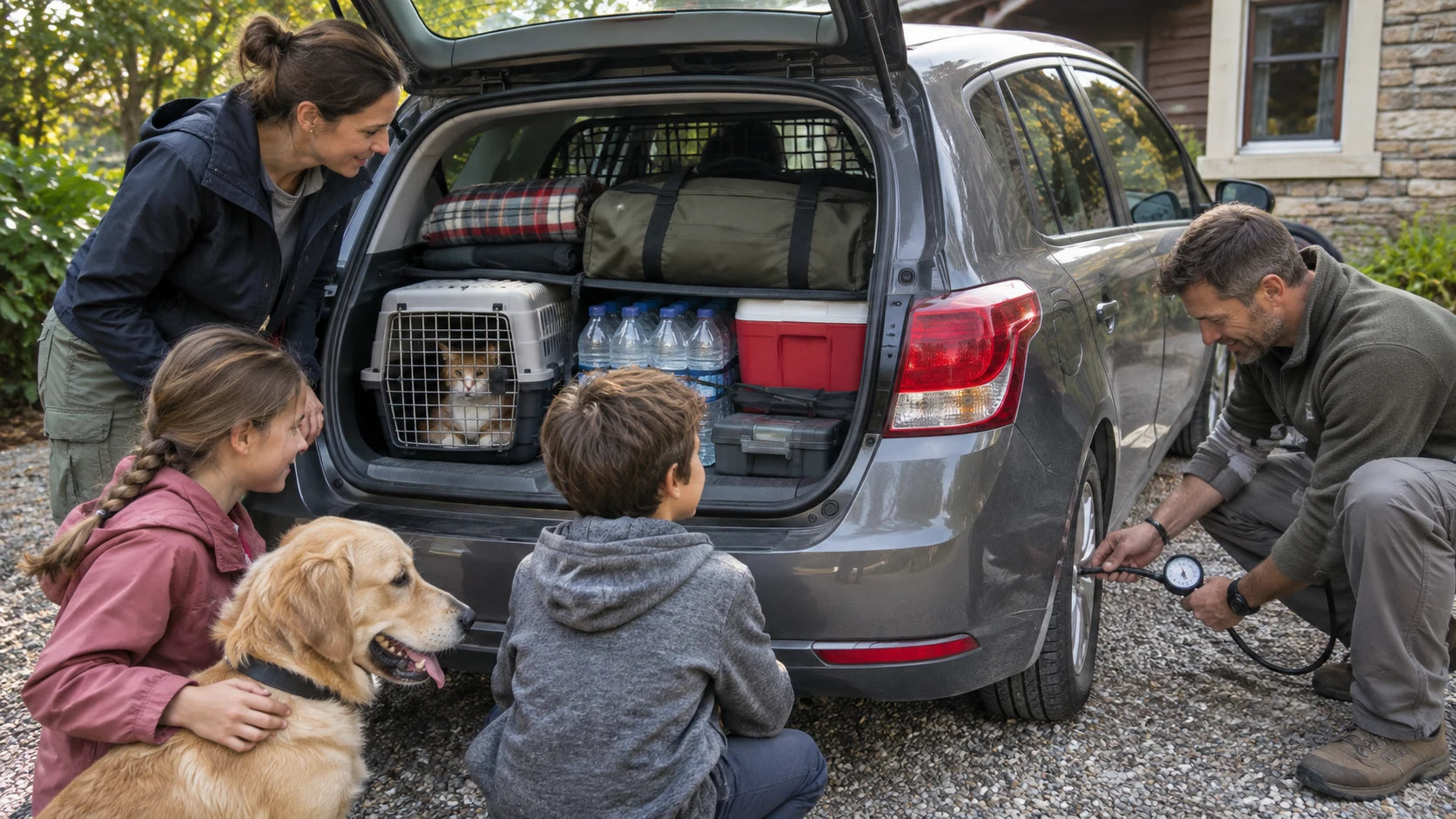
Once a year, load the vehicle as if you had to leave: bags, water, kit, pets, possibly the trailer. Time the loading, then drive to your fallback location or an intermediate point by an alternative route. You will see whether everything fits, whether the load is well balanced, whether your range is sufficient and whether everyone knows their role. Note the adjustments needed and make them before the next season.
Evacuation vehicle checklist
| Item | What to check | Frequency |
|---|---|---|
| Fuel | Tank at least half full; approved, stabilized reserve | Ongoing; rotate every 3 to 6 months |
| Mechanics | Oil, fluids, brakes, battery, belts | According to the maintenance schedule |
| Tires | Pressure, wear, spare, winter tires in season | Monthly |
| Vehicle kit | Water, snacks, blankets, flashlight, first aid, jumper cables, shovel and scraper in winter | Every season |
| Documents | Registration, insurance, paper road maps, routes | Every year |
| Accessories | Straps, shackles, trailer, roof rack | Before each season |
Our guide to the vehicle emergency kit details the kit’s contents, and our article Evacuating by vehicle: benefits, limitations and preparation covers driving during an evacuation.
Summary
There is no need to dream of an armoured vehicle: the best evacuation vehicle is a reliable, well-maintained vehicle, always at least half full, equipped with a kit and suited to your real trips. Gradually add useful accessories, store fuel safely and in compliance with regulations, and plan a backup, a bicycle or a route on foot, in case the road becomes impassable.
Frequently asked questions
Should you buy a vehicle specifically for evacuation?
Not for most families. Your everyday vehicle, well maintained and equipped with a kit, works very well. A second vehicle is only useful if your plan requires it and you can maintain it.
How much fuel can you keep at home?
It depends on the applicable fire code and your municipality. Allowed quantities are generally limited in a house or attached garage. Check with your fire safety department before building a reserve.
Can an electric vehicle be used for an evacuation?
Yes, if it is charged. Keep the battery sufficiently charged during alerts, know your real winter range and locate chargers along the route. During a widespread outage, charging may become difficult: build this constraint into your plan.