
In this article
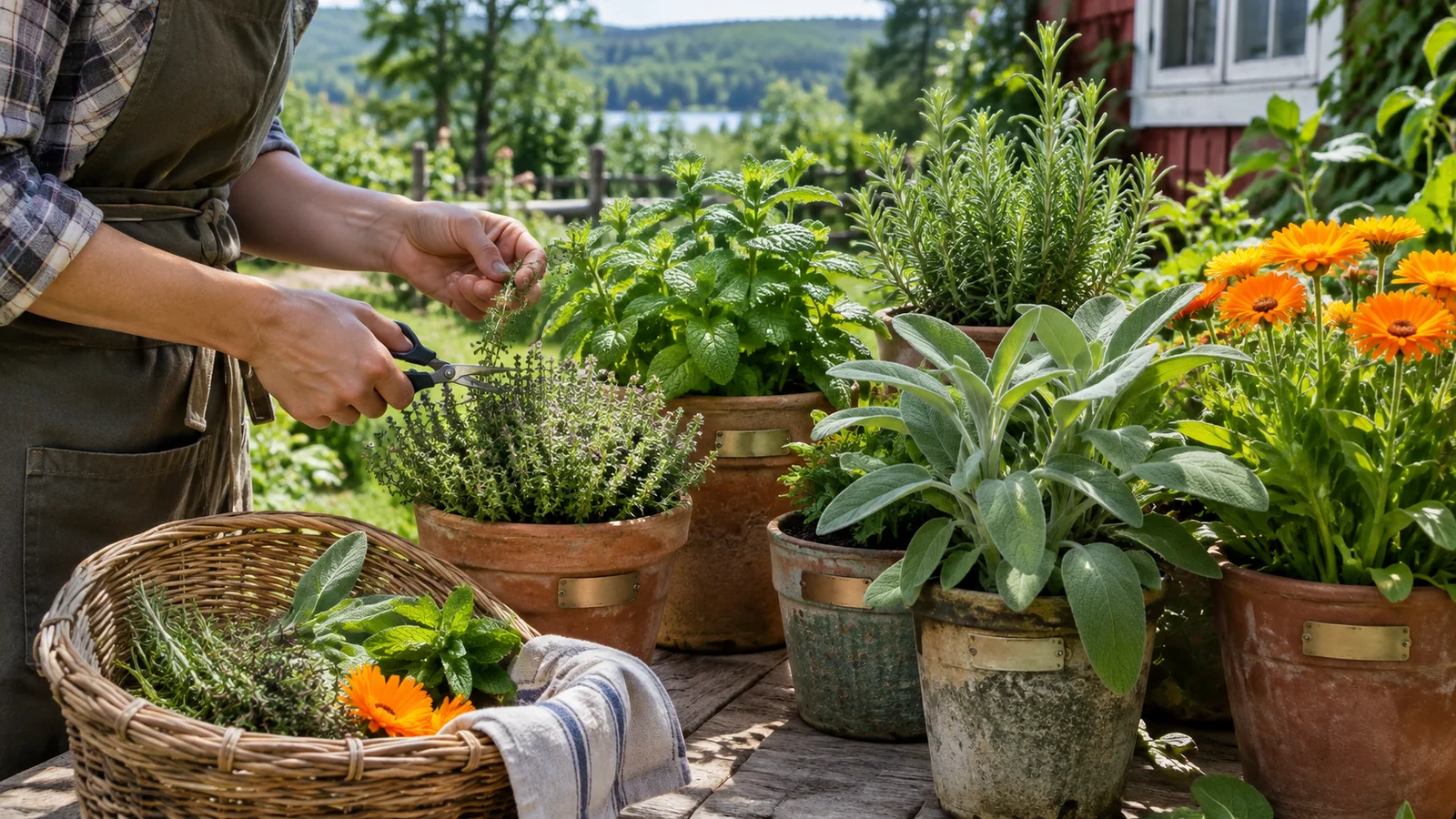
A small garden of aromatic and medicinal herbs is an excellent self-reliance project: it feeds the kitchen, provides comforting herbal teas, attracts pollinators and passes on old knowledge. On a modest area, about 6.7 m² (72 sq ft), you can grow around twenty species suited to Quebec’s climate, most of them perennials.
This guide offers a 20-plant garden plan, with growing tips for each, the part used, the traditional use and what research says, and the precautions to know. It stresses one important reality: most traditional plant uses rest on limited evidence, and an active plant can have side effects and interact with medications.
Important notice. This content is for information and does not replace advice from a health professional. Medicinal plants do not replace a diagnosis or treatment. Before any internal use, particularly during pregnancy or breastfeeding, for children, with chronic illness or when taking medication, ask your doctor or pharmacist. In Quebec, Info-Santé 811 can guide you.
In brief
In brief. A 20-plant garden, on about 6.7 m² (72 sq ft), combines dual-use culinary herbs (garlic, basil, parsley, mint, oregano, rosemary, sage, thyme) and plants for teas or balms (chamomile, lemon balm, lavender, calendula, echinacea, marshmallow, valerian, nettle). Most are hardy in Quebec; aloe and rosemary overwinter indoors. The safest uses are culinary, as mild teas and on the skin. Some plants (St. John’s wort, licorice, valerian, motherwort) have real effects and interactions: use them only with professional advice.
Selection criteria
- Climate suitability: species hardy in zones 3 to 5, or easy to grow in pots for indoor overwintering.
- Dual use: garlic, basil, rosemary, mint and oregano serve in cooking as well as in teas.
- Complementarity: covering varied uses rather than multiplying plants with identical properties.
- Ease: basil, chamomile, echinacea, lavender, lemon balm, calendula, mint, parsley, sage and thyme are among the easiest to start.
- Safety: well-known plants unlikely to be confused with toxic species.
The garden plan
The garden measures about 3.65 m × 1.83 m (12 × 6 ft). It is divided into an annual area, resown each spring in Quebec, and a perennial area that returns each season. For self-reliance, perennials are especially valuable: they regrow without sowing, develop deeper roots and produce more year after year.
| Plant | Type in Quebec | Area | Exposure | Part used |
|---|---|---|---|---|
| Basil | Annual | 0.09 m² (1 sq ft) | Full sun | Leaves |
| Parsley | Biennial, grown as annual | 0.09 m² (1 sq ft) | Sun, part shade | Leaves |
| Spilanthes | Annual | 0.19 m² (2 sq ft) | Full sun | Flowers, leaves |
| Valerian | Perennial, zone 4 | 0.37 m² (4 sq ft) | Sun | Root |
| Aloe | Potted, indoors in winter | 0.28 m² (3 sq ft) | Full sun | Leaf gel |
| Calendula | Self-seeding annual | 0.19 m² (2 sq ft) | Sun, part shade | Petals |
| German chamomile | Self-seeding annual | 0.19 m² (2 sq ft) | Sun, part shade | Flowers |
| Echinacea | Perennial, zone 3 | 0.19 m² (2 sq ft) | Full sun | Roots, aerial parts |
| Evening primrose | Biennial, zone 3 | 0.46 m² (5 sq ft) | Full sun | Seeds (oil), young roots |
| Feverfew | Perennial, zone 5 | 0.19 m² (2 sq ft) | Sun, part shade | Leaves |
| Garlic | Perennial if bulbs are left | 0.65 m² (7 sq ft) | Full sun | Cloves |
| Wild pansy | Self-seeding annual | 0.19 m² (2 sq ft) | Sun, part shade | Flowers, leaves |
| Lavender | Perennial, zone 5 with protection | 0.19 m² (2 sq ft) | Full sun, good drainage | Flowers |
| Lemon balm | Perennial, zone 4 | 0.28 m² (3 sq ft) | Part shade | Leaves |
| Marshmallow | Perennial, zone 3 | 0.37 m² (4 sq ft) | Part sun | Root, leaves |
| Mints | Perennials, zone 3, invasive | 0.37 m² (4 sq ft) | Sun, part shade | Leaves |
| Oregano | Perennial, zone 4 | 0.37 m² (4 sq ft) | Full sun | Leaves |
| Rosemary | Potted, indoors in winter | 0.37 m² (4 sq ft) | Full sun | Leaves |
| Common sage | Perennial, zone 5 with protection | 0.28 m² (3 sq ft) | Full sun | Leaves |
| Nettle | Perennial, zone 3 | 0.37 m² (4 sq ft) | Sun, part shade | Leaves |
Thyme, very hardy and easy, can replace or complement one of the plants above. St. John’s wort, licorice and motherwort, often listed in medicinal garden plans, are covered separately below because of their interactions and precautions.
Annual plants
Basil
A kitchen staple, basil is sown indoors in spring and transplanted outside after the frosts. Traditionally, it is taken as a tea after meals to aid digestion. Its use is mainly culinary; concentrated essential oils are another matter (see below).
Parsley
Very rich in vitamins C and K, parsley is an excellent reserve leafy green. Traditionally associated with urinary problems, it has no proven effectiveness for treating an infection: a urinary tract infection calls for medical care. In large amounts, it is not recommended during pregnancy.
Spilanthes
Nicknamed the “toothache plant”, it causes tingling and mild numbness in the mouth. It is an interesting curiosity and a temporary stopgap for dental discomfort while waiting for a dentist: it does not treat a cavity or an abscess.
Calendula (pot marigold)
Easy and very floriferous, it reseeds itself. Its petals colour soups and are used in infused oils or balms for minor irritation, chapped and dry skin. Topical calendula has some favourable data for irritated skin. Do not apply it to a deep or infected wound, and put nothing into a painful ear without medical advice: an eardrum may be perforated.
German chamomile
One of the best-known tea plants: mildly calming, traditionally used for stomach cramps and to aid sleep. Scientific data are modest, but as a tea it is generally well tolerated. Beware for people allergic to plants of the aster family (ragweed, chrysanthemums).
Wild pansy
Edible flowers that decorate salads. Traditionally used as a tea or compress for the skin; very limited evidence. Mainly ornamental and culinary.
Perennial plants
Garlic
Garlic is planted in October and harvested in July; leaving a few bulbs in the ground keeps it going. A staple food, it has antimicrobial properties in the lab and may contribute modestly to heart health as part of a balanced diet. It does not replace an antibiotic. In large amounts or as a supplement, it can increase bleeding risk, especially with blood thinners.
Echinacea
A superb hardy perennial that attracts butterflies. Some studies suggest a modest effect on the length of a cold, others don’t: results are mixed. Avoid with an aster-family allergy and discuss with a professional in case of autoimmune disease or immunosuppressive treatment.
Valerian
A tall perennial with fragrant flowers; the root is used. Traditionally used for sleep and mild anxiety, with mixed evidence. It can cause drowsiness: no driving after use, no combining with alcohol, sleeping pills or sedatives, and not during pregnancy without medical advice.
Aloe
In Quebec, it is grown in a pot indoors and can go outside in summer. The clear gel from the leaves, applied to a superficial burn or sunburn after cooling with cool water, soothes the skin. Don’t eat it: the yellow latex just under the leaf skin is an irritant laxative, not recommended orally. An extensive or deep burn, a burn on the face or in a child requires medical care.
Evening primrose
A native, very hardy biennial. Its young roots can be eaten as a vegetable; the oil, extracted industrially from its seeds, is sold in capsules. Evidence for eczema, menstrual pain or menopause is weak or contradictory.
Feverfew
Distinct from common chamomile, it is traditionally used to prevent migraines, with some favourable but inconsistent data. It is not recommended during pregnancy or with blood thinners, and can irritate the mouth if fresh leaves are chewed.
Lavender
It needs full sun, well-drained soil and winter protection (mulch, snow) in Quebec; true lavender (Lavandula angustifolia) is the hardiest. Its scent is valued for relaxation; a few studies suggest a slight effect on anxiety. Dried flowers scent linen and repel moths.
Lemon balm
Easy, lemon-scented, tolerant of part shade. As a tea, it is traditionally used for sleep, nervousness and digestion. Modest data, well tolerated as a tea. Caution if you are treated for a thyroid condition.
Marshmallow
A tall perennial of moist places. Its mucilage-rich root is traditionally used to soothe the throat and dry cough. The mucilage can reduce absorption of other medications: space doses a few hours apart.
Mints
Peppermint or spearmint grow everywhere, to the point of being invasive: grow them in pots or a buried container. As a tea, they aid digestion; peppermint oil has good data for irritable bowel syndrome. They can worsen acid reflux. Never apply mint oil near the face of a baby or young child.
Oregano
A hardy culinary herb that attracts bees. Very useful in cooking and teas. Oregano essential oil is very irritating and should not be taken neat or without advice: its antimicrobial effect in the lab does not translate into treating an infection.
Rosemary
Not hardy in Quebec, it is grown in a pot and spends the winter in a cool, bright room. It flavours roast meats and vegetables; as a tea, it is traditionally used for digestion. Its essential oil should be avoided by people with epilepsy and during pregnancy.
Common sage
Perennial in zone 5 with protection. As a gargle, it is traditionally used for the throat and gums. It contains thujone: avoid in large amounts, during pregnancy and breastfeeding, and with epilepsy. Culinary use is no concern.
Nettle
It grows wild in much of Quebec. Young shoots, picked with gloves, lose their sting when cooked or dried and make an excellent mineral-rich vegetable, in soup or tea. Fermented nettle tea also serves as garden fertilizer. Evidence for seasonal allergies is limited.
Three plants to handle with care
| Plant | Traditional use | Why caution |
|---|---|---|
| St. John’s wort | Mild low mood | Major interactions with many drugs (antidepressants, oral contraceptives, blood thinners, some heart and anti-rejection drugs); photosensitivity. Depression is treated with a professional. |
| Licorice | Throat, cough, stomach | Taken regularly, it can raise blood pressure and lower potassium. Not recommended with high blood pressure, heart or kidney disease, or during pregnancy. |
| Motherwort | Anxiety-related palpitations | Palpitations or an irregular heartbeat must be assessed by a doctor. Not recommended during pregnancy. |
They can be part of a garden for their botanical and educational value, but their internal use should be discussed with a professional.
Basic preparations
- Infusion: pour boiling water over leaves or flowers, steep 5 to 10 minutes, strain. The simplest and safest method.
- Decoction: for roots and bark, simmer 10 to 20 minutes.
- Infused oil: steep well-dried flowers (calendula, lavender) in a vegetable oil for a few weeks, away from light, then strain. Fresh plants in oil can go mouldy or even promote botulism: dry them first and keep the oil cool.
- Balm: infused oil thickened with beeswax, for use on the skin.
- Tincture: steeping in alcohol; more concentrated, best left to trained people.
Harvesting, drying and storage
- harvest in the morning, once the dew has dried, just before or at the start of flowering for leaves;
- dry in small bunches, in the shade, in an airy place, or in a dehydrator at low temperature;
- store in airtight, labelled jars (plant, part, date), away from light;
- renew each year: dried plants lose aroma and properties.
See also long-term food storage.
Safety: identification and wild harvesting
Growing your own plants avoids the main risk of wild harvesting: confusion. In Quebec, several toxic plants resemble edible or medicinal ones, notably spotted water hemlock and poison hemlock, which look like wild carrot or parsley and are deadly. Never eat a wild plant without certain identification, ideally confirmed by a competent person. In case of doubtful ingestion, call the Quebec Poison Control Centre at 1-800-463-5060.
What place in preparedness?
A garden of aromatic and medicinal herbs is an excellent complement: it improves your diet, brings comfort, builds skills and creates ties with neighbours. It does not replace a first aid kit, a reserve of usual medications agreed with your doctor, or access to care. For pain, see plants, essential oils and pain: what the science says, and for the kit, the first aid kit.
To go further, favour serious reference works on Quebec’s medicinal plants and the monographs of scientific bodies, which distinguish traditional use from clinical evidence. Natural health products sold in Canada carry a natural product number (NPN) issued by Health Canada, a sign that their safety and quality have been reviewed.
Frequently asked questions
Which plants should you start with?
Basil, potted mint, lemon balm, chamomile, calendula, chives, thyme and garlic are easy, useful in cooking and carry no particular risk in culinary use.
Can medicinal plants replace medication?
No. They can bring comfort for minor ailments, but they replace neither a diagnosis nor a treatment. Some have side effects and interactions.
Are herbal teas safe during pregnancy?
Not all. Several plants (sage, licorice, feverfew, valerian, parsley in large amounts) are not recommended. Ask your doctor, midwife or pharmacist.
How do you overwinter rosemary and aloe?
In pots, in a bright, cool room, with reduced watering. Put them back outside after the last frosts.
Can you gather medicinal plants in the wild?
Only with certain identification, away from roads and treated areas, and respecting regulations and protected species. Growing your own is safer.