
In this article
This week, distribute some resources among authorized places so as not to depend on a single storage. It can be the home, the work with agreement, a vehicle within the limits of temperature or a confirmed place of withdrawal. The priority is reliable access and maintenance.
Define the function of each batch
A small set in the office can respond to a disrupted commute. Clothes at a loved one's home can facilitate accommodation. A documentary copy outside the home can help after a disaster. Choose a specific function rather than reproducing a complete bag everywhere.
Check who is allowed to access the equipment and what happens if the building is closed. A lot located in the same risk area as the home can also become inaccessible. Do not consider it available without reviewing the route and schedules.
Get the agreement and choose a suitable storage
Ask for permission from the owner, employer or host. Keep the locations and content identified for the people involved. Do not bury material on public or private land without agreement and do not mark trees or buildings to locate a cache.
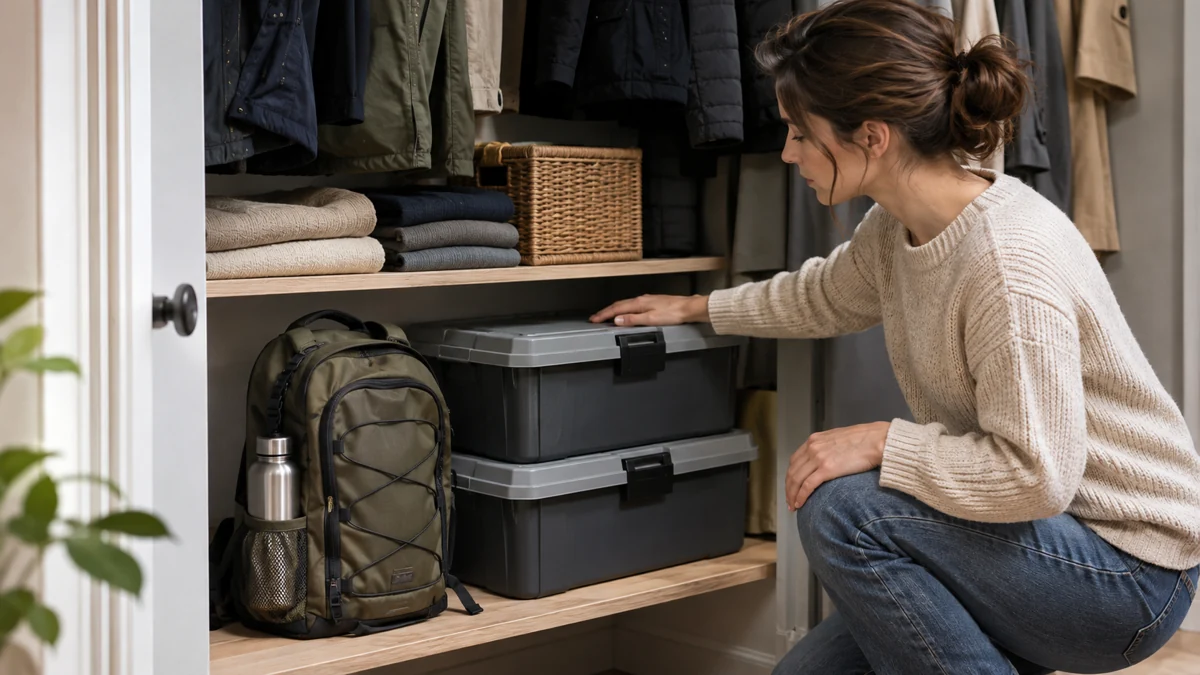
A bin can arrange closed supplies if its size and strength are suitable. It is not automatically waterproof, food or suitable for burial.
Adapt the content to the conditions
Prepare clothes, a lamp, contacts and food as needed. Drinking water, food, batteries and medicines have conservation requirements. A vehicle exposed to frost or heat is not suitable for all products. Check the leaflets and ask for advice for treatments.
A transportable bag can group the material if its load is adapted. It is sold separately from the resources and should not be filled beyond what the person can move.
Do not distribute weapons, ammunition or dangerous products in improvised storage. These goods meet specific rules and do not constitute a civil reserve to be hidden along an itinerary.
Preserve information without losing access
Keep the location details and access agreement in your plan. Limit the dissemination of sensitive data, while allowing responsible people to find what is planned. A reserve whose existence no one knows or whose key is inaccessible may be useless.
For documents, provide a protected copy and official means of recovery. A pouch does not guarantee retention in any disaster; distributing copies and protecting data remain necessary.
Schedule the rotation
Enter content, date of verification and responsible person. Test the access during an ordinary trip and replace the products according to their conditions. If the need or location changes, get the material back rather than leaving a forgotten stock.
Actions of the week
- Choose a function for a second batch.
- Confirm the agreement and access to the place.
- Check the storage conditions.
- Prepare an inventory and a control date.
- Test access without relying on a single person.
Your expected result: a secondary resource that is authorized, maintained and truly accessible.
Put this reading into practice
Perform the action as you wish and then check the result. Your follow-up remains specific to this route.
52 weeks to strengthen your preparation; Week 46
Distribute useful resources
Your action: Avoid a single point of failure for documents and small essentials by using only authorized and accessible locations.
To check: Authorized relatives know where to look; no hidden deposit in a public space is organized.
To do