
In this article
This week, choose the tools that fit your tasks and your emergency plan. The list of an isolated camper is not automatically that of a family evacuated to a reception center. Start with the useful features, and then check what you actually know how to use.
Connect each tool to a task
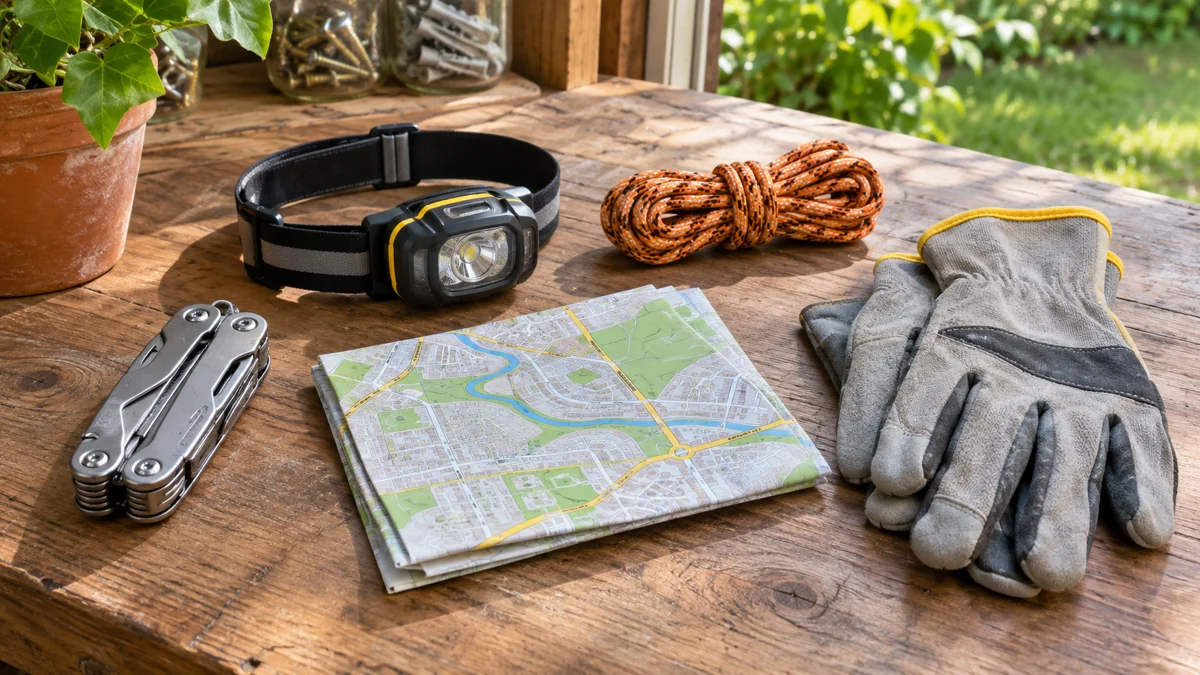
To light you up, a lamp independent of the phone avoids mobilizing its battery. To open a can, a manual can opener tried in advance remains more convenient than an accessory whose operation you do not know. To guide you, a local map and a prepared itinerary complete the phone.
Write the needs before the marks: illuminate, open, transport, fix or maintain. Remove duplicates that unnecessarily weigh down the bag and keep an alternative for an important function when relevant.
Choose a versatile tool with discernment
A multifunction tool can be suitable for small tasks, depending on its functions and your dexterity. Check its grip, the locking of rooms and the rules of places frequented. It does not replace tools suitable for important work, nor a medical device.
If you are planning a cutting tool, learn how to handle, transport and maintain it. Keep it protected and out of the reach of children. A blade is not a mandatory accessory for each person or a general response to a threat.
Provide simple accessories
A suitable rope and ribbon can be used for light bindings. Check their limits. An ordinary paracord is not used for climbing, antichute or rescue; do not improvise a device carrying a person. Capital assets and first aid actions must match the training received.
An emergency cover or tarpaulin can complement equipment in an outdoor context. However, check the protection that is really necessary for the climate and the existence of safe accommodation. A light accessory does not guarantee a safe night in winter.
Keeping choices related to context
For water, distinguish transport, storage and treatment. A filter has precise limits; it does not make all water consumable. For fire, respect the prohibitions and the place of use. A fire-lighter is not a systematic need for a civil evacuation and no external combustion device is used in the housing.
Mirrors or whistles can contribute to signaling in an appropriate context. Rockets require specific precautions and rules; do not add them as a routine item without identified need. Traps and improvised weapons are not part of this week’s tasks.
Test without creating danger
Choose a small authorized task and use the tool in good conditions. Check the ergonomics with the people involved. Clean and store the material according to the package leaflet. Write down the batteries, parts or consumables needed, as well as the tasks to be entrusted to a professional.
Actions of the week
- Associate each tool envisaged with a concrete need.
- Check the tools already available and their status.
- Test a simple and controlled use.
- Prepare consumables and safe storage.
- Review the weight of the bag after additions.
Your expected result: a small usable and maintained set, adapted to your situation.
Put this reading into practice
Perform the action as you wish and then check the result. Your follow-up remains specific to this route.
52 weeks to strengthen your preparation; Week 16
Choosing useful tools
Your action: Combine each tool with an authorized and mastered task, then test its grip and storage.
To check: Protections and notices are available; the tool does not replace a professional.
To do