
In this article
This week, prepare a balance of essential electrical needs before choosing a backup power supply. A phone solution has neither the power nor the capacity of a system for home appliances. The installation must correspond to the uses and the place.
Distinguish power and energy
The power, expressed in watts, indicates what a device is asking for at a given time. The energy, expressed in watt hours, also depends on the duration. Some engines require higher starting power. Check the manufacturer's instructions and ask for advice if they are insufficient.
Make a short list: device, power, life, and priority. Take into account the losses and limits of the catches. Do not estimate the battery life from its commercial capacity alone, without knowing the measurement conditions and conversions.
Start with small charges.
For compatible USB phones and devices, an external battery can be a first solution. Test the cables and the number of recharges in your real conditions, without waiting for the failure.
Battery-powered or rechargeable lighting can reduce the need for a larger system. Choose the right formats and chargers. Do not store batteries in the refrigerator: follow the conditions indicated by the manufacturer.
Examine a battery-powered station
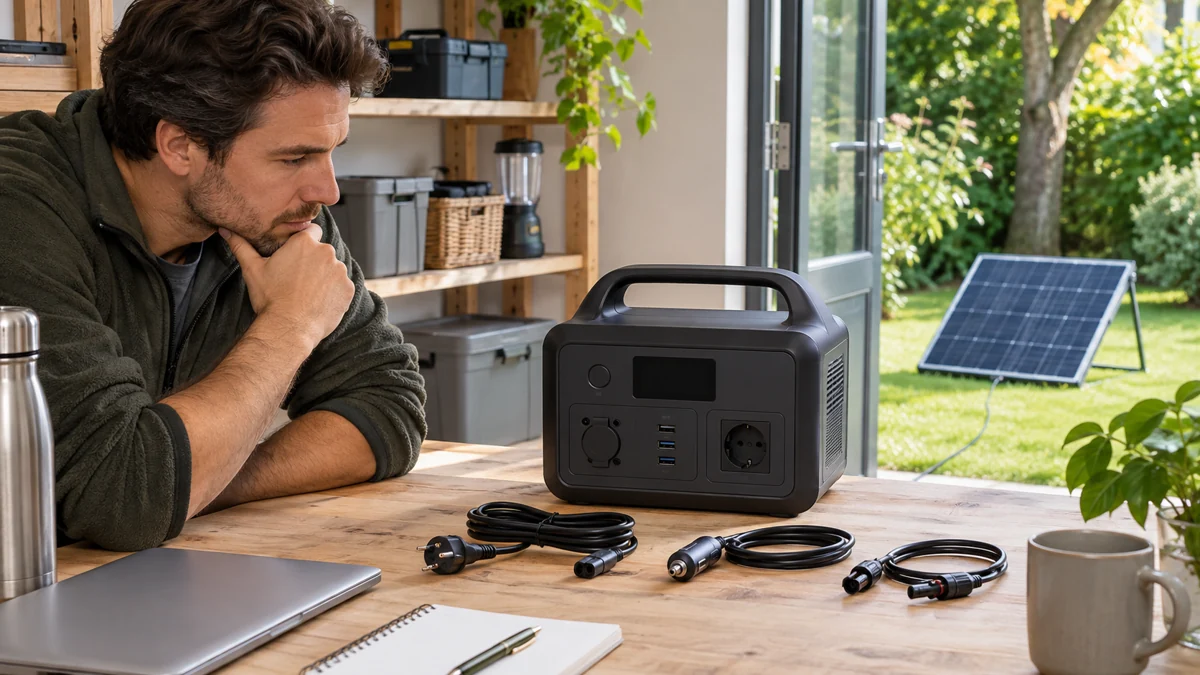
For a larger charge, check payload, continuous and starting power, sockets, operating temperature and charging possibilities. A station is not an unlimited source of energy. Heating appliances can quickly consume its reserve.
For a medical device, have the solution validated by the healthcare team and the equipment supplier. Provide a fallback location if continuity cannot be assured. Do not improvise a battery assembly or a connection to the building.
Understanding the Limits of Solar
A sign depends on the sun, orientation, shade and season. Check the electrical compatibility of the panel, regulator and battery with the supplier. A system connected to the grid does not necessarily provide power during a failure: its emergency operation must be explicitly provided.
Fixed installations and connections require professionals and applicable authorizations. Wind or hydraulic systems are specific projects related to the site, with maintenance and regulatory constraints; they do not automatically adapt to a home.
Anticipate risks and maintenance
Use batteries and chargers according to their instructions. Remove damaged products and protect them from incompatible temperatures, humidity and short circuits. Do not modify a lithium battery or its charger. Recharging must be done in an appropriate place, without blocking an exit.
If a combustion generator is part of the plan, use it only outdoors, according to prescribed distances and precautions, with a compliant installation. It presents risks distinct from those of a battery-powered station.
Actions of the week
- Take stock of the essential loads.
- Test the small power supplies already available.
- Compare capacity, power and recharge of a suitable solution.
- Validate medical needs and connections.
- Define the maintenance and a place of withdrawal.
Your expected result: a documented need and a testable solution, without the promise of permanent autonomy or guaranteed profitability.
Useful reference
Battery Use, Recharging and Storage - Health Canada.
Put this reading into practice
Perform the action as you wish and then check the result. Your follow-up remains specific to this route.
52 weeks to strengthen your preparation; Week 39
Studying energy solutions
Your action: Classify the uses to maintain, postpone or transfer to a place of reception before dimensioning equipment.
To check: Compatibility and security are checked; a major purchase is not decided on the only advertised power.
To do