
In this article
A household has made its plan, packed its bag, filled its water containers. It feels ready. Then comes the first real outage at night: the headlamp batteries are dead, nobody knows where the water shut-off valve is, the out-of-town contact has a new number, and the child who was supposed to take the cat is sleeping at a friend’s.
None of this is serious in itself. But every detail costs minutes, and the minutes add up at the worst moment. A plan that has never been tried is only a hypothesis. Testing it means finding its gaps on a quiet Tuesday evening rather than in the middle of a crisis.
This page explains why and how to test your plan as a family, with three exercise formats, a step-by-step method and the 12 scenarios of the 365 Program.
Why test
Authorities recommend it: review your plan at least once a year with the whole family, and run a home evacuation drill at least once a year, stopwatch in hand. Organizations test their emergency plans regularly, because they know a plan on paper does not survive first contact with reality intact.
A test almost always reveals the same kinds of problems:
- What is missing: dead batteries, expired medication, water forgotten for two years, a charger nobody can find.
- What nobody knows how to do: shut off the water or gas, light the stove, use the hand-crank radio, treat water.
- What was never decided: who picks up the children, when to leave, where the dog goes.
- What has changed: a phone number, a move, a new medication, a child who has grown up.
- What does not last: the water reserve covers drinking, not washing; the lamp lasts one evening, not three.
Every problem found during a test is one less problem during a crisis. It is also the best way to find out what level your household is really at.
Three exercise formats
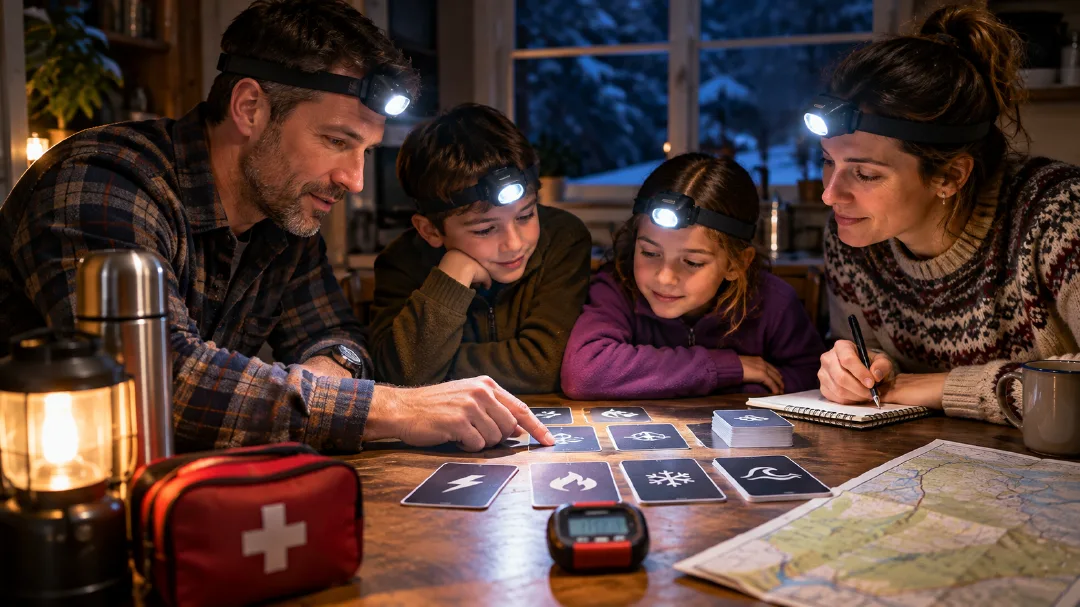
Professionals distinguish several types of exercises. The simplest is the tabletop exercise: people meet to discuss a simulated situation, look for problems and solutions, without deploying anything in the field. More advanced exercises put part of the plan, then all of it, into action in real conditions. A household can follow the same progression.
| Format | What it involves | Duration | Example |
|---|---|---|---|
| Tabletop | You tell the scenario, everyone says what they would do, you note what gets stuck | 30 to 45 minutes | “It is 2 a.m., the power goes out, it is −20 °C outside. What does everyone do?” |
| Partial | You actually carry out one part of the plan | 15 minutes to 2 hours | Evacuate the house with a stopwatch, or cook a meal without power |
| Real conditions | You live the scenario for real, for a set time | An evening to a weekend | Switch off the main breaker from Friday 6 p.m. to Saturday noon |
Always start at the table. That is where you find most problems, risk-free and at no cost. Then move on to a partial exercise, and when the household is ready, to one in real conditions.
Running a test scenario step by step
- Choose the scenario. Start from a hazard that affects your household, using My radar, or from the scenario of the week in the 365 Program.
- Set one simple goal. A single question the exercise should answer: “Can we keep one room warm for 24 hours?”, “Can we leave in 15 minutes with the essentials?”
- Name a facilitator. An adult who tells the scenario, introduces the surprises and notes what happens, without playing.
- Prepare three or four surprises. Professionals call them “injects”: events added along the way to make people react. For example: “The cell network just went down”, “Grandma calls, her heating is out”, “The main road is closed”, “The person who was supposed to shut off the water is at work”.
- Play. Everyone says or does what they really would, with what is really in the house. No “we would have”: if the lamp has no batteries, it has no batteries.
- Stop on time. A short, successful exercise makes people want to do it again; one that drags on discourages them.
- Debrief right away, while everything is fresh (see below).
With children, keep it playful: a challenge, a stopwatch, a reward. The goal is for them to know what to do, not to be afraid.
The 12 scenarios of the 365 Program
The 365 Program places a test scenario every four weeks. Each one follows the weeks that prepared for it, and can be played at the table or in real conditions, in the city or the country, in Quebec or France.
| Week | Scenario | What it tests |
|---|---|---|
| 6 | Ice storm cascade | The outage, cold, water, network chain |
| 10 | Snowstorm | Staying home, the vehicle in winter |
| 14 | 48-hour cyberattack | Payment, documents, communications |
| 18 | 15-minute evacuation | The bag, departure decisions, the meeting point |
| 22 | Spring flood | Protecting the house, leaving in time, hygiene without water |
| 26 | Severe thunderstorm | Taking shelter, mutual aid with neighbours |
| 30 | Wildfire and heat | Smoke, heat, preventive evacuation |
| 34 | Earthquake | Immediate actions, practical skills |
| 38 | 24-hour shelter in place | Sheltering quickly, staying informed |
| 42 | 14-day lockdown | Lasting over time, health, morale |
| 46 | Supply disruption | Supplies, rotation, children’s stress |
| 50 | 7-day regional outage | The 7-day level, the whole plan at once |
The last scenario brings everything together: it is the big test of the year, right after updating the family plan in week 49.
The debrief
This is the most useful part, and the most often forgotten. Fifteen minutes is enough, right after the exercise, with everyone.
Three questions, in this order:
- What worked well? Start with the positive, so everyone wants to do it again.
- What got stuck or was missing? An object, a skill, a decision, a piece of information.
- What do we change, who handles it and by when? One line per action, with a name and a date.
Write the answers on a sheet kept with the family plan. Before the next test, read it first: the problems that keep coming back are the ones to deal with first.
The action list is also your real shopping list, the only one that counts: it starts from what was missing in practice, as explained in Decide before you buy.
What authorities say, and what the field adds
Official guidance — Review your emergency plan at least once a year with the whole family, and run a home evacuation drill at least once a year.
PrépaCivile field recommendation — Go beyond reading it over: actually test it, at the table and then in real conditions, with surprises. One scenario a month following the 365 Program, and at least one exercise in real conditions a year, ideally in winter.
Field insight — When facilitating tabletop exercises, you see the same thing every time: the plan looks solid until the first surprise. It is at the second or third inject that the real questions appear. A household is no different from an organization: the unexpected is what reveals the plan.
Safety during exercises
- For an exercise in real conditions, never turn off the heat if it puts a vulnerable person or a baby at risk, and never cut power to a medical device.
- Never use indoors any appliance not designed for it (camping stove, barbecue, generator): carbon monoxide kills without warning.
- For an evacuation drill using the smoke alarm, notify your monitoring company first if the alarm is connected to one.
- Agree on a word to stop the exercise at any time, and never call 911 or 112 for an exercise.
Frequently asked questions
Will my children be scared?
Not if the exercise is presented as a game or a challenge, and adapted to their age. Knowing what to do is more reassuring than not talking about it.
I live alone. How do I test?
At the table, with a relative on the phone acting as facilitator, or in real conditions, with an evening without power. The out-of-town contact can be tested too.
How often?
One scenario a month if you follow the 365 Program, at least one exercise a year, and after every major change in the household.
What if the test shows we are not ready?
That is exactly its purpose. Note what is missing, pick one or two actions, and test again later.
Sources
- Public Health Agency of Canada, Making an emergency plan
- Government of Quebec, Home evacuation plan
- Office québécois de la langue française, Exercice de table (in French)
- Canadian Red Cross, Make an Emergency Plan
- French Directorate of Civil Security, Exercices de sécurité civile : mémento en 10 points (in French)