
In this article
Preparation and resilience are mutually reinforcing. The first organizes means before an event; the second concerns the ability to pass through a disturbance, to adapt and to regain a satisfactory functioning. A home can have reserves while needing to improve its alternatives, relationships, and recovery capacity.
Preparing resources for a given situation
A family plan, a water supply, a first aid kit and accessible documents meet identifiable needs. They reduce the decisions to be made when time is running out. Their interest, however, depends on their suitability for the person and the situation.
A kit that is too high, food that is incompatible with an allergy or contact that has changed its number reveals a preparation that has become partially unusable. The inventory must therefore be accompanied by tests and revisions. Possessing an object does not confirm that it can be used at the desired time.
Develop an adaptive capacity
Resilience adds a question: what if the planned scenario changes? The reception point can close, the breakdown last longer or a person temporarily lose his mobility. Alternative options, skills, and trust ties help adjust the response.
This ability is not only based on individual willpower. Housing, income, health, access to services and infrastructure strongly influence policy options. Talking about resilience should not go back to assigning people responsibility for difficulties that they cannot solve alone.
| Situation | Useful preparation | Adaptation to be expected |
|---|---|---|
| Power outage | Lamps loaded, meals available | Another welcome if the accommodation becomes unsuitable |
| Closed road | Agreed journey and destination | Other means of transport or postponement of travel |
| Absence of a caregiver | Accessible contacts and information | Confirmed and understandable instructions |
| Unforeseen expenditure | Organized documents and budget | Review of priorities and search for support |
Avoid opposition between people
The terms “prepper”, “planning citizen” and “resilient person” cover a variety of practices. They do not allow to deduce the motivations, the relationship to others or the level of preparation of an individual. A person can start with a few reserves, then develop know-how and a network.
The debate becomes more useful when looking at concrete results: do people know what to do? Are the solutions accessible? Are the resources maintained? Does the plan take into account existing neighbours and services?
Looking for Benefits in Ordinary Life
Sustainable habits maintain the preparation: cook the reserves, repair what can be repaired, check the insurance and know the resources of the neighborhood. They can reduce some costs, but no savings are automatic. Equipment that is little used, difficult to maintain or bought on credit can add a constraint.
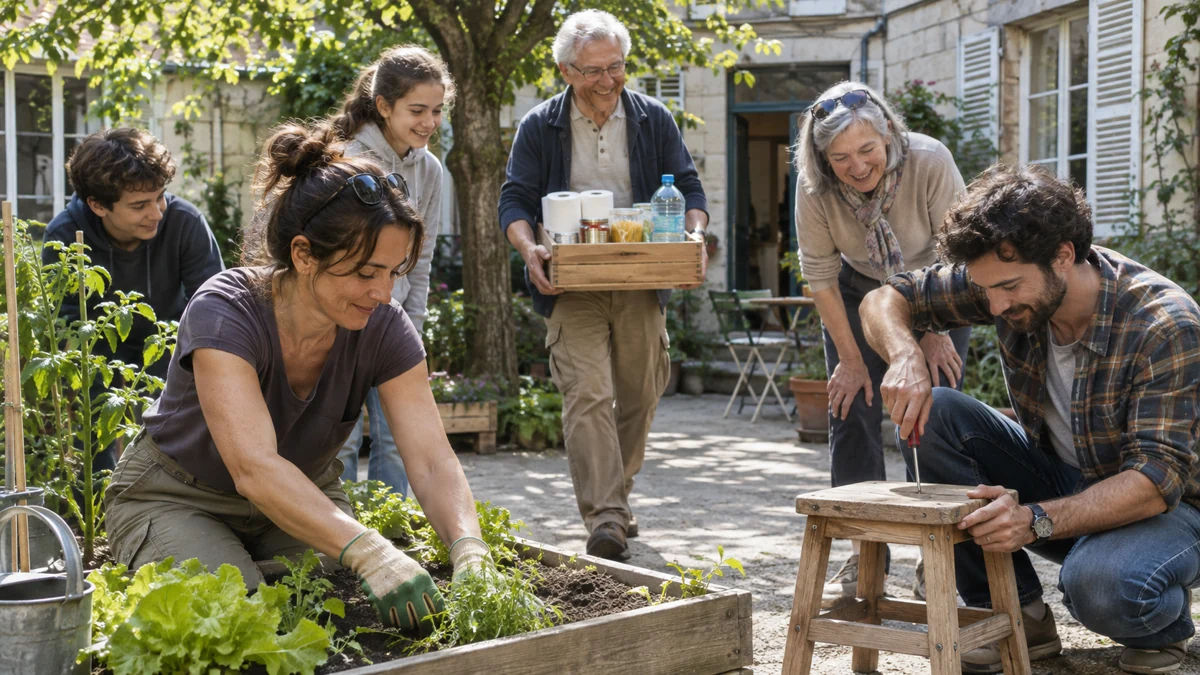
A small vegetable garden is an example of learning: it allows you to understand the seasons and complete certain meals. It remains dependent on water, light, weather and local conditions. Its value is measured by realistic expectations.
The resilience of a neighbourhood is also built in everyday uses: mutual aid, accessible places, shops and organizations. We can contribute without asking neighbors to share all the same opinions or to disclose their reservations.
Preparing for a return to stable operation
After a disaster, the needs change: administrative procedures, authorized cleaning, repair of housing, medical follow-up and resumption of activities. Keep the evidence useful, note the steps and identify who can accompany the home. Recovery is not just about restoring the current.
Once the situation has stabilized, take a moment to examine what worked. Choose a few achievable corrections and give them a date. A useful feedback improves the next try without looking for a manager for each difficulty.
A first approach accessible
Choose a plausible event, then write an answer for three moments: before, during, and after. Add an alternative and a contact person if the first option doesn’t work.
Your next action: Test an element of the plan with your household, then note a material improvement, a skill to practice and a bond of mutual aid to develop.