
In this article
- In brief
- 1. What is potassium permanganate?
- 2. The colour rule: useful, but not enough
- 3. Water treatment: what the authorities say
- 4. Use on the skin: a precise medical framework
- 5. Antidote, bites, food preservation: uses to drop
- 6. Fire starting: a real reaction, but a risky one
- 7. Handling, storage and toxicity
- 8. Buying it and regulations in Canada
- 9. Safer alternatives for your kit
- Summary
- Frequently asked questions
- Further reading
- Sources
Few products fit in such a small container while attracting so much curiosity. Potassium permanganate, also known as Condy’s crystals or KMnO₄, has long appeared in expedition kit lists and in many survival guides. It is a powerful oxidizer, inexpensive and easy to store. But many of the uses credited to it online are exaggerated, outdated or dangerous when the dose is not controlled.
This article sorts fact from myth from a household preparedness point of view: what the product really is, what health authorities say about water treatment, its use in dermatology, the myths to drop, the handling risks and the safer options to favour in an emergency kit. The goal is not to convince you to buy it, but to help you make an informed decision.
In brief
In brief. Potassium permanganate is a strong oxidizer, useful in dermatology when highly diluted and in municipal water treatment, but it is not a recommended method for making water safe to drink at home: boiling, filtration and chlorination remain the standards. The “cure-all,” antidote and food-preservation recipes are not backed by solid evidence. Handled carelessly, it stains, irritates, burns and can start a fire on contact with some substances. In a preparedness kit, it comes after a good first aid kit, a water filter and a reliable fire starter.
1. What is potassium permanganate?
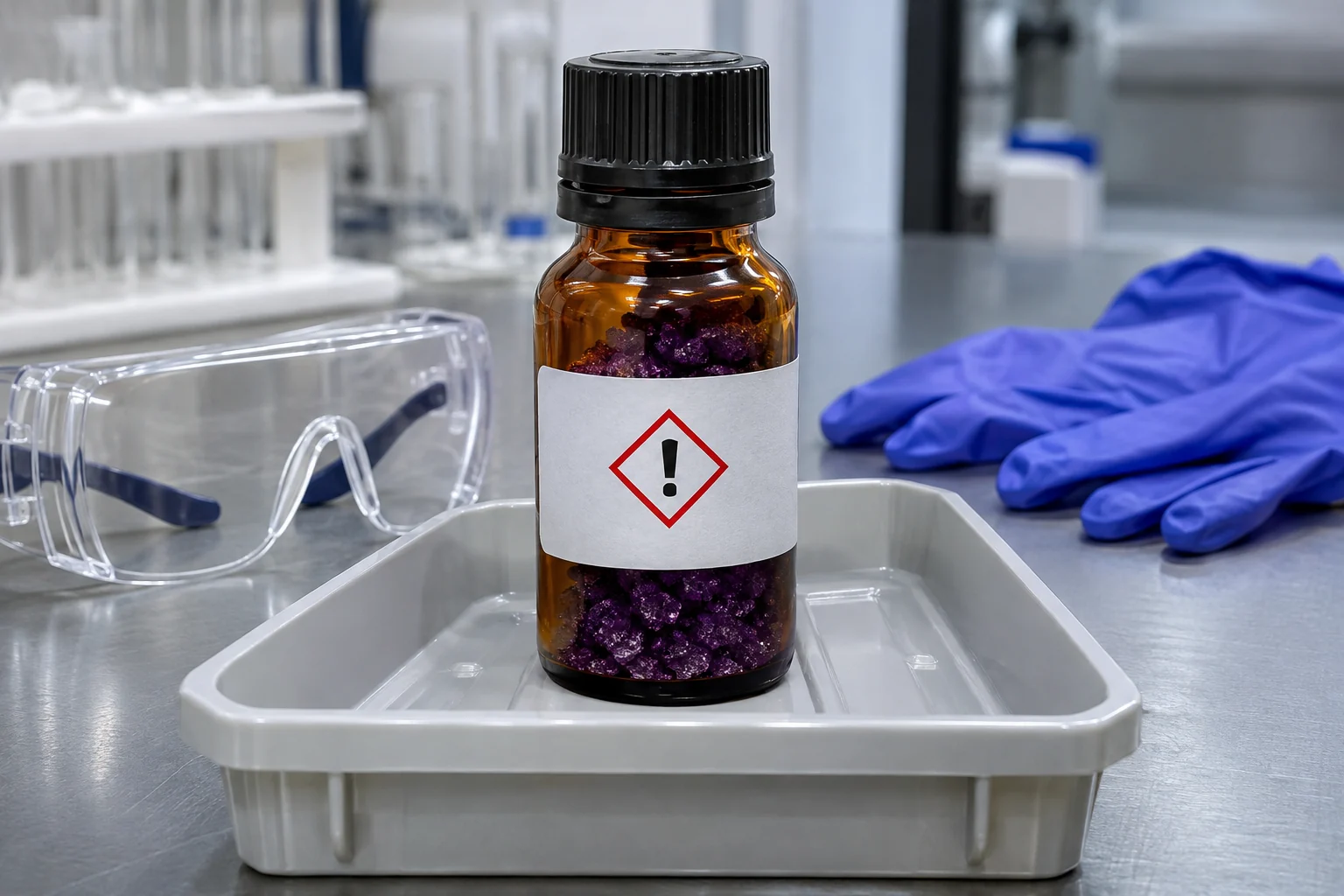
Potassium permanganate is an inorganic chemical compound with the formula KMnO₄. It comes as small dark purple, almost black crystals that dissolve in water, giving a colour that ranges from pale pink to deep violet depending on the concentration.
Its main property is its strong oxidizing power: it reacts with organic matter, many micro-organisms and some dissolved metals such as iron and manganese. That reactivity explains both its usefulness and its dangers. What destroys bacteria on the skin’s surface can also irritate, burn mucous membranes or ignite a combustible mixture.
In some countries it is sold in pharmacies as tablets for dermatological soaks; elsewhere it is found through aquarium, pool or water-treatment suppliers, and online. Concentration and format vary widely from one product to another, which makes recipes found on the internet unreliable.
2. The colour rule: useful, but not enough
Many guides sum up permanganate use with a simple rule: the solution should stay pale pink, never purple. The rule is a useful reminder that a dark solution is too strong and can irritate or burn.
It does not, however, guarantee a correct dose. How we perceive colour depends on lighting, the container, the depth of the water and each person’s eyesight. In dermatology, prescribed dilutions are precise: for example, one 400 mg tablet dissolved in 4 litres of water gives a dilution of about 1 in 10,000. The “3 or 4 crystals per litre” or “1 gram per litre” sometimes quoted correspond to much stronger concentrations that are not appropriate for skin or for drinking water.
So remember two things: a purple solution is always too strong, and a pale pink solution is not automatically safe if you do not know how much product you used.
3. Water treatment: what the authorities say
Potassium permanganate does have a role in water treatment, but mainly at municipal or industrial scale. It is used to oxidize iron, manganese and some compounds that cause bad tastes or odours, in plants where the dose is measured, monitored and followed by other treatment steps.
At home or in the field, it is not a recommended method for making water safe to drink. Public health agencies, including Health Canada and the U.S. CDC, favour methods that are better documented and easier to control:
- Boiling at a rolling boil for at least one minute, the reference method during a boil-water advisory.
- Filtration with a filter designed for drinking water, ideally followed by disinfection if the water may contain viruses.
- Chlorination with purification tablets or unscented household bleach, at the doses given by the authorities.
The amounts of crystals “per gallon” suggested in some guides for treating a well or a spring are not recognized instructions. For a contaminated private well, for example after a flood, follow your province’s or municipality’s disinfection and testing procedure, and have the water tested before drinking it.
When in doubt, permanganate adds nothing that a good water-treatment kit does not already provide. It can even make things harder: coloured or overdosed water is not drinkable, and there is no simple way to check that it has been disinfected.
4. Use on the skin: a precise medical framework
In dermatology, soaks or compresses of highly diluted potassium permanganate are used for some weeping skin conditions, such as weeping eczema or certain infected superficial wounds. This care is given on the prescription or advice of a health professional, at a precise dilution and for a limited time.
Several precautions apply:
- Permanganate is very drying: it is not suitable for dry or cracked skin.
- Too strong a concentration can cause chemical burns; any burning sensation means you should stop and rinse thoroughly with clean water.
- It must not be applied near the eyes or on mucous membranes.
- It leaves long-lasting brown stains on skin, nails and fabric.
For an ordinary wound, the recommended first aid remains simple: stop the bleeding, clean with clean water, cover with a dressing and watch for signs of infection (spreading redness, warmth, pus, fever). A deep or dirty wound, a bite or an extensive burn should be assessed by a professional. Permanganate replaces neither these steps nor a medical visit.
5. Antidote, bites, food preservation: uses to drop
Older books presented permanganate as a treatment for some poisonings through gastric lavage, or as a remedy to apply to snake bites. These practices are no longer recommended: the evidence of effectiveness is weak and the risk of injury is real.
For a snake bite, current guidance is clear: do not cut the wound, do not suck it, do not apply chemicals, keep the limb still, remove rings and bracelets and get to medical care quickly. For a poisoning, call your poison centre (in Quebec, the Centre antipoison du Québec at 1-800-463-5060) or 9-1-1 if symptoms are severe.
The same caution applies to food. After a flood, health authorities ask you to throw out food that has been in contact with floodwater, except some sealed and undamaged commercial containers, to be cleaned according to their instructions. Soaking fruit and vegetables in a permanganate solution is not a recognized way to make them safe. The idea of putting a few crystals in a bag to make fresh produce last longer is not proven either.
6. Fire starting: a real reaction, but a risky one
Potassium permanganate is a strong oxidizer. On contact with certain substances, such as glycerin, it can start burning on its own after a short delay. Survival guides often present this reaction as a way to light a fire in wet weather.
In practice, it has several drawbacks: the delay varies with temperature, the flame is intense and hard to control, the fumes are irritating, and mixing it with other combustible products can lead to unexpected ignition. For this reason, we do not give mixtures or quantities. Some mixtures with sugar or other powders are sensitive to friction and genuinely dangerous.
To light a fire reliably in an emergency, a good lighter, storm matches in a waterproof case and commercial fire starters are safer, simpler and more predictable. If you still want to try this reaction, do it only outdoors, on a mineral surface, with small amounts, away from anything flammable and with a way to put the fire out.
7. Handling, storage and toxicity
Potassium permanganate calls for the same precautions as a strong household chemical:
- Toxicity: swallowing crystals or a concentrated solution can cause serious burns to the mouth, oesophagus and stomach. Keep it out of reach of children and pets, in its original, clearly labelled packaging.
- Eyes and skin: crystals and concentrated solutions are irritating or even corrosive. Wear gloves and rinse immediately after contact.
- Strong oxidizer: never store it near fuels, solvents, alcohols, glycerin, cleaning products or metal powders. Some mixtures can catch fire.
- Fumes: when burned or heated, it releases irritating vapours. Avoid breathing them and never use the product in an enclosed space.
- Stains: it leaves long-lasting brown stains on skin, fabric and porous surfaces.
Keep it in an airtight, non-metallic, opaque container, somewhere cool and dry, away from heat and light. Note the purchase date and the concentration shown on the packaging.
8. Buying it and regulations in Canada
Potassium permanganate is sold in small formats for aquariums, water treatment and some technical uses. It is also a regulated chemical precursor in Canada for businesses that make or distribute it, which is why some suppliers limit quantities or ask about the intended use.
Before buying it, ask yourself what concrete purpose it will serve in your plan. For most households, the money is better spent on a certified water filter, purification tablets, a complete first aid kit and a reliable way to light a fire.
9. Safer alternatives for your kit
Each use credited to permanganate has a better-suited alternative for household preparedness:
- Making water drinkable: boiling, a certified portable filter and purification tablets.
- Cleaning a small wound: clean water, sterile gauze, a common antiseptic and dressings, gathered in a first aid kit.
- Lighting a fire: a lighter, storm matches and fire starters, kept dry.
- Protecting food: good storage practices, stock rotation and, after a flood, discarding affected food.
These options are easy to learn, can be tested in advance and require no chemistry knowledge. That is what makes them better choices when the stress of an emergency leaves little room for dosing errors.
Summary
Potassium permanganate is neither a miracle potion nor a product to ban. It is a powerful oxidizer with specific, supervised uses, notably in dermatology and municipal water treatment. In a family kit, it is at best an extra for someone who knows how to use it, and never a substitute for recognized water-treatment methods, first aid or a reliable fire starter.
As with any preparedness item, its value depends mostly on what you know. If you decide to keep some, learn how to dilute and store it properly, and keep it away from children and combustible products.
Frequently asked questions
Is potassium permanganate legal to buy in Canada?
Yes, it is sold in small formats for everyday uses such as aquariums or water treatment. Because it is a regulated chemical precursor for businesses, some suppliers limit quantities or ask about the intended use.
What is the difference between a pink and a purple solution?
Colour reflects concentration. A purple solution is too strong and can irritate, burn or poison. A pale pink solution is more dilute, but colour alone does not guarantee a correct dose: in medical use, dilutions are measured precisely, for example 400 mg in 4 litres of water.
Can potassium permanganate be used to purify drinking water?
It is not recommended. For drinking water, use boiling, a certified filter or chlorination according to Health Canada guidance. Tap water in Quebec is already treated; during a boil-water advisory, boil water for at least one minute.
How long do the crystals keep?
Kept dry, in an airtight, non-metallic container away from heat and light, the crystals stay stable for several years. A damp container or clumped crystals indicate poor storage.
Does permanganate replace a first aid kit?
No. It replaces neither dressings, gauze, common antiseptics nor a medical visit for a serious wound. A complete kit and first aid training offer far more safety.
What should I do if someone swallows it?
Do not induce vomiting. Rinse the mouth, call your poison centre (in Quebec, 1-800-463-5060) and dial 9-1-1 if there is difficulty breathing, severe pain or drowsiness.
Further reading
Sources
- Health Canada, guidance on drinking water during boil-water advisories and emergencies.
- Centers for Disease Control and Prevention (CDC), household and travel water treatment methods.
- National Health Service (NHS, UK), patient information on potassium permanganate soaks in dermatology.
- Centre antipoison du Québec.