

In this article
Maintaining proper personal hygiene during extended periods of self-sufficiency—whether during long-term camping, off-grid living, or an interruption to running water services—is a health factor directly linked to the prevention of skin and gastrointestinal infections. The solutions available on the market cover a broad spectrum, ranging from solar camping shower bags to fixed systems equipped with tankless water heaters.
This article compares five documented approaches based on their actual effectiveness, operational constraints, and suitability according to the duration and context of use. A sixth option—building a custom system—is also detailed for permanent installations.
Option 1 — The bucket shower
The bucket shower is the simplest, most versatile, and least expensive solution. The concept is minimal: a water container, a pump or dispensing mechanism, and a showerhead. The water can be heated using any available source—a wood fire, solar energy, or an electric immersion heater—before use.
Basic version
Adapters, such as the "Simple Shower," turn any standard bottle or canteen into an instant showerhead. They offer maximum portability, though with a limited flow rate. Suitable for emergency situations and lightweight excursions.
Battery-powered pump version
Systems like the Ivation portable outdoor shower include a battery-operated pump that draws water from any container—a bucket, a barrel, or even a natural water source like a stream. They provide a steady flow, offering about 7 minutes of use per 9.5 liters (2.5 gallons), and allow for hands-free operation.
Some links below are affiliate links: we may receive a commission at no additional cost to you. Products are examples by function, to choose according to your needs; buying the entire selection is unnecessary.
If water is heated over a fire—whether directly in a plastic container or while a plastic pump is submerged—always check the temperature before use. Water that is too hot can damage the plastic components of the pump or hose and poses a risk of burns.
Option 2 — The Solar Shower
The solar shower is based on a simple principle: a dark-colored bag or reservoir exposed to the sun absorbs heat and warms the water through convection. The water then flows out via gravity through a showerhead. While this system is undeniably convenient—requiring no external energy source for heating—its limitations should be taken into account.
Entry-level models often suffer from well-documented, recurring issues: poor-quality valves, low water pressure due to the gravity-fed design, and a short lifespan when exposed to UV rays for extended periods. For regular use, higher-quality models—such as the 5-gallon solar shower from Advanced Elements or the stationary system from Giantex—are well worth the investment.
Pros
- No external energy source required for heating
- Quiet and simple to use
- Few components requiring maintenance
- Suitable for camping trips and temporary settings
Limitations
- Directly dependent on sunlight—ineffective during a Quebec winter
- Low gravity-fed pressure—can be an inconvenience for taller individuals
- The bag must be hung at a height (e.g., from a tree or pole)
- Limited capacity—not well-suited for permanent, daily use
Option 3 — Tankless water heater
A tankless (or instant) water heater offers the experience most similar to a conventional shower in a permanent off-grid setting. Water is heated on demand as it flows through the unit—there is no waiting for a tank to heat up, and hot water is available continuously.
A propane water heater requires a gas supply, a specific water flow rate and pressure, and an installation that complies with the manufacturer’s instructions. Before purchasing, ensure these requirements are compatible with your overall system. A camping model designed for outdoor use does not become an indoor appliance simply by being placed inside a small structure or near an opening.
Additional components required
A tankless water heater alone does not constitute a complete shower system—it requires two additional components:
Water pump
Choose a pump compatible with the flow rate and pressure requirements of the water heater and the plumbing connections. The water itself must be suitable for the intended use; a pump does not treat the water. If using a solar power source, ensure the system can still function when there is no sunlight. The pressure provided by an elevated tank depends on its height and may not necessarily serve as a substitute for a pump.
Showerhead
High-pressure showerheads are not compatible with the pressures typically available in off-grid settings. Choose a low-pressure model with an integrated pressure booster (such as an Oxygenics-style unit) to maximize the sensation of water flow despite modest pressure. Verify that the fittings are compatible with the water heater’s outlet.
Establish a budget based on current quotes and benchmarks, covering the unit, pump, fittings, water supply, wastewater drainage, protective measures, and installation. Variations in equipment and site constraints can be significant. Compare the total cost and maintenance requirements rather than relying on a single price range.
Option 4 — Portable shower with an integrated water heater

Systems such as Geyser Systems combine heating and water delivery into a compact, self-contained unit. This type of solution uses approximately 3.8 liters (1 gallon) of water per session—heated in 15 to 45 minutes via a 12V power source—and dispenses water through a precise control valve rather than a traditional showerhead.
Pros
- All-in-one: no external components required
- Minimal water consumption per session
- Portable—ideal for travel and camping
- Precise control over water flow
Limitations
- Limited pressure—less convenient for rinsing long hair
- Dependent on a 12V power source
- High cost relative to the features offered
- Less suitable for intensive, long-term daily use
Option 5 — Vehicle-mounted shower
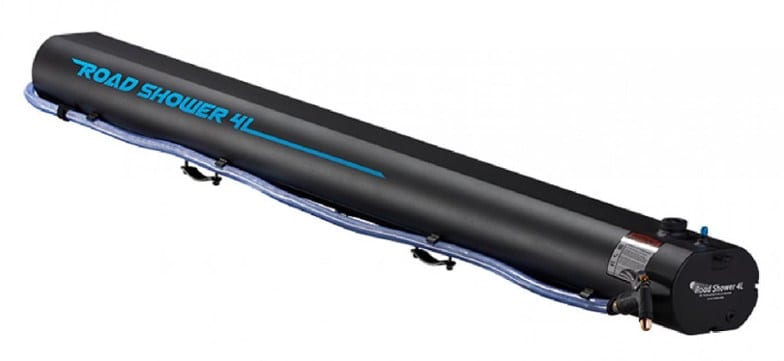
The Yakima RoadShower is a reservoir designed to be mounted onto a vehicle or trailer. The sun can heat the water, while pressurization is carried out—following the provided instructions—using a water supply or an air pump connected to the designated valve. Select the appropriate capacity and mounting hardware for your specific model, ensure you stay within the vehicle’s load limits, and always check the water temperature before use.
This system is particularly well-suited for those who frequently travel by vehicle—such as converted vans, motorhomes, or off-grid trailers. It requires the addition of a compatible showerhead (Yakima offers a dedicated accessory). A makeshift alternative can also be created using a container with holes—see the video below.
An aluminum build, featuring brass connectors and a stainless-steel mount, offers greater durability than plastic alternatives. Reliance on solar heating is the primary limitation in regions with low sunlight during the winter months.
Building your own off-grid shower
For a permanent or semi-permanent setup, constructing a custom system offers the best durability and adaptability to local resources. The cost is generally lower than that of equivalent commercial solutions.
Basic principle
A system with an elevated tank requires a structure designed to support the total weight of the water and equipment. Each liter adds approximately one kilogram, excluding the weight of the container itself. Height generates hydrostatic pressure, though flow rate is also influenced by the plumbing and any potential restrictions. Ensure that supports and mounting hardware are designed to prevent the system from falling, leaking, or tipping over.
Heating the water
- Heating: select a device and a container specifically designed for this purpose; Do not heat a closed container or create an improvised pressurized vessel over a fire.
- Propane tankless water heater connected to the tank outlet
- Solar-powered pump to fill an elevated tank during the day—gravity-fed pressure available in the evening
- Electric immersion heater (if an electricity source is available)
Greywater management
- Drainage trench directing water toward a garden bed or vegetated area
- Drainage pit (sump) for frequent use or households with multiple people
- Choose appropriate hygiene products; do not interpret the label "biodegradable" as permission to discharge them into the soil or water.
- Consult your municipality and relevant authorities regarding wastewater collection and treatment systems, as well as any applicable site-specific regulations or required permits.
For detailed resources on collecting and storing water to supply your system, see our articles on rainwater harvesting and choosing storage barrels.
How to choose based on your situation
Selecting an off-grid shower solution depends on several factors that should be evaluated before making a purchase or beginning construction.
Questions to consider
- How many people will be using the shower daily?
- What water source is available (well, stream, rainwater harvesting)?
- What energy source is available for heating (solar, wood, propane, electricity)?
- Should the system be portable or stationary?
- What is the average level of sunlight in the region across all seasons?
- Is there an adequate drainage system in place, or does one need to be provided?
- What is the available budget—covering purchase, installation, and maintenance?
Recommendations by use case
- Occasional camping, limited budget: bucket shower with battery-powered pump
- Long-term camping, with access to sunlight: high-quality solar shower (e.g., Advanced Elements)
- Camper van or mobile vehicle setup: Yakima RoadShower or equivalent
- Mobile camping, prioritizing comfort: all-in-one portable system (e.g., Geyser Systems)
- Permanent off-grid installation: propane tankless water heater or a DIY system with an elevated tank
Summary
Bucket shower
- Cost: low to medium
- Heat source: flexible
- Use case: camping, emergencies, temporary setup
- Limitation: water volume must be heated manually
Solar shower
- Cost: low to medium
- Heat source: sunlight only
- Use case: summer camping, sunny regions
- Limitation: gravity-fed pressure, weather-dependent
Tankless water heater
- Cost: factor in the price of compatible equipment, installation, safety features, and maintenance based on current market rates.
- Heat source: propane or electricity
- Usage: permanent off-grid installation
- Limitation: additional components required
Portable with water heater
- Cost: medium to high
- Heat source: 12V
- Usage: mobile camping, short trips
- Limitation: modest pressure, battery required
Vehicle-mounted shower
- Cost: high
- Heat source: solar (while on the move)
- Usage: van, trailer, off-grid vehicle
- Limitation: fixed to the vehicle, dependent on solar energy
DIY build
- Cost: variable (generally lower than commercial equivalents)
- Heat source: user's choice
- Usage: permanent installation, adapted to local resources
- Limitation: construction time, skills required
Frequently Asked Questions
How much water is needed for an effective off-grid shower?
A "military-style" shower (getting wet, turning off the water, soaping up, rinsing off) uses between 4 and 8 liters. A comfortable shower with a moderate flow rate uses 10 to 15 liters for 5 minutes. All-in-one systems, such as Geyser Systems, use as little as 4 liters per session thanks to their precise control valve. A bucket shower with a battery-powered pump allows for about 7 minutes of use with 9.5 liters (2.5 gallons). Planning your consumption based on available reserves is the most critical factor for a sustainable installation.
Do solar showers work in Quebec during the winter?
In practical terms, no. In Quebec, winter sunlight—both in terms of intensity and duration—is insufficient to effectively heat a solar shower bag to a comfortable temperature. Even in autumn and spring, frequent cloudy days make this an unreliable solution. For year-round use in Quebec, systems that rely on heat sources other than the sun (such as propane, wood, or electricity) are far better suited. Solar showers remain a practical option for summer outings or for regions with high levels of sunshine.
Is a permit required to build a permanent outdoor shower in Quebec?
Present your project to your municipality before beginning construction. Requirements vary based on factors such as the structure, utility connections, the site itself, and wastewater management. An outdoor shower is not automatically exempt from permit requirements, and simply maintaining a distance of thirty meters does not authorize the discharge of wastewater directly onto the ground. The setup must comply with all regulations applicable to its specific configuration.
What kind of soap should be used for an off-grid shower that drains directly onto the ground?
Choosing a specific type of soap does not eliminate the need to manage greywater. Even biodegradable products can impact aquatic environments and should never be poured directly into a watercourse. Plan for the collection, treatment, or authorized disposal of wastewater, taking into account the location, frequency of use, and local regulations.
Can a propane water heater be used indoors?
A camping water heater designed for outdoor use must remain outdoors and be installed according to its manual, respecting the required distances and clearances. A window, a fan, or a partially open shelter does not make such a unit suitable for indoor use. For permanently installed indoor equipment, have a qualified professional verify the model, certifications, combustion process, and gas venting.
Rainwater harvesting
Ideas and systems for collecting and storing rainwater—a direct supply source for off-grid showering.
Choosing rainwater barrels
Capacity, materials, and taps: how to select the right containers for an off-grid water system.
Essential needs during a crisis
Water, food, and hygiene: health priorities to maintain during a prolonged disruption of standard services.