
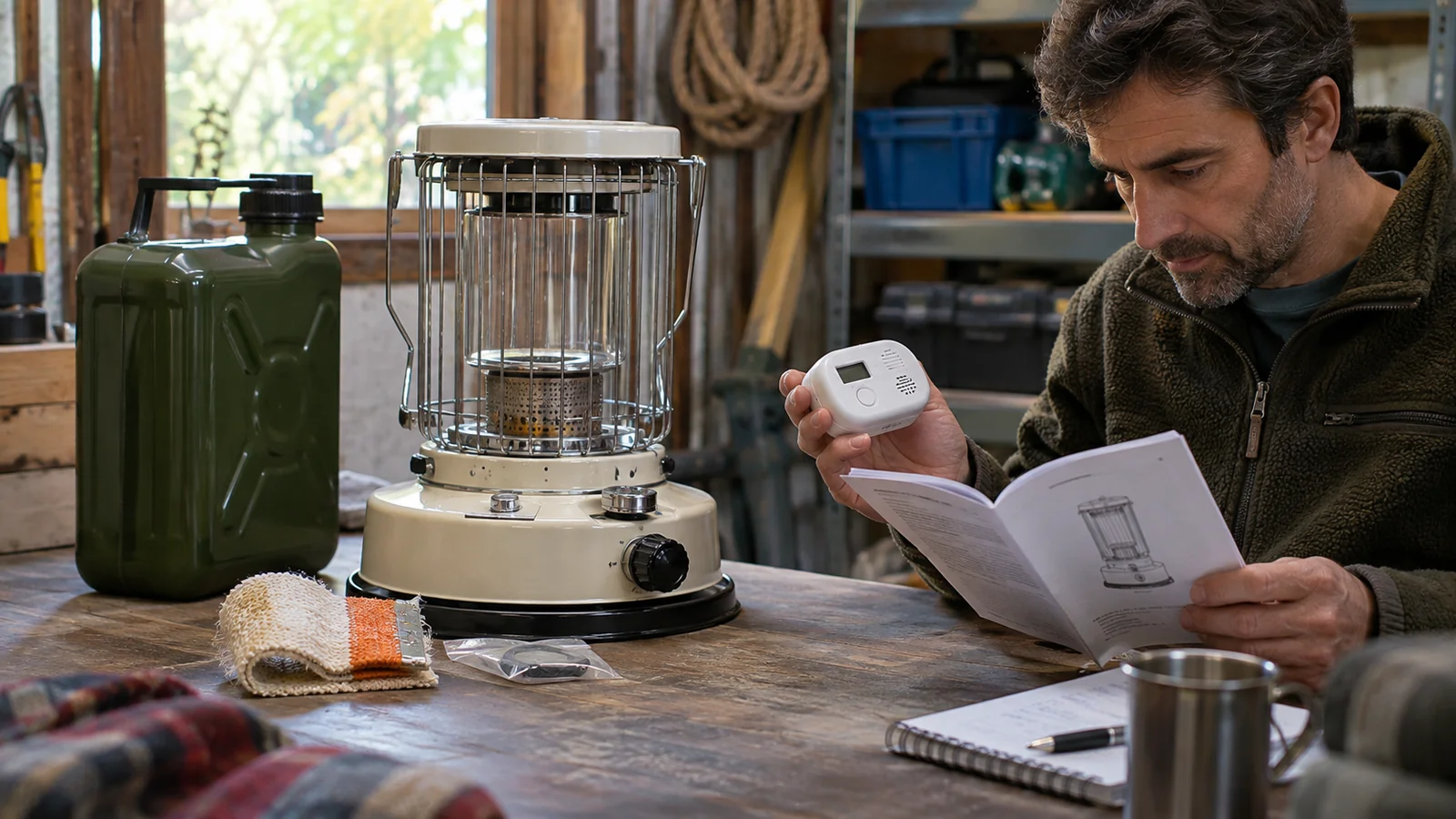
In this article
During a winter power outage, a kerosene space heater can keep a room liveable for hours or even days. It is one of the few heat sources that depends on neither the power grid nor natural gas, and it remains relatively simple to use. But it is also a combustion appliance: poorly chosen, poorly maintained or run on the wrong fuel, it can produce smoke, odours and carbon monoxide, or start a fire.
This guide brings together what you need to know to include a kerosene heater in your preparedness: how it works, how to choose one, how to use it safely indoors, how to maintain and replace the wick, and how to store and assess the kerosene itself. Your appliance’s manual remains the reference: it always takes precedence over general advice.
In brief
In brief. A kerosene heater is useful in a prolonged outage, provided you choose a model certified for the intended use, with automatic tip-over shut-off, and use it with a carbon monoxide detector, adequate ventilation and a fire extinguisher close at hand. Use only clear 1-K kerosene, stored in a labelled container away from heat and renewed regularly. Maintain the wick according to the manual and keep a compatible spare. Never refuel indoors or while the heater is hot.
How a kerosene heater works
The principle is simple: a fibreglass or cotton wick draws kerosene up from the tank by capillary action. The fuel vaporizes at the tip of the wick, where it burns in a combustion chamber designed to produce a clean flame. The heat is then spread in one of two ways, depending on the model:
- Radiant heaters directly warm the people and objects in front of them, like the sun. They suit a room or a zone.
- Convection heaters, often cylindrical, warm the air, which then circulates through the room. They are better for a larger space.
There are also forced-air units, very powerful and fitted with an electric fan, but they are designed for construction sites, garages or well-ventilated farm buildings, not for the inside of an occupied home.
| Advantages | Drawbacks |
|---|---|
| Works without electricity (except some battery igniters) | Produces carbon monoxide and water vapour |
| Fast, substantial heat for one room | Odour when lighting and shutting off |
| Fuel relatively stable and less volatile than gasoline | Fire risk if tipped over or misused |
| Simple appliance without complex parts | Wick maintenance required |
| Several hours of runtime per tank | Indoor use restricted by manufacturers and sometimes by local regulations |
Choosing a kerosene heater
Essential safety features
- Automatic tip-over shut-off: the flame goes out if the heater is knocked over.
- Recognized certification (for example CSA or ULC in Canada, UL in the United States) and a clear statement of intended use: indoors, outdoors or ventilated buildings.
- Match-free ignition (battery or piezo), safer than an open flame.
- Protective guard around the hot zone, especially with children or pets.
- Fuel gauge, so you do not refuel blindly.
Heat output (BTU)
Output is expressed in BTU per hour. A small radiant unit of about 10,000 BTU/h suits one room, while a 20,000 to 25,000 BTU/h model can heat a larger open space. More powerful is not necessarily better: an oversized heater uses more fuel, produces more combustion gases and requires more ventilation. In an outage, the realistic goal is often to keep a single room warm, where the whole family gathers.
| Approximate output | Typical use | Note |
|---|---|---|
| About 10,000 BTU/h | A bedroom or small living room | Often radiant, moderate consumption |
| About 20,000 to 25,000 BTU/h | Open room, ground floor | Often convection, more ventilation |
| Over 30,000 BTU/h | Garage, workshop, site | Generally not intended for occupied rooms |
Runtime and how much fuel to plan
Consumption depends on output and setting. As a rough guide, a heater of about 10,000 BTU/h often burns around 0.3 L (about 0.08 gal) of kerosene per hour at full output, and a tank of a few litres provides about ten hours. Your model’s manual gives exact figures. To estimate your reserve, multiply hourly consumption by the hours of heating you plan per day, then by the number of outage days you are planning for, keeping in mind that you rarely heat continuously. A modest reserve renewed each season is better than a large stock that ages.
| Sample calculation | Value |
|---|---|
| Consumption at full output (check the manual) | 0.3 L/h (about 0.08 gal/h) |
| Hours of heating per day, in periods | 8 h |
| Outage duration planned | 3 days |
| Approximate reserve | 0.3 × 8 × 3 = 7.2 L (about 1.9 gal) |
Before buying: a few checks
- read the manual online before buying to check intended indoor use and ventilation requirements;
- check that replacement wicks are available for that exact model;
- call your insurer to learn its conditions;
- ask your municipality or fire department about local regulations;
- plan where you will store the heater and fuel off-season.
Using a kerosene heater safely indoors
The question comes up every winter: can you use a kerosene heater in the house? The answer depends on the appliance, the manual, municipal regulations and your insurer. Some models are designed for indoor use with adequate ventilation; others are not. Check these three sources before the outage, not during it.
Carbon monoxide
All combustion produces carbon monoxide (CO), a colourless, odourless gas. A well-tuned appliance produces little, but a dirty wick, poor fuel or a room that is too closed off push concentrations up. Symptoms of poisoning (headache, nausea, dizziness, drowsiness, confusion) can be mistaken for the flu. A battery-powered CO detector, installed in the room and near bedrooms, is essential. If it sounds, get everyone out into fresh air immediately and call 911.
The basic rules
- open a window or door slightly to bring in fresh air, as the manufacturer recommends;
- keep at least 1 m (about 3 ft) of clearance around the heater: curtains, furniture, bedding, papers;
- place it on a flat, stable surface, away from walkways;
- never leave it running unattended or while sleeping;
- keep children and pets away;
- keep a multipurpose (ABC) fire extinguisher within reach;
- never dry clothes on or near the heater.
Refuelling
Refuelling is the most delicate moment. Turn the heater off, let it cool completely, then refuel outdoors or in a well-ventilated area away from any flame, using a siphon pump. Do not fill past the maximum level: kerosene expands as it warms. Wipe up any spill before relighting.
Cleaning up a spill
If you spill kerosene, ventilate the room, keep ignition sources away, absorb the liquid with cat litter, sawdust or rags, then place these materials in a closed metal container outdoors until you can take them to a household hazardous waste depot. Then wash the surface with soapy water. Lingering odours usually disappear with good ventilation.
Smoke and odours
A slight odour when lighting and shutting off is normal. Black smoke, an irregular flame or a persistent odour indicate a problem: wick height set incorrectly, a dirty wick, contaminated fuel or the wrong type of fuel. Turn the heater off and fix the cause before continuing.
Maintaining and replacing the wick
The wick is the heater’s wear part. A wick in poor condition causes smoke, odours, hard lighting and irregular burning. But poor combustion does not automatically mean the wick must be replaced: it is often just dirty.
Fibreglass or cotton wick: not the same thing
| Fibreglass | Cotton | |
|---|---|---|
| Durability | High | Lower |
| Cleaning by dry burn | Possible if the manufacturer allows it | Avoid: the wick burns away |
| Sensitivity to poor fuel | Medium | High |
| Common use | Most recent heaters | Older heaters or certain models |
On some heaters with fibreglass wicks, the manufacturer provides for a dry burn: you let the heater burn off all its fuel, in a safe, ventilated place, to burn away deposits built up on the top of the wick. Only do this if your manual describes it, and never with a cotton wick. The old rule of a “half-inch” flame is not universal: the height, colour and shape of a normal flame depend on the burner. The manual remains the reference.
How often to clean and replace?
A well-maintained wick can last more than one season. Inspect it at the start of each winter and after any episode of poor burning. Replacement becomes worthwhile when maintenance no longer restores normal combustion, when the wick is torn, hardened or shortened, when it no longer moves up and down properly, when it has been contaminated by water or poor fuel, or when the manufacturer recommends it. Keeping a compatible spare wick costs little and can put back into service an appliance you may truly need.
Replacing a wick, step by step
The procedure varies by model; here is the general logic, to adapt according to the manual.
- Identify the exact model (rating plate) and buy the matching wick: an “almost compatible” wick burns poorly.
- Turn the heater off and let it cool completely.
- Drain or manage the fuel according to the manual, outdoors.
- Remove the igniter batteries if there are any.
- Remove the outer casing and the combustion chamber.
- Lower the wick fully, then remove the wick adjuster assembly.
- Note or photograph the position of the old wick before removing it.
- Use the disassembly to inspect and clean the heater (deposits, seals, tank).
- Install the new wick in the same position, straight and even all the way around.
- Check that it moves up and down freely, then reassemble the heater.
- Fill with clean kerosene and let the wick soak for the time stated by the manufacturer (often at least an hour) before the first lighting.
- Do the first lighting outdoors or in a very well-ventilated place, and watch the flame.
The fuel: choosing, assessing and storing kerosene
Fuel quality is decisive. Contaminated or unsuitable kerosene clogs the wick, produces smoke and odours and increases emissions.
Which kerosene to use
Use only clear 1-K grade kerosene sold for heaters. Never use gasoline, diesel, heating oil, naphtha or lantern fuel not specified by the manufacturer: these products can cause dangerous combustion or even a fire. Buy small quantities that match your real consumption.
Recognizing contaminated kerosene
- Cloudy or milky appearance: often a sign of water.
- Unusual colour: yellowing, darker tint.
- Abnormal odour: rancid, sharp, different from usual.
- Water or sediment at the bottom of the container.
Water gets in through condensation, especially when the container is stored in a garage or shed subject to temperature swings, or when it is poorly closed. Removing the bottom layer does not guarantee the rest is clean, and filtering through a coffee filter removes particles, not dissolved water or degradation products. Mixing doubtful old kerosene with new does not solve the problem: it just dilutes the contamination.
Can you use old kerosene?
Kerosene a few months old, kept in a good closed container away from heat and light, generally remains usable. Beyond a season or two, or at the slightest abnormal appearance, doubt has value: it is better to replace it. Even perfectly clear old kerosene may have lost some of its qualities. If a wick has soaked in bad kerosene, drain the heater, do a dry burn if the manufacturer allows it, or replace the wick.
Storing kerosene properly
- a certified, clearly labelled container (in North America, kerosene cans are often blue);
- never a container previously used for gasoline;
- cap tightly closed, out of the sun, away from heat and large temperature swings;
- storage outside the occupied home, in a ventilated place away from ignition sources;
- purchase date written on the container, and stock rotation rather than accumulation over years;
- regular inspection for leaks and deterioration.
Respect quantity limits set by your municipality and insurer. Used or contaminated kerosene should not be thrown away: take it to a household hazardous waste depot. For storing other fuels, see storing fuel safely.
- Check the heaterIntended indoor use, tip-over shut-off, wick in good shape.
- Renew the fuelClear 1-K kerosene, dated, in small quantities.
- Set up safetyBattery CO detector, ABC extinguisher, 1 m of clearance.
- Plan the partsSpare wick, igniter batteries, siphon pump.
- Do a test runTest lighting in the fall, in a ventilated place.
The kerosene heater in an outage plan
A space heater does not replace an overall strategy. In a winter outage, gather the family in a single room, preferably in the centre of the house, seal drafts, layer clothing and use sleeping bags and blankets. The heater is there to keep that room warm, in periods, rather than to heat the whole house. If the outage drags on and the indoor temperature drops dangerously, municipal shelters remain a safe option. See ice storms and household needs and preparing for a heating outage in winter, as well as fire prevention.
The most common mistakes
| Mistake | Risk | Good practice |
|---|---|---|
| Refuelling while hot or indoors | Fire, fumes | Turn off, let cool, refuel outside |
| Using another fuel | Uncontrolled combustion | 1-K kerosene only |
| Closing every window | Carbon monoxide buildup | Fresh air supply per the manual |
| Sleeping with the heater on | Poisoning, fire | Turn off before sleeping |
| Keeping kerosene for years | Poor combustion, smoke | Small quantities, rotation |
| Placing it near curtains or a bed | Fire | At least 1 m (3 ft) of clearance |
| Forgetting the CO detector | Undetected poisoning | Battery detector in the room and near bedrooms |
Frequently asked questions
Can you use a kerosene heater in a house?
Only if the appliance is designed for that use according to its manual and certification, if local regulations and your insurer allow it, and with adequate ventilation, a carbon monoxide detector and a fire extinguisher. Never leave it running unattended or while sleeping.
How long does kerosene keep?
A few months to a season or two in a suitable, tightly closed container away from heat. Beyond that, or if it is cloudy, discoloured or smells bad, it is better to replace it and take it to a hazardous waste depot.
Why is my heater smoking?
The most common causes are incorrect wick height, a dirty or worn wick, contaminated kerosene or the wrong fuel. Turn the heater off and check the manual before relighting.
Should you change the wick every year?
No. A well-maintained wick can last more than one season. Replace it when it is damaged, contaminated, no longer moves properly or when maintenance no longer restores normal combustion. Keep a spare.
Can you use gasoline or diesel in a pinch?
No, never. These fuels can cause uncontrolled combustion and a fire. Use only 1-K kerosene or the fuel specified by the manufacturer.