
In this article
A major storm is forecast for this evening. A flood threatens your neighbourhood. A wildfire is moving toward the city. You have just heard the alert on the radio or your phone, and you have a few hours before you need to shelter in place or leave. What do you do first? Should you rush to the supermarket, and if so, to buy what?
Practising imagining this kind of situation in detail is a good preparedness exercise. This guide offers a method for using those few hours in a useful and safe way: first the actions that matter most, then the purchases, with lists suited to your level of preparedness, and the pitfalls to avoid.
In brief
In brief. When a crisis is announced a few hours in advance, the priority is not the store: it is the family’s safety, getting everyone together, filling the gas tank, storing tap water, charging devices and getting ready to leave or shelter in place. Last-minute shopping comes only after that, if it is safe, with a list prepared in advance and without excessive stockpiling. The best preparation is still the one done in quiet times.
The scenario
Authorities generally recommend staying home during a crisis, unless your home becomes dangerous or an evacuation is ordered. Let us imagine the crisis has begun, or is imminent: an official announcement has just been made, and you know you still have a few hours before you need to be sheltering at home or far from the affected area.
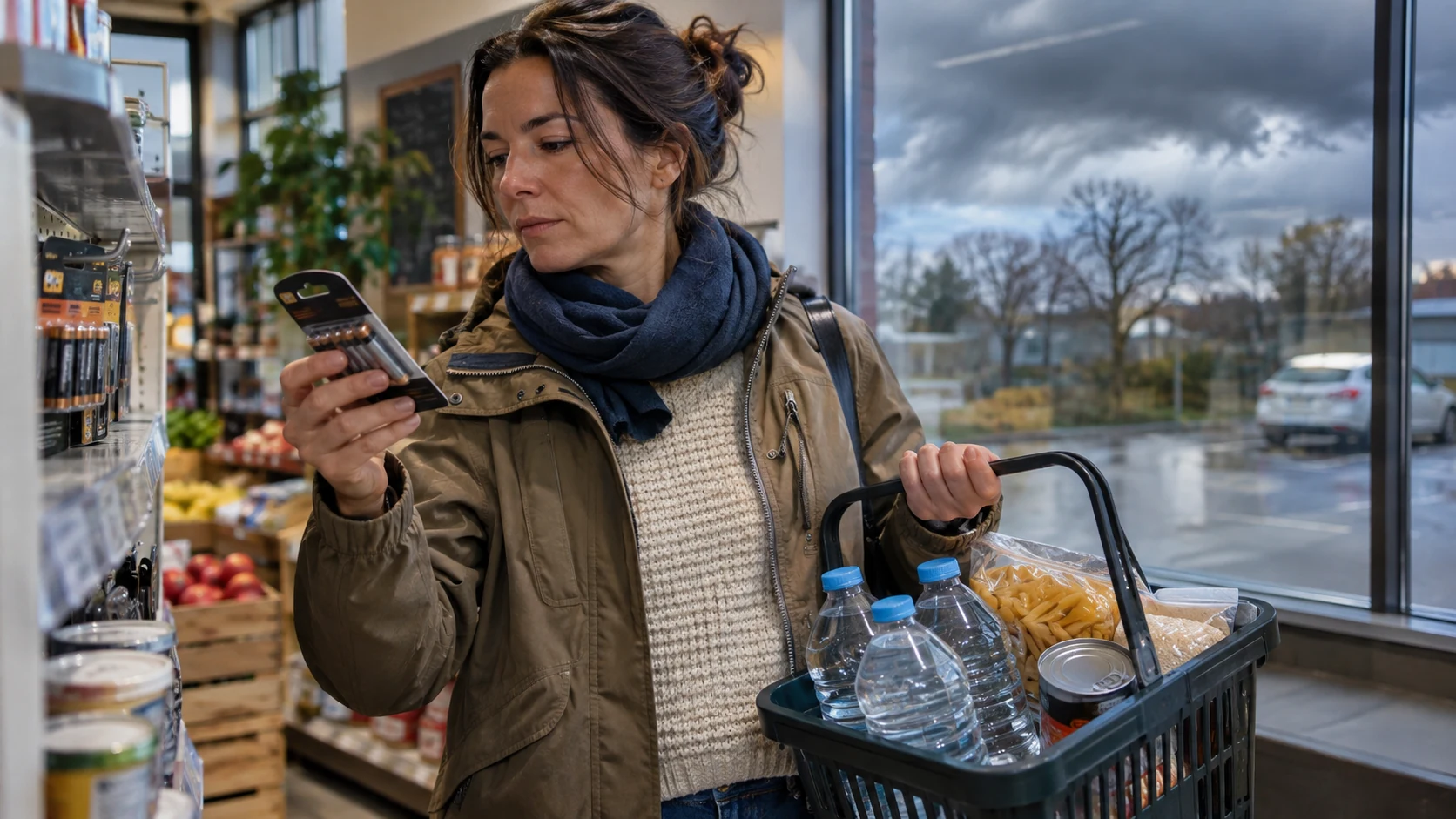
Suppose you have time to go to the store and it is safe to do so. That is an important assumption: as a crisis approaches, stores can be packed, lines long and tension palpable. But let us say the nearest supermarket is calm, you can afford a few purchases and the shelves are still stocked. What will you buy? And above all, what will you have done first?
Before the store: priorities for the first hours
Shopping should come only once the essentials are taken care of. Go to the store at the last minute only if the following are handled:
- The whole family is safe and together, or everyone knows where to go; the family plan is activated and the children are looked after.
- The home is ready for sheltering: outdoor items put away, windows closed, basement protected in case of flooding, documents gathered.
- The vehicle is ready: full tank, go bags in the trunk, route chosen, so you can leave within minutes if needed.
- Water is stored: one family member fills the bathtub, buckets and clean containers while you handle the rest.
- Devices are charged: phones, power banks, flashlights, radio.
- Communication works and everyone knows how to reach each other and the out-of-region contact.
- Vulnerable neighbours have been warned: an older person living alone may not have heard the alert.
For an evacuation, see our guide Evacuating a city: a timeline; to decide between leaving and staying, Evacuate or stay.
What to buy depending on how prepared you are
What you need to buy depends on the state of your preparations. If part of your supplies is at your fallback location while you have to stay home, you may be missing important items. If you are just starting out, you are probably missing essentials. If you are already well prepared, you will simply have a few useful extras to add. In every case, buy reasonable quantities: other families need these products too, and authorities ask people to avoid panic buying, which empties shelves and creates shortages.
Scenario A: you are missing essential items
In this case, a list prepared in advance is your best ally. Under stress, many people find it hard to think clearly and forget important things: keep a written list on your phone and on paper. Focus on:
| Category | Priority items |
|---|---|
| Water and food | Bottled water; long-life canned goods; ready-to-eat foods that need no cooking; some fresh food to eat over the next few days |
| Health | Regular medications (if a prescription can be refilled), bandages of all sizes, antiseptic, pain relievers such as acetaminophen or ibuprofen, hand sanitizer |
| Lighting and power | Flashlights, headlamps, LED lanterns, batteries in various sizes, a power bank |
| Hygiene | Toilet paper, menstrual products, diapers, heavy-duty garbage bags (for waste and an emergency toilet) |
| Pets | Food and litter for several days |
| Vehicle | Fuel, washer fluid and, if you know how to use them, a few fuses and hose clamps |
| Home | Tarp, duct tape, cord, plywood or panels if you need to protect windows from wind |
If you may not be able to cook for a while, also plan ready-made meals for that evening. And if stores are still delivering, having some items delivered saves you a trip.
This looks like an ordinary preparedness list, and it is. That is exactly why it is better to complete it beforehand: our 72-hour kit checklist helps you do so in quiet times.
Scenario B: you are already stocked up
Congratulations: the essentials are done. If you have time to go to the store and it is safe, you can add useful items, keeping quantities reasonable:
- fresh or perishable food to eat over the next few days, to delay dipping into your supplies;
- extra water, juice, rehydration drinks;
- a few comfort foods, such as chocolate or the children’s favourite snacks, which are valuable for morale;
- hardware items for small repairs: tape, a tarp, screws, basic tools;
- insulation or extra blankets if a winter outage is forecast;
- items that are hard to find after a prolonged event: batteries, freezer bags, jars and lids for preserving, coffee filters for pre-filtering water;
- printed guides on first aid or self-reliance, if you do not have any, to keep that knowledge accessible without electricity.
Some guides also recommend buying alcohol or tobacco for bartering. In the vast majority of real situations, crises last a few days or weeks, and mutual aid, cash and organized services play a far bigger role than bartering. It is better to spend your budget on essential needs. As for expensive equipment, such as a chainsaw or a generator, it cannot be improvised at the last minute: using it requires training and significant precautions.
The dangers of last-minute shopping
Going to the store a few hours before a crisis carries risks you should weigh before leaving:
- the store may be packed or become so within minutes, with long checkout lines;
- you may run out of time for more important tasks, such as gathering the family or preparing the house;
- tensions can arise over the last products: if the atmosphere deteriorates, give up and leave;
- rushing behind the wheel increases the risk of a crash;
- the store may already be closed or the shelves empty, wasting precious time;
- roads may be closed or subject to checkpoints;
- the weather may deteriorate faster than expected and catch you on the road.
If any of these risks is present, the best decision is often to skip the shopping and make do with what you have. That moment is exactly what you prepare for in advance.
A sample schedule for the last three hours
| Time | Person A | Person B |
|---|---|---|
| H-3 | Follows official instructions, alerts the family and the out-of-region contact | Picks up the children from school or daycare according to the plan |
| H-2:30 | Fills up the vehicle and puts the bags in the trunk | Fills the bathtub, buckets and water containers |
| H-2 | If it is safe, goes to the store with the prepared list | Puts away outdoor items, closes windows, charges devices |
| H-1 | Comes home, puts purchases away, checks the radio and lighting | Checks on vulnerable neighbours |
| H-0 | The whole family is sheltering or on the way to the fallback location, according to the instructions | |
For a person living alone, the order is the same: safety and regrouping first, then water and power, and shopping only if there is time left.
A final word
Even when well prepared, you can use a few hours’ notice to usefully top up your supplies. But the main message of this exercise lies elsewhere: the more you have prepared in quiet times, the less of those precious hours will be spent at the store, and the more they can go to your family, your home and your neighbours. Buy reasonably, think of others, and never put yourself in danger for a basket of groceries.
Prepare your list today
Take fifteen minutes this week to write your own last-minute list, organized by aisle in your nearest store: you will save precious time when the day comes. Add the tasks to do at home, how they are shared among household members and useful numbers. Keep a paper copy with your emergency kit and another in the vehicle. Review it every season.
Frequently asked questions
Should you withdraw cash before a crisis?
Some cash is useful, since payment terminals do not work without power or network. Keep some in your emergency kit at all times rather than lining up at the ATM at the last minute.
Is panic buying really a problem?
Yes. When many people buy large quantities at the same time, shelves empty and less well-off families, or those who arrive later, end up with nothing. Supply chains generally keep up if everyone buys normally. Authorities regularly ask people to avoid this behaviour.
What if I do not have time to go to the store?
Focus on what costs nothing: filling containers with water, charging devices, gathering the family, preparing the home or the departure. With water, some food from the pantry and a flashlight, most households can get through a few difficult days.