
In this article
- Clothing is already part of your shelter
- We dress for the outdoors… but much less for everyday life
- The problem isn’t the flip-flop: it’s the context
- First criterion: can you run in them?
- Second criterion: does the shoe really protect the foot?
- Third criterion: can you walk a long way in them?
- Fourth criterion: will they last long enough?
- High heels raise the same context problem
- At work: think “getting home”
- In the car: useful, but not as the only solution
- Motorcycle: a completely different logic
- And on a plane?
- A safety shoe isn’t necessarily a tactical boot
- For children too
- And in a Quebec winter?
- A backup pair at the office: probably the best compromise
- Test rather than assume
- Do you need to be able to walk 500 km (310 mi)?
- Mobility is a resilience capability
- Conclusion: think about your feet before you need to walk
- Frequently asked questions
- Further reading
- Sources and references
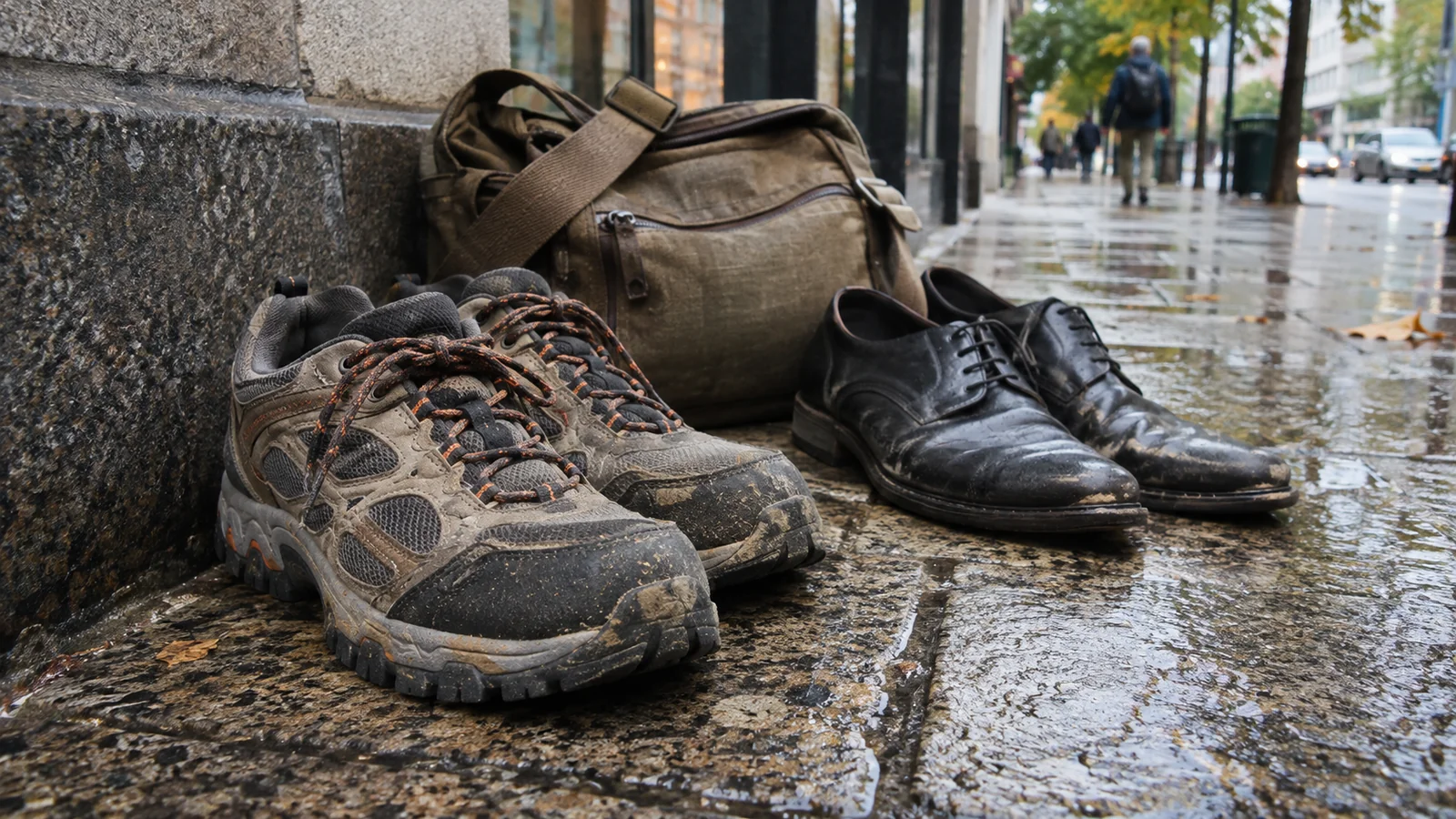
We often think about what goes in a go-bag, water, a radio or first aid. Much less about what we are already wearing when an emergency hits. Yet our shoes and clothes are the first layer of protection available: the one we have on us before we can even reach the rest of our gear.
There is obviously no need to wear hiking boots every day. On the other hand, understanding the limits of your shoes and planning a solution suited to your environment can make a real difference when you have to walk longer than expected, cross debris, face rain or cold, or simply get home another way.
The right question isn’t: “Are my shoes tactical enough?” It is much simpler: if my day doesn’t go as planned, how far will these shoes really take me?
Clothing is already part of your shelter
In many survival or outdoor situations, clothing is an essential part of your protection.
In a go-bag, several layers of clothing let you adapt to temperature, rain or an unexpected change in conditions.
This logic matches what we cover in our guide to cold-weather survival: warmth, shelter and first aid.
A piece of clothing obviously isn’t a building.
But it is the first barrier between the body and:
- cold;
- wind;
- rain;
- sun;
- abrasive surfaces;
- some debris;
- insects;
- the terrain.
Before you can use a shelter, you usually have to reach it. Clothes and shoes directly affect that ability to move.
We dress for the outdoors… but much less for everyday life
When we go hiking, the logic comes quite naturally.
We generally choose:
- shoes suited to the terrain;
- clothes that dry reasonably fast;
- sun protection;
- extra layers if the temperature may change;
- rain gear if the forecast calls for it.
In everyday life, we mostly choose based on:
- work;
- comfort;
- style;
- the current temperature;
- the planned activity.
That is perfectly normal.
But EDC (everyday carry) isn’t only about the items in your pockets or bag.
What you are wearing is also part of the gear immediately available to you.
The problem isn’t the flip-flop: it’s the context
You sometimes hear that you should ban flip-flops to be “prepared”. That isn’t really the right reasoning.
A flip-flop is perfectly suited to:
- the beach;
- the pool;
- a shared shower;
- a very short walk on a suitable surface.
It is much less suitable when you have to:
- walk several kilometres;
- run;
- move over uneven ground;
- cross debris;
- face the cold;
- protect your foot from sharp objects.
The Canadian Centre for Occupational Health and Safety uses exactly this logic for work footwear: footwear should be chosen according to the hazard present, including the risks of puncture, slipping, uneven ground, liquids or ankle injuries.
A shoe isn’t “good” or “bad” in absolute terms. It is more or less suited to the activity, the terrain and the possible consequences of something unexpected.
First criterion: can you run in them?
It is a deliberately simple question.
There is no need to imagine a run of several kilometres.
An emergency may simply require you to:
- leave a building quickly;
- cross a street;
- reach a child;
- get away from a hazard;
- go up or down several flights of stairs;
- walk fast to another means of transport.
With children, this can even become a game.
You can, for example, ask whether they could outrun a horde of zombies in the shoes they are wearing. Obviously, zombies aren’t the point.
But the question works particularly well with a child:
“Could you run in those without losing a shoe?”
It immediately turns a rather abstract concept — mobility in an emergency — into something concrete.
Second criterion: does the shoe really protect the foot?
Feet are particularly vulnerable because a relatively minor injury can quickly limit mobility.
CCOHS identifies hazards such as:
- sharp objects that can puncture the sole;
- materials that can cut the top of the foot;
- slippery surfaces;
- uneven ground;
- exposure to water;
- extreme temperatures.
In a normal environment, these hazards can seem remote.
After an accident, a fire, a storm or an evacuation, the environment may contain:
- broken glass;
- metal;
- branches;
- rubble;
- water;
- slippery surfaces;
- damaged stairs.
The goal isn’t to find a shoe that can handle everything.
It is to understand the level of protection needed in the scenario you have in mind.
Third criterion: can you walk a long way in them?
Many emergency scenarios don’t require running.
They can, however, involve more walking than planned.
Some realistic examples:
- public transit shut down;
- vehicle stranded;
- road inaccessible;
- neighbourhood evacuation;
- long wait at an airport;
- walking from work to another transport option.
Being able to walk comfortably for several hours is therefore probably a much more useful criterion than the theoretical ability to cover 500 km (310 mi) to get home.
A suitable shoe should ideally:
Stay on your foot
The heel shouldn’t keep slipping out and the foot shouldn’t slide around inside.
Already be comfortable
An emergency isn’t the best time to break in a new pair of shoes.
Match the terrain
A sole suited to the ground reduces, among other things, the risk of slipping.
CCOHS also recommends actually trying shoes on by walking in them, keeping enough room for the toes and making sure the heel and ankle are properly supported.
Fourth criterion: will they last long enough?
A shoe used for a single evening doesn’t need the same qualities as a pair meant to cover kilometres on a damaged road.
For a pair that also serves as a backup, look at:
- the quality of the sole;
- grip;
- how the sole is attached to the shoe;
- the condition of the stitching;
- toe protection;
- the general toughness of the material;
- the condition of the laces;
- heel wear.
An old, extremely comfortable pair can seem ideal — right up until the sole starts coming off.
Preparedness therefore also means inspection.
High heels raise the same context problem
Like flip-flops, heels have their place in certain circumstances.
The problem arises when they are the only shoes available in a setting where a long walk becomes possible.
For someone who works in dress shoes or heels every day, a very simple solution is to keep a comfortable pair:
- at the office;
- in the car;
- in a locker;
- in a bag set aside for the purpose.
Redundancy lets you keep comfort and style in normal times without sacrificing mobility if things change.
At work: think “getting home”
The workplace is particularly interesting because it is often where we spend the most time outside the home.
The question becomes:
if my usual way of getting around became unavailable today, would what I am wearing let me reach an alternative?
For many people, a simple pair of walking shoes kept at work solves the main problem.
Depending on the context, it can be complemented by:
- socks;
- a compact rain layer;
- gloves in winter;
- a small warm layer;
- water;
- a light.
This kind of preparation costs little and doesn’t affect your everyday professional dress.
In the car: useful, but not as the only solution
Keeping suitable shoes in the vehicle also makes sense.
But one question remains: what happens when you are separated from the vehicle?
The car may be:
- parked far away;
- stranded;
- inaccessible;
- in a locked garage;
- on the other side of an evacuated area.
The pair in the trunk is therefore an excellent second layer.
It doesn’t completely replace thinking about what you wear.
Motorcycle: a completely different logic
Motorcycling is simply an activity whose level of exposure calls for specific gear.
The SAAQ recommends boots that:
- cover the ankles;
- have non-slip soles;
- are water-repellent;
- are made of leather or abrasion-resistant textile;
- have appropriate reinforcements.
For motorcycle courses and practical road tests in Quebec, boots or closed shoes are among the required protective equipment; check the current requirements with the SAAQ or your driving school.
A flip-flop can make perfect sense on a beach and be completely unsuitable on a motorcycle. That is exactly why analyzing the context is more useful than a general rule about what people should wear.
And on a plane?
You sometimes read that you should keep your shoes on for an entire flight. I would be more nuanced.
There is no reason to keep your shoes on every minute of a long flight just out of fear of an accident.
A simpler approach is to:
- travel in shoes you can really walk in;
- know where they are;
- avoid cluttering the space with personal items;
- pay attention to the crew’s instructions;
- never slow down an evacuation to grab luggage.
The initial choice of shoe is still relevant: a travel day can involve kilometres of walking between terminals without any emergency at all.
A safety shoe isn’t necessarily a tactical boot
For everyday life, the best solution may well be:
- a good walking shoe;
- a hiking sneaker;
- a sturdy city shoe;
- a light boot;
- a work shoe with a suitable sole.
The word “tactical” adds no capability in itself.
What matters instead is:
| Criterion | Useful question |
|---|---|
| Support | Does the shoe stay properly on the foot? |
| Comfort | Can I walk for several hours in it? |
| Grip | Does the sole suit the expected surfaces? |
| Protection | Is the foot protected enough from the likely hazards? |
| Weather | Is it suited to the temperature and humidity? |
| Durability | Is it in good condition and sturdy enough? |
Choosing by scenario
| Scenario | Shoe often worn | Realistic backup |
|---|---|---|
| Office, transit shut down | Dress shoes, heels | Broken-in walking shoes at the office, socks |
| Building evacuation | Slippers, sandals | Closed shoes by the door or the bed |
| Vehicle breakdown in winter | City ankle boots | Real insulated winter boots in the trunk |
| Air travel | Sandals, slip-ons | Walking shoes worn during the trip |
| Family outing, big event | Fashion shoes for kids | Well-fitted sneakers, spare socks |
| After a storm (debris) | Light sneakers | Boots with a rigid, puncture-resistant sole |
For children too
Children grow quickly, which makes it harder to keep a perfectly fitted backup pair for long.
But the principle still applies during:
- an excursion;
- a hike;
- a trip;
- a day at a big event;
- a family outing far from home.
The question can stay very simple:
“Can you walk, run and play properly in those shoes?”
That is far more useful than asking the child to think in terms of disaster.
And in a Quebec winter?
Winter changes priorities considerably.
A shoe that is comfortable for walking in a shopping centre can become completely inadequate at -20 °C (-4 °F) on a snowy road.
Depending on your activities, you then need to consider:
- insulation;
- moisture;
- grip on snow and ice;
- boot height;
- room for thicker socks;
- the expected exposure time.
In a car used in winter, keeping a real pair of boots is often a much more useful measure than several emergency gadgets.
A backup pair at the office: probably the best compromise
For someone whose work requires shoes poorly suited to a long walk, this is the solution I would pick before any other:
Mini mobility kit at work
- A pair of shoes you have already tested
- A pair of socks
- A compact rain layer
- A small layer suited to the season
- A bottle of water
- A small light
- A power bank
It isn’t a spectacular “survival kit”.
But if transit shuts down and you have to walk 5 or 10 km (3 to 6 mi) to another option, it meets a concrete need.
Test rather than assume
There is an extremely simple way to find out whether a shoe works:
walk in it.
- Wear it for a full day.
- Deliberately walk a few kilometres.
- Try stairs.
- Notice the friction points.
- Check grip on different surfaces.
- Inspect the shoe after use.
A shoe marketed as “outdoor”, “tactical” or “performance” may suit your foot less well than a much simpler pair.
The shoe that actually works on your feet is worth more than the one that looks perfect on a spec sheet.
Do you need to be able to walk 500 km (310 mi)?
No.
For everyday preparedness, it is much more reasonable to think in stages:
- 1 km (0.6 mi);
- 5 km (3 mi);
- 10 km (6 mi);
- a day of walking;
- then more if your particular context really justifies it.
Someone who works 3 km (2 mi) from home doesn’t have the same needs as someone who regularly travels hundreds of kilometres for work.
Once again, the scenario should determine the gear.
Mobility is a resilience capability
We often talk about reserves of water, energy or food.
But being able to move is also a resource.
A bad blister, a sprain, a wet foot in winter or a sole coming loose can quickly reduce that ability.
That is why a suitable shoe has particular value:
it doesn’t solve the emergency.
It simply lets you keep moving while you deal with it.
Preparedness doesn’t mean dressing every morning as if disaster were about to strike. It means knowing the limits of your everyday gear and having a solution ready for when those limits could matter.
Conclusion: think about your feet before you need to walk
Shoes are probably one of the most underrated pieces of gear in everyday preparedness.
They are already on us.
They don’t need batteries.
They can work for thousands of steps.
And a good pair can let you leave a place, reach a loved one, get home or simply cross an environment that has temporarily become more difficult.
There is no need to give up sandals, heels, dress shoes or other choices suited to normal life.
Sometimes all it takes is adding a second option.
The best compromise isn’t to always wear the toughest shoe possible. It is never to be left without a solution when mobility suddenly becomes important.
Frequently asked questions
Do you need to wear boots every day to be prepared?
No. For most everyday situations, a comfortable, stable shoe you can walk properly in is enough. A more suitable pair can be kept at the office or in the vehicle when the context calls for it.
Are flip-flops bad in all circumstances?
No. They suit certain uses, especially around water. They simply offer little support and protection when the ground gets uneven or you have to run or walk a long way.
What shoes should you keep at the office for emergencies?
A shoe you have already worn and find comfortable, that allows several kilometres of walking and suits the season, is generally an excellent choice. In a Quebec winter, a real boot may be necessary.
Should motorcycle footwear cover the ankles?
The SAAQ recommends boots that cover the ankles and are designed to offer, among other things, good abrasion resistance and a non-slip sole. For certain practical courses and tests in Quebec, boots or closed shoes are part of the required equipment.
Why do shoes matter in a get-home bag?
Because a get-home plan based on walking first assumes your feet can handle the distance. If the shoes you wear at work are unsuitable, a backup pair can add more value than several specialized pieces of gear.
Further reading
See cold-weather survival, low-profile camping and IFAK first aid kit contents (for treating blisters and foot injuries).
Sources and references
- Canadian Centre for Occupational Health and Safety — choosing protective footwear by hazard, grip, puncture, terrain and foot support.
- Société de l’assurance automobile du Québec — helmets, clothing and protective boots for motorcyclists.
- Société de l’assurance automobile du Québec — protective equipment requirements during certain motorcycle courses and practical tests.