
In this article
- In brief
- 1. Tree anatomy: several layers, two useful ones
- 2. Nutritional value of inner bark
- 3. Medicinal uses: principles and limits
- 4. Where can you harvest? The rules
- 5. Species to favour in Quebec and eastern Canada
- 6. Harvesting: protect the tree
- 7. Preparation and cooking
- 8. Lichens and mushrooms: complementary resources, with caution
- 9. Practise before you need it
- 10. Key takeaways
- Frequently asked questions
- Further reading
- Sources
Disclaimer: this article is for information and household preparedness. It is not medical or nutritional advice. The medicinal uses described are documented traditional practices and do not replace a consultation. If you are unsure about identifying a species or about an interaction with a medication, ask a health professional, a pharmacist or a qualified botanist.
Tree bark is one of the least-known wild food resources. Yet its inner layers, the cambium and the phloem, were used for centuries by Indigenous peoples of North America and by northern European populations, as a fallback food in lean times and for traditional health uses.
Knowing which layer to harvest, from which tree, in which season and how to prepare it is the starting point for any serious use. Without that knowledge, bark is either useless (the outer layer is indigestible) or dangerous (some species are toxic). You also need to know the rules: you cannot strip bark from any tree, anywhere.
This guide covers tree anatomy, the real nutritional value of inner bark, the best-documented species in Quebec and eastern Canada, the ones to avoid, harvesting methods that spare the tree, preparation methods and the complementary resources of lichens and mushrooms, along with their limits.
In brief
In brief. Only two bark layers are useful: the cambium and the phloem, between the wood and the outer bark. White pine, maples, birch, spruce and balsam fir are the best-documented species; yew, wild cherries and horse chestnut must be avoided. Inner bark provides few calories: it is an emergency supplement, never a staple. Harvest preferably from branches or trees that are already down, never by girdling a trunk, and only where it is allowed. Medicinal uses, especially of willow, carry real contraindications.
1. Tree anatomy: several layers, two useful ones
A trunk is made of several distinct layers, grouped into three sets: the wood, the inner bark and the outer bark. From the inside out:
- Pith: the soft central core, of no food value.
- Heartwood: dead wood, often loaded with resins and tannins, that gives the tree its strength.
- Growth rings: one layer per year, which lets you date the tree.
- Rays: they move and store reserves sideways through the trunk.
- Sapwood: living wood that carries water and minerals from the roots to the leaves.
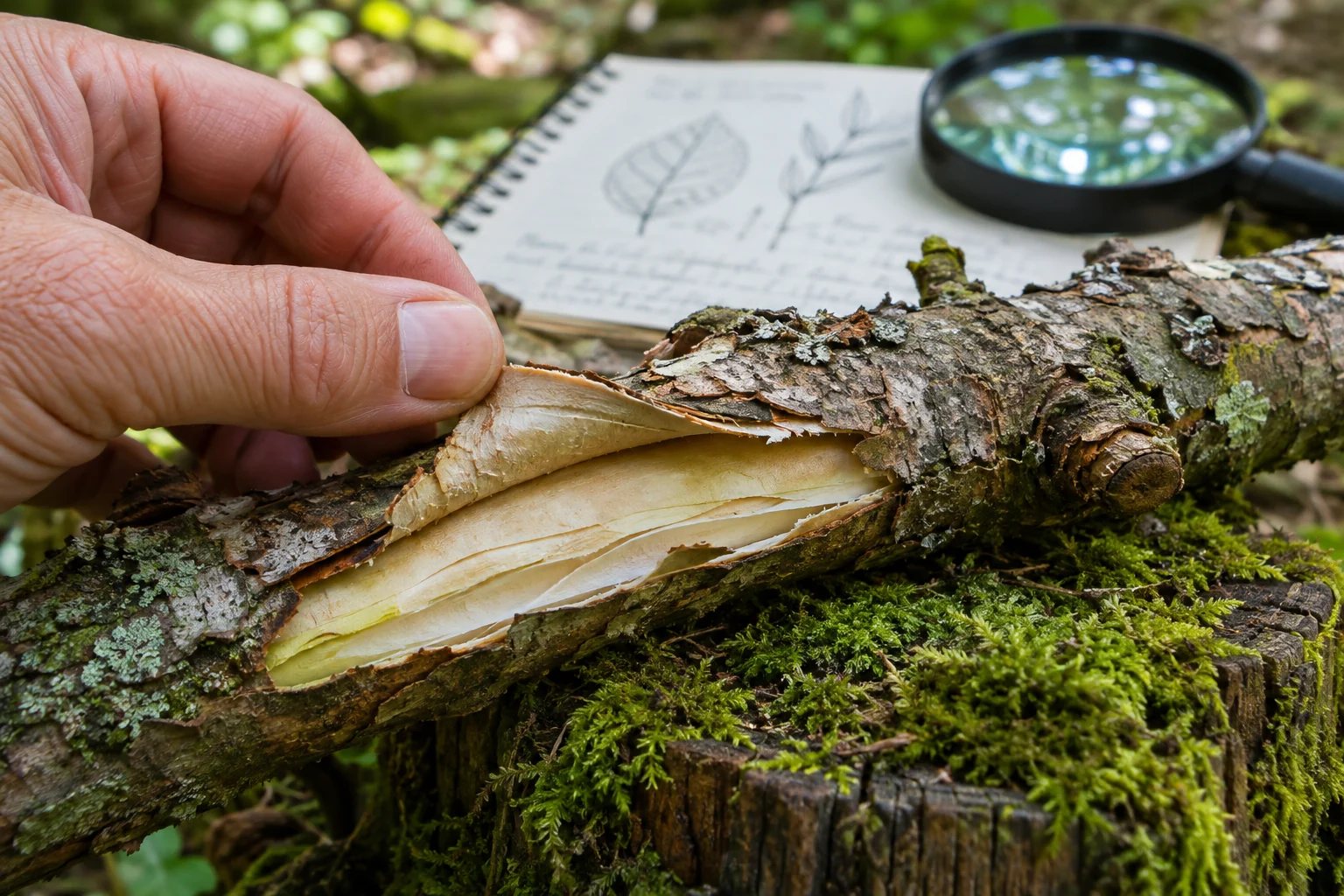
- Cambium: a very thin, moist, translucent layer responsible for growth in girth. It contains sugars and a little protein.
- Phloem (bast): a thicker, fibrous layer that carries sugar-rich sap down from the leaves. This is the layer most often dried for flour.
- Outer bark: dead tissue, mostly cellulose, lignin and suberin, which humans cannot digest.
The two useful layers are therefore the cambium and the phloem; in practice, “inner bark” usually means both together. The thin, moist cambium is scraped off the sapwood with the back of a blade or a spoon. The thicker phloem is separated from the outer bark by working flat with a knife. The outer bark is not eaten.
How easily the layers come apart depends heavily on the season. In spring, when the sap is running, they almost peel off on their own. In midwinter, they cling tightly, and the work is slow for little return.
2. Nutritional value of inner bark
Analyses of pine inner bark, notably lodgepole pine (Pinus contorta) in western Canada and Scots pine in Scandinavia, show simple sugars (glucose, fructose, sucrose), fibre, a little protein and minerals such as potassium, magnesium and phosphorus. Fresh cambium also contains vitamin C, which explains its historical value at the end of winter, when fresh greens were scarce.
Be cautious about calorie figures, though. The numbers quoted in survival guides vary enormously and are not based on systematic nutritional analysis. What is certain is that the energy density of inner bark is low compared with ordinary foods, and much of its mass is water and poorly digestible fibre. Treat it as an emergency supplement, not a main food source.
In Scandinavia and Finland, people long dried and ground pine phloem into flour, usually mixed with grain flour in years of poor harvests. Bark bread, called pettuleipä in Finland, remains a symbol of famine years. Studies of these practices stress that it was crisis food, used to stretch supplies that were too thin.
Bitterness and tannins are the main drawbacks. Boiling with a change of water, drying and then baking, or adding maple syrup or honey all help. Worked into a recipe, bark flour is far more palatable than bark eaten on its own.
3. Medicinal uses: principles and limits
Traditional health uses of bark are often better documented than its food uses, thanks to the knowledge of North American Indigenous peoples, later taken up by Western herbal medicine. Two methods come up most often:
- Infusion (bark tea): small pieces of inner bark steeped or simmered for a few minutes in boiling water, for internal use.
- Poultice: moistened or mashed inner bark applied to intact skin and held in place with a clean cloth.
You will sometimes read that you can extract an “essential oil” by pressing the phloem. That is not accurate: essential oils are produced by distillation with proper equipment and are not made in the woods. Those that come from bark, such as birch oil, which is rich in methyl salicylate, are toxic when swallowed, even in small amounts, and especially dangerous for children. They must never be ingested.
General precautions. The concentration of active compounds in wild-harvested bark varies with the tree, the season and the preparation, so you cannot control the dose as you would with a standardized medicine. Start with small amounts. Do not give it to children, to people who are pregnant or breastfeeding, or to anyone taking medication, without professional advice. A bark tea never replaces treatment for an infection, a persistent fever or a wound that is getting worse.
4. Where can you harvest? The rules
Before even thinking about species, you need to know where harvesting is allowed. Stripping bark injures a tree, and trees are protected by law in many places.
- In Quebec: in Quebec’s national parks (the Sépaq network) and ecological reserves, damaging or removing vegetation is prohibited. On private land, you need the owner’s permission. On public land, forest management rules apply; check with the ministry responsible for forests before taking anything beyond a fallen branch.
- Elsewhere in Canada: in national parks managed by Parks Canada, regulations prohibit removing or damaging natural objects, including plants and trees. Provincial parks have similar rules.
- In France: taking anything from someone else’s forest, public or private, without permission is governed by the Forest Code, and local orders or the rules of national parks and reserves may ban it entirely. The Office national des forêts (ONF) can advise on state forests.
The simplest and most respectful way to practise is to use branches or trees that have already been cut: maintenance cutting on your own land, a blowdown after a storm with the owner’s agreement, or pruned branches. The cambium stays usable for a few days after cutting.
5. Species to favour in Quebec and eastern Canada
First rule: never harvest a tree you have not identified with certainty. A regional tree guide for Quebec and eastern North America is essential, and identification is harder in winter without leaves. The species below are those whose food or medicinal uses are best documented in northeastern North America.
Eastern white pine (Pinus strobus)
White pine is one of the most accessible trees in Quebec and Ontario, and its needles in bundles of five make it easy to recognize year-round. Several Indigenous nations used its inner bark as a famine food; the name Adirondack is often said to come from an Iroquoian word meaning “tree eaters.” Dried and pounded phloem makes a flour for blending, and an inner-bark infusion is a traditional remedy for sore throats and coughs. The flavour is milder in spring.
Spruce and balsam fir
Spruces (Picea) and balsam fir (Abies balsamea), widespread across the boreal forest, also have edible inner bark with a stronger resinous taste. Their main advantage is abundance. Their spring tips, rich in vitamin C, are often more pleasant to eat than the bark itself.
Willows (Salix spp.)
Willow is the best-documented medicinal tree. Its bark contains salicin, which the body converts into salicylate compounds with anti-inflammatory and pain-relieving effects. The World Health Organization and ESCOP, a European herbal medicine body, recognize willow bark extract for some kinds of pain, particularly low back pain, and clinical trials have studied its effect on moderate back and joint pain. White willow (Salix alba), introduced from Europe, is the reference species, but several native willows also contain salicin in variable amounts.
A historical note: willow is often described as the direct origin of aspirin. That is a simplification. Salicin from willow led to the isolation of salicylic acid in the 19th century; aspirin, or acetylsalicylic acid, was then developed in the laboratory, and its name refers to meadowsweet (formerly Spiraea), another plant rich in salicylates.
Contraindications. Willow bark is not recommended for people allergic to aspirin or salicylates, people with aspirin-sensitive asthma, children and teenagers (because of the risk of Reye’s syndrome linked to salicylates), during pregnancy and breastfeeding, or for people taking blood thinners or anti-inflammatories or who have an ulcer. Its effect on clotting is weaker than aspirin’s, but it is not zero.
Maples (Acer spp.)
Sugar, red and silver maples all have edible, slightly sweet inner bark, one of the most pleasant-tasting. In spring, the cambium can be chewed raw in small amounts. Maple is, of course, first and foremost a source of sap and syrup, which offers far more energy than its bark.
Birches (Betula spp.)
Birch inner bark was widely used in Scandinavia for flour. Dried, chopped and pounded, the phloem gives a cream-coloured flour for blending. An inner-bark infusion is a traditional remedy for mild fevers. The outer bark of paper birch is not edible, but it is an excellent fire starter, even when damp, thanks to its natural oils. Take it only from dead or fallen trees: peeling bark from a living birch leaves a permanent scar.
Slippery elm (Ulmus rubra)
The inner bark of slippery elm, also called red elm, is rich in mucilage, a substance that forms a soothing gel for the throat and digestive tract. It is used as a demulcent in some over-the-counter lozenges in North America. In Quebec, however, slippery elm is uncommon and limited to the south of the province, and elms have been devastated by Dutch elm disease, so it is best left alone. If you use a commercial slippery elm product, take it at least one to two hours apart from any medication, because the mucilage can reduce absorption.
Species to avoid completely
- Canada yew (Taxus canadensis): a common understorey shrub in Quebec, toxic in all parts except the red flesh around the berry (whose seed is toxic). Its flat needles can be mistaken for a young fir.
- Wild cherries and plums (Prunus), including black cherry (Prunus serotina) and chokecherry: their bark, leaves and pits contain cyanogenic glycosides that can release cyanide. Levels vary by season and tree. Despite their traditional use for coughs, they are not suitable for amateur harvesting.
- Horse chestnut and black locust, planted in towns and along fields: their bark is toxic.
- Poison sumac and poison ivy: simple contact causes severe skin reactions.
6. Harvesting: protect the tree
The golden rule is simple: never girdle a tree. Removing bark all the way around the trunk cuts off sap flow in the phloem and cambium, and the tree dies within one or two seasons. Girdling was once used to kill trees when clearing land; it has no place in a responsible approach.
In order of preference:
- A tree or branch that is already down: the best option, with no further injury. A wrist-thick branch already yields a good amount of inner bark.
- A side branch cut cleanly near the trunk with a saw, on an abundant, healthy tree.
- A narrow window on the trunk, only in genuine need: a vertical strip, much taller than it is wide, covering only a small fraction of the circumference. The tree slowly closes the wound from the edges over several years and remains exposed to insects and fungi in the meantime. Never cut more than one window on the same tree.
To harvest, score the outline down to the wood with a sharp knife, then lift the bark from one corner. Scrape the cambium from the sapwood with the back of the blade or a spoon and collect the shavings in a clean container. Then separate the phloem from the outer bark in strips. Wear gloves: blades slip easily on wet bark, and resin sticks to your hands.
If you are not processing the bark right away, carry the whole slabs back to camp or home in a clean bag and work them the same day: cambium dries and oxidizes quickly.
7. Preparation and cooking
First steps
- Scrape the cambium from the sapwood and collect it. It is thin, translucent and moist.
- Separate the phloem from the outer bark. Discard the outer bark.
- Cut the phloem into thin, spaghetti-like strips or into cubes, depending on the use.
Five ways to prepare it
- Raw and chewed: white pine and maple cambium, sweeter in spring, can be chewed raw in small amounts. It is fibrous and hard to digest in large quantities.
- As an infusion: a few pieces simmered for five to ten minutes. This is the method used for traditional health purposes, suitable for pine, spruce, maple and birch. A little maple syrup softens the bitterness.
- Fried or roasted: phloem strips fried in a little fat or toasted near the coals turn crisp, like chips, and lose some bitterness. A pinch of salt helps.
- Boiled: boiled strips take on a firm, pasta-like texture. Changing the water once or twice reduces bitterness; a sauce or broth makes them more pleasant.
- As flour: see below. This is the most useful way to keep bark.
For cooking in the field, a small camp stove or a permitted campfire will do. Always check open-fire bans in effect, for example with SOPFEU in Quebec or your provincial wildfire service.
Bark flour
Cut the phloem into strips, then cubes. Dry it in the sun, in a low oven or near a fire on a flat stone until it is brittle. Grind it in small batches, between two stones in the field or in a food processor at home, then sift and repeat until you have a coarse flour.
The traditional ratio is about one part bark flour to three parts regular flour, for flatbreads, camp bread or to thicken a stew. Pine, birch and maple work best. Well-dried flour keeps for several months in an airtight container in a dry place.
8. Lichens and mushrooms: complementary resources, with caution
Lichens
Lichens grow on bark and rocks year-round, even in winter. A few were eaten in hard times, such as rock tripe (Umbilicaria), known from the history of New France and northern exploration, or Iceland moss (Cetraria islandica). They must be soaked and boiled, changing the water several times, to remove bitter, irritating lichen acids. Their nutritional value is low, and some lichens are toxic or accumulate pollutants: eat only species identified with certainty, away from roads and industrial sites.
Mushrooms
Extreme caution is needed. Quebec has several deadly species, including amanitas and Galerina, and many other toxic ones. A mushroom growing on a tree is not guaranteed to be edible. No field rule, whether colour, smell, taste, signs of animals nibbling it or the reaction of a silver coin, can tell an edible mushroom from a toxic one. Only formal, species-by-species identification is safe.
If you are interested in foraging for mushrooms, take training with a local mycological club and use a recent field guide. If you suspect someone has eaten a toxic mushroom, call the Quebec Poison Control Centre at 1-800-463-5060 (or your provincial poison centre), or 9-1-1 for severe symptoms.
9. Practise before you need it
Like any outdoor skill, using bark is learned in calm conditions, not under stress. A few ways to practise responsibly:
- Learn to recognize your region’s trees in every season, especially the yew and cherries to avoid.
- Use pruning or maintenance cutting on your own land to try separating the cambium and phloem.
- Make a small batch of bark flour at home and test it in a flatbread recipe.
- Join an introductory outing in ethnobotany, mycology or Indigenous land-based skills, often offered by regional organizations.
These experiences also give you an honest measure of the return: a lot of work for few calories. That is a strong argument for keeping compact, energy-dense food in your pack rather than counting on the forest.
10. Key takeaways
The inner bark of trees, cambium and phloem, is a real resource in prolonged survival situations or food scarcity. It is available year-round, found on many common species in Quebec, and its food and traditional uses are well documented. Its limits are just as real: few calories, bitterness, a lot of work, serious risks if you pick the wrong species, and lasting damage to trees if harvesting is done badly.
For household preparedness, it belongs to outdoor culture and traditional knowledge more than to food strategy. Your real safety net is still a food supply at home, water, a well-stocked emergency bag and skills practised in advance.
Frequently asked questions
What is the best season to harvest inner bark?
Spring, while the sap is running. The cambium is juicier and sweeter and comes away easily from the sapwood. In summer it is tougher and more bitter; in winter, harvesting is still possible but the yield is low.
Is the inner bark of every tree edible?
No. The best-documented species are pines, spruces, balsam fir, birches and maples. Yew is toxic in all parts, and wild cherries contain cyanogenic compounds. Identify the tree with certainty before harvesting.
Can tree bark keep you alive on its own?
No. Its calorie content is too low to meet an active adult’s needs. It supplements other foods, and its main value is being available in winter when other plants are not.
Does harvesting bark kill the tree?
A small, narrow window does not usually kill a healthy tree, but it does injure it for years. Removing bark all the way around the trunk, called girdling, kills it. Using branches or trees that are already down is best.
Can I harvest bark in a park?
In most cases, no. Quebec’s national parks, Canada’s national parks and many reserves prohibit damaging or removing vegetation. On private land, you need the owner’s permission.
Can willow bark replace aspirin?
No. It contains salicin with documented pain-relieving effects, but the dose varies and it has contraindications: salicylate allergy, children and teenagers, pregnancy, blood thinners and ulcers. For pain or fever, a medication from your first aid kit is more reliable.
Further reading
- Spring: observing, learning and preparing for outdoor activities
- Plants and wounds: traditional uses versus first aid
- The seven pressures of wilderness survival
- A hiking first aid kit: contents and organization
Sources
- World Health Organization, WHO monographs on selected medicinal plants, Cortex Salicis monograph.
- ESCOP, willow bark monograph (Salicis cortex).
- Ethnobotanical studies on the use of pine inner bark in Scandinavia and among Indigenous peoples of North America.
- Sépaq and Parks Canada, regulations protecting flora in national parks.
- Centre antipoison du Québec; Quebec mycological societies, resources on toxic mushrooms.