
In this article
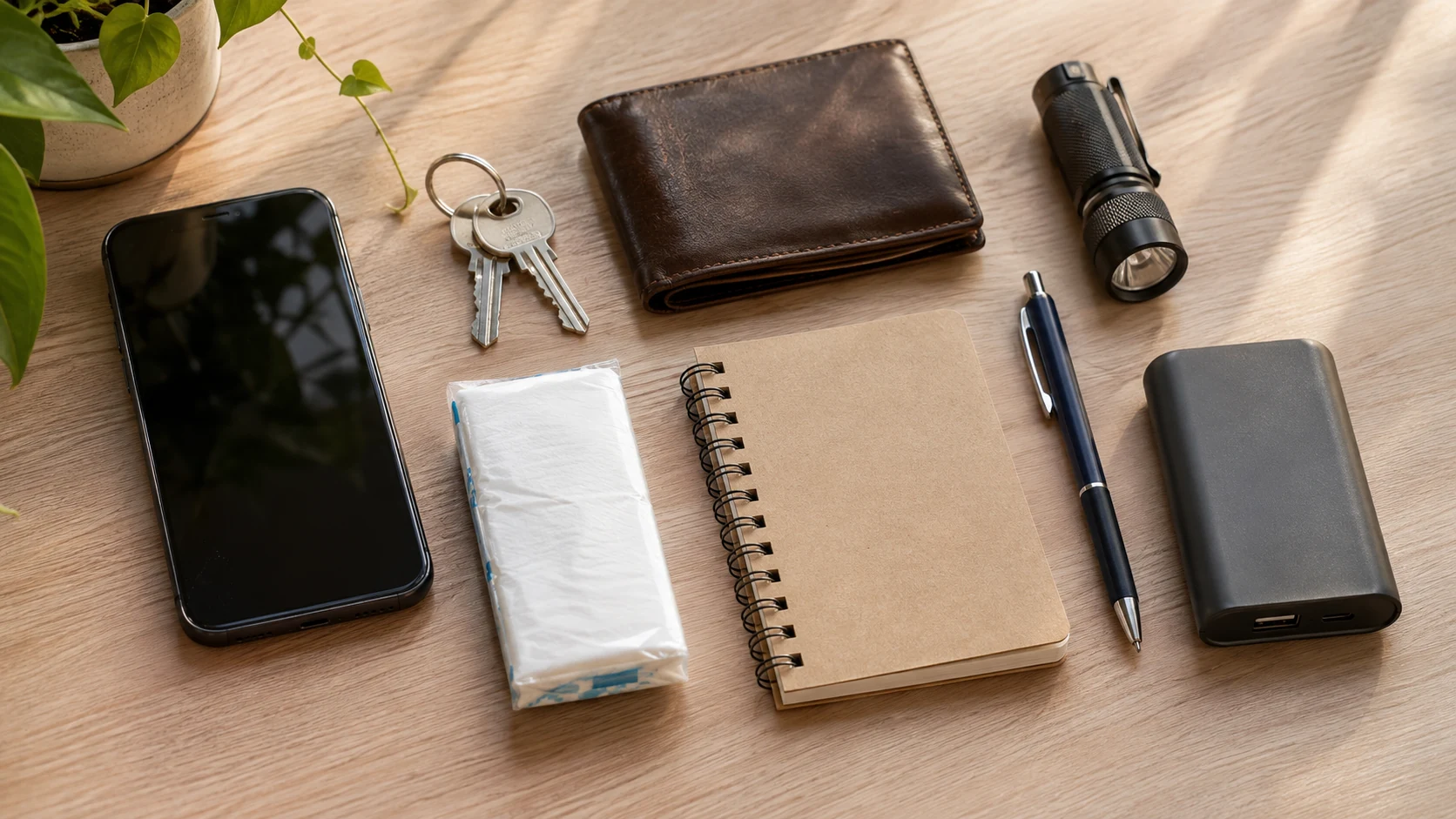
The daily equipment, often referred to by the acronym EDC, includes the items you keep in your pockets or a small bag. For day 15, prepare a light package, adapted to the trips actually made. It complements your home resources; it does not replace an emergency plan or a starting bag.
Describe a day before filling the bag
Note travel, transportation, weather, health needs and the rules of the places frequented. The content of a person who works in an office will not be that of a person who travels in the field. Access controls, aircraft or certain establishments may prohibit objects that are useful elsewhere.
Find two or three ordinary situations: unloaded phone, interrupted transport, small extended wait or return after dark. Choose what to answer and check the total weight. Equipment that you systematically leave at home is too bulky for your daily use.
Light and communication
A small lamp makes it possible to find an object or to illuminate a path. Check its operation, its locking and the availability of a battery or recharge. A rechargeable power supply facilitates certain uses; a replaceable battery may also be suitable. The best choice depends on how you actually maintain the material.
Prepare the phone, a compatible cable and an external battery if your trips justify it. Test the set and protect the connectors. An advertised capacity does not directly correspond to the number of full recharges of the phone.
Add a paper contact and, if necessary, accessible support information without unlocking a device. Don’t concentrate all the numbers, tickets and addresses in one app.
Care, water and comfort
Some dressings and hygiene equipment can treat a simple need within the limits of your skills. Personal medications follow their storage conditions; an analgesic is not automatically appropriate for any person. A small kit does not replace access to emergency services.
A drinking water bottle can be more immediately useful in the city than a filter ever tried. A cloth or bandana does not make water drinkable. A filter bottle has limits specific to its system; it does not allow to treat all the waters or to ignore a non-consumption notice.
Plan a snack, handkerchiefs, protection against the weather and the needs of the people who accompany you. Keep some of the resources in an accessible place if the bag becomes difficult to open in a transport.
Tools, writing and reporting
A small tool can be useful for an identified task. Check its legality, the rules of the place and your skills. A blade, lighter or aerosol is not a universal essential and should not be added to transform the EDC into confrontational equipment.
A notebook, a pen and a whistle can complete communication needs. Verify that the report is context-appropriate; no accessory guarantees outside intervention.
Three Checks of Day 15
- Empty the bag and assign a function to each object.
- Test the lamp, phone, cable and closures.
- Remove duplicates, prohibited items, and outdated or poorly preserved resources.
Review this content after a change in travel, season or medical need. A rarely used object can remain relevant if it responds to a specific risk: the decision is based on its usefulness and limitations, not just on its frequency of use.
France - Port and transport of arms · Quebec - Make your family plan
Put this reading into practice
Perform the action as you wish and then check the result. Your follow-up remains specific to this route.
31 days to better prepare; Day 15
Adapting your daily equipment
Your action: Make an ordinary journey with the objects you carry and remove what is unnecessary, forbidden or too heavy.
To check: Useful objects remain accessible; the rules of places frequented are respected.
To do