
In this article
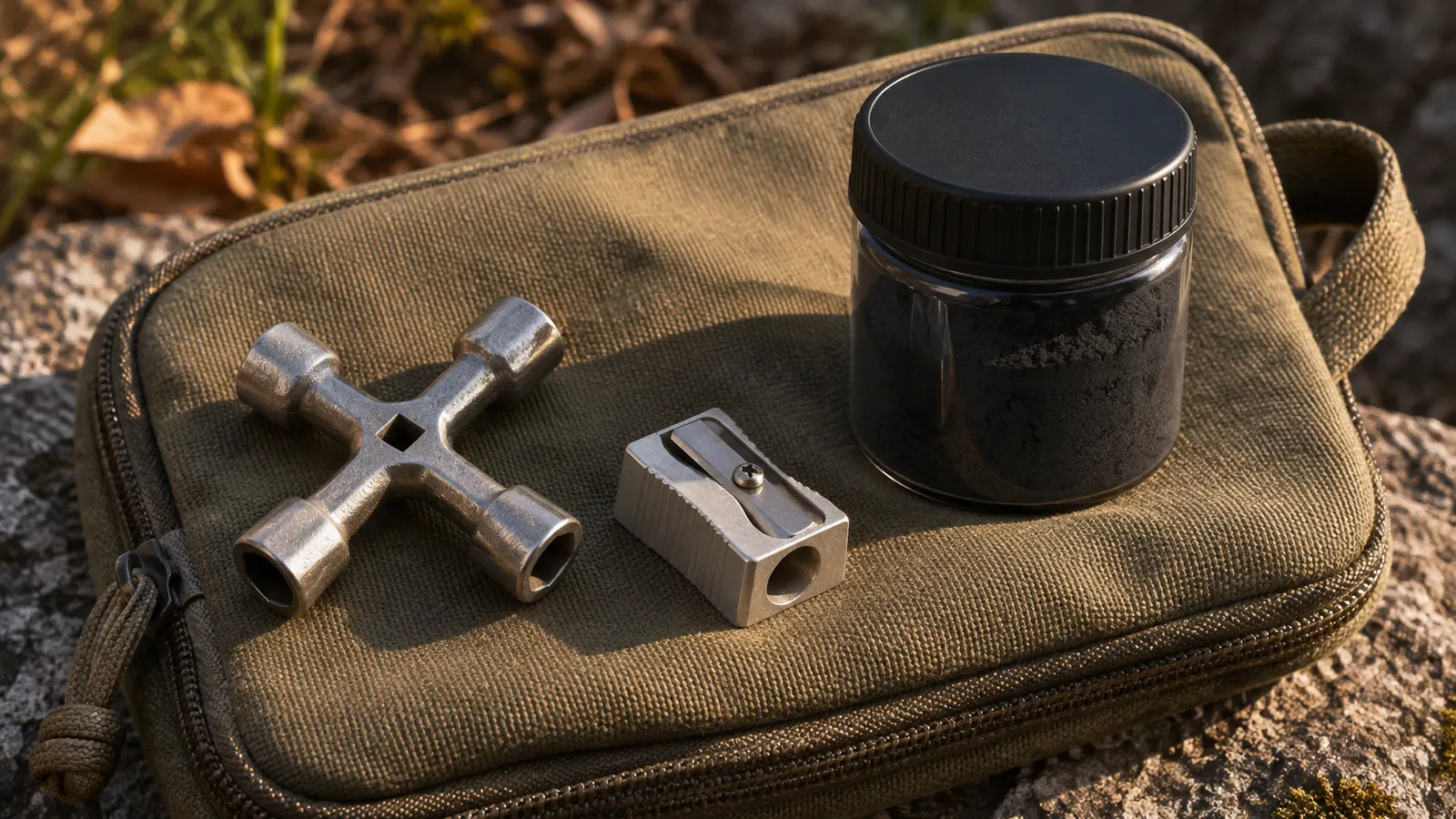
Some of the most useful items in a degraded situation look like nothing at all. They are not tactical, cost next to nothing and fit in a pocket. Yet in the right circumstances, they can make a real difference. Here are three discreet items that deserve a place in any EDC kit or evacuation bag.
The sillcock key — access to water in urban areas
Water is the absolute priority in a survival situation. The human body can tolerate several weeks without food, but only a few days without water — and far less under physical stress or heat. In urban areas, this resource is all around us, but not always directly accessible.
Next time you are out, look at the walls of commercial or institutional buildings: shopping centres, office buildings, public facilities, highway rest areas. Many have outdoor faucets with a square valve stem, designed precisely so they cannot be turned with a standard handle. These water points are technically available, but locked for restricted use.
What is a sillcock key? It is a compact tool, usually metal, with four female sockets of different sizes (typically 1/4, 9/32, 5/16 and 11/32 in, or about 6.4 / 7.1 / 7.9 / 8.7 mm) that fit the standard square valves used on outdoor faucets of commercial and public buildings.
The tool is first useful at home, at the cottage, on a work site or in a building you are responsible for. In an emergency — a prolonged drinking-water outage, an urban disaster — it can also open an outdoor faucet with the owner’s or manager’s permission, for example at an emergency shelter or a business willing to share its water.
Legal framework. Taking water from private or public property without permission can amount to theft or trespass, even in a crisis. Always ask first. The tool’s value lies in having it on hand for a legitimate need, not in routine unauthorized use.
The practical advantage is obvious: the tool is small (it fits in a pocket or on a key ring), inexpensive, and can stay in a kit for years without maintenance. It adds no noticeable weight or bulk to an EDC or evacuation bag.
Even with access to water through a sillcock key, treat that water as potentially non-potable depending on the context. Keep a means of treatment or filtration alongside — purification tablets, a compact filter.
The pencil sharpener — quick, reliable fire starting
Lighting a fire is a basic preparedness skill. Most kits include a lighter or waterproof matches. But an ignition source is not enough: you also need something that catches quickly, especially in damp or difficult conditions.
That is where a simple manual pencil sharpener — the kind found in school pencil cases — proves surprisingly useful. Running a wooden pencil through a sharpener gives you, in seconds, a small amount of very fine, dry and highly flammable shavings. These shavings are ready-to-use natural tinder, with no need to hunt for kindling, carve feather sticks or dig through a more complex kit.
Advantages
- Light and compact
- Inexpensive
- Produces ready-to-use tinder
- Works with any wooden pencil
- Requires no special skill
Limits to know
- Requires a wooden pencil (to carry alongside)
- Produces a limited amount of material
- Does not replace friction fire techniques
- Shavings are sensitive to moisture
The point is not that the sharpener replaces standard fire-starting methods — it complements them. When time is short, conditions are hard, or you simply have no knife to carve tinder, shavings made in ten seconds can be the difference between a fire and a failed attempt.
Slip a small sharpener and a short wooden pencil into your EDC or the fire pouch of your evacuation bag. Together they weigh nothing and take up less space than a pack of gum.
Activated charcoal — a poison-control tool, on advice only
Activated charcoal is used in medical settings to limit the absorption of certain substances in the digestive system. Its extremely porous structure lets it hold some medications or toxins on its surface before they reach the bloodstream.
Activated or ordinary charcoal? Activated charcoal is a treated product, unrelated to barbecue briquettes or lump charcoal. It is sold as powder, liquid suspension or capsules. Only a medical-grade product is of interest here.
For someone who lives far from emergency services (cottage, remote region, island) or is preparing for long response times, it helps to know what this product is and when it is used. But current recommendations are clear: you do not give it on your own initiative.
Why caution is essential
- It only helps with certain substances, and mainly within an hour of ingestion.
- It does not work against alcohol, iron, lithium, acids, caustic products (bleach, drain cleaners) or hydrocarbons (gasoline, lamp oil).
- It can be dangerous for someone who is drowsy, vomiting or at risk of choking: charcoal inhaled into the lungs causes serious damage.
- It also reduces the effect of medications the person needs.
What to do
- Call your poison centre immediately — in Quebec, the Centre antipoison du Québec at 1-800-463-5060 (24/7) — or 911 if the person is unconscious, has trouble breathing or is having seizures. Elsewhere in Canada, keep your provincial poison centre’s number handy.
- Have the container of what was swallowed, the approximate time, the amount and the person’s weight at hand.
- Do not induce vomiting.
- Give activated charcoal only if the poison centre or a doctor asks you to, at the dose they specify.
If you live somewhere isolated and want to keep some in your kit, talk to your pharmacist first and store it with a card showing the poison centre number. Either way, the most useful step is to save that number in your phone and in your kit.
Adding these three items to your kit
These three items are all inexpensive, compact, durable and versatile. They add no weight to a bag, don’t expire quickly and need no advanced training to be useful.
| Item | Where to keep it | Why |
|---|---|---|
| Sillcock key | EDC, car trunk or toolbox | Open a square-stem outdoor faucet, with permission |
| Sharpener + pencil | Fire pouch of the evacuation bag or EDC | Get fire-starting shavings in seconds |
| Activated charcoal | Medical kit, with the poison centre card | Only on the advice of a poison centre or doctor |
The goal of a preparedness kit is not to be exhaustive, but coherent. These three items illustrate a simple logic: anticipate specific needs with light, affordable, well-understood solutions. Every addition to a kit should answer this question: for which scenario? with which associated skill?
Further reading
To round out your gear, see our guide to lighting a campfire safely, our EDC checklist, our advice on over-the-counter medicines for your kit and our guide to calculating an emergency water supply.
Disclaimer: the information in this article on activated charcoal is general and does not replace the advice of a doctor, pharmacist or poison centre. In an emergency, call 911.
Frequently asked questions
Is it legal to carry a sillcock key?
The tool itself is not illegal to own or carry. It is how you use it that the law governs. Using another property’s resources without permission can be an offence, even in what feels like an emergency. Use it at home or with the permission of the owner or manager.
What kind of pencil sharpener works best?
A simple, sturdy manual sharpener, preferably metal. Double-hole models accept pencils of different diameters. What matters is that it is compact and produces fine shavings. Carry a standard wooden pencil with it.
Can activated charcoal be given to a child?
Only if a poison centre or doctor asks you to. Doses for children are different and the risk of choking or vomiting is higher. Call the poison centre first, or 911 if the child is in distress.
Do these three items replace a complete kit?
No. They complement an existing kit. A complete evacuation bag also includes water, food, a first-aid kit, important documents, a means of communication and other essentials suited to the risks in your area. These three items fit into that whole; they don’t replace it.