
In this article
- Your body is set to run at around 37 °C (98.6 °F), within a very narrow margin. A few degrees too many or too few, and it can no longer recover on its own.
- Heat comes in and goes out by four routes: contact (conduction), moving air or water (convection), radiation and evaporation.
- To keep the balance, you have three levers: produce heat, receive or avoid it, and insulate yourself.
- The secret of insulation is still air. Wet clothing drains your reserves very quickly.
- As long as the body compensates (shivering, sweating), there is time to act. When it stops compensating (hypothermia, heat stroke), it is an emergency.
01A body built for the tropics
Without clothes or shelter, humans are comfortable in a tropical climate, around 28 °C (82 °F) in the shade. Everywhere else, in Quebec in January as in a French city during a heat wave, they need protection to stay alive. This guide is about that protection: understanding how the body manages its temperature, so you know what to do when the heating fails or when the heat does not break at night.
Your body works like an engine. It burns food, powers the muscles and gives off a lot of heat along the way. The brain, in charge, has two demands: sugar, and a body core (heart, lungs, brain) kept at around 37 °C. When either is not met, it reacts, and it will go to great lengths to put things right.
02The four routes of heat
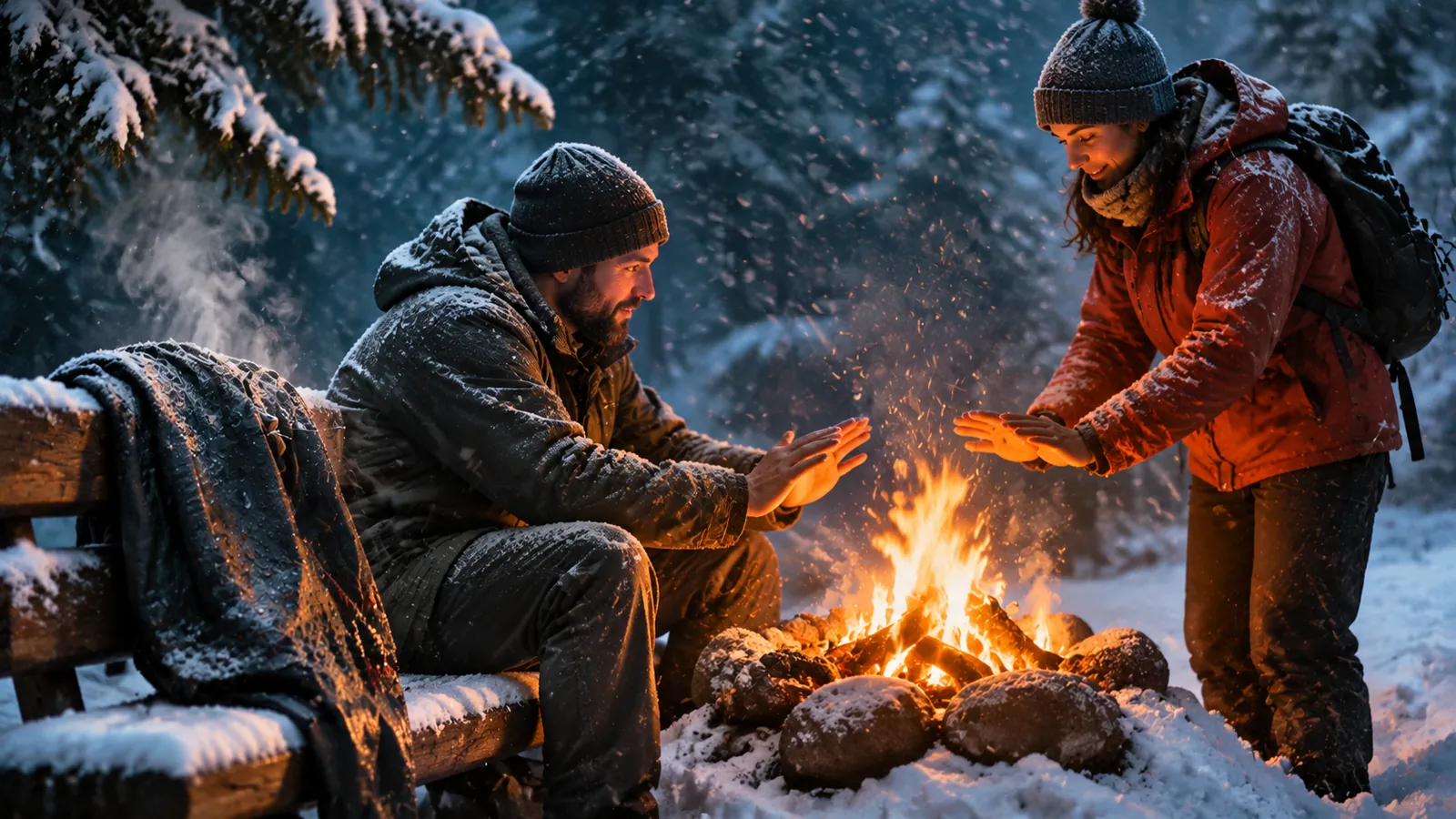
Heat always moves from warmer to colder. Your body is constantly losing or gaining heat by four routes. Knowing them tells you where to act.
| Route | In winter, it chills you when… | In summer, it helps or hurts when… | The right reflex |
|---|---|---|---|
| Conduction | You sit on snow, a concrete floor or an icy car seat | A damp cloth on the neck cools you; a scorching car body heats you | Insulate from the ground (mat, cardboard, cushion); stay dry |
| Convection | Wind or a draught gets through your clothes | A cool night breeze lowers the room temperature | Windbreaker in winter; air out at night in summer, close up by day |
| Radiation | You stay near a cold window at night | The sun heats a room through the glass or hits you at noon | Sit in the sun or near a stove in winter; shutters and shade in summer |
| Evaporation | Sweat or rain soaks your clothes, and moist breath leaves with every exhalation | Sweat cools you… if you drink enough to produce it | Remove a layer before sweating in winter; drink regularly in summer |
03The three levers of balance
Your body aims for balance: the heat it produces and receives must equal the heat it loses. To keep it, it has three levers, which it works partly on its own (shivering, sweating, blood vessels narrowing or widening) and partly through your choices.
A simple example
You are at home, the thermostat is set to 21 °C (70 °F) and you feel fine. An outage drops the room to 17 °C (63 °F), then 14 °C (57 °F). Your body is losing more than it produces, and you start to feel cold. You have three choices: move a little (produce), settle in the sunny room (receive) or put on a sweater and a hat (insulate). In a crisis, you combine all three, starting with insulation, which does not tire you out.
04The secret of insulation: still air
It is not the fibre that keeps you warm, it is the air it traps. Air that does not move cannot carry your heat away by convection. Down, wool, fleece or a thick blanket all work the same way: they create thousands of small pockets of still air.
But the material matters too. Picture a volume of down and the same volume of steel wool. Both trap air and slow convection in much the same way. Yet steel conducts heat very well, while down conducts it very poorly: down therefore insulates far better. Two materials can be good against one route of heat loss and poor against another.
| Material | Insulates dry | Insulates wet | Dries fast | Remember |
|---|---|---|---|---|
| Cotton (T-shirt, jeans) | ●●○ | ○○○ | ○○○ | Comfortable when dry, a deadly trap when damp. Avoid it in the cold. |
| Wool (merino, sheep’s wool) | ●●● | ●●○ | ●○○ | Keeps some warmth even when damp. Ideal for socks and hats. |
| Synthetic (fleece, polyester) | ●●● | ●●○ | ●●● | Light, quick-drying, inexpensive. Excellent as a base or middle layer. |
| Down (coat, sleeping bag) | ●●● | ○○○ | ○○○ | The warmest for its weight, but keep it dry at all costs. |
| Emergency blanket (foil) | ●○○ | ●○○ | ●●● | Reflects radiant heat and blocks wind. Adds to insulation, does not replace it. |
●●● very good · ●●○ fair · ●○○ weak · ○○○ very weak. Simplified comparison for teaching purposes.
05Think in layers, from body to home
Anything that protects the body is a shelter: your clothes, a blanket, the car, a tent, a room, the house. You can see them as the layers of an onion around you. The more layers you have, and the more easily you can add or remove them, the better you manage your temperature.
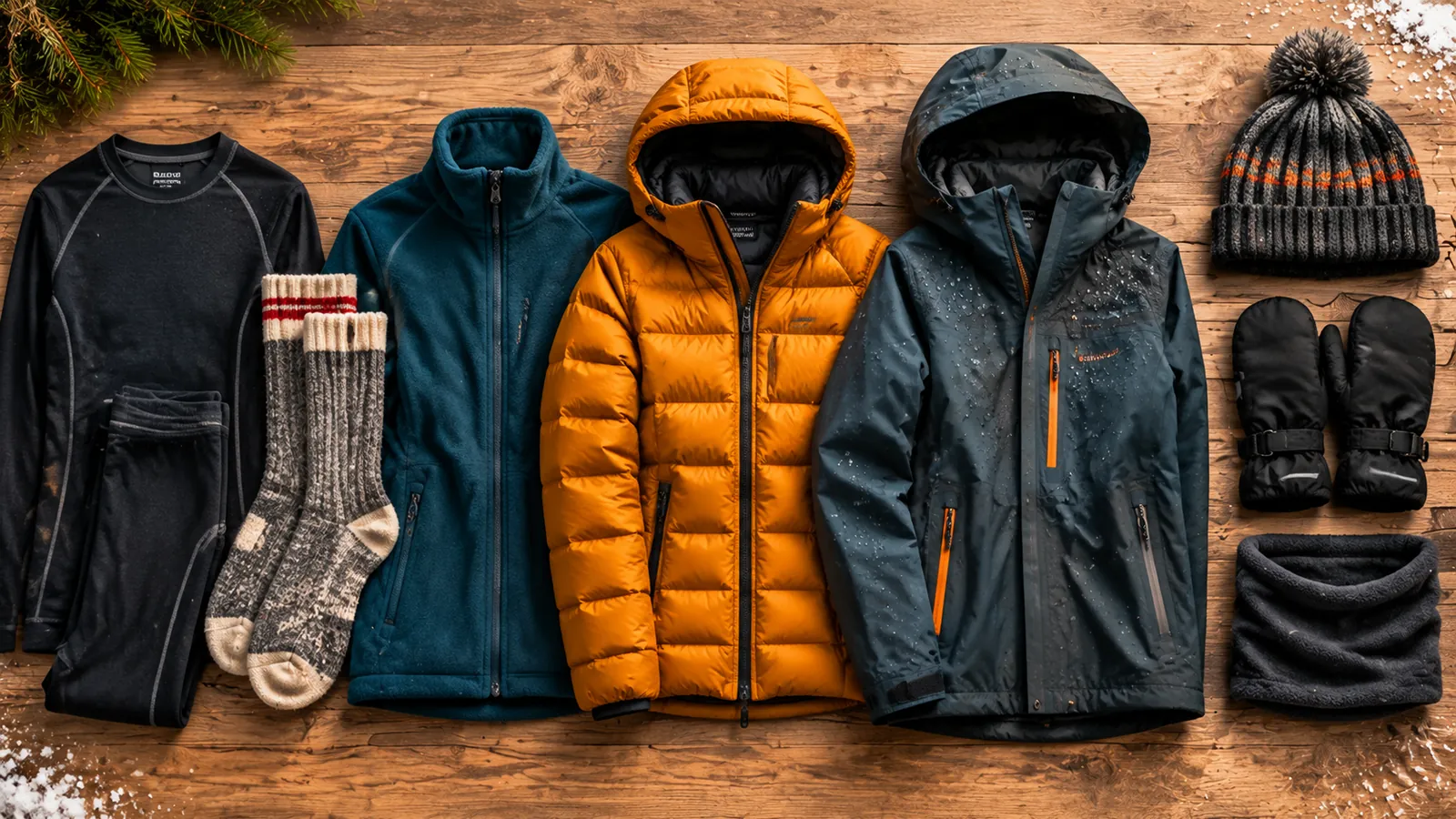
The golden rules of layering
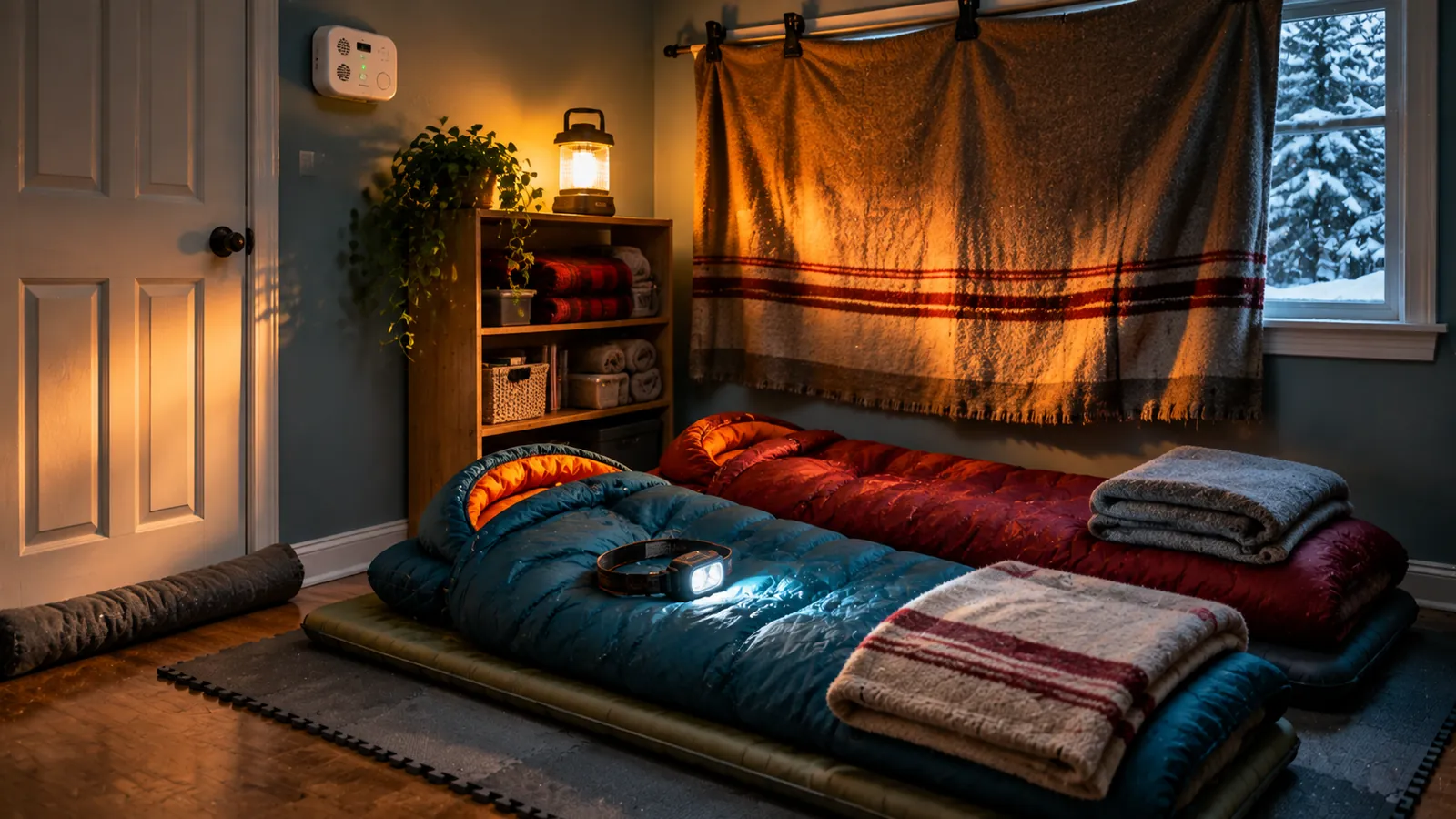
Shrink the shelter when the heating fails
During a winter power outage, a whole house loses its heat in a few hours, or in a day or two depending on its insulation. Rather than fighting everywhere, you shrink the “home” layer down to a single refuge room: the smallest, best insulated one, ideally on the sunny side, where the whole family gathers.
06Sweat: an air conditioner that runs on water
When it is hot or you are exerting yourself, sweating is the body’s main way to cool down. The mechanism is simple: warm blood is sent to the skin, sweat glands release water, that water evaporates by drawing energy from the skin, and the cooled blood flows back to the muscles and organs. Then it starts again.
This air conditioner has two limits. First, it uses a lot of water. In hot weather, you can easily lose a litre and a half a day in sweat, and more than five litres with sustained physical effort. If that water is not replaced, dehydration sets in quickly, bringing fatigue, headaches and the end of cooling. Second, when the air is very humid, sweat drips instead of evaporating, and it hardly cools at all. That is why humid heat is more dangerous than dry heat at the same temperature.
| What you notice | What it means | What to do |
|---|---|---|
| Pale, plentiful urine | Good hydration | Keep drinking regularly |
| Dark, infrequent urine; dry mouth | Early dehydration | Drink right away, small amounts often |
| Thirst, fatigue, headache, cramps | Established dehydration | Rest in the shade or somewhere cool, drink, cut the effort |
| Sweating stops even though it is hot, confusion | The cooling system is failing | Emergency: see section 07 |
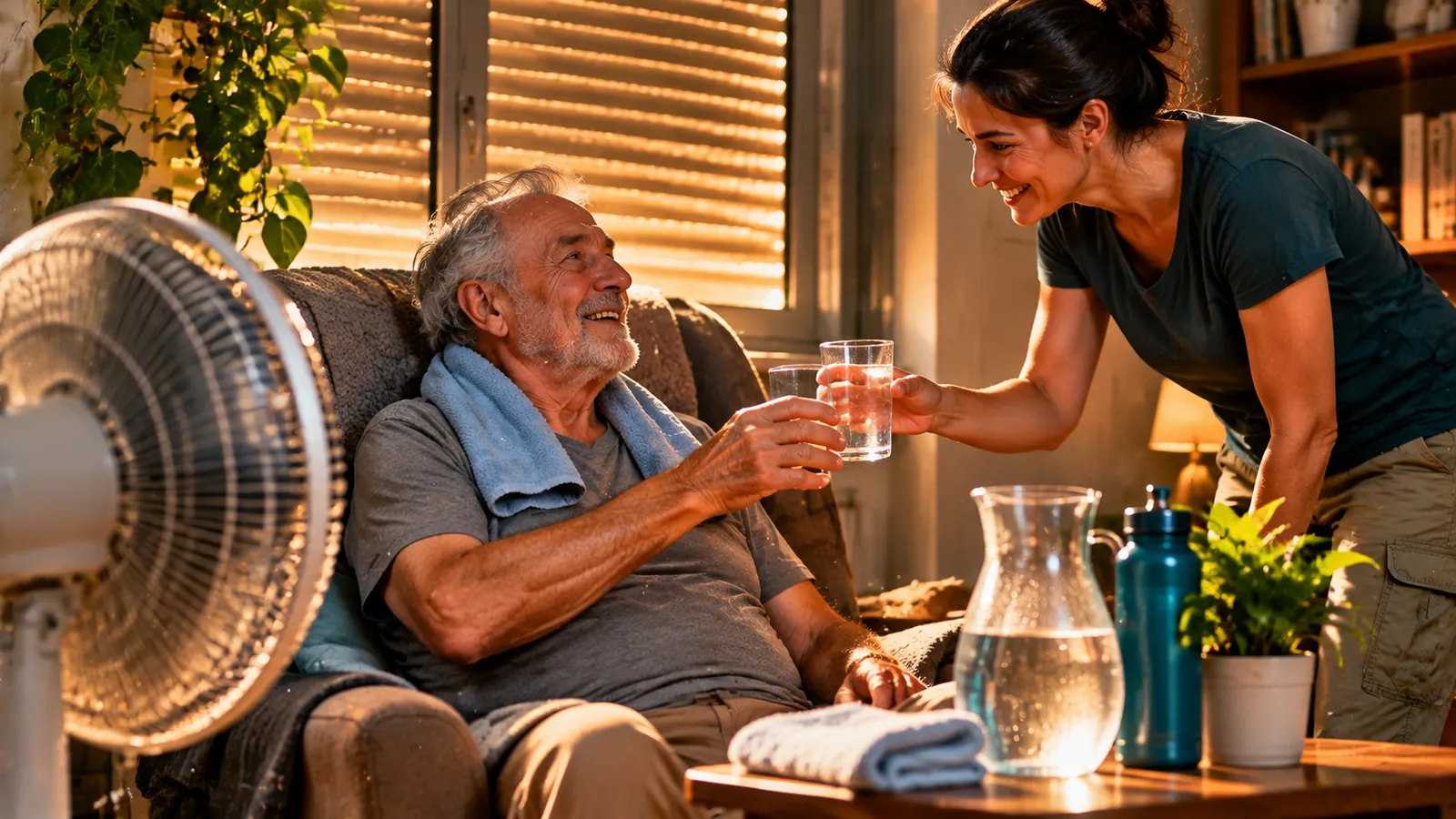
Keeping the home cool in a heat wave
In summer, the layering principle is reversed: you keep the heat out. Close shutters, blinds and curtains on the sunny side from the morning, and open wide at night when the outside air is cooler than inside to create a cross-draught. Wet your skin and sit in front of a fan: you add evaporation to convection. If your home stays above 30 °C (86 °F), spend a few hours a day somewhere cool (library, shopping centre, municipal cooling centre).
07When the body stops compensating
As long as your body manages to restore the balance, it is compensating. Shivering in the cold or heavy sweating in the heat are warning signs, but also proof that the system still works. There is time to act.
When losses or gains exceed what the body can handle, it decompensates: it stops fighting and its functions break down. In the cold, that is hypothermia; in the heat, heat stroke. At this stage, the person can no longer save themselves: they need help from outside.
| In the cold | In the heat | |
|---|---|---|
| The body compensates | Get out of the wind and wet, remove damp clothing, add layers, insulate from the ground, a warm sweet drink if the person is fully alert | Move to the shade or somewhere cool, give small sips of water, wet the skin and fan, stop the effort |
| The body decompensates | Call for help. Handle the person gently, lay them down, insulate them from the ground, wrap them (blankets, emergency blanket), warm the trunk first | Call for help. Cool them right away: remove clothing, spray with water, fan, wet cloths on the body; do not give drinks to a confused person |
| Emergency numbers | Quebec: 911 · Info-Santé 811 for advice · France: 15 (SAMU) or 112 · Canicule Info Service: 0 800 06 66 66 (during heat alerts) | |
Hypothermia and heat stroke will be covered in detail in upcoming guides in the series. This guide does not replace first aid training.
08Your tools
My heat balance
Choose a situation and describe where you stand. The tool shows which way the scale tips and which lever to pull first.
Educational tool, not medical advice. If warning signs appear, call for help.
Is my home ready?
Tick what is already in place at home.
09Useful equipment
No expedition gear needed. A few well-chosen items cover the essentials for both seasons: something to layer, something to insulate and reflect heat, water, light and news when the power is out.
10Key takeaways
- The body aims for 37 °C (98.6 °F), within a narrow margin. Beyond it, it needs outside help.
- Four routes of exchange: contact, moving air, radiation, evaporation. Act on the right one.
- Three levers: produce, receive or avoid, insulate. Insulation is the most economical.
- In the cold, still air and dryness above all; in the heat, shade, water and the night.
- Shivering and sweating are warnings; confusion, and shivering or sweating that stops, are emergencies.
Sources and inspiration. This guide is inspired by chapter 3, “Thermoregulatory Physiology”, by Robert B. Kauffman (Frostburg State University, 2015), which draws in particular on G. Fear and J. Mitchell, Fundamentals of Outdoor Enjoyment (National Search and Rescue, 1977) and SOLO’s Wilderness First Responder Review (2010). Advice on water, carbon monoxide and heat waves follows that of the Government of Quebec, Santé publique France and the French Ministry of Health. The text, examples, figures and tools are original and adapted to Quebec and France by PrépaCivile. This guide does not replace medical advice or first aid training.