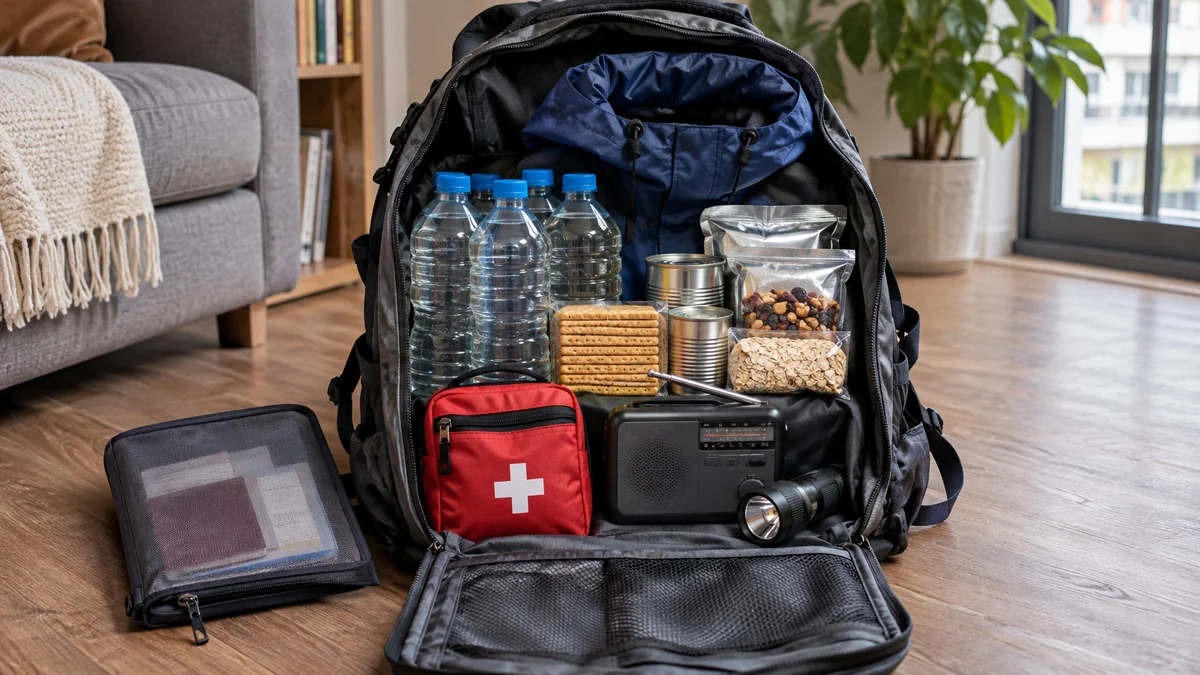
Urban emergency kit: organizing a useful, portable bag
An urban emergency kit should help to wait in acceptable conditions or to reach a reception when a departure is necessary. Its content depends on the routes, the people and the season.…
By Mathieu Montaroux · Published on February 1, 2025; Updated on November 4, 2026; 16 min read
An urban emergency kit should help to wait in acceptable conditions or to reach a reception when a departure is necessary. Its content depends on the routes, the people and the season. The right bag is the one that can be transported and whose equipment is understood, maintained and adapted to the real needs.
Define the mission of the bag
A small bag back home, a reserve in the accommodation and an evacuation bag are not interchangeable. Before choosing the equipment, note the possible distance, the accessible transport and the destination. Plan an alternative if the trip or reception becomes unavailable.
The 72-hour marker is used to prepare the autonomy of the home. It does not mean that a person must walk all the water, food and equipment of a group for three days. Distribute needs, transportation opportunities and confirmed resources.
Bag and organization
Try the bag loaded and adjusted. Examine closures, access to priorities, and the possibility of transportation assistance. People should not be forced to carry a load that puts them in trouble.
Small pockets separate lighting, care and accessories. However, avoid an organization so complex that objects can no longer be found. Other members of the household must include storage.
Personal protection and reporting
Protection begins with instructions, safe places and avoiding dangerous situations. A bag does not have to contain weapons to be useful to a family. Instead, keep the means to ask for help and move around without improvisation.
A personal alarm can attract attention in certain situations. Check the trigger and remember that it does not necessarily contact a rescue service.
For dust or certain particles, a breathing apparatus must be adapted, well adjusted and used within its limits. It does not protect against all gases, does not provide oxygen and does not make a smoky area accessible.
Lighting and energy rather than improvised fire
A lamp makes it possible to read an instruction, find an object and circulate in a dark place. Battery-operated or rechargeable lamps avoid the risk of a flame in a home or reception area.
A frontal release hands, especially to accompany someone. Choose a power supply compatible with the rest of your equipment and check the useful settings, not just the maximum brightness announced.
For the phone, an external battery and the right cable can extend the battery life. They do not restore an interrupted network and must be loaded regularly.
Transportable water and food
Bring drinking water in clean containers intended for this use. Adjust the quantity to the duration, heat and carrying capacity. Do not rely on a fountain or a store whose access has not been confirmed.
A soft pocket or gourde can facilitate storage, but its resistance and cleaning must be suitable for use. Once filled, its weight counts in the total load.
A filter can be a complement under certain conditions. Check the organisms and contaminants it actually treats. Salt water or water exposed to chemical pollution does not become potable with a simple hiking filter.
A treatment product must be used according to its instructions, with the volume, the deadlines and the expected water conditions. Do not combine products with intuition. An accessible drinking water supply remains the first solution to organize.
Choose foods that the household can consume without complex preparation. Allergies, health needs and children’s habits matter. Some hiking meals require water and a source of heat: they do not always replace an immediately consumable meal.
For canned goods without easy opening, a manual can opener should be tried before depending on it. Check its handling by the affected users.
A reusable cover can facilitate a meal, provided you plan to clean it. Avoid redundant accessories and unnecessary cutting objects at the reception place.
Weather protection and temporary waiting
Provide suitable clothing, usable shoes and rain protection. The needs vary greatly between a hot day and a winter breakdown. Business should stay dry in the bag.
A reflective cover is compact and can complement other protections. It does not replace sufficient insulation against the cold or the ground.
Shelter and reception place
Prioritize a confirmed welcome at a loved one or place announced by the authorities. An abandoned building, a stairwell or a service room are not accommodation solutions to plan without permission.
A tarpaulin may be used as temporary protection in an authorized location, depending on the conditions. Its use and its fixings must be known; it does not dispense with a reception adapted to the cold or medical needs.
Communication and documents
Keep contact information and a meeting point on paper. A reception radio can complete the phone if stations are still broadcasting in the area. Do acceptance and change of power tests.
Gather the necessary copies to move in a pouch, limiting sensitive data. Originals requiring special protection should not remain in a daily bag at all times.
First aid and hygiene
Adapt a small kit to your needs and skills. The packaging must remain intact, the processing identifiable and the useful information accessible to authorised persons. Training and the possibility of alerting are more important than an assortment of specialized devices not under control.
Plan for hand hygiene, taking into account the water available and the products used. A cleaning product is not automatically suitable for a wound, food or all materials.
A toothbrush and a small hygiene kit can improve a prolonged wait. Choose the usual formats and products of the home.
Kit accessories and maintenance
A multifunction tool can meet a few small tasks, within the limits of its design and transport rules. It does not replace a specialized repair and does not allow access to a building or facility.
A notebook and pen can record an address, a deposit or an expense when the phone is not suitable. Keep personal information out of sight of people who don’t need it.
Check the kit after use and at the change of season. Try porting, opening, and ordering. Replace what has been used, remove duplicates and keep a short inventory.
Your next action: make an ordinary trip with the bag loaded, then check the access to the water, documents and lamp. Fix anything that slows down or fatigues before adding material.