
In this article
- 1. Choose the right container
- 2. Verify the applicable legal framework
- 3. Properly estimate its volume requirements
- 4. Let the roof rinse before collection
- 5. Understanding treatments and their limitations
- 6. Evaluate the relevance of a prefabricated system
- 7. Install a filter screen at the barrel entrance
- 8. Provide for a convenient access and evacuation system
- Summary: the essential points to remember
- Frequently asked questions
- Sources and benchmarks
Rainwater harvesting is one of the first practices of water autonomy that citizens concerned about resilience are interested in. In appearance simple, however, it has several points of vigilance which, neglected, can reduce the efficiency of the system or, in the most serious cases, compromise the quality of the recovered water. Here is a structured overview of the most common mistakes and practices to implement a reliable system.
This article focuses on rainwater recovery and uses consistent with its quality. Water collected on a roof is not automatically drinkable. A clear appearance, a food container or an isolated treatment is not enough to demonstrate that it can be drunk. Keep a separate potable water supply and check the permitted uses in your territory.
1. Choose the right container
Not all containers are suitable for prolonged storage of rainwater. Two main problems arise: the migration of chemicals from plastic to water, and the transparency of the container that promotes the growth of algae under the effect of light.
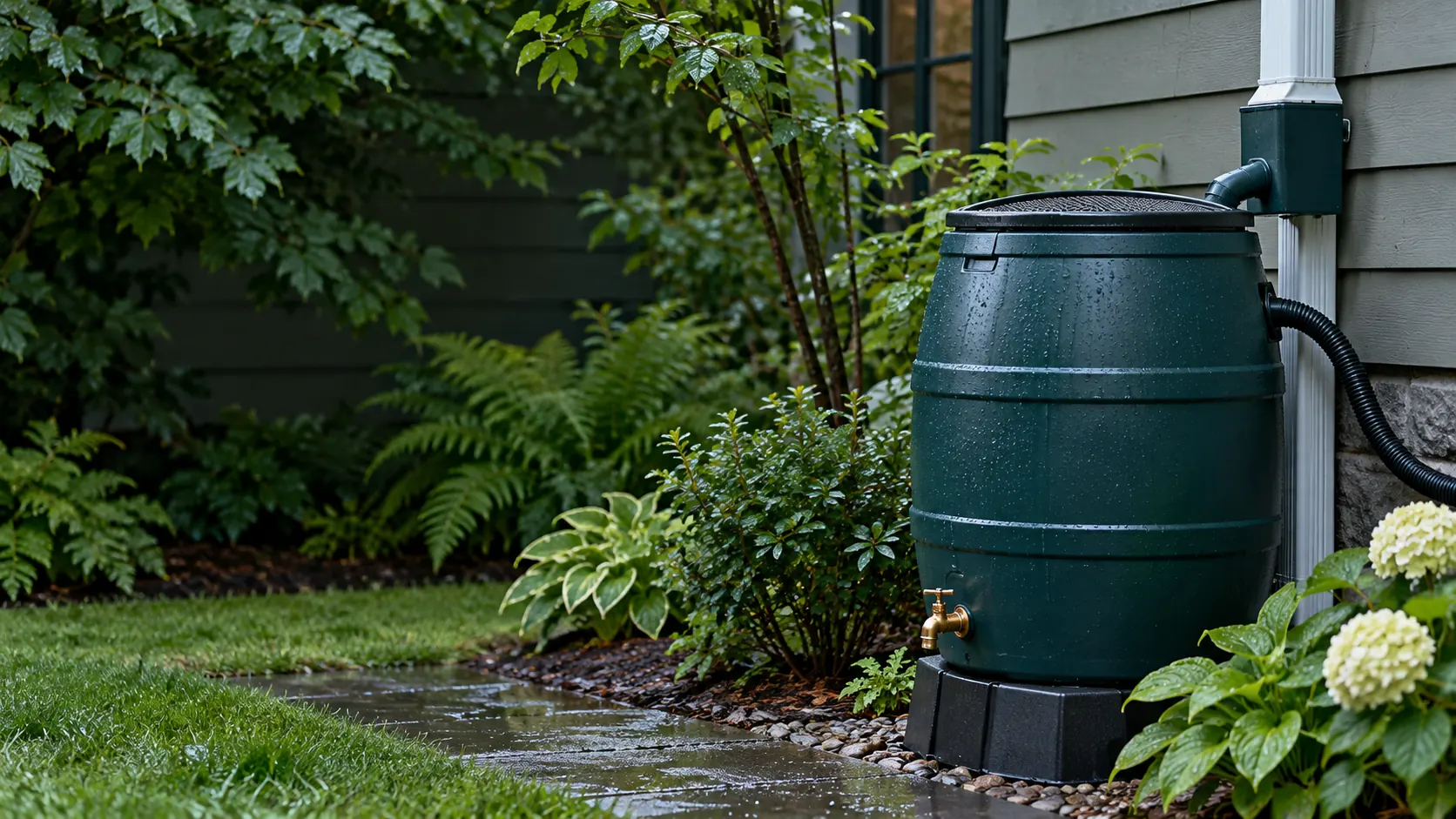
Dark colored plastic barrels - opaque - are generally well suited. They limit light penetration while being robust and relatively easy to find. Other containers may be suitable if three criteria are met: sufficient capacity, adequate opacity, and the absence of coatings or chemical residues that could contaminate the water.
Preferred: a container intended for the intended use, whose composition, fittings and provenance are known. High-density polyethylene is used in many tanks, but the material, dark color or old food use alone does not demonstrate the ability to produce or conserve drinking water. Discard drums that contain solvents, chemicals or substances whose traceability is unknown. Also check the lid and parts in contact with water.
2. Verify the applicable legal framework
Rainwater harvesting is regulated differently by Canadian provinces, countries and sometimes even municipalities. In Canada, several provinces recognize and regulate this practice, but conditions of use vary. In France, specific regulations distinguish between uses allowed inside homes and those limited outside.
Before installing a recovery system, it is useful to consult local municipal by-laws as well as applicable provincial or national regulations. This is especially important if the system is large in volume or connected to indoor plumbing.
Legal frameworks are evolving. The information available at the time of writing may no longer reflect the current situation in your area. A direct audit with the competent authorities - municipality, regional authority, Ministry of the Environment - remains the most reliable approach before any major investment.
3. Properly estimate its volume requirements
The amount of water needed on a daily basis is often underestimated, especially in a context of preparation. Even reducing non-essential uses – showers, laundry, intensive washing – the need for drinking water and cooking water remains significant.
A recovery system that is undersized in relation to actual needs will not render the services expected in a degraded situation. It is better to take the time, from the design, to calculate the available roof area, the average rainfall of the region, and the estimated daily needs per person.
Estimate the potential collection
Estimate the needs
For your emergency supplies, distinguish between drinking water and water needed for other uses. Health Canada cites 2 liters of water per person per day, with an additional 2 liters to consider for food preparation and cleaning. This preparation mark does not constitute an individual prescription and does not make rainwater potable. Needs vary depending on the situation, heat, activity, health and the people or animals involved. The PrépaCivile water reserve calculator allows to separate the uses without confusing them with the capacity of the barrel.
4. Let the roof rinse before collection
When a rain starts after a dry period, the first runoff water brings with it everything that has accumulated on the roof: dust, pollen, bird droppings, decomposed plant matter, atmospheric particles. This first water is of significantly lower quality than the rest of the rain.
A diversion of the first waters can remove some of what has accumulated on the roof and in the gutters. The volume to be diverted depends in particular on the connected surface and the design of the system. A fixed duration of ten minutes does not allow to properly dimension this bypass for any roof and any shower. Sizing the device according to appropriate recommendations and maintain it. An automatic or manual bypass does not guarantee potability.
A first water diverter can be purchased or assembled with suitable components, if you know how to size and maintain it. It diverts part of the initial runoff laden with dirt. Its effectiveness depends on the roof, the conditions and the device: it does not alone attest to the sanitary quality of the water and does not replace either the evaluation of the use or a suitable treatment.
5. Understanding treatments and their limitations
Even visually clear, water from a roof and gutters should not be considered potable. It can contain bacteria, parasites, metals or atmospheric contaminants depending on materials, pollution and storage. Any treatment is not proof of potability: for food use, have the risks, device and local requirements assessed. An independent drinking reserve remains a priority.
The methods below respond to different functions. Comparing them does not mean providing a universal procedure for drinking roofing water. First identify contaminants and authorized use, and then have the appropriate treatment assessed. For regular consumption or family preparation, choose a safe drinking source and the applicable sanitary instructions.
- Mechanical filtration: it retains certain particles according to the media, pore size and filter design. The performance of a cartridge or a ceramic filter is not inferred from the name of the technology. Consult the model limits and relevant tests or certifications; retaining visible materials does not demonstrate the removal of all microorganisms or dissolved compounds.
- Activated carbon: it can improve certain tastes and smells or reduce certain compounds depending on the cartridge and its demonstrated performance. It does not offer universal protection against chemical and biological contaminants. The duration of use, flow and maintenance must correspond to the indications of the product and the water actually treated.
- Chemical disinfection: a suitable product can act on certain microorganisms when its concentration, contact time and conditions of use are appropriate. Bleach or pellets do not remove all chemical contaminants from a roof. Do not improvise a dosage from a product name or another concentration. Follow a sanitary instruction or a precise notice, without making this method a general authorization to consume the recovered water.
- Bullition reliable method for removing biological pathogens, but does not remove chemical contaminants.
- Portable filters: Sawyer families, LifeStraw and other hiking models can meet certain needs defined by their documentation. Their functions differ: bacteria, protozoa, viruses and dissolved substances are not automatically covered by all filters. The short duration of use does not remove chemical contamination. Check the exact model and don’t present it as a universal solution to roof water.
A succession of treatments is only useful if each step responds to the contaminants present and if the whole is properly designed, maintained and controlled. Filtering and disinfecting alone does not guarantee the absence of chemical pollutants. Analyses, source assessment and health requirements remain necessary when a use involving consumption is envisaged.
6. Evaluate the relevance of a prefabricated system
A barrel, tap, fitting and sieve assembly may be suitable for some non-potable uses. A prefabricated system can provide other functions: documentation, compatible fittings, access security, maintenance or integration. Compare these functions and full costs, rather than assuming perfect equivalence or always lower price. Interior connections and treatment projects require additional requirements.
The 200-litre food casks, often available from agri-food companies or breweries, provide a solid economic base. The necessary accessories - crimp valves, seals, downspouts - are easily found in hardware stores.
A prefabricated system can, however, be justified in specific contexts: aesthetic integration with a terrace, high capacity systems, or installations related to indoor plumbing requiring certification.
7. Install a filter screen at the barrel entrance
An open or poorly protected lid lets in leaves, insects, plant debris, mosquitoes - and their larvae. A simple fine mesh wire mesh or non-woven fabric is enough to filter out large particles and prevent insects from colonizing the barrel.
This point is often overlooked, but it directly conditions the quality of water stored over time. A poorly covered barrel can become a mosquito larval house in a few days of heat, which poses both a health problem for the water and a public health problem if the barrel is located outside.
The lid should be light and insect-proof, but allow filtered water to enter. A good balance is usually achieved with a pierced lid covered with a fine sieve attached by a collar or seal.
8. Provide for a convenient access and evacuation system
A barrel without a tap makes it necessary to dip a container inside to recover the water - unhygienic and tedious method. The installation of a withdrawal valve in the lower part of the barrel is a simple, inexpensive modification, which radically changes the ergonomics of the system on a daily basis.
In a logic of preparation, it is better to test the system before needing it: check the joints, make sure that the faucet is accessible even when the barrel is full, and that the overflow is correctly directed to avoid creating a wet area at the base of the wall.
Summary: the essential points to remember
Water quality
System sizing
Calculate requirements, connected area, losses and available capacity. A tank that is too small can overflow quickly; a larger tank is not automatically preferable if the location, stability, water renewal or maintenance does not follow. Sizing the system for a defined use and plan a safe overflow.
Container and equipment
Favour opaque food containers, install a withdrawal tap, cover the barrel with a sieve. These simple adjustments make all the difference.
Frequently asked questions
Is the rainwater collected drinkable directly?
Nope. Roofing water can contain microorganisms and chemicals even when it is clear. Filtration and disinfection are not always enough to respond to all contaminants. Choose a drinking water source that is known for drinking and cooking; any different project requires verification of quality, treatments and applicable rules.
Do I need a permit to collect rainwater in Quebec?
The requirements depend on the municipality, the building, the type of installation and the uses. Do not infer from this article that no authorization is required anywhere in Quebec. Check local regulations, plumbing requirements and connection conditions before installing or modifying a network. In France, see also the official factsheet on rainwater and its authorized uses.
How much water can be collected with a standard roof?
The volume depends on the roof surface, local rainfall and the runoff coefficient. As an indication, a surface of 50 m2 under a 20 mm rain can generate about 800 to 900 liters of recoverable water. This calculation remains approximate and varies according to the system configuration.
Can any drum be used as a collection barrel?
Nope. Discard drums that contain solvents, chemicals or substances whose history is unknown. A food drum made of HDPE may be suitable if it is traceable, in good condition and suitable for use; its blue or black color does not prove anything on its own. Check for provenance, previous contents, materials, cleaning and compatibility with the intended storage.
Aquatabs 334 mg (167 mg) Active Oasis Water Purification Pastilles
Example to compare according to your real need. The Canada and France variants may differ: check dimensions, capacity, power supply and delivery conditions.

Aquatabs Lot de 2 paquets de 30 comprimés de traitement de l'eau 334 mg
Visit on Amazon.ca — Aquatabs Set of 2 packs of 30 water treatment tablets 334 mg
Aquatabs 100/Pack Water Purification Tablets (Canadian size) with Whirl-Pak Emergency Water Bag as a bonus...
Example to compare according to your real need. The Canada and France variants may differ: check dimensions, capacity, power supply and delivery conditions.

Aquatabs Kit de traitement de l'eau d'urgence 72 heures, 20 comprimés
Visit on Amazon.ca — Aquatabs Emergency Water Treatment Kit 72 Hours, 20 TabletsUV treatment of water
Check the target organisms, device limitations, and required maintenance. No device presented here should be assumed to remove any chemical contamination. Follow the advice of the authorities on potability.

SteriPEN Purificateur d'eau UV ultraléger
Visit on Amazon.ca — SteriPEN Ultralight UV Water Purifier
SteriPen UltraLight traveler UV purificateur d'eau, taille unique
View on Amazon.co.uk — SteriPen UltraLight traveler UV water purifier, one sizeMiniwell Ultralight and Versatile Gravity Water Filter TUV Hurricane Storm Supplies Certified Emergency Kit.
Example to compare according to your real need. The Canada and France variants may differ: check dimensions, capacity, power supply and delivery conditions.

miniwell Filtre à eau par gravité avec paille, ultraléger et polyvalent, pour randonneurs, accessoires en option. Kit d'urgence éprouvé TUV, fournitures pour ouragan et tempête. (Filtre à eau avec
Visit on Amazon.ca — miniwell Gravity water filter with straw, ultralight and versatile, for hikers, optional accessories. Proven TUV emergency kit, hurricane and storm supplies. (Water filter with
LifeStraw Peak Series - Paille filtrante Personal Water pour filtration, urgence, survie, et hydratation ultra-légère ; Sans BPA, Mountain Blue (bleu)
View on Amazon.co.uk — LifeStraw Peak Series - Personal Water filter straw for filtration, emergency, survival, and ultra-light hydration; BPA-free, Mountain Blue)Sources and benchmarks
www.canada.ca - verification reference
www.cdc.gov - verification reference
Public Service - Rainwater Uses in France