
In this article
- What is hardtack?
- A food rooted in history
- Materials needed
- Recipe
- Preparation method
- Possible variations and additions
- How to consume hardtack
- Nutritional profile
- Preservation and Storage
- Commercial alternatives
- In summary
- Frequently Asked Questions
- Sources and References
- Related resources
- Equipment to compare for your needs
Among long-shelf-life foods, few have as long a history or as simple a recipe as hardtack. This dry biscuit, which has existed for millennia, is resurfacing in contemporary discussions about food self-sufficiency—and for good reason. Here is how to prepare it, store it, and realistically incorporate it into your food supplies.
What is hardtack?
Hardtack is a very dry biscuit made from flour, water, and salt. Its basic recipe is intentionally minimalist; it is precisely this simplicity that gives it an exceptional shelf life when prepared and stored correctly.
Keep in mind: Adding ingredients beyond the basic recipe (such as herbs, spices, or fats) can shorten its shelf life. If you wish to enhance your recipe, vacuum-sealing can help mitigate this effect.
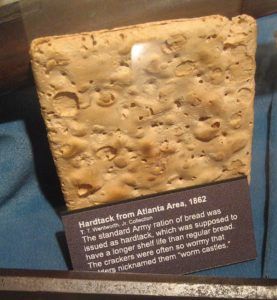
The oldest surviving specimen is held in a museum in Florida and dates back to 1851. Other examples from the American Civil War have also been documented. Well-prepared hardtack, if kept dry, can be stored for long periods—depending on the quality of the product, its packaging, and how often the stock is rotated—making it one of the few foods that meets this criterion.
A food rooted in history
Unleavened breads have existed for at least 6,000 years. Before the Egyptians mastered the use of yeast, grains processed into dry flatbreads served as a reliable way to extend food supplies during travel or times of scarcity.
Hardtack later became a staple during major maritime expeditions and military campaigns. During the American Civil War (1861–1865), it was a basic ration for troops on both sides—appearing in the popular songs of the era, noted as much for its utility as for its lack of palatability.
This long history illustrates an important point: in situations where food supplies are uncertain, durability and practicality take precedence over taste.
Materials needed
Making hardtack requires very little equipment. Most of the necessary items can already be found in an ordinary kitchen.
1. Mixing bowl
Metal, glass, or ceramic—any size or material will work.
2. Dough docker
Used to evenly prick holes in the dough, allowing steam to escape during baking. If you don’t have one, a fork or an awl will suffice.
3. Baking tray
A mesh pizza screen promotes air circulation and speeds up even drying.
Buy online
Recipe
[tasty-recipe id=”62888″]
Preparation method
The method below applies regardless of the recipe chosen.
- Mix the dry ingredients together in a bowl.
- Gradually add the water, about ½ cup at a time, working the dough as you go.
- Knead until the dough reaches a firm yet uniform consistency that is easy to roll out. The goal, once baked, is for the product to be completely free of moisture.
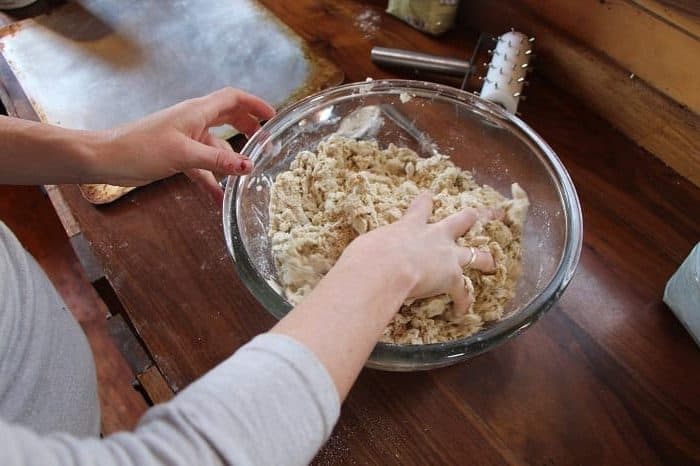
- Roll out the dough to your desired thickness.
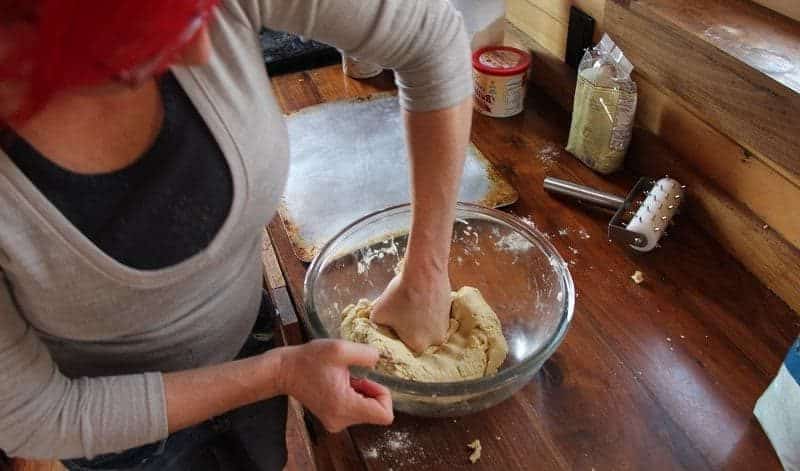
- Pierce the dough using a docker or a fork. These holes allow steam to escape and ensure the dough dries out completely.
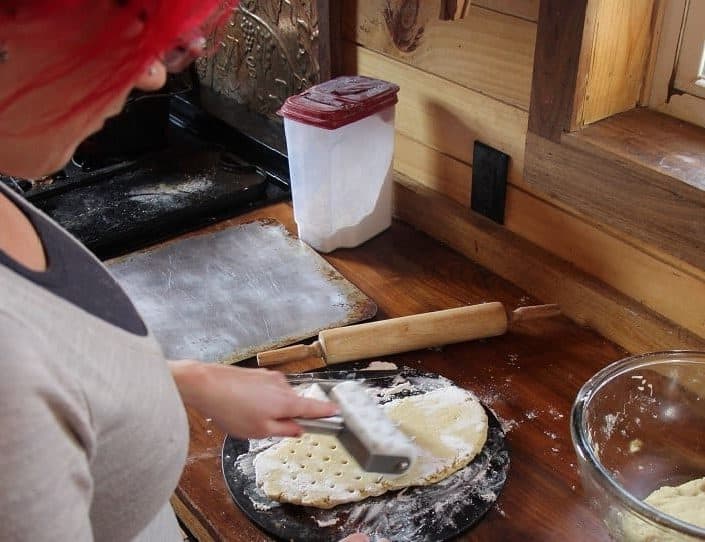
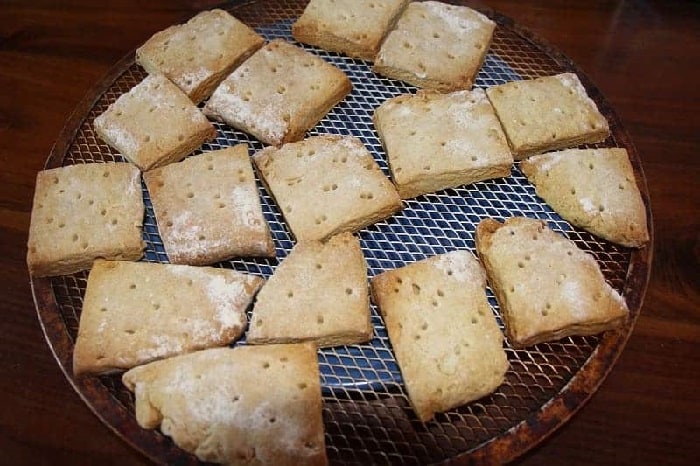
- Cut into squares or other uniform shapes. The size only affects the drying time—smaller pieces will dry faster. Minor variations in size or shape will not affect the final result.
- Bake in an oven preheated to 190°C (375°F) for 30 to 40 minutes, or until lightly golden brown.
- Allow to cool completely on a wire rack so that any residual moisture can evaporate before storage.
Possible variations and additions
The basic recipe can be modified by adding dry ingredients that are suitable for long-term storage. Some documented options include:
- Dried buttermilk powder—for added flavor and nutritional value (avoid this if you are lactose intolerant).
- Sugar or brown sugar—to slightly sweeten the biscuit.
- Highly refined oils — choose oils with a long shelf life (avoid animal fats like lard or tallow, which are more prone to going rancid).
- Cocoa or carob powder — for flavor variety.
- Nutritional yeast — provides a cheese-like flavor and B vitamins, including folic acid, without the use of dairy products.
Adding fats, milk, seeds, or other ingredients affects the drying process and shelf life. Vacuum sealing or using an oxygen absorber cannot compensate for unknown levels of residual moisture. For an enriched hardtack, plan to consume it relatively soon or freeze it, rather than storing it in the pantry for an extended period.
How to consume hardtack
Hardtack is designed to be eaten after being rehydrated. It is extremely hard when dry and can pose a risk to your teeth if bitten into directly. Traditional methods involve soaking it in broth, soup, milk, or any other available liquid until it softens sufficiently.
Historically, people would simply let their saliva soften the biscuit. In the context of emergency food supplies, pairing it with a hot liquid—such as vegetable broth or instant soup—remains the most comfortable and nutritious method.
Nutritional profile
The table below provides an estimate of the nutritional values for the enriched recipe (containing nutritional yeast and dry additives) and the traditional recipe (consisting only of flour, water, and salt). These data are calculated based on the nutritional labels of the ingredients used and represent estimates rather than certified values.
The role of salt

The amount of salt can be adjusted to taste. It is worth noting that salt plays an important physiological role: during sustained physical activity or in hot conditions, significant amounts are lost through perspiration. Hardtack provides a way to naturally incorporate this intake into rations.
Historically, salt was sometimes intentionally omitted from hardtack because it was already present in other salty foods—such as salt pork or canned goods—that were part of the rations. Sodium intake should be considered within the context of overall food supplies, rather than in relation to a single, isolated food item.
Protein: reference requirements
Generally accepted reference intakes are approximately 46 g of protein per day for an adult woman, 56 g for an adult man, and 71 g for a pregnant or breastfeeding woman. These values increase during periods of intense physical activity. Nutritional yeast provides a simple way to adjust the protein content of hardtack.
Folic acid and pregnancy
Nutritional yeast is a notable source of folic acid, which is particularly relevant for women of childbearing age. A half-portion of an enriched recipe (approximately 1,700 kcal) can provide a very significant portion of the daily recommended intake of folic acid, based on standard reference values.
Vitamin C: A Point of Concern
Hardtack is low in vitamin C. In situations involving long-term reliance on stored food supplies, a vitamin C deficiency can develop within a few weeks—scurvy is a well-documented reality throughout the history of expeditions and conflicts.
Including vitamin C supplements—in capsule or powder form—within food storage supplies is a simple and inexpensive measure. Vitamin-fortified drink mixes, such as Emergen-C, can also serve as a useful supplement while making hydration more enjoyable.
Maintaining an intake of essential vitamins and minerals—especially when access to medical care is limited—directly contributes to one’s ability to navigate difficult situations under better conditions.
It may also be beneficial to keep multivitamins or nutritional yeast in your food stores to complement hardtack and ensure a complete nutritional profile.
Preservation and Storage
While hardtack is a very dry biscuit, the shelf life of a homemade version varies depending on the quality of the product, how it is packaged, and how the stock is rotated. Historical specimens kept in museums do not serve as a validation of safety for consumption. Factors such as residual moisture, thickness, the specific recipe, the baking process, and the packaging all influence the actual shelf life.
A cautious approach: prepare thin, uniform pieces, bake according to the recipe, and then allow them to cool completely on a wire rack. Keep a small batch in a clean, dry container; label it with the date and monitor its condition. In the absence of a validated process or moisture-level measurement, avoid long-term storage in an oxygen-depleted environment; freeze the items to extend their shelf life.
What to avoid: Storing items before they have cooled completely, exposing them to moisture, or using non-airtight containers. Moisture is the primary cause of spoilage.
Packaging materials
How much should you prepare?
The answer depends on your intended use. As a low-cost, basic food reserve, hardtack offers a cost-to-calorie-to-durability ratio that is hard to beat. Preparing more than what is needed for immediate consumption also provides a surplus to share—an approach that fosters community resilience rather than just individual self-reliance.
Commercial alternatives
There are very few commercial producers of hardtack in Canada. Similar products, known as "pilot crackers," are available online. However, these options are significantly more expensive than making it yourself, which allows for better control over ingredients and results in a much lower cost for comparable quality.
For further reading: The Ultimate Guide to Food Preservation
In summary
Hardtack is not "comfort food," and it was never intended to be. Its value lies in a combination of three rarely found characteristics: simple preparation using common ingredients, a very low cost, and an exceptional shelf life—provided that proper storage conditions are maintained.
When integrated into a diverse food reserve—particularly as a supplement to foods rich in vitamin C and protein—it serves as a solid, economical foundation for any long-term food self-sufficiency initiative.
A question worth considering: in your own personal or family situation, what role do you assign to foods with a very long shelf life, as opposed to the regular rotation of your provisions? Both approaches are complementary, and each is suited to different scenarios.
Frequently Asked Questions
Does hardtack truly remain edible for a long time, depending on the quality of the product, its packaging, and how it is rotated?
No: one cannot guarantee that homemade hardtack will remain edible for several decades. The presence of old biscuits in a historical collection is no proof that they are still fit for consumption. For long-term storage, opt for commercial rations for which the manufacturer specifies the conditions and duration of shelf life, or, if you make your own, ensure a frequent rotation of your stock.
Can it be eaten without soaking it first?
Technically yes, but with caution. Hardtack is very hard—it poses a real risk to your teeth. Soaking it in a liquid (broth, hot water, soup) is highly recommended, and was the standard practice historically.
Can it be made without an oven?
Oven-baking is the most effective method for achieving complete dehydration. Using a pan over low heat, with frequent flipping, can yield an acceptable—though less uniform—result. The key is to remove all residual moisture.
Is hardtack suitable for children?
Yes, but with the same precautions as for adults: moisten it before consumption. For young children, soak it for a longer period in a hot liquid until it reaches a texture that is easy to chew.
Sources and References
Local guidelines and product manuals take precedence for your specific situation. References consulted for this update include:
- Utah State University — Food Storage and Low-Oxygen Packaging
Related resources
Equipment to compare for your needs
Some links below are affiliate links: we may receive a commission at no additional cost to you. Products are examples by function, to choose according to your needs; buying the entire selection is unnecessary.