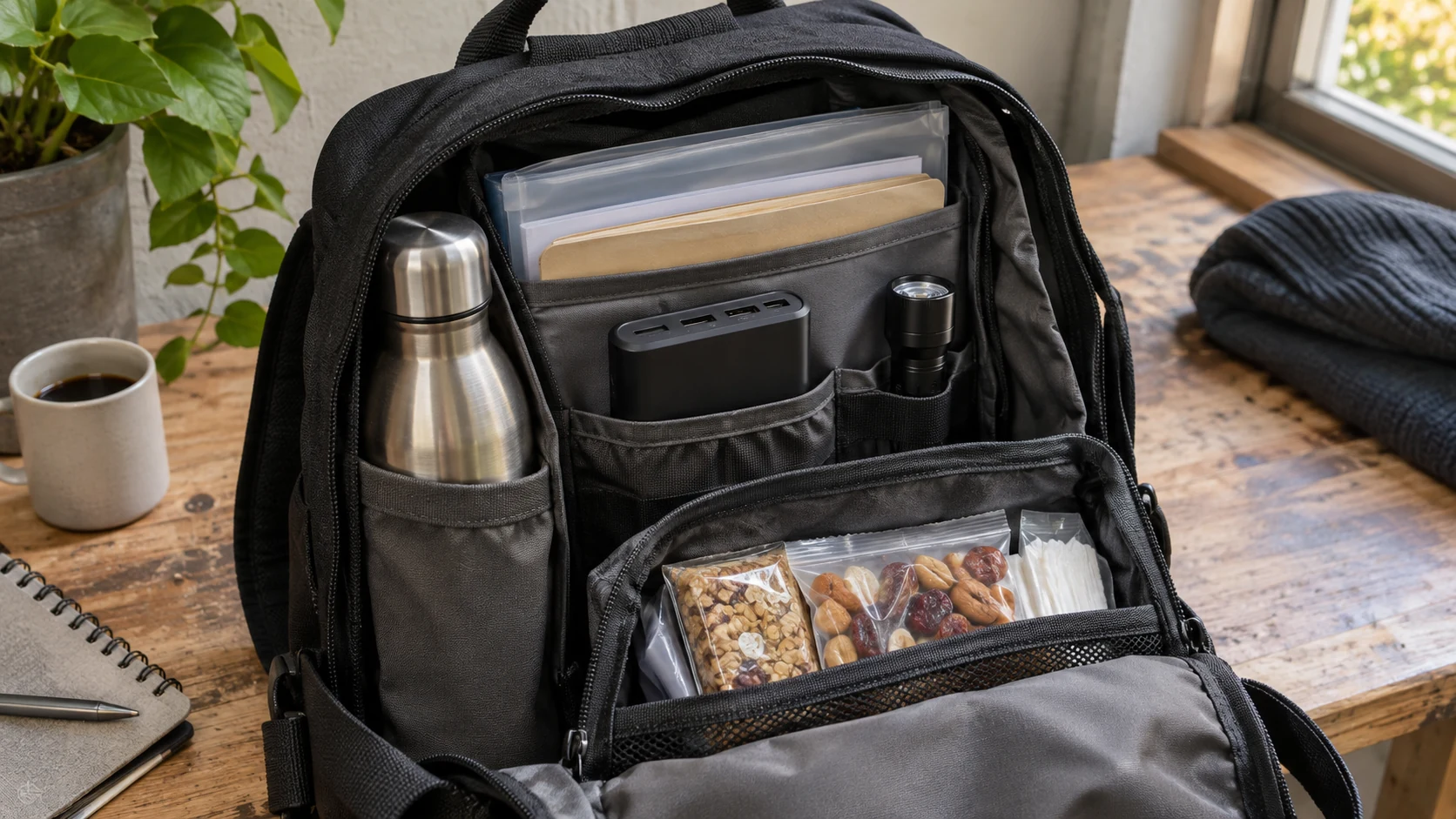
Everyday carry bag: planning supplies for a twelve-hour journey
A daily bag, often called EDC, gathers a few objects that facilitate the next hours when a trip or a day goes differently than expected. The twelve hour mark helps…
By Mathieu Montaroux · Published on March 7, 2025; Updated on November 4, 2026; 11 min read
A daily bag, often called EDC, gathers a few objects that facilitate the next hours when a trip or a day goes differently than expected. The 12-hour marker helps define usage; it does not guarantee universal autonomy. The content depends on the route, the climate, health needs and opportunities to reach a safe place.
Organize before adding
Start with what you’re already using and the difficulties you’re actually experiencing. A discreet, comfortable and easy-to-open bag is often enough. A pouch organizes small objects without requiring to wear an overloaded set. Place frequent items at your fingertips and protect what might flow.
Test the bag during an ordinary ride. If you systematically leave it at home because of its weight, reduce the content. The equipment reserved for the home or the vehicle does not necessarily have its place in the bag carried every day.
Choosing a tool for a known task
A small multifunction tool can help with a light repair. Check the really necessary functions and restrictions of the workplace, transport and establishments visited. A blade may be prohibited in some places. No tool should be used to force access, modify an electrical installation or replace a qualified repair.
A multi-function metal card sometimes adds unusable functions. Compare it to the tool you already know how to use before adding it. The accumulation of advertised functions does not guarantee their effectiveness.
Providing an accessible light
A small lamp independent of the phone remains practical during a breakdown. Check the switch, batteries or charging and the risk of accidental ignition in the pocket. The lamp must be found without emptying the bag.
A small rechargeable keychain lighting can complete this organization if its autonomy and storage are suitable. It does not automatically replace a lamp more suitable for a long task.
Write and retain information
A pen and notebook can record a contact, an address or a deposit. A marker can be used to identify a container. Limit the sensitive information being transported and keep a copy of important contacts elsewhere.
If you carry a USB stick, check the files, their protection and the devices on which you could open them. A robust or water-resistant shell does not prove that the data is encrypted. Do not store all your passwords in clear.
Keeping the phone available
Choose a battery with capacity and power consistent with the device. Check the connectors and the cable, and then do a real test. A very high capacity advertised in a commercial record is not an independent measure of usable energy.
A multi-ended cable can be convenient, but its compatibility and charging limits need to be confirmed. Do not assume that all tips charge simultaneously at full power.
Report your presence without creating a new danger
A whistle may allow an audible signal when appropriate. A light stick provides limited lighting without flame; it does not replace a work lamp and must be used and disposed of according to its instructions.
A lighter fuel supply is not a basic need for most city trips. For lighting during a breakdown, choose the lamp. A means of ignition has its place only for an authorized use, prepared and compatible with transport. Do not cook in a closed space with an outdoor appliance.
Water and accessories: recognizing the limits
A bottle of drinking water is a more direct starting point than the idea of finding water to treat in the city. A flexible pocket can facilitate transport, provided it is adapted to food contact and maintenance.
Treatment tablets should match the water and the exact instructions of the product. Dosages and deadlines are not interchangeable between brands. Chemical contamination or a notice of non-consumption is not regulated by an ordinary hiking treatment.
A little bit of rope can help with a light fixation, without being a climbing or rescue equipment. A compact utensil is used for a meal, without justifying the purchase of a “tactical” accessory for each function.
Customize and maintain
Add the special needs that are really needed: treatments organized with the usual professional, glasses, weather protection or small snack adapted. Periodically check your destination’s consumables, recharging and restrictions.
Practical test : find the lamp, a contact and the cable without unpacking everything. Then remove an object that you cannot explain its use. The bag should facilitate a safe decision and a realistic move; it should not encourage you to stay in a dangerous area.