
In this article
Most people who prepare do so for certain kinds of events, and most keep their supplies in the same place: at home. Water, food, gear, a first aid kit, documents, all stored at home, ready for the day they’re needed. That setup rests on an assumption that’s rarely spelled out: that you’ll be at home, or close by, when the crisis hits.
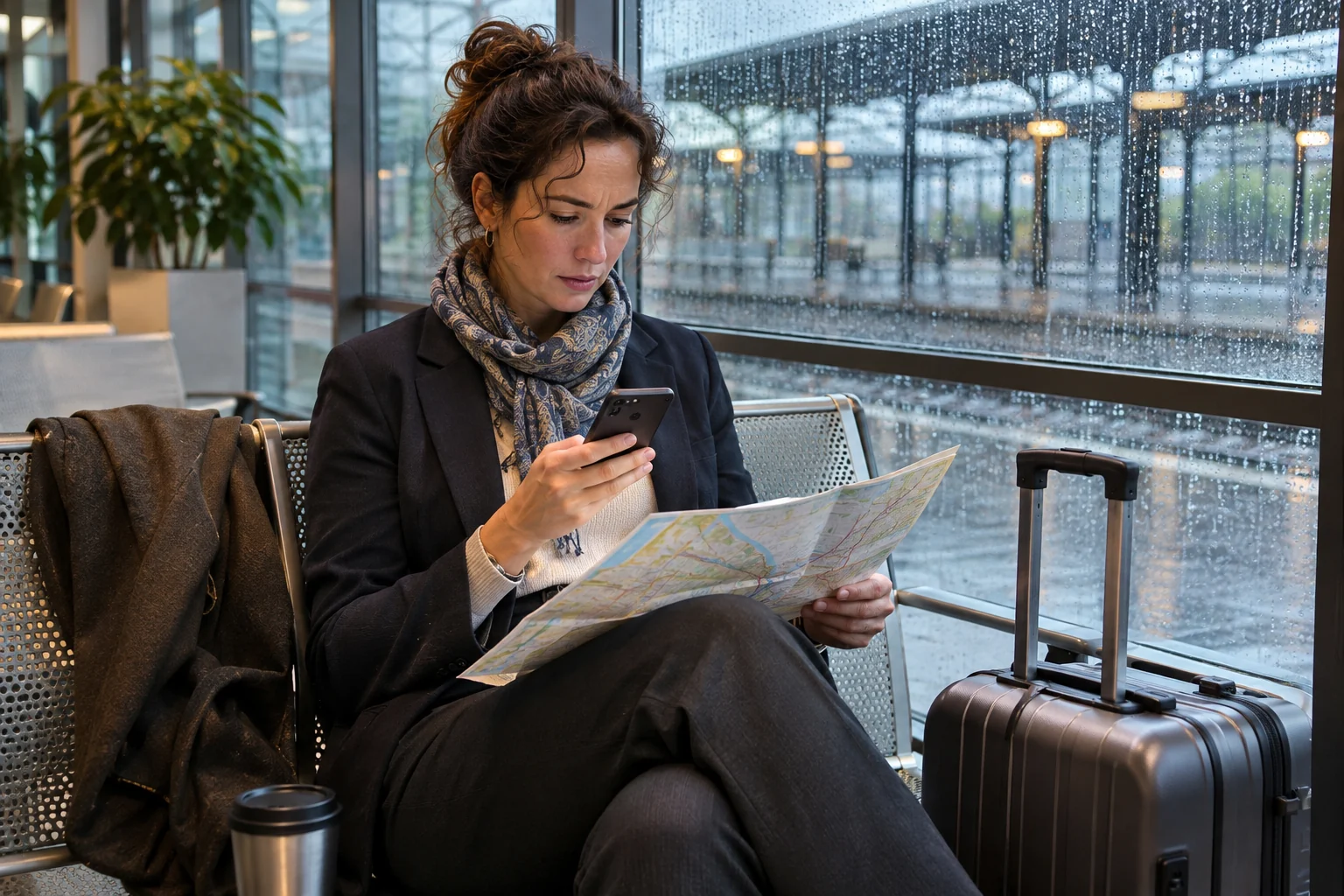
But what if you’re away? What if you’re tens or even hundreds of kilometres from your supplies and your family, on a business trip, on vacation, visiting relatives or on a day trip? Is all lost? No. But you need to have thought about it beforehand.
In short
In short. A crisis can hit when your family is scattered and you’re far away. Prepare three things: a family communication plan (who stays where, who to notify, where to leave a message), a small travel kit (water, a light, a charger, suitable clothing, medication, documents, cash), and a clear decision rule for when to head home and when to wait somewhere safe. Always follow local authorities’ instructions wherever you are.
A crisis while you’re away
Leaving home in the middle of a crisis, with much of your gear left behind, is the last thing a prepared person wants. Yet millions of people might have to if circumstances required it. And the reverse is even more likely: not being able to reach your supplies because you’re far away.
Daily life regularly takes us away from home: work, vacations, business trips, family obligations, a day out. If disaster strikes then, serious delays or obstacles can separate you from your family and supplies. Murphy’s law also suggests the unexpected rarely happens when the whole family is home, healthy and ready. It’s far more likely to happen in broad daylight, when everyone is at work, at school or elsewhere, and you have to manage without your supplies for a few hours, maybe a few days.
For daily commutes, see our article on a plan for getting home from work. This one focuses on longer absences.
Share your plan before you leave
In the worst disasters, communications can be cut or overloaded for a while. Amateur radio is often suggested as the answer, but it requires a certificate and know-how: it isn’t like making a phone call, and handheld units need repeaters to cover long distances. For most families, the real answer is a simple plan agreed in advance that works even when you can’t talk.
Before each trip, make sure your family knows:
- where you’ll be, with your accommodation address and itinerary;
- what they’ll do if a crisis hits: usually stay home if they’re not in danger, knowing you’ll do everything to get back;
- where they would go if they had to leave (fallback locations agreed in advance), and how to let you know: a message left in a specific spot, a text to the out-of-area contact;
- which out-of-area contact to reach, since it’s often easier to reach someone far from the affected area.
That last point is essential: if your family has to leave home, they need to tell you where they went, so you don’t come home to an empty house with no idea where to look. See also our article on the family emergency guide for when you’re away.
If you’re travelling abroad, register with your government: Registration of Canadians Abroad, or Ariane for French travellers, lets authorities reach and inform you in a crisis. Also keep the embassy or consulate’s contact details.
Head home right away or wait?
That’s the big question. In discussions among prepared people, many say they would leave immediately to rejoin their family. The instinct is understandable, but it deserves some nuance. Leaving early has real advantages: roads aren’t jammed yet, stores are open, cash is still accepted, and you avoid lineups for fuel and transport seats. For a trip by car or train, a decision made in the first hour is much more likely to work out.
But leaving isn’t always the best option. A snowstorm, a flood, a wildfire, closed roads or a shelter-in-place order can make the trip far more dangerous than waiting. In those cases, staying at your hotel, with your hosts or at a reception centre, in touch with your family through the out-of-area contact, is often the safest choice. Getting home safe a few days later beats hitting the road at the worst possible moment.
Contrary to a common belief, people don’t all freeze or panic in a disaster: research shows panic is rare and mutual aid is common. Many people do, however, take time to react while they figure out what’s happening. Paying attention to information (alerts, radio, local instructions) and deciding quickly, but without rushing, is still an advantage.
Set a simple rule in advance, for example:
- I leave right away if the road is safe, the authorities aren’t asking people to stay put and I have reliable transportation.
- I stay safe where I am if conditions are dangerous, roads are closed or a shelter-in-place order is in effect; I let my family know through the out-of-area contact.
- I reassess every 12 to 24 hours, as the situation and instructions evolve.
A rule set in advance avoids deciding on emotion.
- Safe road, no contrary instructionReliable transportation available: leave in the first hour.
- Dangerous conditions or shelter-in-placeStay at the hotel, with hosts or at a reception centre; notify family.
- Every 12 to 24 hoursBased on instructions, weather and road conditions.
A small travel kit
Some people travel with a full go-bag. It seems logical, but it’s impractical for most trips, especially by air. A more realistic approach combines everyday items (phone, light, a multi-tool that complies with transport rules, a bandana, a water bottle) with a small get home bag suited to the destination. For what to put in it, see our article on the get home bag.
Before you leave, check your luggage and add, depending on the destination and season:
- a water bottle or hydration bladder, and a few purification tablets;
- a power bank and cables;
- your medication for a few days longer than planned, with the prescription;
- copies of your documents (ID, insurance, contacts);
- some cash, in local currency if you’re going abroad;
- clothing suited to walking: a rain layer, a warm layer, sturdy walking shoes. Nobody wants to walk through Montreal’s suburbs in January in dress shoes;
- a paper map of the area between your destination and home.
If you’re flying, follow aviation security rules (knives and tools not allowed in the cabin, liquids limited): those items can go in checked luggage or be bought on arrival. If you’re crossing a border, check the rules of the country you’re visiting, especially for the items you carry.
If you have to make the trip on your own
For short distances, a day or two of walking with the essentials is enough. For long distances, you need more food, a light shelter (a tarp and a sleeping bag or wool blanket) and a map. Food can often be bought quickly before shelves empty if you act early and have cash. A sporting goods or hardware store can fill gaps in your gear. A bike can speed up the trip considerably.
But let’s be realistic: in most situations it’s better to wait for transportation to resume, rent a vehicle, go to a reception centre or ask authorities for help than to cross hundreds of kilometres on foot. A long walk home, as in some disaster novels, is an extreme scenario; your plan should rest first on simple, safe options.
Other people along the way
Unless you’re in the middle of nowhere, you’ll meet other people. Some will need help, others may be able to help you. In the vast majority of disasters, mutual aid prevails: strangers share water, offer a ride, open their doors. Teaming up with other travellers heading the same way is often an advantage.
Caution still applies: keep your gear low-key, don’t show everything you’re carrying, avoid tense gatherings and dangerous areas, and favour busy roads and official reception centres rather than hiding away from roads. Travelling at night is generally riskier (accidents, falls, cold); walk by day and rest in safe places. If a situation feels threatening, move away and alert the authorities.
What if the whole family is away from home?
If you’re all travelling together, the stress of separation disappears, but the logistics change: more mouths to feed, children to carry or reassure, special needs. In that case the best strategy is almost always to stay safe where you are, follow local instructions and head home when conditions allow. Pack medication and snacks for a few extra days, and some entertainment for the kids.
Everyone has a different life and different realities. What matters is having thought, before you leave, about what you’d do if a crisis struck while you were away, and having talked it over with your family.
The pre-trip check
The best preparation for a crisis far from home happens the day before you leave, in fifteen minutes. Get into the habit of reviewing these points before any trip longer than a day:
- Itinerary shared: your family and out-of-area contact know your dates, accommodation and transportation.
- Family plan up to date: everyone knows what to do and where to go, and where to leave a message if they must leave home.
- Destination risks: wildfire, hurricane, winter storm or flood season; check weather alerts and travel advisories.
- Travel kit: water, charger, light, medication for a few extra days, document copies, cash, clothing and walking shoes.
- Backup transportation: identify an alternative (train, coach, car rental, ride-share) and a paper map of the region.
- Alerts set up: local alerts on your phone, Registration of Canadians Abroad or Ariane if you’re leaving the country.
- Home in order: supplies accessible for those staying behind, working alarms, the family emergency guide in its place.
Here’s an example: you’re on a trip 400 km from home when an ice storm hits your region. Roads are icy and the power is out at home. Your family follows the plan: they stay home, safely heat a single room and text you through the out-of-area contact. You stay at your hotel as long as authorities advise against travel, extend your booking, then head home when the roads reopen. No heroics: just a plan everyone knows, which avoids needless risks.
Frequently asked questions
Should you travel with a full go-bag?
Rarely. A small kit suited to the destination, combined with everyday items, is enough in most cases. The rest can often be bought locally.
What should my family do if I’m far away?
Usually stay home if they’re not in danger, follow instructions, and tell you where they’re going if they must leave, through a message left in an agreed spot or the out-of-area contact.
Should you leave immediately to get home?
Only if the road is safe and no instruction asks people to stay put. Otherwise, waiting somewhere safe and reassessing regularly is often wiser.