
In this article
- In brief
- 1. Why sanitation is part of preparedness
- 2. The ingenuity of earlier generations
- 3. Managing the buckets: a simple, effective system
- 4. Dealing with waste: safety first
- 5. Flies: an enemy not to underestimate
- 6. Summary table: good practices
- 7. Lessons for today
- Frequently asked questions
- Further reading
- Sources
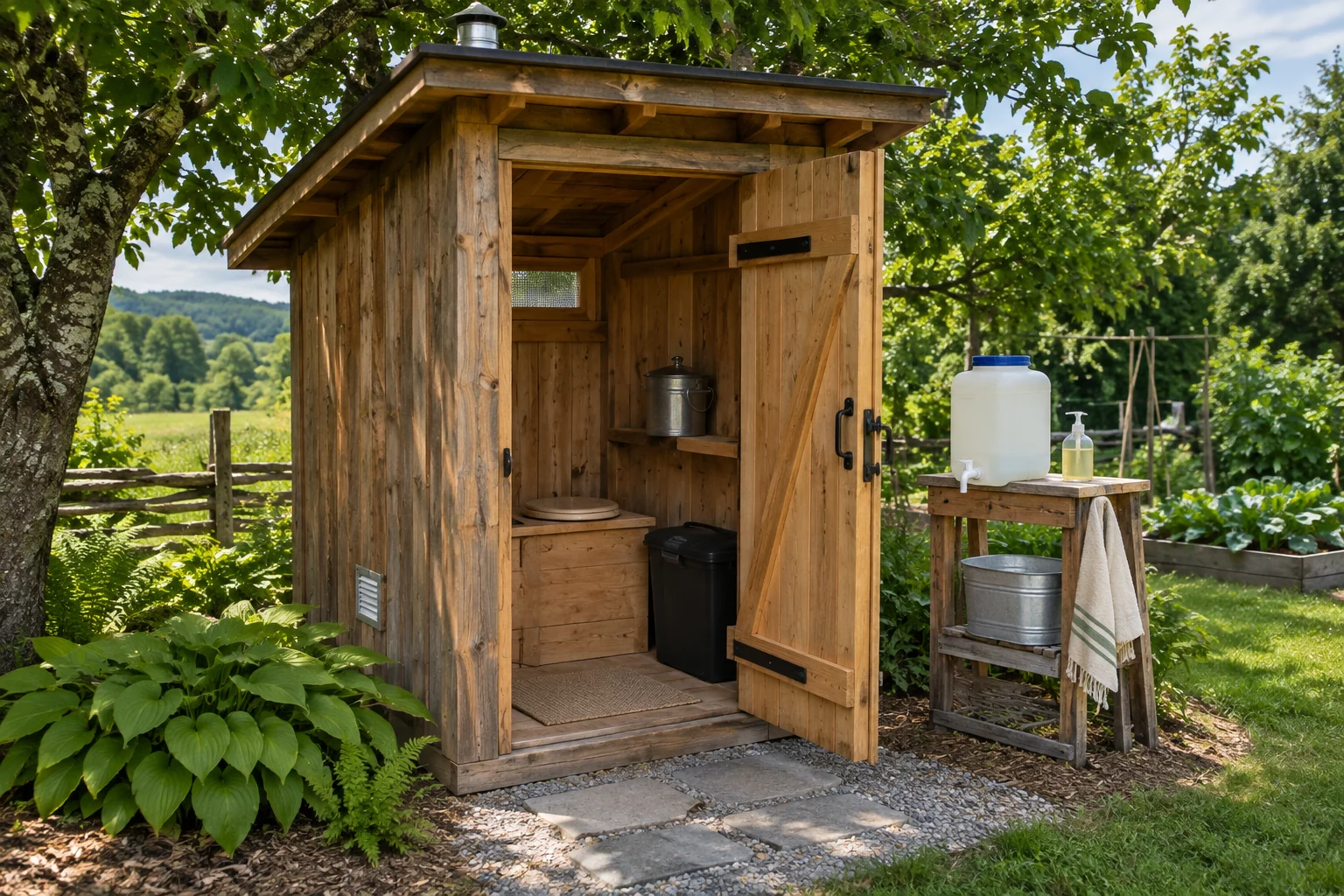
Sanitation seems like a minor topic… until the day the toilets stop working. A long water outage, a frozen pipe, a sewer backup, a cottage without running water or an extended stay off-grid: suddenly you have to manage the whole family’s needs, in the cold or the rain, without losing hygiene or dignity. Our ancestors lived this for centuries, and the old Quebec outhouse, the “bécosse,” is its symbol.
A 1909 book, Household Discoveries and Mrs. Curtis’s Cook Book, already offered plans for outdoor “sanitary closets” and surprisingly modern maintenance advice. This article revisits those lessons, compares them with current hygiene knowledge and explains what is allowed or recommended today, in Quebec and elsewhere.
In brief
In brief. A well-managed outhouse or dry toilet protects health when regular toilets can no longer be used. The principles have not changed since 1909: cover each use with dry material, alternate containers, keep waste away from any water source and fight flies. For a home emergency, a bucket toilet with bags and sawdust is enough. A permanent installation is regulated: in Quebec, check with your municipality before building one.
1. Why sanitation is part of preparedness
People think first of water and food, much less of human waste. Yet illnesses spread by poor waste management, such as gastroenteritis, are among the first health problems after a disaster. Flies, poorly washed hands and contaminated water are enough to spread germs through a household.
Planning an emergency toilet protects the family’s health, but it also preserves dignity and morale. A clean, simple system that everyone knows avoids a lot of tension when a situation drags on.
2. The ingenuity of earlier generations
According to the 1909 book, “any boy of fourteen” with a little practical sense could build an outdoor closet from its plans, at a cost of about 15 to 40 dollars at the time, depending on materials. The design could be adapted to a single seat or several, up to five, depending on the size of the family.
The book also suggested surrounding the structure with a trellis covered in climbing plants for privacy and to blend it into the yard. The idea still holds: a discreet shelter, out of the wind and out of sight, is more likely to be used properly by the whole family.
3. Managing the buckets: a simple, effective system
At the time, each seat sat over a removable bucket rather than a pit. The trick was to have two in rotation:
- bucket A is used for a week;
- bucket B, emptied and cleaned, waits outside, covered;
- the following week, they are swapped;
- after each emptying, a little soil was placed in the bottom of the clean bucket to limit odours and insects.
The same principle is found in today’s dry toilets: each use is covered with dry material (sawdust, wood shavings, dry soil or cat litter), which limits odours, absorbs moisture and keeps flies away. For a home emergency, the simplest version is a sturdy bucket with a lid, lined with two heavy bags. Closed bags are then stored outside in a covered container until collection or until your municipality gives instructions.
4. Dealing with waste: safety first
The 1909 book recommended burning or boiling human waste or, failing that, burying it far away and downhill from any water source. The basic idea remains right: germs must be kept from reaching the water you drink. But burning or boiling waste is unrealistic and dangerous for a family.
Current guidance is simpler:
- In cities and suburbs, keep bags closed and follow municipal instructions; never dump anything into storm drains or waterways.
- In rural areas or when camping, a latrine or burial hole must be placed far from wells, springs, lakes and streams. Humanitarian standards use at least 30 metres from a water source, and more if the soil is sandy or the water table is close to the surface. Always place it downhill and away from flood-prone areas.
- At a cottage or isolated residence, a permanent installation such as a pit privy or composting toilet is regulated in Quebec by the regulation respecting waste water disposal systems for isolated dwellings (Q-2, r. 22). Check with your municipality before building.
Some farmers used this waste as fertilizer. That is risky: human waste can contain parasites and bacteria that survive a long time in soil. Never use it on crops eaten raw, such as lettuce or root vegetables, unless it has gone through complete, well-controlled composting.
5. Flies: an enemy not to underestimate
Flies carry germs from waste to food and household surfaces. The book already advised keeping a box of lime or soil near the seat to cover each use, noting that people never used enough.
Today, the recommendations are to:
- cover each use with a good handful of sawdust or dry soil;
- keep the lid closed at all times;
- put screens on the openings of an outhouse;
- handle lime with gloves and eye protection, since it is irritating and quicklime can burn the skin;
- wash hands with soap and water after each use, or with hand sanitizer if water is unavailable.
A poorly maintained toilet can quickly become the source of an outbreak in a family or group. Handwashing remains the most effective measure.
6. Summary table: good practices
| Action | Purpose | Frequency | Risk if ignored |
|---|---|---|---|
| Cover with dry material | Limit odours, moisture and flies | Every use | Flies, food contamination |
| Alternate or change containers | Avoid overflow and odours | Depending on the number of users, often once or twice a week | Odours, bacterial growth |
| Keep waste away from water | Protect wells and springs | Each emptying | Water contamination, illness |
| Wash hands | Break the chain of transmission | After each use | Gastroenteritis in the household |
7. Lessons for today
In Quebec as in France, many off-grid families still use dry toilets, and many cottages have no running water. The 1909 lessons still apply: a well-designed outhouse provides hygiene and dignity, and managing waste is essential to avoid illness and contamination.
Resilience is not just about storing food and water. Prepare a simple home emergency toilet now: a bucket with a lid, heavy bags, sawdust or cat litter, gloves, soap and hand sanitizer. Try it once as a family so everyone knows how to use it the day it is needed.
Frequently asked questions
Can I build an outhouse on my property in Quebec?
For permanent use, sanitation installations for isolated dwellings are regulated by Q-2, r. 22, enforced by municipalities. Some dry installations are allowed under conditions, notably where there is no pressurized water. Check with your municipality before building.
What should a home emergency toilet include?
A sturdy bucket with a lid, two heavy bags, sawdust, cat litter or dry soil to cover each use, gloves, toilet paper and a way to wash hands. Closed bags are kept outside in a covered container.
Can human waste be composted?
Yes, but only with a composting system designed for it, well managed and over a long period. The resulting compost should not be used on vegetables eaten raw. In an emergency, bagging and disposal according to municipal instructions is safer.
Further reading
- Step-by-step preparedness plan: home security and hygiene
- Evacuation hygiene kit: preparing for essential needs
Sources
- Household Discoveries and Mrs. Curtis’s Cook Book (1909), available on OpenLibrary.org.
- Regulation respecting waste water disposal systems for isolated dwellings (Q-2, r. 22), Quebec.
- Sphere Handbook, minimum humanitarian standards for water supply, sanitation and hygiene.