
In this article
Personal and community preparedness concerns ordinary needs that may become difficult during an outage, storm, supply interruption or health problem. People interested in it have varied backgrounds. Without an identifiable survey, we cannot quantify motivations or claim what a “vast majority” would do. PrépaCivile aims to reduce practical difficulties through proportionate measures, with a clear role for mutual help and public services.
This guide presents the foundations of preparedness: practical implications, three supporting pillars and how to start gradually without disproportionate investment.
Who is preparedness for?
It can begin without purchases or specialist training: a conversation, local information or a written contact. Some needs still require equipment, training or assistance; describing all preparation as easy and inexpensive would mislead. Adapt the plan to resources, mobility and health, including requesting help when individual self-reliance is unrealistic.
Some misconceptions to clarify:
Preparedness does not mean:
- A conviction that the apocalypse is imminent
- Distrust of institutions or emergency services
- A massive financial investment in Explore the resources
- A marginal or ideological lifestyle
- An obligation to build an arsenal
What it does mean:
- Explore the resources and resources for disrupted conditions
- Complementing institutional arrangements rather than replacing them
- A gradual approach adaptable to each situation
- Adaptation to age and abilities with support and assistance where necessary
- Combining needs, skills, resources and support rather than opposing them
Preparedness seeks informed self-reliance—the ability to decide and act during disruption—not total independence from society. Responders, institutions and community solidarity networks remain complementary resources, not adversaries.
Three fundamental pillars
Sound preparedness combines three dimensions. None is sufficient alone; together they create a coherent, robust approach.
1. Skills
Practical skills may help: raising the alarm, using a kit within your training, reading a map or following instructions. They also require refreshers, practice and sometimes equipment. They may deteriorate or become inapplicable; claiming skills can never be lost or become outdated would mislead. Learning once to light a fire, treat water or preserve food does not generalize to every situation.
Useful skills develop gradually. Priorities vary by household profile—urban, rural, children or living alone—and geography, such as flood zones, northern regions or nearby critical infrastructure.
2. The plan
Develop a plan suited to actual circumstances. It addresses likely local scenarios, identifies available resources and gaps, and defines actions for different situations.
A suitable plan considers:
- Local risks: flood zones, industrial hazards and dependence on critical infrastructure
- Dependants and particular needs: young children, older adults and people with medical needs
- Meeting points and communication arrangements if separated
- Remaining in place versus evacuating
3. Equipment
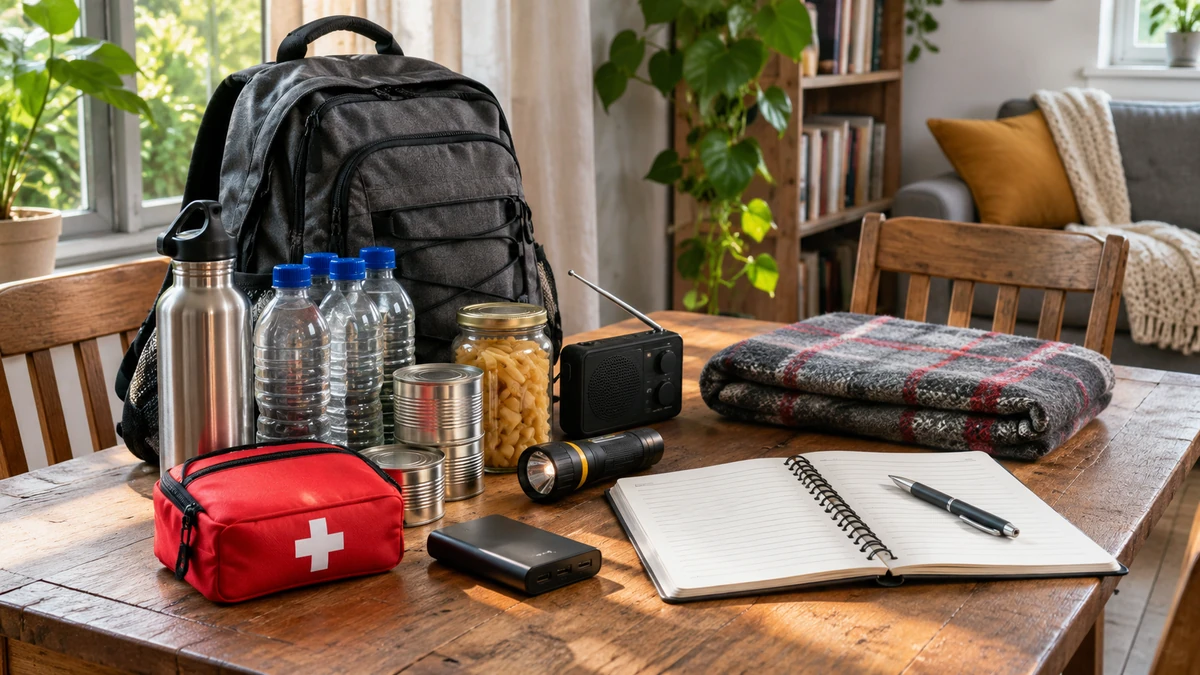
Equipment serves defined functions: lighting, keeping water safe, carrying treatment or receiving information. Its importance depends on needs, particularly mobility aids or medical devices. Willpower and a plan cannot replace it. Before purchase, check use, compatibility and maintenance; seek appropriate advice for critical functions rather than choosing the product most visible in media.
Distinguish home reserves from a carryable bag. Three days or a week of supplies, particularly water for a whole household, may be too heavy to carry. Prepare the bag for departure, particular needs and the intended destination, keeping useful documents accessible. The first-days reference guarantees neither response time nor complete self-reliance; specialist equipment follows actual need.
Skills, equipment and use conditions complement each other. A quality knife is not “infinitely” more valuable than a beginner’s bag and does not measure preparedness. A simple light, contact or first aid course may address a more immediate need. Learning to avoid an unfamiliar action matters as much as using a tool.
When should you begin?
There is no ideal moment: preparedness fits gradually into everyday life. Consider these observations about timing:
Progress matters more than the starting point
Small regular actions may make a plan more concrete than a postponed shopping list. They do not guarantee someone is better prepared in every area than someone else. Choose an observable result—test a light, discuss transport or check reserves—then reassess what remains without imposing a monthly rhythm or six-month duration.
Adapt the approach to real life
Some tasks take little time: record a number, read instructions or check a date. Watching a video does not validate first aid, electrical or water-treatment competence. Divide projects into stages with suitable time and support; someone already overloaded need not demonstrate daily progress for their approach to be legitimate.
Each situation has its own pace
A family with young children, someone living alone in a city apartment, a rural homeowner and a retired person with reduced mobility have different priorities and constraints. Preparedness is inherently adaptable; comparisons across profiles may be unhelpful or counterproductive.
Where to start in practice
With so many topics, choosing an entry point is a legitimate question. Begin with a simple actionable objective achievable this week rather than in six months.
Basic skills to explore first
Distinguish an introduction from a skill actually mastered. These three subjects may interest readers according to activities without being mandatory priorities for every urban household:
- Map reading and navigation
- Fire: learn only within safe, authorized conditions, without using outdoor combustion equipment indoors. It is not universal heating for an apartment outage.
- Navigation without a compass may complement learning but cannot replace a map, planned route or assistance. Do not test a method where an error would create danger.
Next steps once basics are learned
Once comfortable with the fundamentals, possible next steps include:
- Evacuation bag essentials
- A family evacuation bag
- A family evacuation plan
Start with a need connected to a plausible local risk: a winter outage, threatened water or access, or interrupted travel. A limited scenario helps choose an action without making other situations irrelevant. Check health needs and the ability to leave too; do not remain to follow a plan when an evacuation order or immediate danger rules it out.
Exchanging with readers and nearby networks
Exchanges may provide questions, shared experience or local resources. An online presence guarantees neither expertise nor available help. Distinguish personal advice from official information, protect household data and check moderation rules.
The historical Québec Preppers group remains a community space separate from the PrépaCivile website. It allows the community to continue discussions while respecting the group’s rules and people’s privacy. The source also mentioned Telegram: for any prospective channel, check its destination, administration and rules before joining; no unconfirmed registration link is provided here. On PrépaCivile, you can contribute directly to an article, and contributions are reviewed before incorporation.
Offline documentation: check contents and currency
The source offered a Québec Preppers USB drive claimed to contain all articles and resources. This adaptation confirms neither offer, contents, availability nor updates; it must not be advertised as a PrépaCivile download. For an authorized offline copy, retain original documents with date and origin, then check current instructions where possible. No PDF is modified or recreated to replace a missing document.
Frequently asked questions
Do I need a large budget to start?
Several first steps need no purchase: contacts, discussing departure, local information and inventory. Others require budget or assistance of varying scale; do not assume water supplies or a kit are inexpensive for everyone. Begin with existing resources, identify a priority and seek suitable support. Complete bags and longer reserves remain goals adapted to carrying, storage and replenishment abilities.
Does preparedness mean owning weapons?
A weapon is unnecessary for preparing water, care, lighting, communications or departure. Someone lawfully hunting must meet that activity’s obligations. That creates neither general carry or home-defence permission nor an armed neighbourhood role. Rules are not suspended during a crisis and need checking with competent authorities.
How do “prepared resident” and “survivalist” differ?
“Survivalist,” “prepper” and “prepared resident” cover diverse practices; labels alone establish neither ideology, mutual help nor institutional trust. PrépaCivile offers a proportionate approach complementing services and adapting to needs. One to three weeks may be a personal goal in some cases, not a universal standard or guarantee of household independence. What matters is what can actually be prepared and maintained.
Is preparedness suitable for families with young children?
For families, anticipate children’s needs without portraying them as weakness. Food, treatments, changes, mobility, contacts and reassurance deserve an adapted plan. Adults remain responsible for protection and decisions; children may take part through simple actions, without critical loads or missions. Stability and relationships matter too, and activities should suit age and sensitivity.
How can I assess my current preparedness?
My assessment helps organize reflection according to your answers. Its suggestions are neither medical diagnosis nor a home safety inspection. Urgent needs, official instructions and professional advice may take precedence; you can also start directly with a simple action without completing a questionnaire.
Why become a prepared resident?
Practical reasons to prepare for needs with adapted goals rather than ranking people by self-reliance.
Personal preparedness assessment: where beginners can start
A reflection tool for identifying priorities, recognizing self-assessment limits and possible assistance needs.
Prepare without overspending
Building sound preparedness gradually on a limited budget: purchase priorities, economical alternatives and actions requiring no spending.