

In this article
Adding a micro-wind turbine may be considered when a solar installation fails to meet certain needs, but the decision depends on the specific site and equipment. A report of disconnecting from the grid "three weeks ago" does not represent a current, documented experience verified by PrépaCivile; furthermore, the "rainy season" context does not apply uniformly across Quebec. Before concluding that adding more solar panels would be ineffective or that a wind turbine would solve the problem, begin by analyzing your energy consumption, measured production, storage capacity, and periods of energy deficit.
A system combining solar and wind power is feasible, provided the project is specifically designed for it. Simply bringing together a turbine, a charge controller, and a device labeled a "hybrid inverter" is not sufficient. Rectification, regulation, protection, storage, and grid/load connection all depend on the specific model and system architecture. While solar and wind can be complementary, there are also times when both may be unavailable; a constant power supply cannot be guaranteed without a proper energy assessment and an appropriate backup solution.
Charge control units for hybrid wind/solar systems
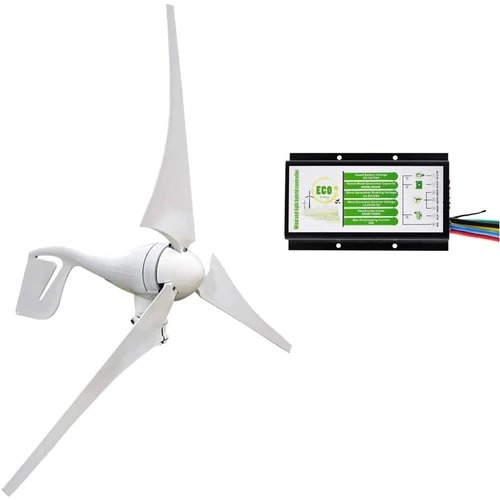
Power sources have different electrical characteristics and cannot be connected interchangeably to the same input. A solar charge controller may have operating requirements that are incompatible with the output of a turbine. The system architecture must account for voltage, current, fault behavior, and battery specifications, while adhering to the manufacturer’s protection requirements and operating conditions. This document does not provide a wiring diagram for direct replication.
An illuminated photovoltaic panel can maintain a voltage even when its circuit is open; therefore, the absence of current flowing to a load does not render it harmless. A wind-driven turbine can also present an electrical output as well as mechanical risks. Its behavior under no-load conditions, its braking mechanisms, and its protective features depend on its specific design. Energy does not simply "accumulate" inside a motor—avoid this explanation, as it could lead someone to dangerously disconnect or short-circuit a component.
Some wind power systems utilize a controller, a braking mechanism, and a diversion load (dump load) specified by the manufacturer. These components must be present and correctly sized for the specific model; simply adding a resistor at random does not provide protection. While it is possible to design a system using separate controllers or a hybrid configuration, the mere fact that you already possess a modern solar charge controller does not determine the feasibility or cost of the project. Evaluate the entire system—including protective measures, structural components, the battery bank, commissioning, and maintenance.
How a hybrid inverter works
An inverter converts a compatible DC (direct current) power supply into AC (alternating current) with specific electrical characteristics. The term "hybrid" can encompass various functions, such as battery management, grid interaction, or other designated inputs. It does not imply that the device can directly accept any renewable energy source. A battery stores energy; it is not a source of energy production comparable to wind or solar power.
The claim that the majority of residential installations use a hybrid inverter is not substantiated here. An input designed for a generator cannot automatically accept the output from a wind turbine, as the voltage, frequency, and operating behavior may differ. Do not replace an auxiliary power source with a turbine simply because a connection terminal appears to be available; the manufacturer and the system designer must confirm the connection requirements.
Replacing an inverter is not always necessary, nor is it always sufficient. A project may require different system architectures depending on the equipment involved. A thorough assessment must verify overall compatibility and operating modes—including scenarios such as power outages, fully charged batteries, system faults, or high wind speeds. Adding a hybrid inverter does not automatically guarantee a reliable and constant power supply for the entire home; request a written description of the intended operation and its limitations.
Electrical integration: matters for qualified professionals
The choice between individual components and an integrated system depends on technical documentation, certifications, and the existing installation. A controller marketed as "hybrid" does not necessarily simplify or optimize every system. Identify authorized inputs, battery limits, fault protection mechanisms, and conditions for grid disconnection. Wiring requires skilled design and execution; it is not merely a matter of joining positive and negative leads.
A modular design may incorporate regulation specific to each source, provided the equipment manufacturers and the system architecture allow for it. The traditional term "manual transfer switch" is imprecise; switching, conversion, and regulation are distinct functions. Simply having a compatible nominal voltage does not mean that equipment can be connected. Never directly combine outputs or create a backfeed to the grid; appropriate protection and coordination must be established for every operating mode.
In Quebec, electrical work must be performed by a qualified contractor. If the system is grid-connected, verify the required procedures with the utility provider. The mounting mast, foundations, and site layout also require specialized expertise. While professional installation mitigates certain risks, it does not in itself guarantee specific energy production or financial profitability. Request the underlying design assumptions and commissioning documentation rather than relying on a vague promise of "energy autonomy."
Before making a purchase, compare specific models by reviewing their power curves, technical manuals, and the feasibility of your site. Do not assume that a "forthcoming" guide is available until it has been officially completed and verified.
Expanding your solar energy system or adding a wind turbine
Your comparison should be based on the specific service you require—such as reducing electricity purchases, powering certain appliances during an outage, or operating entirely off-grid. These different objectives may not necessarily require the same type of installation. Solar expansion, energy storage, the reduction of certain types of consumption, and wind power must all be evaluated over the same timeframes and against the same requirements, without automatically favoring any one technology.
Reliability versus productivity
A secondary energy source can provide power at certain times, though it does not necessarily improve reliability; it also introduces additional components and maintenance requirements. It is important to distinguish between instantaneous power (measured in kW) and energy produced over a period of time (measured in kWh). A turbine with a 1 kW nominal rating will not consistently deliver 300–400 W, even if an average capacity factor of 30–40% is estimated—such a percentage is not guaranteed for a small-scale site. Wind measurements taken at the intended operating height, combined with power curves and projected losses, allow for an estimation of energy output, while also accounting for inherent uncertainty and potential periods with no production.
How to interpret a quote: If an average power output of 300 W were maintained consistently for twenty-four hours, the energy produced would be 7.2 kWh (before accounting for losses). This calculation cannot predict future wind conditions. Compare this energy output against the measured consumption of your priority appliances and the actual usable capacity of your battery bank—taking care to distinguish between the different units of measurement.
Legal Aspects
There is no universal "optimal" height—such as 65 feet (approximately 20 meters)—for a turbine. Factors including obstacles, turbulence, the tower, foundations, required clearances, maintenance needs, and local regulations must all be carefully evaluated. Rural environments are not free from constraints. Consult with your local municipality and relevant authorities before making a purchase; electrical permits do not supersede zoning, planning, or structural requirements, and installing a small turbine on a rooftop is not necessarily an appropriate solution.
Noise Disturbance
Noise levels vary based on the specific turbine, wind speed, site layout, vibrations, and the proximity of neighbors. Simply being a "modern" model does not automatically make a turbine nearly silent. Request relevant data and information regarding the conditions under which noise measurements were taken; verify local regulations and discuss potential noise issues—but be careful not to assume that a low noise level specified for a certain distance will necessarily apply to your specific property.
Maintenance and Associated Costs
Consider the total cost, which includes equipment, site assessments, the tower, foundations, safety/protection systems, site access, installation, ongoing maintenance, and the eventual replacement of parts. The historical rate of 1.5% to 2% per year is not a guarantee of actual expenditure. The calculation of $120 to $160 on an $8,000 purchase is arithmetically correct, but it remains a hypothetical example—not a formal quote or a current price. Any intervention requiring specialized lifting or relocation equipment can significantly alter the budget.
Conclusion
A micro-wind turbine can complement a solar power system, provided the site is suitable, the architecture is permitted, and the system is correctly sized. The decision should be based on a formal study, not merely on the inclusion of a hybrid controller in a commercial offer. Factors such as wind conditions, energy storage, maintenance requirements, proximity to neighbors, and grid or system connection constraints may make an alternative solution preferable. Energy independence is not guaranteed simply by combining two variable energy sources.
Before modifying your system, obtain a proposal that details the equipment, operating modes, safety protections, and projected energy production. Verify that the necessary professional qualifications and permits are in place, and keep all original documentation and maintenance information on file. While this documentation provides a basis for comparison, it does not serve as a DIY guide for making electrical connections. Do not attempt to test a turbine on your existing system just to see if the inverter will accept it.
Sources for the study of the project
Hydro-Québec: self-generation approachandPlanning a solar installation— including the relevant stakeholders and the authorizations required, depending on the project. TheU.S. Department of Energy’s guide on small-scale wind powerhighlights the importance of a site assessment; however, its U.S.-based guidelines do not constitute valid permits in Quebec.
Equipment to compare for your needs
Some links below are affiliate links: we may receive a commission at no additional cost to you. Products are examples by function, to choose according to your needs; buying the entire selection is unnecessary.