
In this article
- Moving beyond labels to discuss household preparedness
- Get ready because you can't predict what's going to happen
- Recent habits do not guarantee continuity of all services
- Daily situations you can prepare for
- Natural disasters and climate change
- Technological risks such as artificial intelligence and CRISPR
- Economic shocks and the future after work
- Diseases and panic
- Understanding the limitations of services and preparing useful supplements
- Maintaining useful skills rather than comparing generations
- A growth mindset and enjoying preparedness
- Ready to start?
Reasonable preparation can improve certain daily decisions, regardless of opinion, age or place of residence. However, it must be adapted to resources and capabilities: it cannot be assumed that all Canadians have the same storage, training or travel opportunities. This guide examines the reasons for preparing a home without assigning, in the absence of an identified survey, a percentage of the population without reserves or skills.
The guiding thread: many situations can interrupt a household's ordinary functions: travelling, drinking, eating, receiving care and reaching a loved one. This guide preserves the historical article's themes and corrects figures, quotations or promises that are not established. It does not predict the next crisis or claim to calculate anyone's lifetime probability of experiencing a disaster.
Moving beyond labels to discuss household preparedness
Preparing does not require a political identity or an extreme way of life. A maintained lamp, a family contact and a usable reserve cover ordinary needs. Also avoid referring to "paranoid" people who are concerned: psychological difficulty requires respect and sometimes support, not a comparison with equipment or a quantity of supplies.
The history of certain media and communities helps explain why fortifications, isolation and military equipment are often associated with the subject. These images do not describe everyone preparing their home. Without an identified study, summarizing the social or political origins of this entire community would be misleading. A household's needs and constraints are more useful than that classification when discussing a practical action.
An open approach: a family, someone living alone, a tenant, student or retiree can examine their dependencies and seek suitable assistance. Preparedness should not be presented as evidence of intelligence, success or superiority. The same functions can be covered in different ways: personal resources, neighbours, public services and professionals.
Who's really getting ready?
People with very different work and family situations may be interested in preparation. The choice of a known personality or billionaire does not, however, constitute evidence of relevance to your home. Start with a plausible interruption and ask what functions would become difficult. A modest but accessible solution can bring more than a spectacular device that cannot be maintained.
Systems thinking helps identify connections: a phone depends on charging, medical equipment on a power supply and a journey on an open route. These are dependencies we can check. The fame or wealth of someone who prepares does not establish imminent danger or the best response for everyone.
Get ready because you can't predict what's going to happen
Knowing a difficulty can occur is not always enough to prepare for it. Tasks require time, information and sometimes money; some can also be emotionally difficult. The following examples distinguish a general intention from a next action without judging people whose means or priorities limit their options.
Death
End-of-life planning may involve contact information, wishes and useful documents prepared with competent professionals. A will or estate process depends on applicable rules and personal circumstances; this guide does not replace legal advice. The idea is to know where relatives would find necessary information and to confirm arrangements.
Retirement
Retirement and reduced activity may require financial and administrative preparation. Needs and resources differ; a lack of savings does not establish that someone simply avoided the subject. For this guide, focus on knowing essential expenses, resources and relevant contacts, then obtain advice suited to important decisions.
Bad decisions
A daily habit can be adjusted when a difficulty appears: overspending, a device never charged or a repeatedly forgotten item. One meal cannot establish someone’s diet or health. Choose a specific behaviour whose effects you can observe and discuss with the person concerned.
Postponing a task may reflect uncertainty, workload, cost or a subject that is difficult to discuss. Breaking it down sometimes helps: locate a document, ask a question or confirm a contact. This does not remove structural obstacles. Constructive preparedness distinguishes what the household can decide, what requires assistance and what remains outside its control.
A proportionate reference: optimism and trust in services do not make accidents or storms impossible. Conversely, one failure does not prove all systems will stop. Preparing an alternative complements collective resources; it does not require treating people or institutions as fundamentally unreliable.
The mistake of focusing on a single scenario
Focusing exclusively on war or collapse can obscure an outage, a closed route or a health problem. Extreme scenarios can be exercises, but they are not forecasts. Examine several shared needs and some local risks before multiplying purchases for an event whose probability is not established here.
Relate efforts to available local information, the seriousness of consequences and household needs. A numerical probability is not always known or applicable to an address. A measure useful in several situations — contacts, documents or simple meals — may take priority even without a precise ranking of every possible event.
Recent habits do not guarantee continuity of all services
Advances in housing, water, health care and communications have transformed living conditions, but access varies by location and resources. Comparing a middle-income person with the wealthiest people of another century requires comparable indicators. Identify the services your daily life depends on without assuming a universal golden age or inevitable collapse.
History includes improvements, disruptions and very different regional situations. Reducing it to a simple alternation between prosperous civilizations and general decline would mislead. For family preparedness, the practical lesson is more concrete: equipment or arrangements that work normally may need an alternative when a condition changes. Keep opportunities to adapt rather than a fixed narrative about the future.
The Trap of Normality Bias
A long experience of reliable services can make dependencies and their limitations less visible. Conversely, a difficult experience may lead to overestimate some hazards. It is not necessary to attribute this phenomenon to all humans or to an age group: you can simply check the assumptions that your own plan takes for granted.
“Normalcy bias” is often used to discuss expectations that usual conditions will continue. It is not a diagnosis to assign a relative who refuses a purchase. To test an assumption, ask what would happen if a service were unavailable and what information would change the decision. An announced exercise is more useful than a surprise difficulty.
Sustainable growth or temporary bubble?
Economic, technical and environmental debates present a variety of perspectives. To say that "experts" all announce unsustainable progress would mask these differences. The home does not need to resolve this debate to act: it can examine its expenses, access to care, travel and alternative resources, and then identify decisions that are too dependent on a single favourable condition.
Three frequently discussed areas deserve separate examination. Debt concerns income, expenses and due dates; supply chains connect businesses and regions; environmental damage can change how a place is used. Their combination does not predict a general crisis. It mainly invites identification of the household's essential commitments, suppliers and resources:
- Debt: know due dates, essential expenses and relevant contacts; debt does not automatically become good or bad according to a single measure of economic growth.
- Supply chains: examine lead times, supplier concentration and alternatives without assuming every producing country has identical working conditions or regulations.
- Environment: To distinguish an observed local effect, a documented trend and a hypothesis; prevention and adaptation measures sometimes require collective and professional decisions.
Compare living conditions with identified indicators
To assess change, specify the indicator, location, period and method. An opinion survey about children’s futures measures perceptions; it does not predict income or health. Check the survey and its date before presenting a percentage as a current finding.
- Control point: The proportion of people saying that their children will live better must be linked to a specific survey, its question and its population; the historical figure of 37% is not presented as a current measure of Canada.
- Comparisons over time: changes over ten years require comparable questions and samples. “Almost double” is not a statistical series when no publication allows the calculation to be checked.
- Intergenerational comparison: old values of 20% and 67% are not used to classify the capacities or prospects of two generations. Income, housing, ages and survey formulations may change the meaning of comparison.
A pessimistic perception can open a discussion of needs without demonstrating that all conditions are getting worse. For the home, take note of the concrete changes: an expenditure that has become difficult, a less reliable journey or a need for new help. Then choose a proportionate action, instead of trying to prove that the future would be uniformly better or worse.
Daily situations you can prepare for
Before we talk about catastrophic scenarios, let's focus on the common and realistic emergencies you could face:
Transport and travel
- Car accidents
- Mechanical breakdowns
- Stuck in the snow
- Getting lost while hiking
Medical emergencies
- Heart attacks
- Broken bones
- Burns
- Haemorrhage
Domestic accidents
- Fires
- Frozen water pipes
- Power cuts
- Home invasions
Personal security
- Domestic violence
- Assaults
- Theft and burglary
- Carjacking
Concrete example: car accidents in Quebec
The original SAAQ road safety report for 2016 provides a verifiable historical example. Distinguish a fatal collision from the number of people killed: several people can die in one collision. These figures concern 2016, not the current year, and do not calculate an individual driver's collision frequency.
- Deaths in 2016: the SAAQ report records 351 deaths. The 327 fatal collisions are a different count: more than one person can die in the same collision.
- Injuries in 2016: There are 1,476 seriously injured and 35,826 slightly injured. These categories must remain distinguished from a number of collisions or a count of persons with disabilities.
- Total: 37,653 casualties across these categories. These counts cannot establish a personal probability without a defined exposed population and period. Distinguish casualty counts, collisions and rates before comparing them.
Knowing one hundred people who have not reported an injury neither proves exceptional luck nor predicts the next hundred. The report highlights everyday exposure, then encourages vehicle preparation, contacts and first aid within the limits of training. The original PDF is retained unchanged and identified as historical.
The concept of the Get Home bag
A travel or return kit (“get-home bag”) can complement the evacuation bag kept at home. Contents depend on the route, vehicle and needs: water, suitable clothing, lighting, communications and necessary personal items. It is not a basis for calling someone a “good” or “bad” preparer. Also check storage conditions at work or in the car.
These get-home bags can help not only during a major disaster but in everyday situations: witnessing a highway collision, a winter breakdown or needing to assist someone.
Accessible equipment and training can help with particular actions: alerting services, describing a location, providing protection without personal danger or performing a learned first aid action. They neither require physical intervention nor replace emergency services. The best decision may be to keep away from dangerous traffic or unstable structures and transmit precise information.
Natural disasters and climate change
Natural hazards can disrupt housing, travel and services. Their consequences vary with exposure, construction, health and collective resources; they are not evenly distributed. Local weather preparation is still useful, without presenting nature as a hostile force or assuming that all households could absorb its effects alone.
A disaster can be understood as a serious disturbance exceeding the usual capacity of a community to deal with it. It must be distinguished from the physical phenomenon itself: rain, earthquake or heat become more or less harmful depending on people, places and means. The WHO citation in the old text is not reproduced as a verified official definition.
For the family plan, translate this distinction into functions: access to usable water, meals, protection, care and communications. It is also necessary to provide for people who cannot reach a place of help alone. A good understanding of the danger does not replace an actually available assistance solution.
Global assessment of natural disasters

These data cover 1994–2013, not the 2000–2019 period of the report discussed in the text.
The CRED–UNDRR report for 2000–2019 uses EM-DAT's recording criteria. It describes 7,348 major recorded events in that period. These figures do not cover every local incident or predict an annual total; the same people may be affected repeatedly.
- Mortality over 2000–2019: About 1.23 million lives lost in the events of the balance sheet, rather than a universal annual number applicable to any disaster period and definition.
- People affected over 2000–2019: approximately 4.2 billion cumulative instances in the report's presentation, including people affected more than once. This is not a count of that many unique displaced people.
Floods feature prominently in disaster reports, but their share depends on the period and criteria. Do not combine percentages and volumes from different studies into a single series. For a home, consult local maps and alerts, low-lying routes and building conditions; a global total does not describe possible water levels at your address.
Canada is not spared
A country with infrastructure and services can also suffer significant damage. Their extent depends on the phenomenon and the people exposed, not on a simplified category of "first world". Old death shares by income level are not used without time and source identified. Heat, fire, water and communications can request different responses within a city.
Canada in 2024: dating and comparing insured losses correctly
The Insurance Bureau of Canada table consulted lists approximately $9.4 billion in insured losses and adjusted expenses for 2024, in 2025 dollars. A January 13, 2025 publication gave a different initial estimate. Insured amounts are not total social costs; revisions and monetary bases must remain explicit.
- Annual total: the IBC series consulted ranks 2024 first, with approximately $9.4 billion in 2025 dollars. This dated amount must not be added to initial event estimates without checking their basis.
- Summer concentration: IBC's January 13, 2025 publication reported more than $7 billion in insured losses for four major July and August events. This shows a concentration of losses, not the cost of a future season.
- Toronto and surrounding area, July 2024: the initial publication gave approximately $990 million for flash flooding. Losses from one event and the country's annual losses are different levels of measurement.
- Jasper, summer 2024: The estimate published on 13 January 2025 was approximately $1.1 billion in insured losses. The old figure of 880 million should not be presented as a definitive or present value.
- Calgary, August 2024: about $3 billion in the same publication for the hailstorm. The practical benchmark is to verify the appropriate warnings and protection possibilities, without assuming that preparation would eliminate damage.
- Quebec, remnants of Debby in August 2024: approximately $2.7 billion in that initial estimate. Any comparison with the 1998 ice storm must specify inflation, scope and the type of damage rather than compare two isolated nominal amounts.
The initial estimates of the four events were derived from the LAC publication of 13 January 2025. This dated reference and the current adjusted table respond to different presentations; keep their date and base when you compare them.
Climate change is making things worse
The climate influences several hazards, while exposure, urbanization and vulnerability influence the consequences. This does not make it possible to attribute each local event to a single cause or to announce an identical increase in all phenomena. Trends must be linked to an indicator, territory and period.
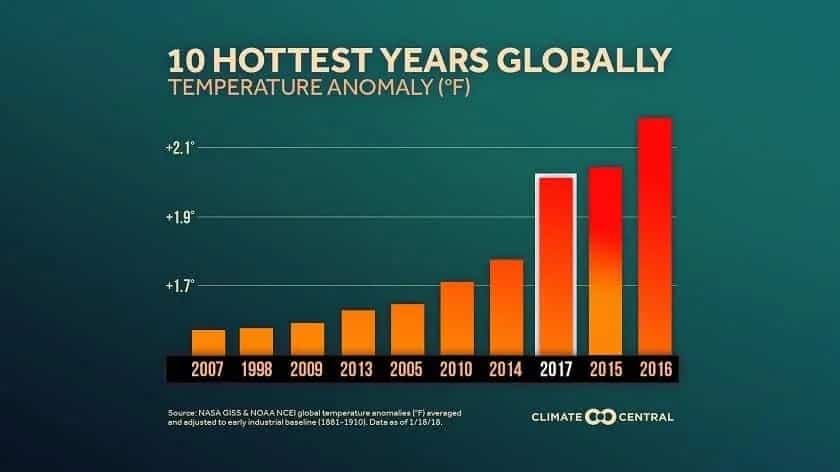
Dated chart ending in 2018; consult recent climate series for subsequent years.
The following examples compare specifically dated observations. They help identify questions to ask without turning a global series into a forecast for your household:
- Global temperature: according to the WMO assessment published in January 2026, 2015–2025 are the eleven warmest years in the observations analysed. Global temperature does not describe every day or neighbourhood.
- Recorded events: a comparison between two periods requires consistent criteria and must consider changes in registration. An increase in recorded disasters does not automatically amount to an identical rise in all physical phenomena.
- When comparing percentage changes, keep the study, scope and period consistent. Local preparedness also depends on information about your area, not merely an aggregated global change.
- Wildfires: distinguish fire starts, area burned, intensity, smoke and population exposure. They do not necessarily change together. A claim of global doubling since 1980 is not used here as a single risk indicator.
- Ecosystems: the Great Barrier Reef faces pressures and bleaching events; it has not been declared entirely “dead”. Monitoring by its management authority describes different conditions across reefs. A degraded local condition must not become a uniform diagnosis for the entire ecosystem.
Sea level rise
Sea level rise requires a baseline, time horizon and scenario. A single figure of 79 centimetres presented as certain over coming decades does not account for these parameters. Distinguish global mean sea level, local effects and inundation during a storm. For coastal housing, use local maps and instructions rather than directly applying a global threshold.
The number of exposed communities varies according to the coastal definition, the populations selected and the projections. The old figure of 670 does not allow it alone to decide where to live or when to leave. Check local studies, access infrastructures and evacuation procedures. A real estate or construction decision requires specialized information, beyond this preparation guide.
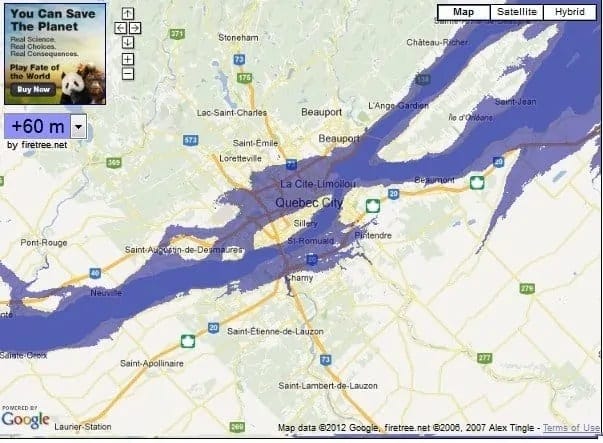
Hypothetical +60 m simulation: this is neither a local forecast nor a flood warning.
Forest Fires: follow several indicators and local conditions
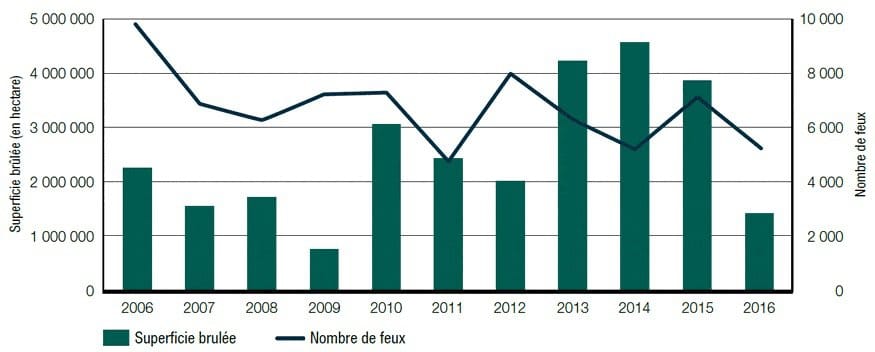
The two indicators use different axes; this 2006–2016 series does not describe the current season.
Relationships between climate and fire must be examined by region and indicator. Human-caused ignitions, fuels, land management and weather also contribute. Old claims of doubling or a 400% rise are not presented as verified global findings without an identifiable study. For households, smoke, access routes and evacuation orders are directly useful parameters.
Warming and drought conditions can contribute to the danger of fire, but an average of a forested region does not define the risk of a given day. Check the indices and restrictions of the competent services, prepare the reception of alerts and a possibility of departure. Do not stay to defend property solely on the basis of equipment purchased or a quantity of supplies.
Impact on biodiversity and food
Environmental changes can affect ecosystems and food production. Their description requires precise measurements and horizons. The disappearance of 75% of all species during the life of children is not a deadline set here. For the preparation of the home, reasonably diversify food options, know health needs and maintain a usable reserve without presuming an imminent disappearance of all supplies.
Environmental damage has human, material and collective dimensions, not all of which are covered by insurance. Family preparation may reduce some difficulties, but does not replace land use planning, public health or infrastructure protection. Identify what requires personal action and what needs to be reported or discussed with the appropriate officials.
Technological risks such as artificial intelligence and CRISPR
Sci-fi stories sometimes illustrate technology-related concerns, but do not constitute evidence. Discussions on artificial intelligence and biotechnology bring together different questions: reliability of a tool, confidentiality, malicious uses, access to care and choice of governance. A concern expressed by a personality does not give a numerical probability of event.
It is possible to examine these risks without opposing blind enthusiasm to a fear that would be automatically rational because an inventor shares it. Ask what technology, use and horizon are involved. For the home, practical dependencies — data, communications, procedures and alternatives — remain a useful starting point.
Public Debates: Distinguish Warning, Opinion and Established Result
Elon Musk
The former article attributed to Elon Musk a statement on an existential risk of AI, in an American political context. In the absence of a precise primary reference retained with this quotation, it is not reproduced word for word or presented as a scientific conclusion. The subject to be considered is the difference between leaders' opinions and documented evaluations of a given technical use.
Stephen Hawking
The old text also quoted Stephen Hawking about artificial intelligence exceeding human capabilities. This historical attribution is not transformed into a forecast of the replacement of humanity. For a critical reading, look for the original document, its date, conditions and nuances of the subject. A famous name does not replace the examination of evidence or the continuity measures already useful today.
CRISPR and genetic modification
CRISPR refers to a family of gene-editing techniques used in research and some treatments. One concrete example is the US authorization of Casgevy in December 2023, described in the FDA's original announcement. That example does not establish a generally available CRISPR treatment for Parkinson's or Alzheimer's, or that millions will necessarily be cured on a given timetable.
Ethical questions concern the cells treated, possible effects, consent, access and potential inheritance of changes. Embryo research and an authorized treatment of a patient’s cells are different activities. A 2017 embryo publication does not establish clinical authorization or a general rule for current research.
These technologies can bring benefits and require protections, with decisions belonging to research, authorities and professionals. Patients must rely on an appropriate indication and qualified care, not an article's promise. Household preparedness includes neither personal genetic experimentation nor anticipating social conflict as a certain consequence of these advances.
Economic shocks and the future after work
Artificial intelligence, machine learning, robotics, automation, a globalized workforce, 3D printing and unlimited computing resources help us in everyday life. They also change the fabric of our capitalist economy.
Automation can change certain tasks, occupations and organisations. Its effect is not just a uniform elimination of jobs: adoption, new activities, training and economic decisions also matter. The views of leaders cited in an old text can inform a debate at the time; they do not constitute a timetable applicable to all workers.
The statement attributed to Mark Cuban in 2017 expressed concern about tasks being replaced and the need to anticipate change. Without a precise primary transcript, it is not reproduced as an exact quotation. The useful point is to learn about changes in your sector and training resources, without treating personal unemployment as already announced.
Basic income has featured in public debates about automation, including Mark Zuckerberg’s 2017 Harvard address. A debate guarantees neither a programme nor a benefit to include in your budget. Check the assistance actually available to your household with the relevant agencies.
Three levers of economic growth
In the background, the economy develops in several simple ways:
- Productivity: Better organization, tools and knowledge can change production per work or surface unit. Any quantitative agricultural comparison must specify the crop, territory, measure and period; the old example of bushels is not an indicator of the entire economy.
- Reduce costs: Globalization, relocation to low-cost labour countries
- Create a new value: New inventions and services (iPhone, Tesla, etc.)
These mechanisms continue to interact; their development cannot be declared “exhausted” through a slogan. Productivity improvements can also shift tasks and require different skills. For households, the value lies in understanding dependence on an income or sector, then preparing information and options without betting on a single economic scenario.
Efficacy limits
Workload, rest and employment conditions deserve an assessment suited to your situation. Comparing holidays across countries requires distinguishing entitlements, leave actually taken and populations studied. Persistent fatigue can limit preparedness: your plan must accommodate rest and commitments without demanding that you optimize every hour.
An automated tool can be quick for a particular task without replacing professional judgment or operating in the same way elsewhere. The old figure of "3 000 %" applied to cancer detection is not a general clinical measure. Any medical performance requires a relevant population, protocol and validation; this guide does not allow the selection or refusal of an examination on the basis of such a comparison.
Limitations on cost reduction
Wages, living costs and production choices can make budgeting harder. Low-paid employment must not be devalued as though it could not legitimately support a dignified life. For household preparedness, identify essential expenses and support resources, then avoid equipment purchases that would immediately undermine housing, food or care.
The effects of a minimum wage or technological change are discussed with data, rules and context. They cannot be summed up by an automatic relationship between wage claims and replacement of people by machines. A proportionate financial preparation retains options and seeks appropriate assistance, without making a categorical economic forecast.
Creations, closures and transformation of enterprises
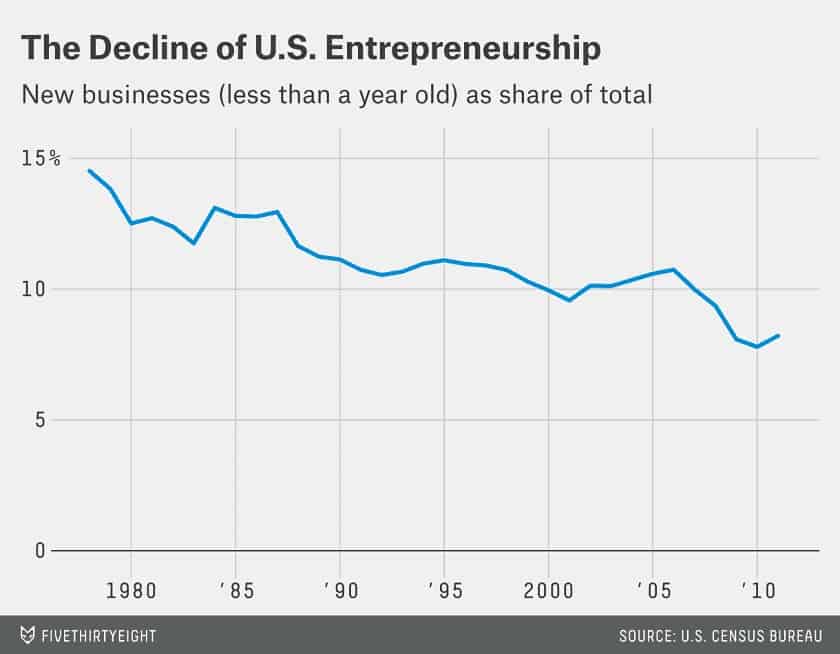
Dated US series: it does not directly measure current conditions for Canadian businesses.
Comparing business openings and closures requires specifying businesses, establishments, sectors and dates. Young firms’ role in employment does not mean they create every new job. Workers and business owners should follow information about their own sector and actual commitments rather than slogans about general decline.
The case of autonomous cars
Road transport serves as an example of a sector whose tasks can evolve with automation. The former source cited a union official to highlight possible effects beyond drivers, including on maintenance and associated services.
A technical transition can affect related activities: driving, dispatch, maintenance, insurance, food service and accommodation. Scale and timing depend on authorizations, uses, safety and business decisions. A forecast made years ago must not be recirculated as a new ten-year deadline. For your household, find out about the actual employment situation and available resources without assuming an identical effect across the entire sector.
Estimates of automatable tasks, exposed jobs and net job losses measure different things. A forecast for 2030 must identify its study, assumptions and geographic scope. Do not turn a research scenario into a certainty for an individual, business or country.
The expression "unnecessary class" used in certain philosophical debates should not become a way of qualifying people who are unemployed, sick or in difficulty. Their dignity is not linked to an economic task. The relevant topic for preparation is access to resources, training and support, and how to maintain links when activities change.
Diseases and panic
An epidemic can affect health and the organization of care, as well as travel, work and family activities. The dissemination of incorrect information adds a distinct difficulty. The answer is not just to wait for social chaos: health information, prevention, continuity of treatment and assistance to those concerned are functions to be prepared.
The 2014–2016 Ebola epidemic in West Africa is a major historical example described in the WHO's milestones. Reactions and measures varied by place and time; they do not prove an epidemic automatically causes every society to break down rapidly. Retain dates and geographic scope when relating a past event to a present situation.
Historical epidemics
- Plague of Justinian, beginning in the sixth century: historical estimates vary and rely on limited data. A death toll of one hundred million or half the world's population must not be presented as a certain finding allowing direct comparison with current surveillance systems.
- Black Death in the fourteenth century: its historical importance does not permit direct conversion into contemporary risk. Plague cases currently reported by authorities in some places do not mean the same medieval scenario is returning worldwide.
- HIV/AIDS: It is an epidemic over several decades, not a death record limited to 1960–1980. The numbers must be dated and distinguish infections, people living with HIV and deaths. Do not mix these indicators with the short episodes on the list.
- Hong Kong Flu, from 1968: This example recalls a historical influenza pandemic. Mortality estimates and their uncertainties should remain linked to a source and period, without deducing the balance of a future season.
- SARS, 2002–2003: an example of an international outbreak whose surveillance scope and categories of cases need to be specified. A number of countries or cases rounded in an old text is not an updated data on coronaviruses in general.
- Ebola, 2014–2016 in West Africa: the reports relate to an epidemic and defined territories. They do not make it possible to describe all African countries or to promise an evolution identical to another disease.
- Zika, especially during the international emergence of the years 2015–2017: transmission areas and travel or pregnancy recommendations require up-to-date health information. The old figures do not replace this consultation.
- Polio: it was not eradicated worldwide and then simply “returned”. The WHO distinguishes poliovirus types and progress towards eradication. A territory declared free of a disease and global eradication are not synonymous.
Aggravating factors
Several factors can change transmission and response capacity. They must be examined with the health authorities for the disease concerned. No list is sufficient to predict a catastrophic pandemic or to designate a population as its source:
Population density
Contacts and housing conditions may influence certain transmission risks. Density alone is not a diagnosis: ventilation, water, care, prevention and organization are also important. A global urbanization projection does not describe the precise conditions of a neighbourhood.
International travel
International travel can rapidly connect regions. A flight's duration does not establish a disease's contagiousness, incubation period or outcome. Health and travel advisories must correspond to the agent and situation.
Inadequate infrastructure
Access to water, care, testing and prevention varies within every country. Avoid equating two continents with uniformly inadequate infrastructure or the origin of diseases. Identify the needs and capacities of the area actually concerned.
Antimicrobial resistance
Resistance to certain drugs can make infections more difficult to treat. It is not identical for all diseases or treatments and requires a clinical evaluation. It does not justify building or using a stock of antibiotics on its own.
Antimicrobial Resistance (AMR)
According to the WHO fact sheet on antimicrobial resistance, bacteria, viruses, fungi or parasites may stop responding to the relevant medicines. Treatment then becomes more difficult or sometimes impossible. Distinguish resistance in an infectious agent from a person supposedly becoming “resistant” to all care.
The prevention of infections, access to care and appropriate use of medicines are part of the collective response. For the home, maintain the prescribed treatments and ask the professional how to organize their continuity. Do not share an antibiotic or change a prescription to extend a reserve. A treatment difficulty alone does not announce a new influenza of 1918.
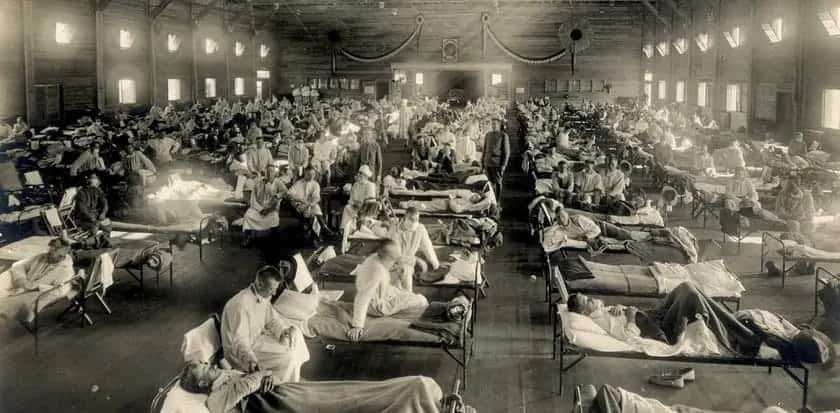
Hospital during the 1918 influenza pandemic at Camp Funston. This photograph documents a historical setting; it cannot identify strains circulating during later outbreaks.
The influenza pandemic of 1918–20 was the subject of significant but variable historical estimates. A number of deaths or a percentage of the population must be accompanied by its study and its uncertainties. For the current preparation, health facilities, recommendations and care opportunities should be considered in their present context, without directly transposing an old assessment.
Biological weapons
Intentional biological risks involve public health, security and international commitments. Allegations about national programmes require precise, dated sources. An old list of countries must not become unverified current information. Citizens should follow appropriate alerts and instructions without trying to identify or handle a suspected agent.
Public warnings attributed to personalities about the possibility of malicious use of biotechnology must remain distinguished from a forecast. A formula announcing billions of deaths does not provide a probability or a deadline. The family plan may provide for the receipt of information and continuity of needs without inventing the scenario of an attack.
Smallpox and nuclear weapons are different hazards whose consequences and responses cannot be compared through a general formula. During a health alert or when encountering a suspicious object, follow authorities and request appropriate help. Reading does not replace professional identification or protective procedures.
Understanding the limitations of services and preparing useful supplements
A major disruption can strain services and delay responses without establishing that they should no longer be relied on. Prepare information useful when requesting help and some accessible resources. A medical emergency or immediate danger always justifies seeking emergency assistance; stored supplies do not make those services unnecessary.
There are two big problems:
- Prevention and continuity: climate, economics or infrastructure issues require multi-scale decisions. The preparation of the home does not repair a system alone and does not exempt the reporting of difficulties to the competent officials.
- Response to the event: the resources available, access and extent of the disaster influence the timing. Providing basic contacts and needs helps to wait when this remains appropriate, but does not mean staying in a dangerous place.
Institutional dysfunction
Expectations of institutions can be discussed using precise facts: a missing message, difficult access or interrupted service. A general impression voiced in political debate does not prove every organization is deteriorating. For the family plan, identify the relevant service, its information channel and an alternative if the first contact does not respond.
An organization may face constraints in expertise, resources or coordination. Distinguish these from an intention not to help. Prepare a clear request: location, need, people involved and access difficulties. Check what has actually been confirmed; sending a message does not yet mean assistance or delivery is arranged.
The great historical transformations are not limited to depression, war or the space programme. This guide does not seek to classify the effectiveness of governments. The useful preparation consists of knowing the present arrangements, participating in the authorised procedures and identifying the points to be improved after an exercise or event, without generalisation across all institutions.
Distinguish geopolitical analysis and family plan
The international place of a country can change. However, the analogy of a declining empire does not predict the living conditions of a household or the date of a breakdown. Instead, consider the practical dependence on travel, suppliers and communications, with solutions that remain useful in several situations.
A strategic report generally describes a mandate, assumptions and time horizon. The old quotation attributed to the Pentagon and a military institution is not used as broad proof of global deterioration without a precise reference. Analysis can inform debate; it does not replace local instructions or assessment of a building or health needs.
The example of Venezuela
The example of Venezuela requires a period, indicators and sources to compare wealth, health and nutrition. An old economic ranking does not describe all the situations of the country or an inevitable trajectory for another territory. This guide retains this theme to examine what a prolonged change in income and services could change in a home.
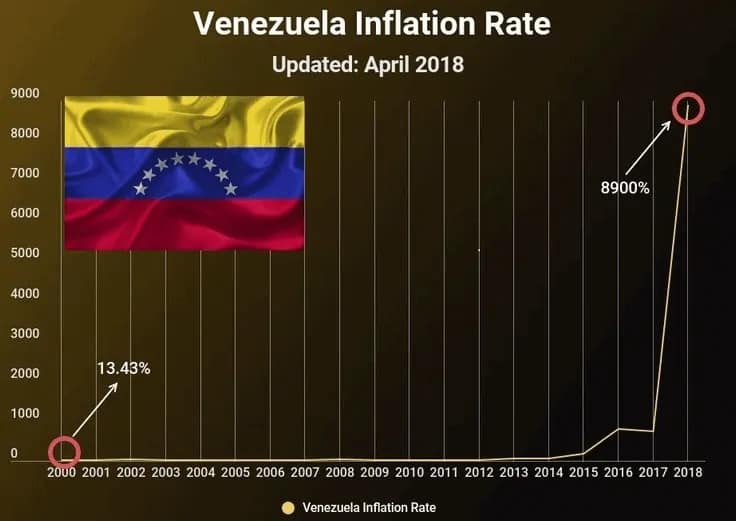
The chart ends in 2018; it is not an economic forecast for Quebec.
Distinguish access to meals, care and income using dated, verifiable information. Any percentage must identify the population studied and the indicator measured:
- Food and weight: an average loss cannot be attributed to an entire population without a specific survey. For the home, note if meals and individual needs are still covered and where to ask for help when this is no longer the case.
- Children's health: care and nutrition needs should not be portrayed through alarming images without context. Persistent difficulty requires professional and social assistance, not merely larger household supplies.
- Price and income: any comparison with a minimum wage requires a basket, date, currency and identified rules. A variation can make certain purchases inaccessible without affecting all households in the same way.
- Food insecurity: surveys distinguish several levels and populations. An old percentage without method does not make it possible to conclude that the same share of people can no longer feed themselves today or elsewhere.
- Diseases: malaria variation should be linked to a territory and surveillance period. It does not apply to all diseases or to every person living in the country.
- Medical supplies: a shortage is assessed by product, establishment and period. An overall percentage does not replace a discussion with the pharmacist or caregiver on the continuity of individual treatment.
Poor performance in crisis management
Critical reviews of crisis management must identify the event, responsibilities and recommendations. Difficulty in a different public programme does not automatically establish failure of local emergency services. Keep contact details, local instructions and assistance options, then use lessons learned to improve the plan.
Emergency resources can be used heavily in the event of a regional disaster. This justifies the preparation of precise information and basic means, without presenting the call to the emergency number as unnecessary or inappropriate in the event of danger. An expert's old quote is not necessary for this benchmark: follow the information received and report the evolution of needs where possible.
No universal 2 per cent death rate in an "immediate crisis" is retained here. Periods and causes of death differ depending on the event. A person may need care or leave a place well before a specified reserve period. Do not turn an unverified figure into a decision to wait without asking for help.
Examples of failures
- Hurricane Katrina: lessons learned raise issues including coordination, communication and assistance. To use them, consult original reports and distinguish facts, recommendations and debates rather than infer every service will always fail.
- Flint water crisis: it underlines the importance of health authorities, testing, advisories and protection of exposed people. A city's entire population cannot be presented as confirmed poisoning cases without appropriate study. A generic filter does not replace contaminant-specific instructions.
- Haiti’s earthquake and housing assistance: funds collected, new construction, repairs and assistance services are different categories. To assess an organization’s results, distinguish those categories, the needs actually met, the duration of assistance and the transparency of commitments.

Maintaining useful skills rather than comparing generations
Cooking, repairing, navigating and organizing mutual aid are skills that have evolved with places and techniques. There is no single set of “250,000 years” of skills supposedly lost by every person. Preparedness can combine practical actions, contemporary knowledge and access to services according to present needs.
Previous generations have developed certain habits, but they did not all know how to do the same things and did not live under the same conditions. Ask what a relative can transmit rather than assume his or her competence according to his or her age. A cooking, sewing or gardening experience can complement a digital skill or a knowledge of local resources.
Which functions do you already know how to perform, which require a trial and for which do you need a professional? This question is more useful than an overall judgment on your ability to "survive".
Demonstrative data
- Passing on skills: an old survey about a “survival knot” does not establish that one generation is three times more competent. Identify the exact action, its relevance and conditions for practice, then learn it in a safe setting.
- Supplies: assess quantities actually usable at home, their accessibility and the needs they cover. A national percentage measures neither your worth nor your responsibility and cannot replace this practical inventory.
- Food and water outdoors: do not rely on foraging or water found during an outing without appropriate skills, rules and treatment. An assumed percentage of people unable to do this does not justify a dangerous experiment.
A function that has become rare on a daily basis may require a reminder or practice before use. The opposite also counts: a modern tool can provide support absent in the past. Prepare the complementarities and limitations of each, with a solution if the equipment is missing. Transmission works better as an exchange than as a competition of generations.
A growth mindset and enjoying preparedness
Learning can be enjoyable: cooking, finding a lamp or reading a map with a loved one is a concrete activity. This must remain compatible with abilities, preferences and rest. A person does not have to practice outdoors or like exercises to be legitimate in the process.
Leisure and recovery differ between people. An activity one person finds meaningful may suit them while someone else needs rest. This article does not establish that a challenge is systematically more restorative than a quiet moment. Choose a short, announced task without turning every free moment into a preparedness obligation.
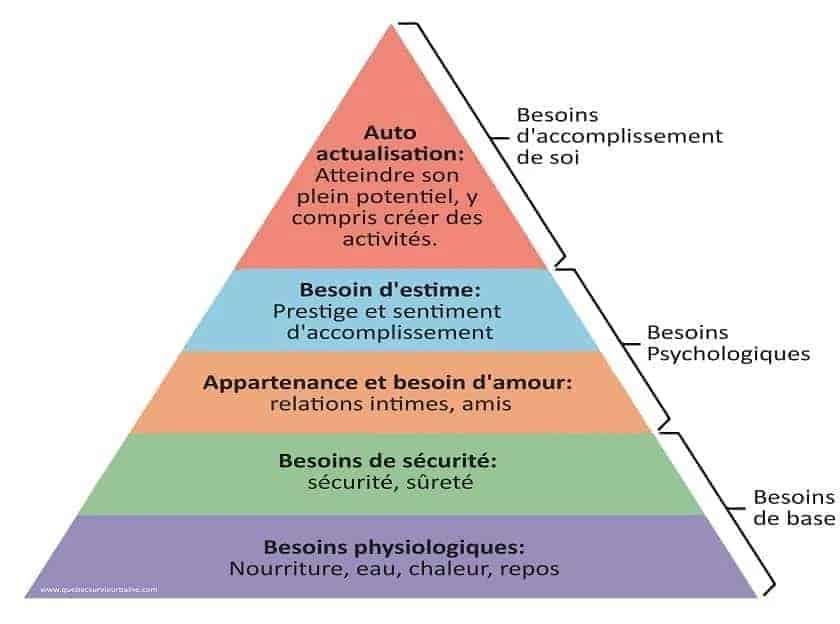
A needs model is a reference tool; it does not rank people’s worth or predict their emergency reactions.
Maslow's hierarchy applied to preparation
Maslow's pyramid can illustrate a discussion of needs, but it is not an emergency procedure imposing an identical order on everyone. Water, protection, care and relationships may require simultaneous responses. Real decisions must account for danger, people and instructions, not just a level in an educational diagram.
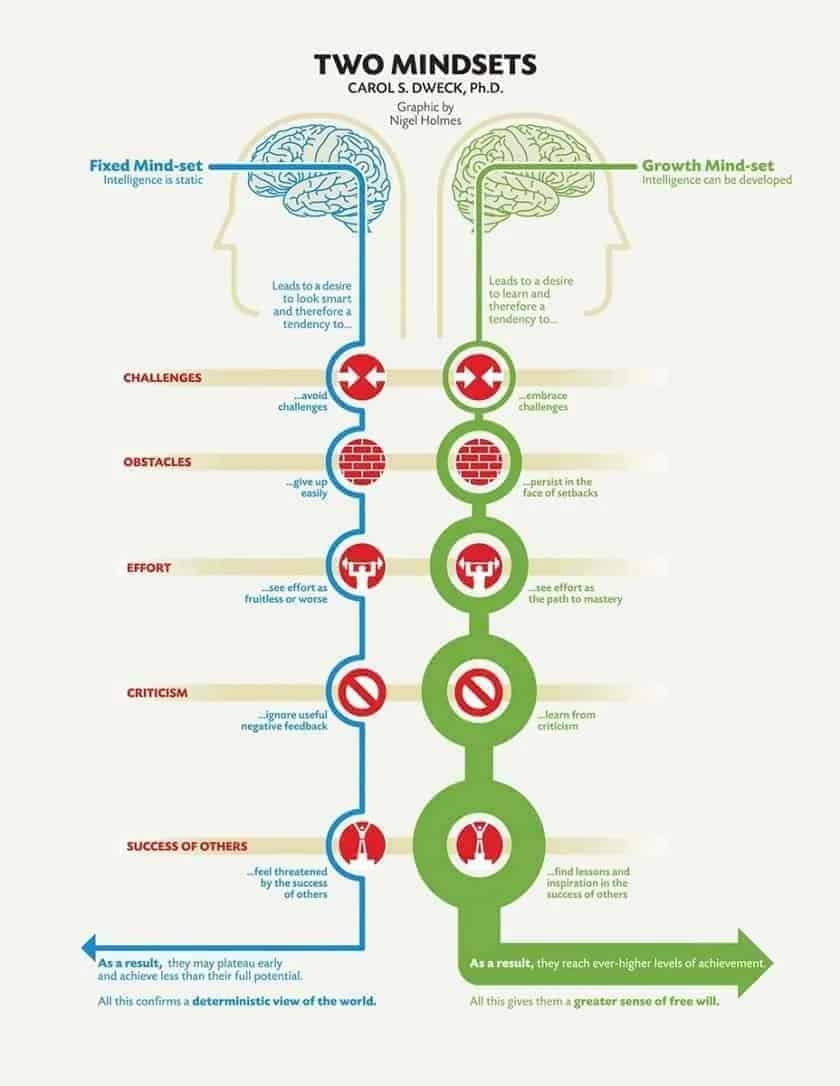
Growth mindset
A willingness to learn and revise a plan can help move forward. It does not alone determine happiness, success or the outcome of a crisis. Resources, health, environment and available assistance also count. Use exercises to identify an improvement, without interpreting a difficulty as the sign of a bad state of mind.
Choose a skill that meets a need: prepare a meal, understand instructions or transmit a location. Supervised training can complement learning and clarify its limits. Neither skill nor equipment guarantees saving every relative; knowing how to ask for help and abandon a dangerous intervention is part of preparedness.
Various motivations for preparing
- Personal responsibility: identify the decisions that can be made, with realistic means, without making the difficulties of a home a moral mistake.
- Family Responsibilities: prepare the needs of children and assisted persons with the adults and professionals concerned; children do not become responsible for protecting the whole family.
- Solidarity: offer agreed, proportionate help while retaining the right to request emergency or social support when needs warrant it.
- Learning: to acquire and maintain useful know-how, paying attention to rules, capabilities and the need for specialized supervision.
- Practical reference points: make a next action clearer without promising freedom from fear or making someone affected by an event responsible for their suffering through a supposed lack of preparedness.
The best type of insurance
Insurance, prevention and preparedness have different functions. A contract may cover certain damages according to its conditions; a plan and resources facilitate certain decisions during the event. They complement each other without cancelling. Any insurance or financial decision must be reviewed according to the situation and guarantees, not replaced by a purchase of equipment.
In a wildfire-exposed area, checking alerts, access and an option to leave can complement appropriate prevention measures. Someone may nevertheless lack time or means for every desired improvement. Do not compare an insurance premium with supposed willingness to protect children; identify a next action and possible support.
A plan people understand can reduce some hesitation but does not guarantee permanent peace of mind. Psychological support, care and social relationships remain important. A purchase driven by worry does not automatically improve safety.
You have seen that there are real reasons with real chances that you should use your preparation — but we sincerely hope that you will never need it!
Preparedness does not provide a ranking that supports being better prepared than 99% of people. Assess observable results instead: a lamp works, a contact has agreed to help, a document can be found. Other people also have resources and skills, sometimes different ones, that can support a collective response.
Ready to start?
Take a deep breath. Even the simple fact of writing this article may seem frightening and pessimistic. But we can do something while enjoying the good life we have today.
Modern services offer important possibilities and can experience interruptions. The useful question is not whether comfort is a “lucky break” destined to disappear, but how to preserve essential functions when one option is unavailable. This reflection can remain measured and compatible with ordinary life and collective resources.
Sudden disasters vs. progressive decline
It is easier to think of sudden disasters: the big storm, a nuclear attack or anything that could lead us from a normal life to a complete breakdown in a few minutes.
Slow change — lost income, increasing assistance needs or housing that no longer fits — may call for different steps from a sudden storm. Sometimes it leaves time to organize support, but it can also exhaust resources. A “frog” metaphor does not replace recognizing concrete signs and requesting help early enough.
There is no research specific to PrépaCivile here that indicates that the risk of sudden disaster would be equal to that of a significant decline or prolonged unemployment. Populations and indicators differ. Prepare several useful functions without building a budgetary decision on this unproven equality.
Local emergencies versus widespread disasters
Just as a situation can occur quickly or slowly, an emergency can occur on a large scale or just for you.
It's easy to think about big disasters, but you can't ignore localized problems that could affect your city, neighbourhood or even just your home.
A family approach can cover collective disruptions and personal difficulties: an interrupted journey, temporarily inaccessible home, helping a neighbour or changed income. Each situation has relevant contacts and limits. Stored supplies do not replace benefits, care or professional intervention.
First concrete steps
Begin with a short check and an understandable plan. Distinguish the essential need, the current solution and what remains to confirm. The PrépaCivile assessment can help choose three next actions without treating a score or pathway as safety certification.
Thematic tools and articles then develop water, food, communications, housing and departure. No universal order prevents every waste of time or money. An emergency, treatment or official instruction may make an action a priority before a preparedness programme ends.
Share tasks with relatives' agreement, in accessible formats and without alarming surprises. Confirm availability and an alternative. Working together can help organization; it does not guarantee a particular outcome or oblige a neighbour to face danger to keep a promise.
It is not necessary to adhere to all the concerns raised in order to choose a useful first action. A question or reservation deserves discussion; the refusal of a purchase does not mean that the person can never be convinced to prepare a concrete need.
Start with current resources and protect essential expenses. The purchase of a few hundred dollars of equipment is neither an entry threshold nor a guarantee. A contact, accessible storage or a confirmed request for assistance may be the next step. Then review the plan with changes in the home, keeping the services and links you need.