
In this article
- 1. Read a paper map and prepare an offline alternative
- 2. Check the kit rather than its possession alone
- 3. Examining housing and neighbourhood risks
- 4. Build a financial cushion within your means
- 5. Understand when to use a fire extinguisher and when to exit
- 6. Act within the limits of your skills
- 7. Preparing an accessible support network
- 8. Distinguish camping and preparation for evacuation
- 9. Know your limits in water
- 10. Take first aid training and keep it current
- 11. Connect personal preparedness with the public response
- 12. Prepare simple and safe meals
- 13. Support mental health and organize help
- Build preparedness across generations
Natural, economic and health disruptions concern every age group. Experience with paper, digital tools, income and training opportunities may differ; labels such as Generation X, Millennials and Generation Z do not establish who is prepared. The following thirteen areas help organize practical mutual support without assigning strengths or weaknesses automatically by generation.
Comparing generations requires a survey identifying its country, date, sample, questions and method. An age label measures neither skill nor the ability to act during an emergency. The thirteen areas below help identify skills to practise and share between people without automatically ranking generations.
1. Read a paper map and prepare an offline alternative
- Check: a readable paper map and route landmarks.
- Practise: follow a simple route without depending on network service.
- Share: explain the map and GPS limitations to someone else.
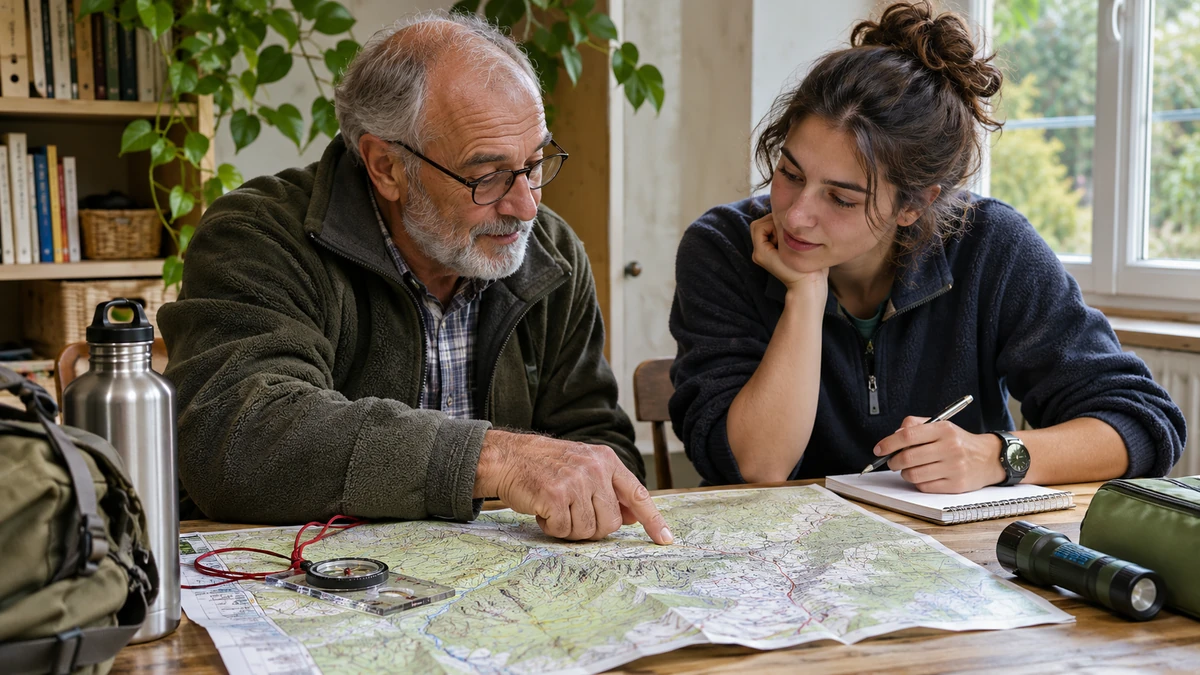
A paper map and a route you understand can help when a phone's battery is flat or there is no network coverage. Growing up before GPS does not prove navigation skills; using an app does not mean someone cannot learn. As a family, choose a simple route, identify landmarks and compare the map with the terrain. Also plan offline digital maps and the power they require. Reported confidence and observed ability are not equivalent. Testing them in a safe setting helps distribute roles without judging by age.
2. Check the kit rather than its possession alone
- Check: supplies actually available for each household member.
- Practise: find lighting, water and contacts promptly.
- Share: assign date checks and individual needs.
A kit is useful only when its contents suit the people, home and risks. Check water, food, lighting, medications and communications, then the supplies' accessibility and dates. Someone without a commercially purchased emergency bag may have suitable items stored around the home. Conversely, a new bag may lack an essential item. Ask everyone what they already have and know how to use. This check is more relevant than a kit ownership rate attributed to an age cohort.
3. Examining housing and neighbourhood risks
- Check: hazard maps and household dependencies.
- Practise: identify an accessible alternative place to stay.
- Share: discuss building instructions with occupants.
Housing choices depend on budget, work, family and available properties; they are not a simple measure of risk awareness. Examine flood maps, winter access, proximity to services and dependence on elevators or shared heating. When moving is not possible, identify feasible actions: protect documents, plan an alternative place to stay and understand building instructions. Avoid describing a generation as less proactive because its members live in an exposed area: constraints matter as much as intentions.
4. Build a financial cushion within your means
- Check: essential expenses and debts before setting a savings target.
- Practise: choose an affordable amount without compromising essentials.
- Share: explain a budgeting method and known assistance.
Accessible savings can help with an unexpected expense, but the amount possible varies with income, expenses and debt. Three months is one possible planning reference, not a measure of personal worth or proof that a generation is more responsible. Begin with a small amount compatible with essential needs and progress without promising a universal timeline. An older person can also be financially vulnerable; a younger person may have a sound system. Share budgeting methods rather than compare ages.
5. Understand when to use a fire extinguisher and when to exit
- Check: the alarm, exits and meeting place.
- Practise: an announced evacuation drill without smoke or actual danger.
- Share: read extinguisher instructions and identify suitable training.
Confidence in using a fire extinguisher does not establish the ability to assess a fire. Knowing building instructions, the alarm, exits and meeting point remains the priority. Reading the extinguisher's instructions and taking appropriate training helps explain its limits. Do not enter smoke or delay evacuation to try to extinguish a fire. A supervised exercise can bring all ages together: nobody should be considered competent or behind simply because of their generation.
6. Act within the limits of your skills
- Check: tasks actually mastered and professional contacts.
- Practise: a minor permitted task using suitable tools.
- Share: instructions and limits for gas and electrical work.
Paper instructions, device details and professionals' contact information are useful without Internet access. Identify the small tasks you can perform and work to leave to a qualified person. Electrical installations, gas and certain structural work involve hazards and obligations that do not disappear during an outage. Experience is shared through demonstration and supervised practice; watching an online video is neither evidence of incompetence nor sufficient qualification for a risky repair.
7. Preparing an accessible support network
- Check: your contacts’ agreement and availability.
- Practise: agree on a message and backup communication method.
- Share: a useful list accessible only to the people concerned.
The number of close friends does not by itself measure the help available during a crisis. One reliable contact can be valuable, while several people may be affected simultaneously. Plan contacts among neighbours, relatives and someone outside the area, with their agreement and suitable communication methods. Digital connections can support real relationships, and in-person contacts may be unavailable; do not automatically set the two against each other. Check support needs without unnecessarily collecting or sharing private information.
8. Distinguish camping and preparation for evacuation
- Check: possible evacuation destinations.
- Practise: pack essentials for an actual accommodation option.
- Share: useful camping skills without assuming evacuation means going into the forest.
Camping can build familiarity with weather, packing or simple meals, depending on the activities actually practised. It does not guarantee the ability to live outdoors after a disaster, and evacuation does not necessarily lead into a forest. First plan for announced destinations, accommodation with relatives and accessible reception centres. Someone who does not camp may organize documents, transportation or communications very well. Outdoor experience can be shared as specific skills without giving an age group a general advantage.
9. Know your limits in water
- Check: swimming abilities and flotation devices suited to the activity.
- Practise: suitable water-safety training in a safe setting.
- Share: reinforce the rule against entering floodwater.
Knowing how to swim in a pool does not make a current, cold water or a flooded area safe. Assessing your ability, wearing a flotation device suited to the activity and taking appropriate training are separate steps. Never treat confidence or a past course as permission to enter floodwater. People of all ages can learn or update their skills, with adaptations where needed. Also plan for those who cannot swim rather than rely on one supposedly athletic household member to ensure their safety alone.
10. Take first aid training and keep it current
- Check: the content and currency of completed training.
- Practise: skills and communication within the training framework.
- Share: locations of the first-aid kit, defibrillator and contacts.
Recognized first aid training maintained through refreshers tells us more than a statement of confidence. Identify who was trained, in what content and when, then check refresher needs. School programmes and training opportunities differ by place and period; they do not establish that everyone in a generation received mandatory courses. Assign tasks, locate the defibrillator and practise emergency communications within the framework of the training.
11. Connect personal preparedness with the public response
- Check: official and municipal information channels.
- Practise: find instructions and distinguish rumours from alerts.
- Share: public and community assistance options.
Trust in an institution and material preparedness are not the same variable. You can understand a service's limits while following its alerts, and own a kit while needing rescue. Identify official sources, municipal channels and local organizations. During a disruption, check information and request the help you need rather than assume self-reliance excludes all public support. Without a traceable survey, supposed generational scepticism cannot tell us who prepares their household better or worse.
12. Prepare simple and safe meals
- Check: familiar recipes, allergens and individual needs.
- Practise: prepare a stored-food meal and count its water and energy.
- Share: a simple recipe and a no-cook option.
Cooking with ordinary ingredients helps use a rotating food supply and reduce some waste. Prepare a few recipes people actually enjoy, calculate the water and energy required, and plan foods that can be eaten without cooking. Food safety, allergens and individual needs matter as much as creativity. Everyone can share a recipe, technique or shopping routine; age does not establish what someone learned as a child. Testing a stored-food meal together is more useful than attributing general cooking ability to a cohort.
13. Support mental health and organize help
- Check: contacts and continuity of care chosen by the person.
- Practise: plan suitable breaks and routines.
- Share: ask what helps without assigning a diagnosis by generation.
Mental health cannot be ranked using a generational label. An undefined indicator does not allow comparisons of stress, well-being, access to care and ability to act. Planning routines, breaks, contacts and continuity of care can support every household member. People living with a mental health condition can contribute fully to preparedness with the support they choose. Avoid turning a population's difficulties into criticism; ask what helps and facilitate professional support when necessary.
Build preparedness across generations
Each person can bring useful experience, regardless of generation. To bring it together:
- Identify the skills actually present: maintenance, cooking, navigation, organization or helping others. Ask what the person knows and wants to share rather than infer it from their birth date.
- Share methods and tools: creativity, digital skills, knowledge of the neighbourhood and adaptability can come at any age. Combining demonstration with practical exercises helps pass skills on.
- Make room for learners: start small, ask questions and practise without judgement. A lack of experience in one particular task does not define a person's overall abilities.
To prepare the household, choose a shared activity from the thirteen areas: check the kit, cook a stored-food meal or work out a route. Then review the needs still unmet. Skills complement one another when roles are discussed and adapted to abilities, rather than imposed by a generational ranking.
Collective preparedness builds on the resources, limits and preferences of the people involved. Review progress regularly and choose a realistic next action. Assess progress through what you have prepared, tried and understood together rather than an assumed ranking of generations.