
In this article
- Understand the dynamics of a train derailment
- The first few seconds: what to do immediately
- Priority actions according to the context
- The Most Common Mistakes
- And with children on board?
- After Evacuation: Secondary Management
- Simple preparation before taking the train
- Waiting for a supervised evacuation and reporting the danger
- Official sources and landmarks
A train derailment is a rare event on a statistical scale – and precisely for this reason, most passengers have never thought about their reaction to a rail incident. It is in the first few minutes that individual decisions have the most influence on the outcome.
In France, the rail network carries about 4 million passengers per day. In Quebec, passenger rail transport is less developed but remains present - commuter trains in the Montreal area, inter-city connections, and especially freight rail transport that coexists with populated areas. Incidents involving freight trains, such as the Lac-Mégantic tragedy in 2013, have reminded us that the consequences of a rail accident can far exceed the direct occupants of a train.
This guide deals specifically with the situation of passengers on board a train during a derailment or major rail incident – the reflexes to adopt, the traps to avoid, and the specifics of different railway environments.
Rail transport remains one of the safest modes of transport per kilometre travelled. Knowing the right reflexes is not an invitation to anxiety – it’s a prepared citizen skill, just like knowing how to use a fire extinguisher.
Understand the dynamics of a train derailment
A derailment is rarely a one-time event. It’s a sequence – often brutal and fast – followed by a secondary phase that can be just as dangerous as the initial shock. Understanding this dynamic makes it possible to orient the right priorities from the first seconds.
What Happens During a Derailment
The initial phase of a derailment usually lasts a few seconds: loss of control of the convoy, intense abnormal vibrations, sudden deceleration or tipping of one or more cars. Passengers are exposed to projections, falls, and the impact of unsecured luggage – all causes of shock-independent injuries with an exterior structure.
The secondary phase is often the one that poses the most risk to passengers not injured in the initial shock. It can include:
Electrical risks
The overhead contact lines (catenaires) supply trains with high-voltage current - 25,000 volts in France on the high-speed network, voltages varying according to the networks. A catenary sectioned or on the ground near a derailed train represents a mortal danger. The electrified rails of metros and some suburban networks present the same risk, at ground level.
Fire and smoke
A derailment can cause short circuits, fuel leaks, or the burning of cabin materials. In confined spaces – especially tunnels – smoke is often more dangerous than fire itself: dense smoke can reduce visibility to zero and saturate breathable air in minutes.
Residual movement of the convoy
A derailed convoy does not stop instantly. Cars can continue to move, tip over or be pushed by the inertia of the cars after several seconds after the beginning of the incident. Staying in a protected position until complete immobilization is essential.
Tunnel environment
A tunnel derailment combines several aggravating factors: partial or total darkness, confined smoke, difficult access for rescue, absence of spatial markers for passengers, and risk of electrocution amplified by proximity to traction equipment.
The specifics of the railway context
Unlike a car accident, a train passenger does not have control of the vehicle and cannot anticipate the shock by an avoidance maneuver. Its only margin of action is in the phase following the incident – and it is precisely on this phase that mental preparation has its effects.
The first few seconds: what to do immediately
During a derailment, the sequence of the first few seconds is strongly influenced by the shock - the state of temporary blockage that the brain goes through in the face of a sudden and unexpected event. Knowing it in advance allows you to short-circuit it faster.
During the movement of the convoy - protective position
If you experience abnormal vibrations, sudden deceleration or tipping motion before the main shock: cling firmly to the seat structure or a fixed bar, lean forward and protect the head with the arms. Do not attempt to get up or move during the movement of the convoy.
From the moment of complete immobilization
1. Evaluate your own condition
Before any action, check his physical condition. Post-shock adrenaline can mask significant pain. An injury to the head, neck or back changes priorities - staying still and reporting to other passengers rather than attempting to move alone.
2. Identifying the dominant threat
Smoke visible? Smell of burning? Sound of fire? Presence of water (flooded tunnel)? The threat identified determines the urgency of the evacuation. In the absence of an immediate threat, wait a few seconds to assess the situation before taking action.
3. Listen to staff instructions
Railway personnel are trained in emergency evacuation procedures. If they are able to give instructions, follow them first. In their absence or if their location is unknown, apply the general principles of evacuation.
4. Alert rescue if possible
Dial 911 (QC), 18 or 112 (FR) giving the most precise location possible - train number, direction, name of the last crossing station, description of the situation. In the tunnel, the connection may be absent - attempt the call as soon as the signal reappears.
Priority actions according to the context
Derailment in full lane, outdoors
Priority electrical risk: Before exiting the car, see if cables hang outside or if a catenary is visible on the ground or within range. Do not touch the metal frame of the train if a catenary is in contact with it - the current spreads to the entire structure. Wait for personnel or emergency services to confirm the power off before going down the lanes.
Incident in tunnel
The tunnel is the most demanding environment during a rail incident. The top priority is not to panic – which is easier said than done in the sudden darkness with smoke.
Metro or RER incident at the station
A station incident is usually handled by station personnel who trigger evacuation protocols. Follow the sound and visual instructions. Do not get off the tracks without explicit instructions from the staff - the power supply rails of the metros are at ground level and can remain energized for several minutes after an incident.
The Most Common Mistakes
Go down the tracks without checking the power supply
This is the potentially fatal mistake in this context. A catenary sectioned to the ground, a metro power rail still energized - the railway electric current is at levels that leave no margin for error. The rule: only descend on the tracks on explicit instruction of the staff or rescue.
Rushing to the exit without evaluating
In a car cluttered with projected luggage and passengers in a state of shock, a hasty evacuation generates jostling and secondary injuries. A few seconds of evaluation - immediate threat? Accessible exit? Passengers to help? — allow a more orderly and safe evacuation.
Recovering your luggage
Documented during each major rail incident, this behavior significantly slows evacuation. Footage from railway incident surveillance cameras shows passengers stopping to pick up their luggage in the middle of an evacuation – sometimes in the middle of an already smoky corridor.
Walk along the tracks after evacuation
Trying to help without assessing your abilities
Wanting to help the injured is a noble reaction - but attempting to move an injured person's back or neck without proper training can make their condition worse. The most useful contribution of an uninjured passenger without medical training is often to clear the passageway, guide others to exits and communicate with rescuers.
And with children on board?
The presence of children in a wagon during a railway incident introduces several specific variables to anticipate.
Children travelling alone - common practice on TGV and Intercités networks in France with accompanying services - are supported by rail staff during evacuations. If you are accompanying a child, maintain constant physical contact from the beginning of the incident - car movement and shock can quickly disorient a child.
After Evacuation: Secondary Management
Once removed from the car and safely, a sequence of priorities applies within minutes and hours.
Management of psychological shock
Children can manifest these reactions differently - behavioral regression, nightmares, refusal to return to a train. A gradual return to rail transport, without forcing, and open discussions about the lived experience contribute to a normal recovery.
Administrative procedures
Keep all travel documents - ticket, reservation card - that may be necessary for the procedures with the railway company. In France, the SNCF has compensation procedures in the event of an incident. In Quebec, procedures vary depending on the operator. Report any physical or material damage to the authorities present on site.
Simple preparation before taking the train
Preparing for a rail incident requires no special equipment or specialized training. It is based on some systematic observation habits that can be applied as soon as you get on board.
Getting in the car
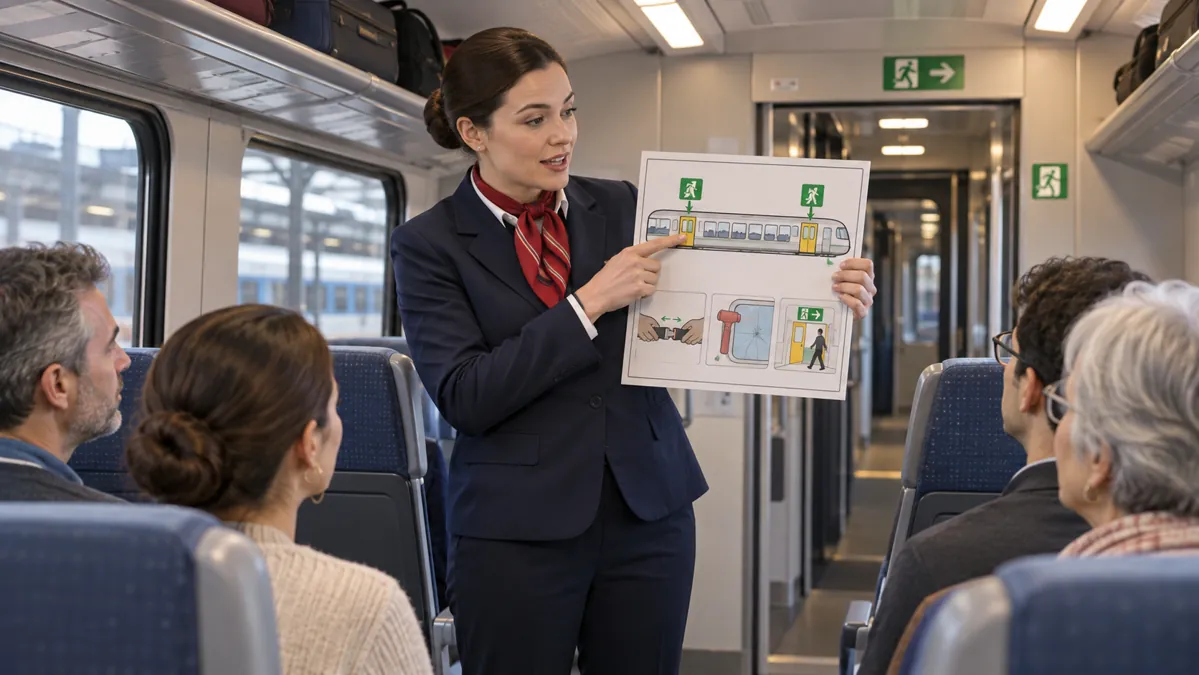
- Locate the nearest window breaker hammer - usually attached near windows
- Identify the communication intercom with the driver
- Mentally count the number of rows between its seat and the nearest exit - useful in case of reduced visibility
Baggage management
- Store heavy luggage in the designated storage spaces, not in the hallway
- Keep essential documents and phone on hand – not in checked baggage
- In the event of an incident, leave the luggage: they slow down the evacuation and can hurt other passengers
The simplest and most neglected reflex: count the rows of seats between its location and the nearest exit. In case of darkness or dense smoke, this digital marker makes it possible to go to the exit by counting the files by hand - a technique used in air survival training and applicable to the railway.
Waiting for a supervised evacuation and reporting the danger
Do not go down the path of your own initiative. One train stopped and the lack of lighting does not prove a power cut; another train can also run. The cables, rails and equipment must be considered dangerous until the intervention of the competent personnel.
During a framed evacuation, use only the exit and path indicated. The output side and direction depend on the network and the incident. Report a person from the outset who cannot follow; do not leave them without staff knowing their position. Keep the children close to you and clear the exits.