
In this article
- A simple and powerful tool to build family resilience
- 1. QQQOQCP: a professional tool... serving citizens
- Origin and philosophy of the method
- Why is this method so effective?
- 2. Why the QQOQCP must enter into preparedness?
- A simple, readable and accessible tool
- A natural pillar of the 3P Program (Predict – Protect – Participate)
- A common language for citizens
- 3. Adapting each “Q” to the reality of families
- Who? – The people involved
- What? – The observed fact
- Where? – The exact place
- When? – Time and frequency
- How? – Conduct of the facts
- Why? – Causes and Factors
- 4. Use the method in all three phases: before, during and after
- Before: Plan
- During: Protect
- After: Participate
- 5. Five concrete examples of use in a citizen context
- Kitchen fire
- Prolonged electricity failure
- Loss of a child in the park
- Intrusion or attempted burglary
- Storm, flood, ice
- 6. Integration into the PrépaCivile+ application
- The Interactive Family Plan
- The Crisis Journal
- The Action Module
- The Restore Module
- Conclusion
- FAQ – To go further
- How to explain QQOQCP to a child?
- Does this replace a family plan?
- Can QQOQCP be used during a crisis?
- What is the difference with the 5 Whys method?
A simple and powerful tool to build family resilience
In a context where the crises of everyday life – power outages, domestic fires, storms, incidents in the neighbourhood or health problems – can occur without warning, preparedness is no longer a luxury: it becomes a necessity.
At the heart of this approach is an essential principle: Clarity of analysis.
Too often, when an incident occurs, families react in confusion:
Everyone interprets in their own way, facts mix, emotions take over, and precious minutes are lost.
Yet, in the professional circles of QHSE and crisis management, a simple and terribly effective method has structured the analyses for decades: the QQOQCP.
A tool based on six key questions to observe a situation objectively and rigorously.
This article demonstrates how this method, although from the industrial world, can become a Major lever of family and community resilience, accessible to all.
1. QQQOQCP: a professional tool... serving citizens
Origin and philosophy of the method
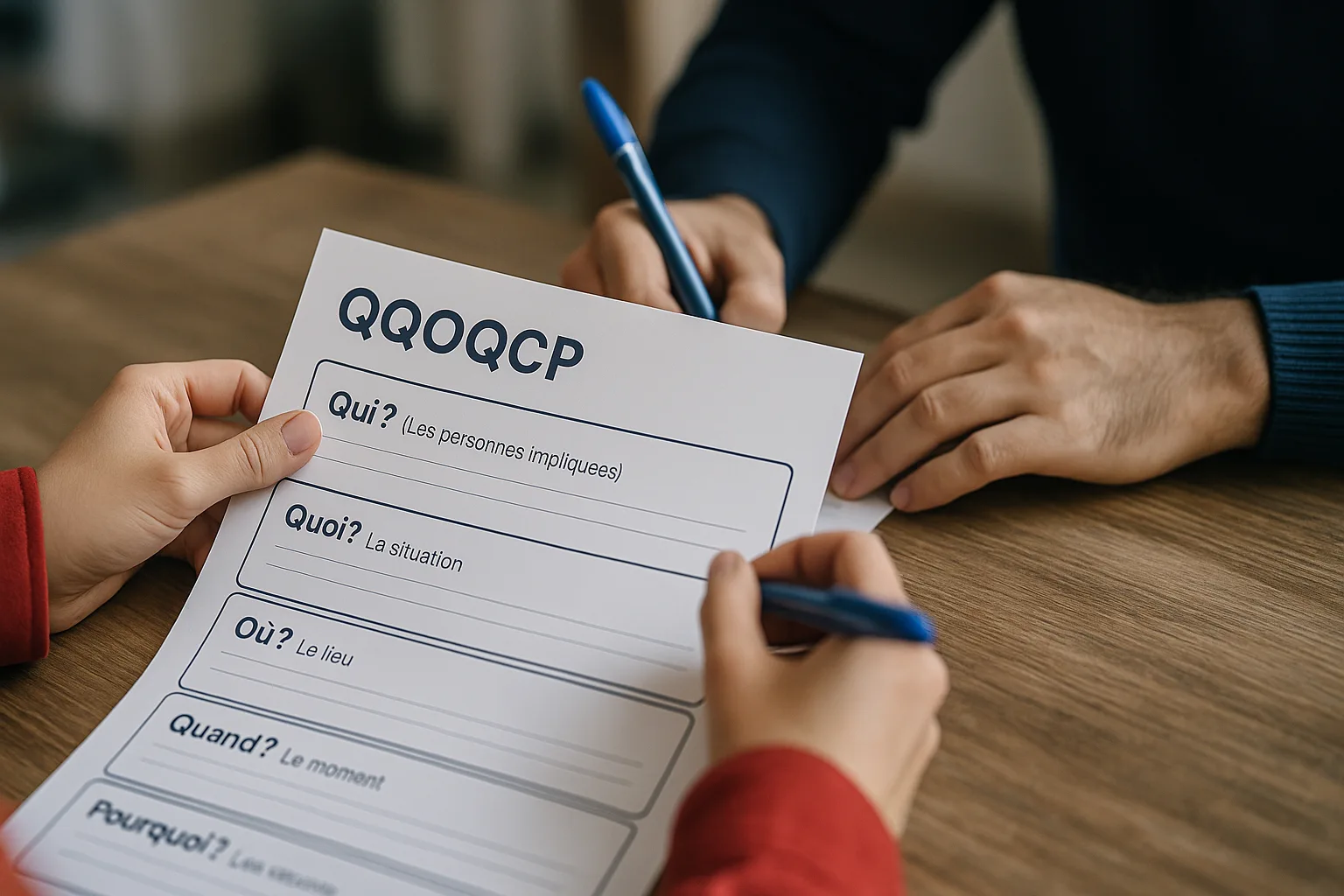
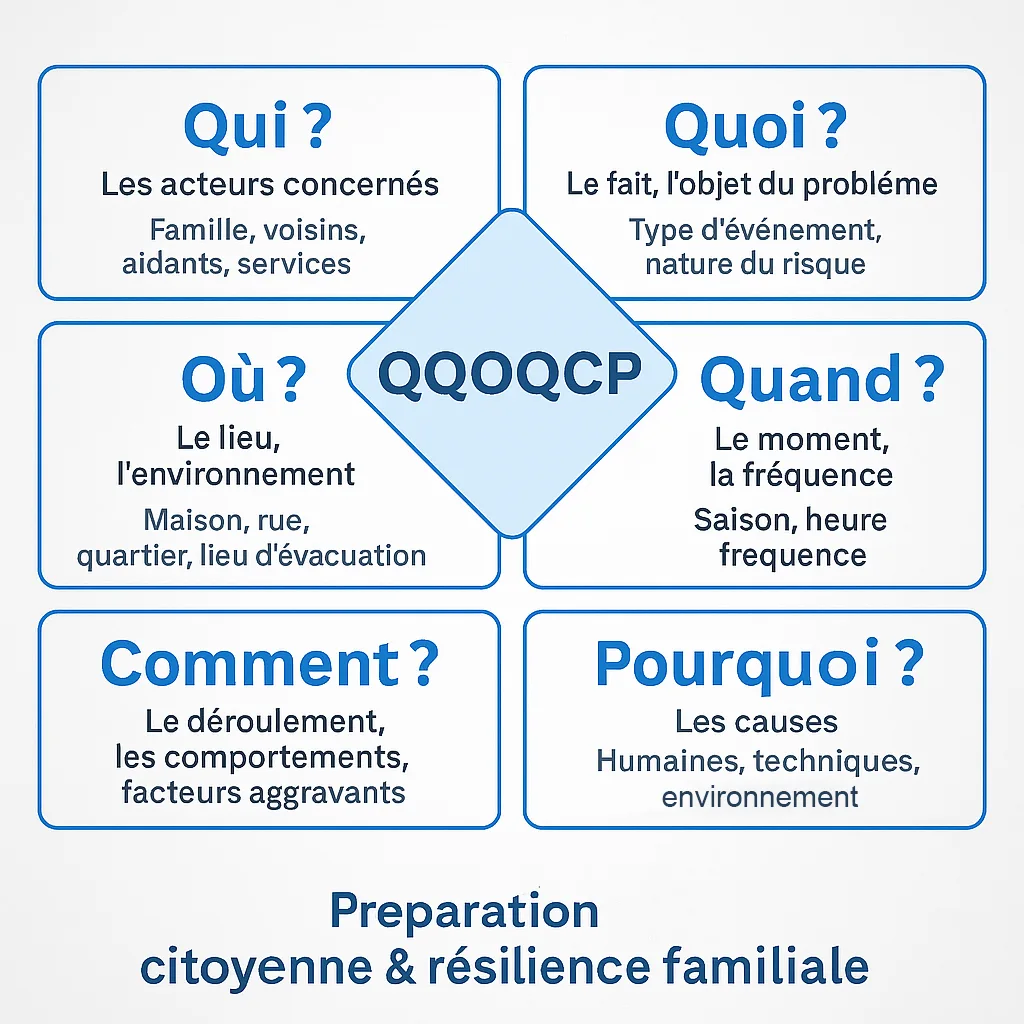
QQOQCP (Who? What? Where? When? How? Why?) is an analytical matrix designed to structure a situation without hasty interpretation.
It is used in:
-
analysis of professional incidents,
-
solving complex problems,
-
quality management,
-
the treatment of accidents in an industrial environment.
Its advantage is based on three principles:
-
Asking the right questions from the beginning
-
Describe the facts objectively
-
Build a clear narrative shared by all
Equally relevant principles... in a home.
Why is this method so effective?
Because it prevents classic traps:
-
Misinterpretations,
-
hasty judgements,
-
confusion between facts and emotions,
-
vague or contradictory communication.
In an emergency, this clarity saves lives.
2. Why the QQOQCP must enter into preparedness?
At the family level, we face three major issues:
-
a lack of habit of calmly analyzing a situation,
-
communication often improvised,
-
a fragmented or non-existent preparation.
The QQOQCP then becomes a Universal Framework, suitable for all ages and situations.
A simple, readable and accessible tool
Even a 12-year-old can understand this method.
It is therefore an excellent starting point for family pedagogy.
A natural pillar of the 3P Program (Predict – Protect – Participate)
-
Prediction : analyze the risks of the house, the neighborhood, travel.
-
Protect React calmly during the incident.
-
Participate Improve the family plan after the fact.
A common language for citizens
A shared vocabulary between family, neighbours, and even schools or local organizations (CRCs) promotes a coordinated and coherent response.
In a crisis, collective clarity makes a difference.
3. Adapting each “Q” to the reality of families
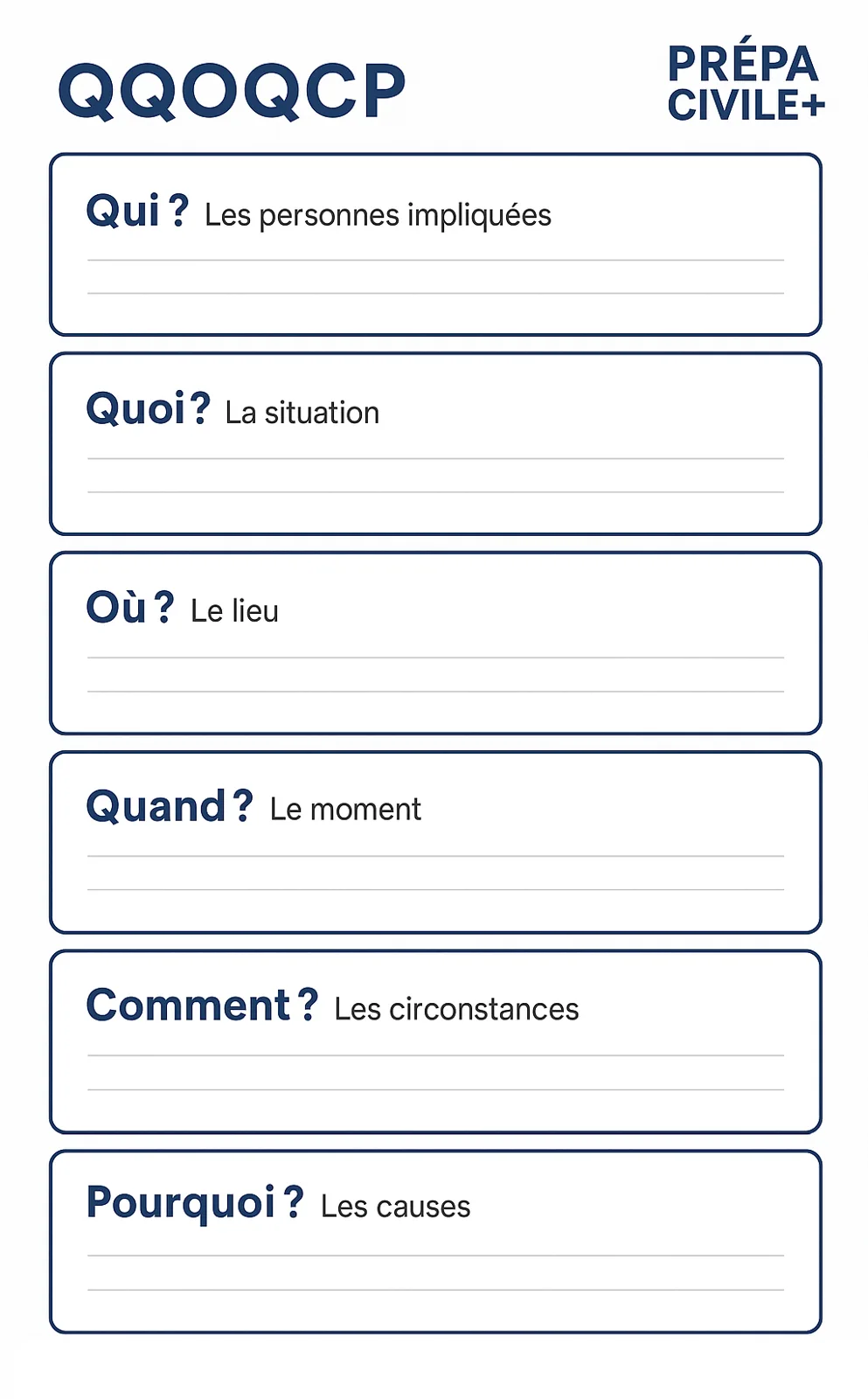
Here is the citizen version of the QQQOQCP proposed by PrépaCivile.
Who? – The people involved
Identify specifically:
-
members of the household concerned,
-
children present or absent,
-
neighbours involved,
-
vulnerable people (health, mobility),
-
potential stakeholders (911, fire safety, Hydro-Québec).
Example :
Who was there when the fire broke out in the kitchen?
What? – The observed fact
Describe the problem without interpretation:
-
water leak, suspicious smell, fire, power outage, intrusion, injury...
-
intensity of the problem, visible evolution.
Example :
What happened? A fire started in an unattended pan.
Where? – The exact place
Locate with precision:
-
room of the house,
-
floor,
-
area of the neighborhood,
-
road or external environment.
Example :
In the kitchen, near the stove.
When? – Time and frequency
Please specify:
-
time of the event,
-
season,
-
special conditions,
-
possible repeatability.
Example :
In the evening, after a succession of micro-cuts.
How? – Conduct of the facts
Describe the sequence:
-
How the situation started,
-
how it has evolved,
-
what actions aggravated or limited the incident.
Example :
How? Too hot oil caught fire when the person walked away.
Why? – Causes and Factors
Look for the factors:
-
Humans (mistake, inattention)
-
technical (failure, defective equipment),
-
organizational (absence of family procedure),
-
environment (weather, neighbourhood infrastructure).
Example :
Lack of a functional smoke detector in the kitchen.
4. Use the method in all three phases: before, during and after
Before: Plan
The QQOQCP is used to:
-
analyze the risks of home,
-
define the most likely scenarios,
-
identify the areas to be secured,
-
Raise children’s awareness with simple examples.
It effectively structures everything Family Emergency Plan.
During: Protect
At the heart of an incident, this method:
-
Avoid panicked interpretations.
-
allows for clear communication,
-
Guiding decision making.
Examples of use during the incident:
-
"Who's with me? Who's missing?"
-
“Where is the origin of the problem?”
-
“How is the situation evolving?”
After: Participate
This is the time of RETEX citizen :
-
Analyze the errors,
-
update the material,
-
Adapting family roles,
-
Correct the procedures.
The QQOQCP then becomes a tool for continuous improvement.
5. Five concrete examples of use in a citizen context
Kitchen fire
Two children in the living room.
Flames in the stove.
Where? Electric cooker.
When? 18:30.
How? Overheated oil.
Why? Inattention + lack of cover within reach.
Lessons : kitchen reorganization, assigned role, rapid training.
Prolonged electricity failure
Who, the whole family.
What? Total loss of power.
A line torn off by the wind.
Lessons : batteries, water, lighting, solar chargers.
Loss of a child in the park
A classic behavioral analysis for families.
Intrusion or attempted burglary
Analysis of human and environmental factors.
Storm, flood, ice
Perfect for working family management Seasonal Risk.
6. Integration into the PrépaCivile+ application
The QQQOQCP method will naturally integrate into:
The Interactive Family Plan
Section of risk analysis.
The Crisis Journal
Each entry will automatically follow the 6 questions.
The Action Module
Quick form to send a situation to the members.
The Restore Module
Automatic generation of an integrated mini-RETEX.
A clear, coherent, shared language: this is the basis of the RCRC.
Conclusion
Adapting QQQOQCP to community preparedness is offering families a simple, powerful and universal tool to better understand and manage everyday incidents.
In a world where local resilience is becoming essential, this method is a strong pillar for:
-
structure the thoughts,
-
Clarify the communication,
-
maintain control in an emergency situation,
-
Constantly improving family preparation.
A full QQOQCP is already Half of the analysis done.
It is also one of the best ways to develop a true culture of preparedness.
FAQ – To go further
How to explain QQOQCP to a child?
With simple examples: “Who was there? What did you see?”
Does this replace a family plan?
No: it feeds it and makes it more efficient.
Can QQOQCP be used during a crisis?
Yes, in a simplified form: Who? Where? What?
What is the difference with the 5 Whys method?
The QQQOQCP describes the facts; the 5 Why explore the root cause.
Both are complementary.