
In this article
- In brief
- 1. What is infrared?
- 2. What a thermal camera sees, and what it does not
- 3. Emergency blankets and insulation: what they really do
- 4. Being found: thermal imaging in the service of rescuers
- 5. At home: spotting heat loss and electrical risks
- 6. The limits of the technology
- Frequently asked questions
- Sources
Thermal cameras are now part of daily work for many services: firefighters, search and rescue teams, building inspectors, electricians and even some consumer drones. They also attract a lot of curiosity online, where you can find plenty of tips on how to “hide” from infrared imaging. Most are exaggerated, and they miss what really matters for a household.
From a household preparedness point of view, thermal imaging is above all a useful tool: it helps find a lost person, spot heat loss in a house before winter or detect an electrical hot spot. This article explains in simple terms what infrared is, what a thermal camera can and cannot see, what emergency blankets really do, and how this knowledge serves your safety.
In brief
In brief. A thermal camera does not “see” through walls: it measures the heat given off by surfaces. The human body, warmer than its surroundings most of the time, stands out clearly. Emergency blankets and insulating clothing reduce the heat you lose, which makes them valuable against hypothermia, but in an emergency, being spotted by rescuers is almost always what you want. At home, a thermal inspection helps target heat leaks and electrical hot spots.
1. What is infrared?
Infrared is a part of light that the human eye cannot see. It is electromagnetic radiation with a longer wavelength than visible red light, from about 0.7 micrometres to 1 millimetre.
Every object gives off radiation that depends on its temperature. Objects around us, at room temperature, emit mostly in the so-called “thermal” infrared, around 8 to 14 micrometres. The human body, at about 37 °C inside and a little less at the surface, also emits mainly in that range. That is the radiation thermal cameras pick up.
This thermal infrared should not be confused with the “near” infrared used by remote controls or some night-vision security cameras. Those cameras light the scene with invisible infrared light and capture the reflection; they do not measure heat.
2. What a thermal camera sees, and what it does not
A thermal camera builds an image from differences in surface temperature. The warmer a surface is compared with its surroundings, the more it stands out. That is why a person or an animal shows up clearly at night in a cold field.
Several misconceptions are common:
- It does not see through walls. It can show that a wall is warmer in one spot, for example over a hot-water pipe or an air leak, but not what lies behind it.
- Glass is opaque to it. Ordinary glass blocks thermal infrared: through a window, the camera mostly sees the temperature of the pane and reflections. That is also why these cameras use lenses made of other materials, such as germanium.
- Shiny surfaces fool it. Polished metal or an emergency blanket reflect the heat of the surroundings, which can distort temperature readings.
- Weather matters. Rain, fog and snow weaken the signal, and temperature differences shrink when everything is wet or at the same temperature.
3. Emergency blankets and insulation: what they really do
You often read that a Mylar emergency blanket “blocks” infrared. That is partly true: its metallized surface reflects much of the thermal radiation. For an injured or hypothermic person, that is exactly what makes it useful: it sends back toward the body some of the heat that would otherwise be lost.
But the heat does not disappear. It builds up under the blanket and escapes at the edges, the openings and the head. A thick wool blanket or a sleeping bag works differently: it insulates, slowing the flow of heat outward. In both cases, the outer surface eventually warms up.
For preparedness, remember this:
- an emergency blanket works best with an insulating layer between the body and the ground, which draws away a lot of heat by contact;
- the head and neck lose a lot of heat: cover them;
- wet clothing speeds up cooling dramatically: change it as soon as you can;
- emergency blankets tear easily; keep several in your home and vehicle kits.
4. Being found: thermal imaging in the service of rescuers
Search and rescue teams increasingly use drones and thermal cameras to find people lost in the woods, in snow or after a disaster. At night, a person on the ground stands out clearly against a cold background. In a real emergency, your interest is almost always to be seen.
A few simple actions improve your chances of being spotted:
- stay in an open area if you hear an aircraft, rather than under thick cover;
- make large, repeated movements to draw attention;
- use a whistle, a headlamp or a signal mirror, which rescuers can also see with their eyes;
- keep an emergency blanket, shiny side out, to reflect daylight;
- if you carry one, activate your personal locator beacon.
Conversely, covering yourself completely or hiding under trees can make a person harder to find. That is why we do not give concealment advice: in household preparedness, the goal is to stay safe and make rescuers’ work easier.
5. At home: spotting heat loss and electrical risks
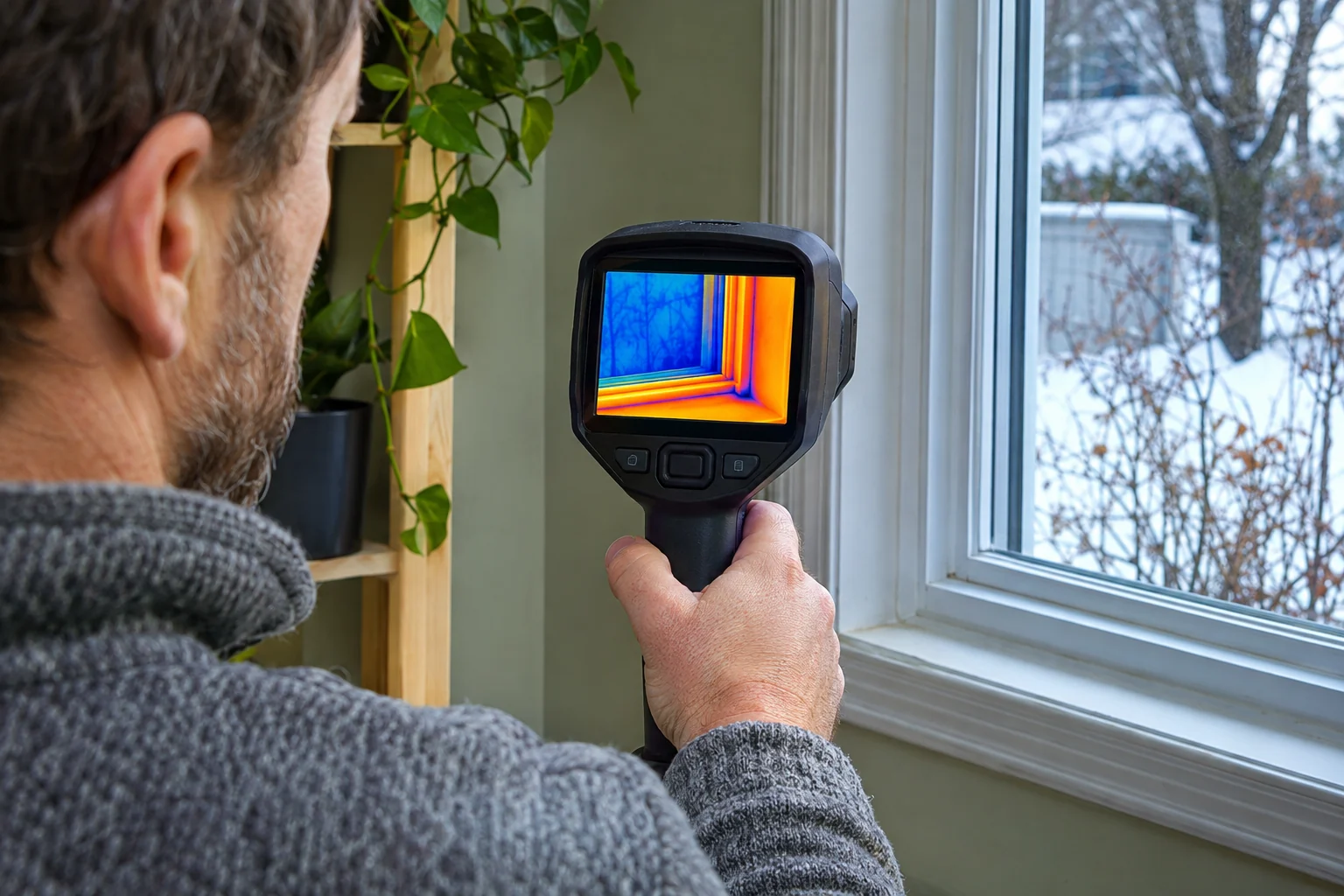
Thermal imaging has a very practical use for a household: getting ready for winter. An inspection, done by a professional or with a rented camera or a phone attachment, can reveal:
- air leaks around windows, doors and wall outlets;
- poorly insulated areas in walls, attics or basements;
- moisture in a wall or ceiling, which often appears cooler;
- abnormal hot spots on an electrical panel, an extension cord or an appliance, signs of overheating that an electrician should check.
Inspections give the best results when the temperature difference between inside and outside is large, typically in cold weather. A better-insulated house keeps its heat longer during a winter power outage, which buys valuable hours of comfort and safety.
6. The limits of the technology
Thermal cameras are powerful but imperfect tools. They measure surface temperature, not the inside of objects. Reflective surfaces distort readings. Small temperature differences, at sunrise or in damp weather, reduce contrast. And image quality depends heavily on the sensor’s resolution: a small consumer device does not see as far or as finely as a professional camera.
For a home inspection, these limits are why a trained professional interprets the images while taking materials, weather and wind into account.
Frequently asked questions
Can a thermal camera see through a wall?
No. It sees the temperature of the wall’s surface. It can reveal a warmer or cooler area, caused for example by a pipe, an air leak or moisture, but not what is behind the wall.
Why does glass block thermal images?
Ordinary glass absorbs thermal infrared. Through a window, the camera mostly measures the temperature of the glass and picks up reflections. Cameras therefore use lenses made of infrared-transparent materials such as germanium.
Does an emergency blanket really help against the cold?
Yes, especially by reducing radiant heat loss and protecting from wind and moisture. It works better with an insulating layer underneath and dry clothing. It is not a sleeping bag, but it is an excellent emergency addition.
Should I buy a thermal camera for my home?
It is not essential. A one-time inspection by a professional, or a rented camera, is often enough to find the main heat leaks and target insulation work.
Sources
- Natural Resources Canada, guidance on home energy efficiency and energy evaluations.
- Thermal camera manufacturers’ documentation on spectral bands and emissivity.
- Search and rescue organizations’ guidance on signalling in the outdoors.