
In this article
In Quebec, as elsewhere, weather events, breakdowns or financial difficulties can disrupt everyday life. Citizens' preparation consists in examining the needs of their home and the resources available, without assuming that a collapse is imminent. Interest in this subject should not be described as "exponential" growth without data. The historical figure of over 60% of underprepared Quebecers was not associated with an identifiable survey; a personal inventory is more useful in determining your starting point.
Trade from Quebec Preppers included evacuation bags, equipment, urban and rural autonomy, and weapons. PrépaCivile takes up the needs of an accessible approach: water, care, information, housing security and support for relatives. Owning a weapon is not a necessary preparation step. Shared experiences should be distinguished from official instructions, permitted uses and actual tests.
For a person who starts, a long list may seem discouraging, especially if the budget or space is limited. A hesitation does not indicate a lack of will. It is more realistic to choose a specific difficulty — to receive an alert, to keep a medicine or to illuminate a room — than to try to cover all the scenarios and purchases proposed in a single approach.
Yet it is imperative to start somewhere. No individual can claim to possess all the necessary tools, skills or resources from the outset. The key is the ability to develop a sound plan, tailored to its own needs and context. The purpose of this article is to provide pragmatic guide for beginners, stressing the first steps to be taken in the world of Prepping, and stressing the importance of the community and the exchange of experiences to collectively overcome the challenges ahead.
Developing a plan: The crucial first step
A plan begins with the people concerned, their health needs, means of transport, contacts and already accessible resources. Supply interruptions or climate events are situations to be considered, without retaining a reference to "present year 2024" that would pass an old text for news. You can note what you would do if you stayed home, then what you would need to leave.
First, rely on the municipal information, the competent bodies and the resources corresponding to your country. Books and videos can complete this work, without certifying a specialized gesture. The first phase seeks to cover the initial needs of your home, not to place yourself in front of "90 % of neighbours", a comparison that is not established here. Instead, check some concrete results: marked contact, tested lighting, an accessible reserve and a solution for essential treatment.
Your plan must take into account adults, children, people with special needs and animals, depending on the actual situation. Discuss with people who can help you or ask for help, without promising a care that you can't provide. Responsibilities, contact information and consent must be clear. A neighbourhood relationship can support an approach without replacing a need for specialized service.
Your plan must evolve according to the number of people to be cared for (e.g. 6 people and 2 animals) and adapt to unforeseen situations, such as the arrival of additional members within your group. Flexibility and adaptability are the key words of effective preparation, allowing us to face with serenity the challenges that the future may set for us.
Prioritizing your needs: An essential approach
Prioritizing needs is a crucial step in planning your survival. Imagine facing an endless list of preparations, an inventory of what it would ideally take to be ready to deal with any situation. This perspective can be dizzying, especially without unlimited financial resources. Reality forces us to make informed choices, to set priorities according to our specific needs and our means.
A hierarchy helps decide what to do first, without guaranteeing survival from a list. An immediate hazard, evacuation order, temperature or medical need may change the order. The following categories are used to organize the preparations, not to wait until a heading has been completed to meet another urgent need:
Water
The vital importance of water in survival
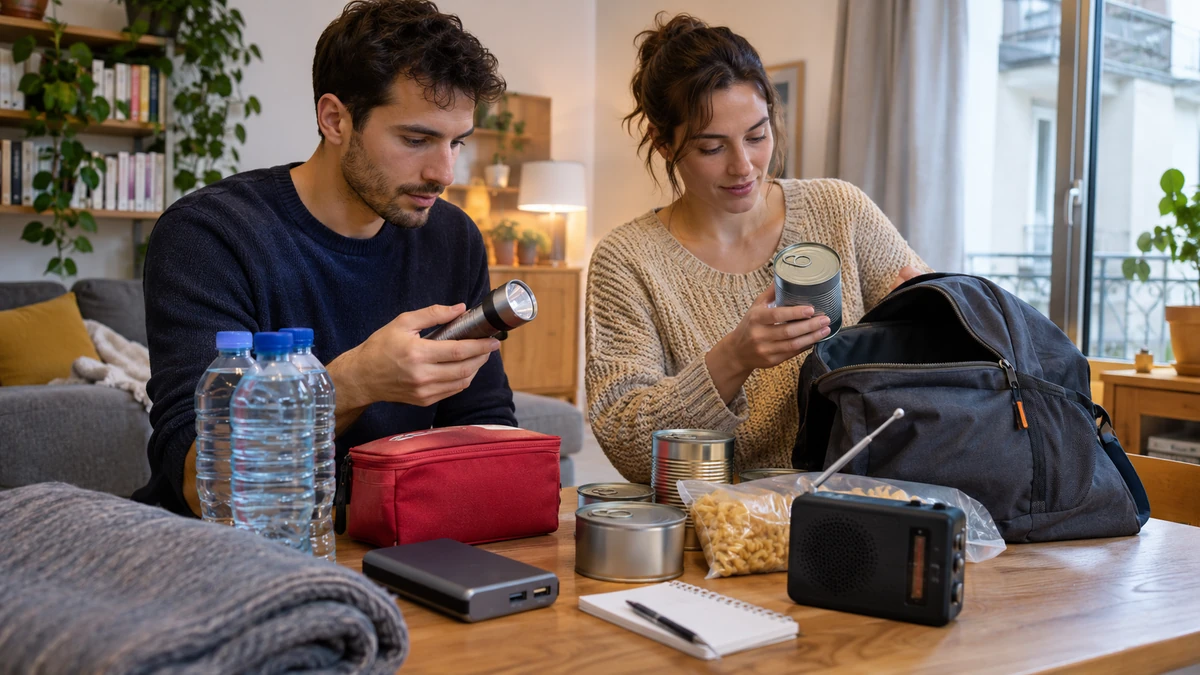
Safe water is a priority. The "rule of three" is an extension aide-memoire, not a medical period during which everyone could wait without drinking. Heat, effort, disease and treatments change needs. Provide an available quantity, suitable containers and a supply solution; in case of water advisories, check if boiling is indicated or if another source is required.
For initial supply planning, PrépaCivile uses two litres per person per day for drinking plus two litres for food preparation and minimal hygiene. Four people therefore require sixteen litres per day in this planning scenario, plus the animal’s needs. This is not a medical drinking prescription. Prefer litres: US and imperial gallons represent different volumes.
Choose clean, closed food containers that have never received a chemical. A large 55-gallon American drum contains about 208 litres and exceeds 200 kg once filled: this is not necessarily the first purchase suitable for an apartment or a person to carry its reserve. A hiking filter does not remove all contaminants and rainwater is not automatically drinking. Installation, processing, maintenance, cost and access must be verified before relying on these solutions.
Start with a realistic reserve and gradually increase it if your means allow. Five days can be a work objective, without constituting a universal threshold or a step towards an apocalyptic scenario. Check for rotation, health needs and information on local distributions. Managing a reserve means planning how to use and renew it, not imposing a beverage restriction to make the stock last at the expense of health.
Security
Security: A fundamental pillar of preparedness
Safety includes the prevention of fires, falls, poisonings and intrusions, as well as the possibility of alerting and exiting. Start with proportionate gestures: maintained alarms, clear exits, appropriate locks, lighting and contacts. For travel, avoid a confrontation and seek help. The rules on defence objects and animals vary from country to country; a preparation does not give additional authorisation.
In Canada, aerosols designed to neutralize humans are not a general legal alternative to personal defence. A product intended for animals does not become an authorized tool against a person because it is sold in stores. Taser-type electrical devices shall also not be offered as an ordinary preparation accessory. The rules are not limited to certain major cities: check the applicable texts and give priority to prevention, remote planning and the use of competent services.
The shotgun was presented as a first acquisition to defend the home. This is not a recommendation adapted to a general citizen preparation guide: legally possessing a weapon does not give general permission to threaten an intruder or to protect property by force. Housing security is first prepared through avoidance, protections compatible with evacuation and reporting. Do not try to face a person to test your equipment.
Similarly, the historic proposal to add an AR-type rifle and a handgun should not be treated as a legal shopping list in Canada. AR-15 weapons and variants are prohibited and handguns are restricted. Classifications and obligations must be verified with the authorities; a preference or habit of shooting does not resolve these issues. These items are not necessary to start a family emergency plan.
For a person already holding a weapon, prevention of unauthorized access, storage, transport and compliance remains essential. A crisis does not suspend these responsibilities. Training does not turn risky intervention into permissible action; no preparation guide can provide a general guarantee of self-defence. For this starting plan, focus decisions on common hazards, exits, alarms and ways to get help.
Shelter
The importance of shelter in preparation for urban survival
The shelter is an essential element of survival, often underestimated until an emergency situation highlights its vital importance. Whether as a result of natural disasters such as tornadoes we have had in recent years or as a result of floods, or in the context of forced evacuation, the ability to effectively shelter can make the difference between safety and exposure to environmental hazards.
In the city, plan first the possibilities of reception: close friends, place announced by the municipality or other confirmed accommodation. A tent and tarpaulin can be used outdoors, without being a universal solution for camping in urban areas during evacuation. The right of access to the ground, weather, sanitation, mobility and health needs also matter. A light bag does not replace access to a truly habitable place.
Climate conditions, particularly in areas prone to cold temperatures or extreme weather conditions, require further reflection. The inclusion of a sleeping bag suitable for low temperatures, as well as warm and spare clothing in your survival equipment, is essential. These elements, in addition to providing minimal comfort, can be crucial to avoid hypothermia.
Heating and Protection: A combustion appliance requires authorized use, proper installation, expected ventilating and ventilating. Do not use inside a barbecue, stove or heating designed for outdoor use, even open window. A portable stove does not move freely into a dwelling. Emergency coverage limits certain losses but does not produce heat; if the home becomes too cold or dangerous, follow the instructions and look for suitable accommodation.
In short, the shelter in urban survival is not limited to a roof above the head. It is a complex component of the preparation that requires careful planning and adaptation to the specificities of your environment and the environment. scenarios potential emergency. Having a flexible and well equipped shelter plan will prepare you to face a wider range of emergency situations, thereby strengthening your resilience and your ability to effectively protect yourself and your loved ones.
Food
The food strategy for urban survival
Limited space may complicate a food reserve, but do not assume that an average family has exactly three days of provisions. Make your inventory: quantity, conservation, water and cooking required, allergies, child needs and treatments. A filled closet does not amount to meals that can be used during a breakdown if all products require impossible preparation.
You can choose a realistic initial duration and then gradually increase. Lyophilized foods can be suitable for certain uses, without being mandatory or all simple to prepare: check water, energy, servings and cost. Stable usual products, actually consumed and renewed, can provide an accessible basis. The best list is one that covers your needs with controlled storage and preparation conditions.
This method not only allows you to diversify your food reserves, but also ensures that you have food that is familiar and appreciated, an important factor for morale in crisis situations. The construction of a food stock over a week, and its extension to two weeks and possibly one month, is a realistic and pragmatic approach. It is crucial to remember that the establishment of food reserves is not an invitation to excess. Impulsive purchase or excessive storage on a credit card can cause financial difficulties, without significantly increasing your security. The key lies in the progressive and thoughtful accumulation of your stocks, ensuring that the products are rotated regularly to maintain their freshness.
Storage: A closet or space under a bed may be suitable if the temperature, humidity, access and resistance to pests are suitable. Avoid household products, flood-prone areas and obstruction of an exit. Keep the labels and organize the rotation; a box moved out of sight does not become an forgetable reserve until the next crisis.
Finally, food preparation for urban survival is not limited to food storage. It also includes the ability to prepare these foods under potentially precarious conditions.
Alternate cooking: check the authorized place of use and fuels. Barbecues and outdoor stoves are not used in a dwelling, garage or tent, due in particular to carbon monoxide and fire. Consumable meals without cooking can reduce this dependency. The purchase of a burner is not enough to ensure a safe solution during a breakdown.
A reserve is therefore built with a budget, adapted food and rotation. It can reduce certain difficulties without guaranteeing the feeding of the entire household for each crisis. If quantities, health needs or preparation conditions become insufficient, ask for help or join a reception place is part of the plan rather than trying to hold it at any cost with the stock alone.
Money
Financial management in preparation for survival
A payment breakdown or unforeseen expenditure can complicate daily life without implying the collapse of a banking system. Financial preparation seeks to limit this difficulty: knowing the essential invoices, the institution's contacts, useful documents and a small amount accessible according to your means. The priority remains not to finance a long list of equipment at the cost of immediate difficulties.
If your budget allows, setting aside a modest amount — twenty dollars a month or less — can contribute to an emergency fund. A small banknote reserve for immediate needs differs from savings for unforeseen needs. Gold and silver do not retain a guaranteed value, may incur fees and are not accepted everywhere as payment. Their purchase is not a necessary preparation step and does not replace a liquid savings adapted to your situation.
Distinguish availability, protection and risk: Species can be used if a terminal no longer works, but they can be stolen, lost or destroyed. Avoid keeping all your savings at home or publishing its location. Check with your institution how to access your money, and keep useful contact information on paper. An alternative payment plan must remain proportionate, without requiring a definite collapse.
Review your budget and savings when your income, expenses or household needs change. An accessible sum and a progressive goal can help; no strategy guarantees financial autonomy in any crisis. For a decision to invest, debt or persistent difficulties, look for appropriate support rather than a product presented as a universal refuge value.
By doing this, you not only strengthen your ability to manage emergencies, but also contribute to the overall resilience of your family and community to the unpredictable.
Conclusion and invitation to reflection
Preparation is an evolutionary approach, not a competition for complete autonomy. Homes have different needs, means and constraints. Choose what reduces a concrete difficulty and also plan how to ask for help, join a relative or follow evacuation instructions. You don't need to buy everything to start usefully.
This article addressed the fundamental pillars of survival – water, security, shelter, food, and finance – to lay the foundation for effective and appropriate preparation for each. However, the path to integral preparation does not stop there. It is an ongoing quest for improvement, learning and adaptation to the uncertainty of our world.
We invite you to share your experiences, personal tips or the challenges you have faced in your preparation journey. Your contribution will enrich our community and help others navigate their own preparation journey.
What aspects of preparation are of greatest concern to you? Do you have any specific advice that could benefit others? How do you plan to expand your preparations in the future?
To ask a question, report an outdated link or share an experience, use "Contribute to this article". Proposals are reviewed prior to integration and are not published automatically. Distinguish a personal experience from a technical or medical recommendation, so that the exchange helps readers without presenting an unverified tip as a rule for all.
Benchmarks to start
- Financial Consumer Agency of Canada: establishing an emergency fund.
- CBSA: weapons and devices, including aerosols, to be read in its field of application.
- RCMP: Prohibited weapons and devices in 2020; also check the subsequent applicable rules.
- Quebec: Power Outage, for heating and cooking precautions.