
In this article
- Understanding children’s fears
- Age-adapted communication
- Avoid frightening language and tactics
- Using positive encouragement
- Developing a family action plan
- Role play and exercises
- Setting an example
- Family values and safety routines
- Emotional support and active listening
- Frequently asked questions
- Conclusion
Facing a disaster can be frightening, and even more so for a child. Yet it is possible to prepare children without frightening them, by emphasizing clear explanations, familiar routines and simple actions.
The aim is neither to turn your home into a bunker nor to impose anxiety-provoking scenarios. Healthy preparation should above all strengthen three things for children: a sense of safety, familiar reference points and concrete actions they can use.
This article offers age-adapted approaches, communication without fear tactics and a practical family method combining plans, practice and positive encouragement to support emotional and practical coping.
PrépaCivile guidance: seek understood instructions and accessible support without requiring prepared children to remain calm or less worried. Strong emotion is neither a fault nor proof learning failed.
Understanding children’s fears
Begin with what the child already knows and worries about. Age, experience and development influence understanding without identical imagination or needs. Short explanations can develop through questions rather than imposed detailed scenarios.
A. Sources of fear
1) Media and adult conversations
- Media: striking fire, flood or storm images may seem nearby and frequent to children even when events are rare.
- Adult conversations: children may hear more than expected. Without suitable explanation, anxious discussion can become lasting worry.
2) Uncertainty and loss of control
- Unknowns may feed worry, but excessive detail may increase it too. Check what the child actually asks before explaining everything.
- Familiar support matters: children may notice adult stress without reacting automatically. Adults can acknowledge difficulty and available help without appearing perfectly in control.
B. Recognizing and validating emotions
Validation is not dramatization. It means: “I hear you. It is understandable, and we will work on this together.”
1) How fear may be expressed
- Mood changes: irritability, sadness or anger.
- Regression: increased need for a comfort object or reluctance to sleep alone.
- Physical signs such as stomach aches, headaches and disrupted sleep have several possible causes. Do not automatically attribute them to anxiety; seek advice for concerning intensity, persistence or overall condition.
2) Why dismissal may worsen matters
- Greater anxiety: feeling alone with fear.
- Reduced trust: hesitating to speak next time.
Repeated questions do not necessarily mean a child “is not listening.” They may seek emotional reassurance as well as information.
Age-adapted communication
The same information cannot be expressed in the same way to a child aged 4, 9 or 15. The challenge is not simply to say “more,” but to provide just enough information for the child to act.
A. Adapting explanations by age
Ages 2–5
Young children
Simple words, short instructions and action. Avoid unnecessary detail; use play and repetition.
- “For this fire practice, we use the planned exit with the adult’s help and meet at the agreed place.” Match words and actions to the real plan rather than asking children to find a parent through danger.
- Play scenarios using dolls or soft toys.
- Reassure through presence and accessible language while giving necessary action information. A gentle tone does not replace an explanation when needed.
Ages 6–12
School-age children
Explain why, invite questions and assign simple responsibilities.
- Explain instructions and their reasoning.
- Develop a short family plan together.
- Possible tasks: light, bottle or knowing the meeting point.
Ages 13 and over
Teenagers
They may analyse, question and disagree. Include a meaningful role and emotional discussion.
- Defined plan roles: kit, communications or pets.
- Skills: first aid, navigation and emergency calls.
- Discuss stress, reactions and decisions.
All ages
Communication principles
Clarity, consistency and repetition. Avoid jargon and check understanding.
- Say “a big storm” rather than “an extreme phenomenon.”
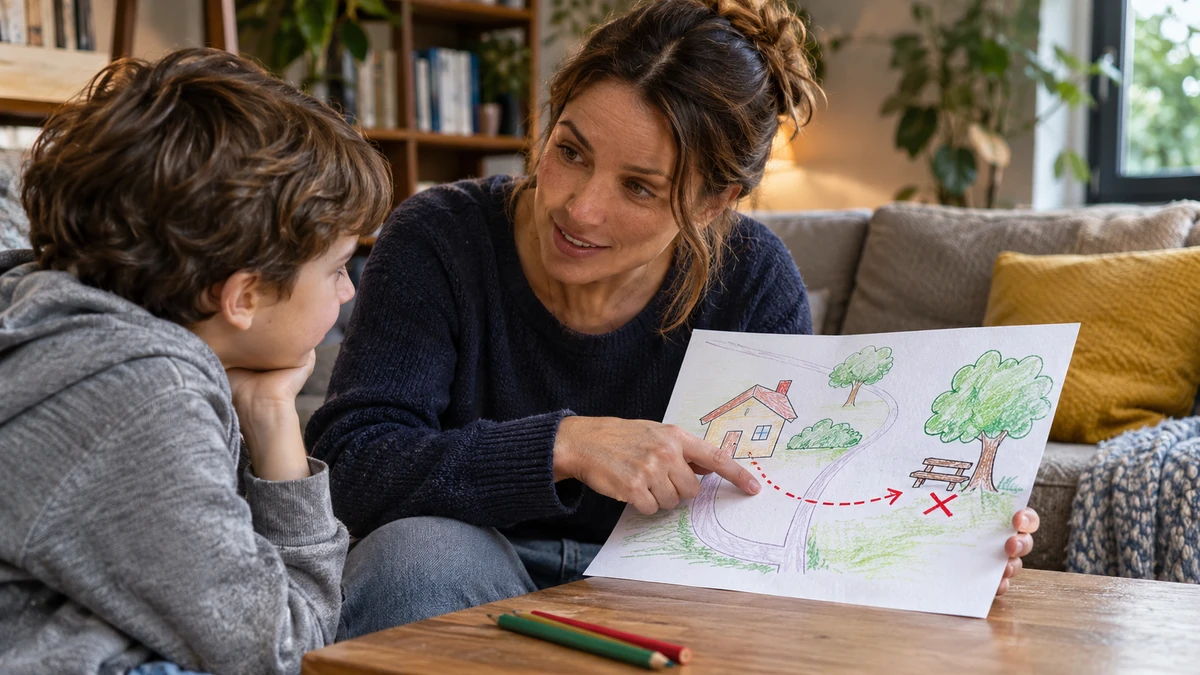
- Use drawings, maps and visual landmarks.
- Ask: “What did you understand?”
B. Simple, clear language
- Avoid jargon: explain necessary terms in a sentence.
- Concrete examples: outages, storms, evacuation and alarms.
- Check understanding: ask the child to explain in their own words.
Avoid frightening language and tactics
Do not use shocking images or threats to obtain obedience. Reactions vary: worry, sleep disruption, avoidance or freezing are possible. No single effect can be predicted, and frightened children are not necessarily unable to act. Teach safe action and welcome feelings rather than provoking reactions to measure readiness.
A. Possible effects of excessive fear
- More anxiety: rumination, repeated worry or hypervigilance.
- Freezing: an overwhelmed child may freeze instead of following a plan.
- Lost trust: feeling manipulated may reduce openness.
B. Positive alternatives
A simple sequence
Describe → demonstrate → practise → encourage.
This sequence can make an instruction more concrete, while allowing the child to pause and ask questions. Its usefulness does not mean that explaining the risk should always be avoided, or that it will be more effective for every child.
- Focus on the action that corresponds to the situation: the planned exit for a fire exercise, or the safe location for sheltering. “Come to me” must not become a universal rule if following it would require the child to take a dangerous route.
- Positive wording: “We stay together” rather than “You will get lost.”
- Skills and support: small successes may build confidence but are not anxiety treatment. Persistent fear may need specific assistance rather than exercises alone.
Using positive encouragement
Encouraging effort and specifying what the child has understood can support learning. Do not punish hesitation or a strong emotion. Responses vary from one child to another; a reward or a compliment guarantees neither lasting recall nor an absence of worry.
A. Principles
- Prompt recognition: acknowledge the useful action soon afterwards.
- Specific praise: identify what was understood or done well.
- Progress, not perfection: value effort.
B. Examples
After practice
“Well done remembering the meeting point without a reminder.”
Everyday actions
“Thank you for checking the light. That helps the family.”
A playful system
A chart may suit a child who enjoys it, without scoring calmness or withholding activities for fear. Games encourage chosen participation rather than making safety competitive.
Sharing knowledge
“I liked how you explained that to your brother or sister.”
Developing a family action plan
Taking part in the plan can provide familiar reference points, as long as the tasks remain appropriate. It does not guarantee less panic. The adult retains responsibility and can simplify the activity if it becomes too demanding.
A. Creating the plan together
- Identify plausible scenarios: outage, storm, fire, evacuation and sheltering.
- Write simple instructions: a sentence per situation.
- Choose a meeting point: accessible, nearby and familiar.
- Emergency numbers: fit location and child’s age.
B. Small, meaningful responsibilities
- Choose an accessible torch location.
- Check radio and batteries with an adult.
- Place a comfort item in family supplies.
C. Write it down and keep it accessible
- Display: refrigerator or entrance with simple symbols.
- Review: after moves, school or routine changes.
- Repeat: spend a few minutes rereading together regularly.
A short version may use a few instructions and clear drawings. Three instructions is a presentation suggestion, not a universal limit. Check that each action fits the situation and real plan.
Role play and exercises
Practice helps reveal what is unclear and allows children to become familiar with actions. A plan that has not been practised is not necessarily forgotten, and a simulation does not automatically turn a response into a reflex. Announce the exercise and provide a setting without surprises, smoke or a real threat.
A. Why practise?
- Familiarity: repeating understood actions may help recall without ensuring automatic responses under stress. Adult presence and assistance options remain important.
- Correct: identify unclear routes or meeting points.
- Reassure: “We have practised this; we know the plan.”
B. Planning enjoyable exercises
- Suitable scenarios: simple for younger children, more structured for older ones.
- Accessories such as drawings or soft toys can support play. A stopwatch is not necessary and should be removed if it creates pressure. Do not organize a race or introduce dangerous handling merely to make the activity more spectacular.
- Rhythm: short regular practice can be preferable to rare major simulations.
Five to ten minutes may be a starting point according to attention and needs, not one best format for everyone. One instruction, pause and conversation may suffice. Shorten or postpone for worry or fatigue.
Setting an example
Children may observe adult reactions, but no parent must remain perfectly calm. Explaining actions and requesting support also models coping. Adults can feel emotion and still protect children; preparedness should not add guilt.
A. What behaviour communicates
- Adult support: taking care of your own stress and having someone available to take over can help you remain available to your child. This does not mean that the child’s emotional security depends entirely on the parent’s mood.
- Consistency: contradictory words and actions make rules harder to learn.
- Openness: taking safety seriously encourages questions.
B. Demonstrating reasoned responses
- Explain: “We keep the light here so we can find it.”
- Include: “Can you check where the kit is?”
- Stay factual: “A big storm is coming; we are preparing.”
Family values and safety routines
Aim for preparedness that fits ordinary family routines through understandable, manageable practices rather than frightening scenarios.
A. Everyday safety
- Natural reminders: exits, landmarks and simple habits.
- Suitable news discussion: no shocking images; return to useful actions.
- Routines: review kits and lights periodically.
B. Open communication
- Active listening: no judgement, ridicule or dismissal.
- Empathy: “I understand. Let us see what to do.”
- Honest answers: age-appropriate without unnecessary detail.
Emotional support and active listening
Even appropriate preparation may raise worries. Support helps children name feelings, express them and find a next step.
A. Noticing stress
- Sleep changes, irritability, avoidance and repeated questions.
- Physical symptoms such as stomach aches and headaches.
B. Supporting expression
- Play and creativity: drawing, toys and stories.
- Open questions: “What worries you most?”
- Welcome feelings: listen without dramatizing, then suggest a simple action.
C. Coping options
- Breathing: gently suggest a rhythm if comfortable without fixed timing or breath-holding. Four seconds is an example, not a prescription; stop for discomfort or increased worry.
- Visualization: imagine a reassuring place.
- Recall achievements: “You have already managed to…”
Resilience involves many factors including support, experience and resources. Feeling supported and asking for help matter without excluding fear. Children may remain worried despite well-learned actions; they need not prove resilience.
Frequently asked questions
At what age should emergency preparation begin?
Start with actions suited to understanding and needs alongside adults. Young children may recognize a place, object or trusted person. Fire, sheltering and travel instructions differ; do not teach one reflex of finding a parent in every situation.
How should I answer worrying questions?
Validate—“I understand your worry”—then explain the action: “Here is what we do.” Be honest, brief and age-appropriate.
Should disaster videos be used to educate?
Avoid shocking or repetitive images to teach reactions. Discuss appropriate educational materials with an adult rather than assuming every video has identical effects. Drawings, explanations and announced practice provide alternatives.
How often should families practise?
Plan regular practice suited to your family, then review it when the home, school or a person’s needs change. The suggested five to ten minutes is neither a mandatory frequency nor a mandatory duration. Finish by discussing what was understood and what needs adjusting; the exercise should not become a repeated source of tension.
How can teenagers have roles without pressure?
Assign clear, useful, realistic tasks involving supplies, communications, pets or landmarks. Recognize effort. Support self-reliance without making them the adult responsible for everything.
Conclusion
Balance information without dramatization, resources without overload and practice without fear tactics.
Understanding questions, adapting language and offering small practices may build confidence without guaranteeing lasting resilience or no anxiety. Seek professional advice when worry persists, intensifies or impairs daily life rather than automatically adding exercises. Preparedness complements support rather than replacing needed care.
Preparation is ongoing, not a single event. Adapt guidance to children’s ages, family circumstances and daily life.
Guidance: supporting a worried child — Government of Quebec; preparing children for emergencies — Public Safety Canada. Adapt activities and seek help for concerning reactions.