
In this article
- Area 1 — Food and production
- Area 2 — Health and emergency care
- Area 3 — Social cohesion and culture
- Area 4 — Construction and engineering
- Area 5 — Communication and diplomacy
- Area 6 — Processing food and cooking
- Area 7 — Safety and situational awareness
- Mapping the strengths of people around you
- Overview
- Frequently asked questions
- Complementary references
One person can prepare a great deal without being able to meet every household need alone during prolonged disruption. Food, health, maintenance, information and support require different resources. A mutual-aid network can broaden options without guaranteeing complete independence or replacing public services. Its strength also depends on relationships, constraints, availability and people's agreement, not only a list of skills.
Unclear roles can create tension, but two people sharing a skill are not automatically competitors. Backup coverage and shared work can help. Clarify responsibilities, decisions and limits while planning for absences: complementary skills also include the ability to replace someone who is unavailable.
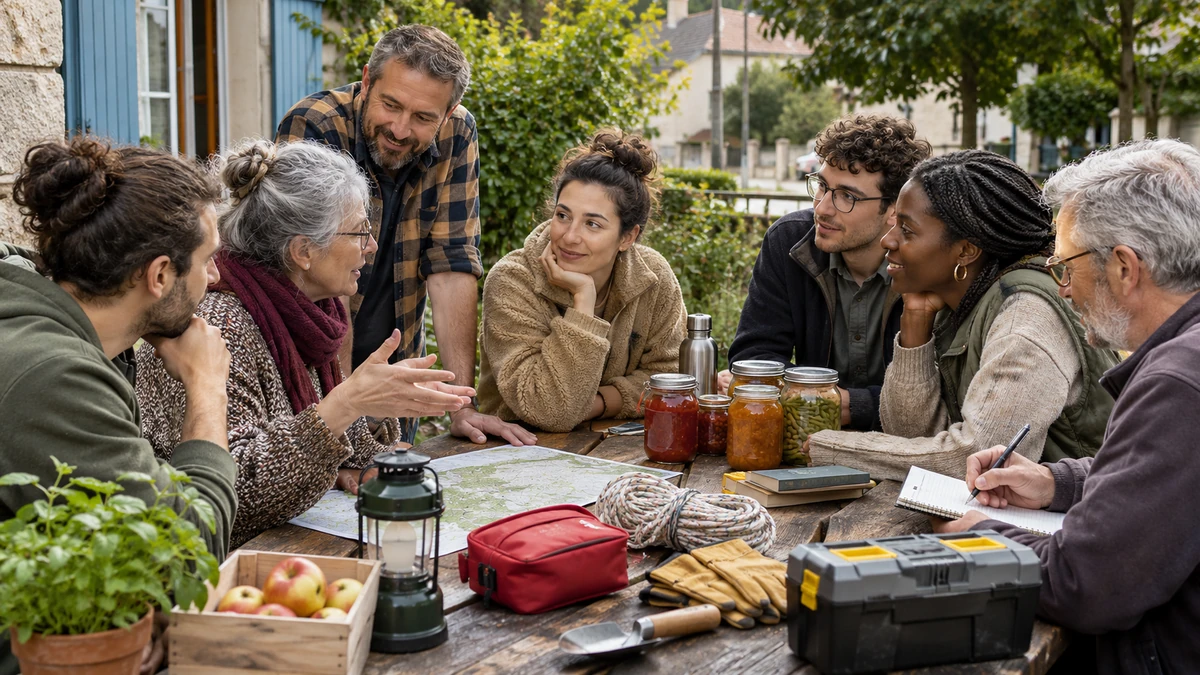
This article offers a framework to identify and value seven complementary skill areas in a resilient group, whether an extended household, neighbourhood or community preparedness group.
Area 1 — Food and production
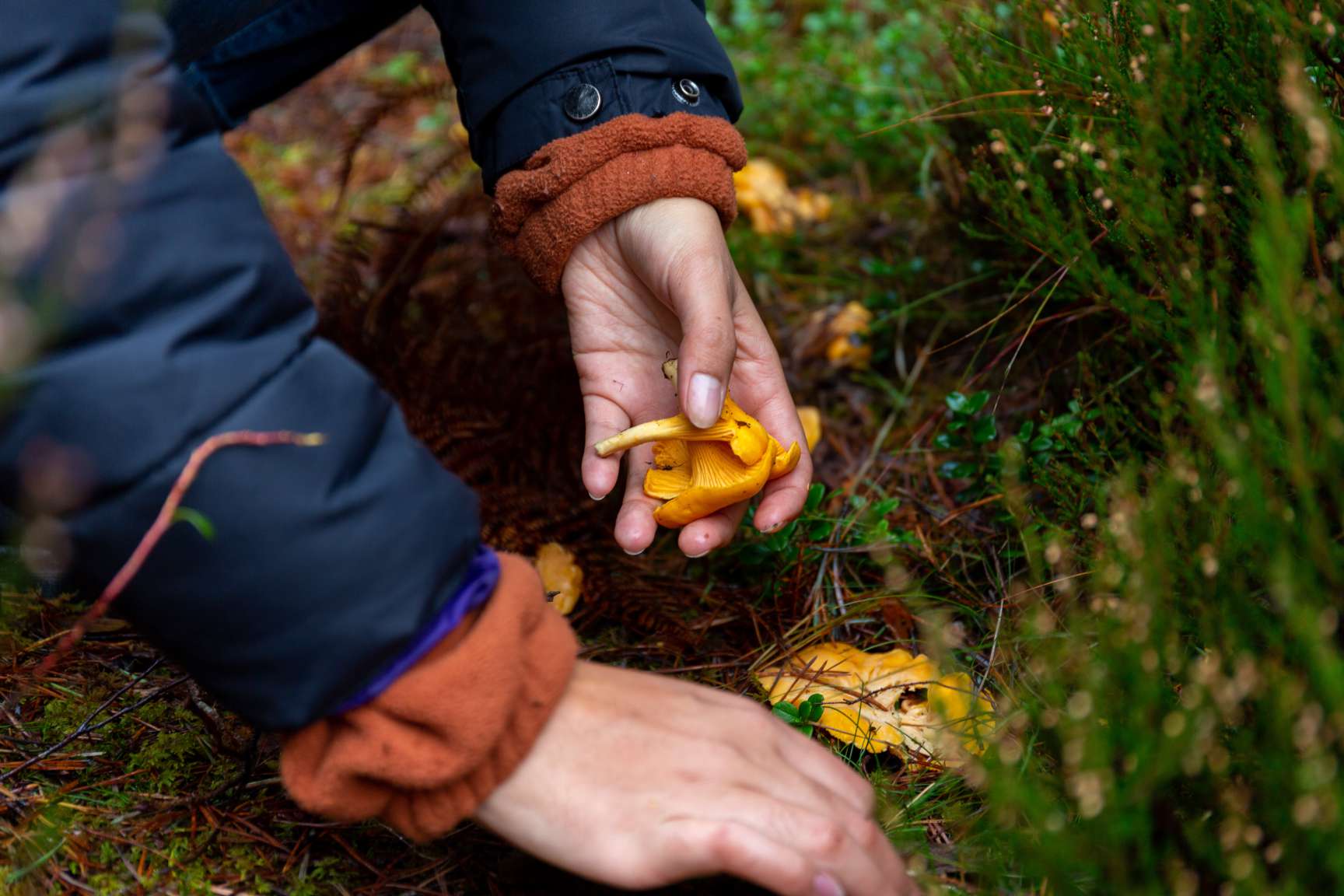
Eating mushrooms requires competent identification; a photograph is insufficient to establish an edible species.
Food begins with access to safe products, inventory, meal preparation and individual needs. Producing some food can complement arrangements according to location and season without being a prerequisite for joining a network. A vegetable garden does not immediately solve a supply-chain disruption; distributions, suppliers and existing support also matter.
The most valuable skills in this area cover three aspects:
- Animals and livestock: feeding, care, welfare and local rules require preparation. Poultry, cattle and fish are neither interchangeable resources nor suited to every neighbourhood. Livestock experience does not confer veterinary qualifications, and introducing animals during a shortage can increase needs rather than reduce them.
- Seed saving and gardening — Selecting, storing and germinating seeds, maintaining working compost and managing a productive garden over several seasons are fundamental skills acquired gradually.
- Plants and foraging: identification, look-alike hazards, contamination, access rights and rules must be learned before depending on them. Foraging does not guarantee extra meals out of season. An app's advice or online image is insufficient for eating an unknown plant; familiar foods and organized resupply may be safer.
Area 2 — Health and emergency care

Disruption can complicate continuity of care and increase some needs. That does not mean every crisis automatically overwhelms facilities or that individual emergencies are treated only after collective priorities. Report a medical danger immediately. A community network can facilitate alerts, access to information and learned first aid without creating an improvised healthcare service.
Someone with medical, paramedic or first aid qualifications can help within the limits of training, personal condition and obligations. A basic course is not a clinical qualification. Discuss beforehand what each person actually agrees to do and which situations require professionals.
- Wounds: cleaning, protection and bleeding-control actions may fall within learned first aid. Suturing, assessing infection or sepsis and choosing treatment do not automatically become part of that role. Wound-closure strips do not suit every wound and must not delay assessment of a deep, contaminated or serious injury.
- Medications: an up-to-date personal list, storage conditions and pharmacist contacts help. Knowing the names of pain medicines, antihistamines or antibiotics grants neither the right nor competence to choose treatment for the group. Do not share prescriptions or create antibiotic supplies to administer without professional assessment.
- Environment: recognizing an urgent need related to cold, heat, water or a product can help raise the alarm. Heatstroke, poisoning and radiological exposure require instructions and care specific to the situation. Iodine tablets or other products must not be taken preventively solely on a community group's decision.
Training: begin with recognized first aid and resuscitation training suited to your needs. Bleeding control, tourniquet use and haemostatic dressings require the actions and limits taught; owning the equipment does not replace a specialized module. Check the programme, prerequisites and instructor qualifications rather than assume every organization teaches every technique to the public.
Area 3 — Social cohesion and culture
Social, cultural and creative activities can offer structure and shared experiences. Offer them according to preferences, fatigue, accessibility and group resources without requiring participation. They guarantee neither freedom from conflict nor identical psychological benefits for everyone.
Skills in this area also serve practical functions:
- Drawing, mapping and documentation — Producing readable plans, terrain maps and technical diagrams, and visually recording available resources or decisions, is a communication skill beyond creativity alone.
- Music and activities: a shared moment may suit some participants without being imposed on people who are exhausted, grieving or need quiet. Account for age, sensitivities and accessibility. Success does not require everyone to display the same mood; participation must remain a choice without disrupting rest or important instructions.
- Education and passing on knowledge — Any group with children or teenagers must consider their education. People who can teach in a structured way, from school basics to practical skills, fulfil an essential educational and social role.
Area 4 — Construction and engineering
Maintaining, repairing and adapting the built environment is an operational need in any long-term scenario. Construction skills span a wide range, from basic DIY to structural engineering.
- Carpentry: repairing storage or making a simple item requires tools, protection and competent use. Reinforcing a load-bearing structure or damaged building requires qualified advice; do not confuse DIY ability with validation of safety after a disaster.
- Systems: hydraulics, electricity, batteries, solar and mechanics involve different risk levels and qualifications. General understanding does not authorize connecting a generator to the grid, altering a gas installation or declaring a building safe. Assign authorized tasks and request necessary professionals rather than expect one “group engineer” to validate every field.
- Tools: adapting storage or repairing a handle can help if use remains safe. Equipment intended to support a person, hunting equipment or electrical devices cannot be made through improvisation judged clever. Check function, limits and rules; declining a dangerous fabrication is also a skill.
Area 5 — Communication and diplomacy
Communicating effectively, managing internal tensions and maintaining constructive outside relationships is among the least formalized household preparedness skills, and among the most decisive in practice.
- Conflicts can occur without being inevitable or proving that a group has failed. Provide ways to express disagreement, review an assignment and seek support. Mediation does not replace reaching safety or requesting appropriate help when violence occurs.
- Leadership and collective decisions — Effective crisis leadership is not authoritarian: it structures decisions, distributes responsibilities clearly and maintains trust. People who can de-escalate tense situations before they worsen bring immediate practical value. Poor leadership can weaken a group as surely as missing resources.
- Outside relationships: identify relevant services, associations and contacts for a request or exchange. A neighbourhood need not become rival alliances. Resource discussions must respect consent, distribution rules and organizations' roles; do not negotiate for neighbours without their authorization.
Area 6 — Processing food and cooking
Turning available food into nourishing, appealing and safe meals is a skill in its own right. Its value is often underestimated until it is missing.
- Animal processing: slaughter, butchering, inspection, preservation and waste disposal involve specific skills and rules. Using every part is not automatically safe or legal. A crisis does not turn a home or plot into a slaughter facility; favour authorized services and practices rather than learn these actions under pressure from an article.
- Preservation: pressure canning, dehydration, fermentation, smoking and salting have distinct protocols. A tested method and complete conditions are required; combining poorly mastered methods does not increase safety. Do not try to salvage unfit food or validate a jar by smell. Preservation is prepared before an outage with appropriate equipment and training.
- Cooking: adapt meals to allergies, health needs, food that is actually safe and available cooking methods. Pulses and flours require appropriate preparation; wild resources are not edible on approximate identification. Creativity must respect food safety rather than treat every available resource as a useful ingredient.
Area 7 — Safety and situational awareness
Safety: preventing fires, falls, poisoning and conflicts, receiving alerts and being able to evacuate are concrete needs. Observation can help notice danger without guaranteeing detection before it occurs. No skill gives the group a policing role or a right to control neighbours' movements.
- Observation: noting an obstructed exit, smoke or an instruction differs from labelling movements or people as “precursors”. Describe facts, seek safe verification and report danger. Appearance, origin, disability or an unfamiliar presence is not an established threat.
- Surroundings: lighting, usual access points and escape routes can be checked with those responsible. Do not create roadblocks, traps, coercive patrols or devices blocking responders. Voluntary rotations to check on people must not become surveillance of residents or imposed deprivation of rest.
- Weapons: possessing them is not an essential mutual-aid role. If someone lawfully hunts, permits, storage, transport and use remain regulated. This authorizes neither armed patrols nor threats to protect property. Do not confuse hunting with general security competence or a duty to arm the group.
Mapping the strengths of people around you
Knowing these seven areas in theory is one thing; identifying who actually knows what is another. Mapping skills is itself a preparedness task.
Voluntary inventory: invite people to state what they want to offer, their limits and contact details. Do not secretly collect neighbours' qualifications, availability or resources. Restrict necessary information to agreed recipients with an option to withdraw; people can participate without revealing supplies or health conditions.
Backup: similar skills can complement one another and allow relief. Tensions can arise from unclear expectations or responsibilities rather than inherently bad duplication. Agree who coordinates a task, how relief works and when a professional is needed instead of assuming responsibilities distribute themselves naturally.
Points to watch when forming a group
- A group composed only of similar profiles — all technicians, administrators or security specialists — has structural blind spots in uncovered areas.
- Gaps: care and food can be important needs, but shortages within your network must be established with participants. A technical group may already include trained people; voluntary inventory is better than a general claim about profiles.
- Culture and education: examine their place without claiming they are always neglected or an unidentified study proves a universal effect. Children's needs, rest, relationships and chosen activities deserve discussion as concrete as equipment.
- Useful overlap: several people knowing a basic action can facilitate relief without replacing specialized expertise. Two or three beginners do not automatically equal one professional. Plan teaching, practice limits and access to qualified advice.
Overview
A group's resilience is not measured only by its material supplies. It depends on available skills' diversity and complementarity and how clearly roles are assigned and recognized. These seven areas provide a framework to assess a local network's strengths and gaps, whether an extended household, organized neighbourhood or structured preparedness group.
Knowing the network's capacities before disruption can help some tasks. Consent, clear limits and respect for responsibilities prevent unrealistic promises of care. This complements supplies and services rather than replacing water, healthcare or professional needs.
Frequently asked questions
How many people does it take to cover these seven areas?
No ideal size is established here. Five, eight to fifteen or twenty adults are not validated thresholds predicting network success. Useful size depends on relationships, distances, availability and tasks. A small household can arrange outside support; a larger group needs explicit rules rather than a recruitment target based on a number.
What if a critical area is not covered in its immediate surroundings?
Two complementary approaches are to acquire a basic level yourself — first aid training, gardening classes or an introduction to carpentry — or broaden trusted contacts to include people skilled in that area. Structured preparedness groups and local community resilience networks are appropriate settings for such connections.
How can the division of roles be approached without creating a rigid hierarchy?
Skills can guide assignments, but technical superiority does not automatically confer responsibility. Plan agreement, coordination, backup and applicable professional or institutional obligations. Communication training can offer tools without preventing every tension. Someone must be able to refuse a task, report a limit or request assistance without losing their place.
Do these roles apply to a home, or only to large groups?
They apply at every scale. For a household, mapping is simpler: which skills do adults have and which gaps take priority? The same logic applies to a neighbourhood or community resilience group with more people available. Mapping is useful regardless of group size.
Alone we plan. Together we act: creating a resilience group
Practical steps to form and structure a local community resilience group, from choosing participants to assigning roles.
Small-scale community resilience: building together
Why and how to build resilience connections within a neighbourhood and local micro-community, with concrete examples applicable in Quebec.
Interpersonal skills in a crisis — Part 1: de-escalation
The basics of de-escalation and managing conflict under stress, a practical companion to this article’s communication area.
Complementary references
For medicines, see information of the Ordre des pharmaciens du Québec. For first aid training, check the programme with a competent body; Red Cross markers on bleeding do not replace the supervised practice. This framework of seven areas is an editorial tool for discussion, not a standard certifying the autonomy of a community.