
In this article
Living alone while advancing in age requires a preparation adapted to its real situation. Experience, habits and relationships are important resources. The plan must also take into account the mobility, treatment and assistance available, without imposing a model based on carrying a heavy bag or complete isolation.
Taking stock of essential gestures
Consider what should remain possible during a breakdown or evacuation: drinking, eating, taking treatment, moving and communicating. Identify tasks that already require an effort or the intervention of a loved one. These are things that need to be prioritized.
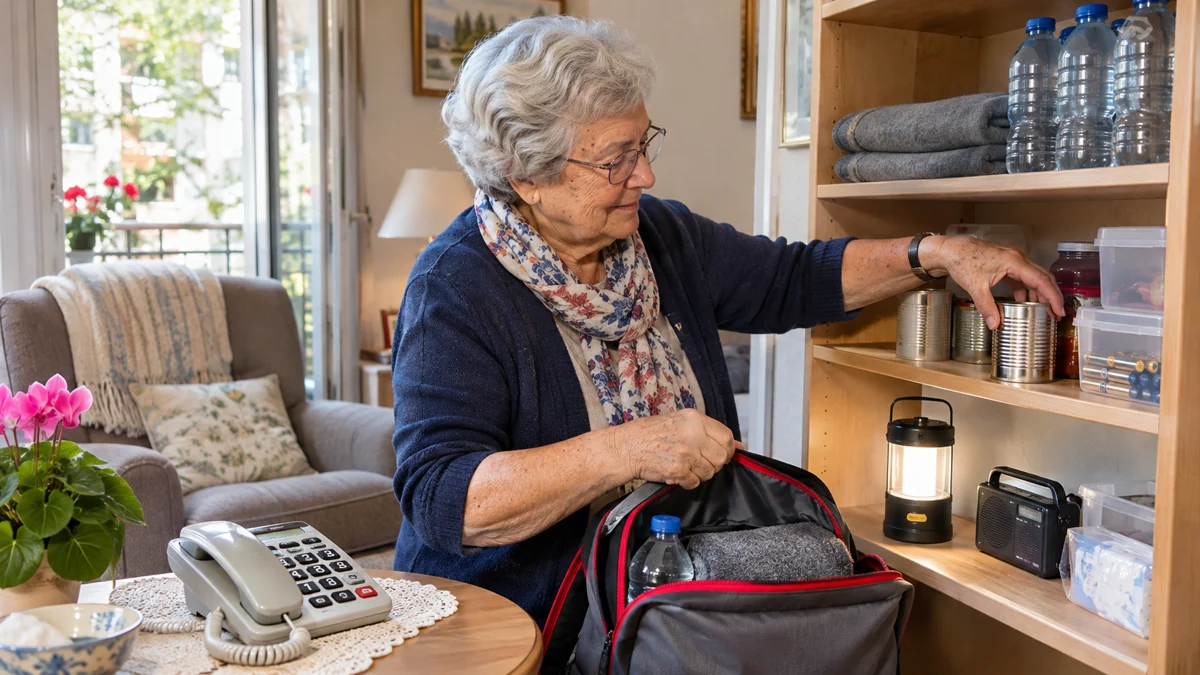
Place common objects at an accessible height, in a stable and well-lit storage. Avoid reservations that require you to sit in a chair or move a large load. Split the quantities and keep containers easy to open.
A stable lantern can illuminate a room without having to hold a lamp permanently. Check the controls, weight and battery change with the person who will be using it.
Prepare communications and news taking
Choose two voluntary contacts, including one person who can move around if needed. Agree on the time and means of taking news, then on the procedure to follow in the absence of a response. Keep contact information on paper in a known location.
A telephone must remain accessible, including at night. An external battery can extend its power supply, provided the cable, connectors and handling are suitable. It does not restore an unavailable cellular network.
If an alert or remote assistance device is used, check its operation during a breakdown and the conditions of the service. A personal sound alarm can attract attention nearby; it does not necessarily send a call to a monitoring center or rescue.
Organizing care and technical aids
Prepare a list of treatments, allergies, professionals and storage modalities. Talk to the pharmacist or healthcare team about possible continuity during an interruption. Do not modify a treatment or its duration of reservation without their notice.
For a breathing apparatus, bed or other equipment dependent on electricity, confirm an alternative and a compatible reception. Note who can help, in what time and with what means of transport. A simple battery estimate does not replace this agreement.
Glasses, hearing aids, canes and other personal equipment must be part of the plan. Plan suitable consumables and information that is easy to find by an authorized representative.
Choose a realistic start
Examine the building’s evacuation plan with its manager. Ask how to report a need for assistance and what steps are planned. Do not assume that an elevator will remain usable during all situations.
Prepare a small piece of luggage or a solution on wheels only if it is suitable for the course. The bag must contain personal priorities without becoming a physical ordeal. Test the output under ordinary conditions with proper help, without exposing yourself to a fall.
An accessible first aid kit can cover some common needs. Its content must be known and completed according to the recommendations of the professionals concerned; it does not replace access to care.
Maintaining the network without losing its autonomy
Asking for specific help keeps control of your choices: call at an agreed time, carry a container or confirm a trip. A network can bring together relatives, neighbours volunteers and local services. It does not require disclosure of all its files to everyone.
Plan a solution if the usually available person is absent. Review the plan after hospitalization, a change in treatment, a change in mobility or a move. These revisions are normal adaptations of the preparation.
Your next action: check with a trusted person three elements: a usable lamp, two contacts on paper and a possibility of departure or reception adapted to your situation.