
In this article
A home can prepare its essential needs and the people to contact before an emergency. This approach complements public services and mutual aid. It does not automatically turn household members into professional first responders and does not replace the call for help.
Preparedness: a movement in transformation
Preparedness can be approached without adopting a particular identity. It consists in knowing the local risks, preparing the needs of the home and maintaining useful links with relatives, neighbors and competent services.
Building a culture of foresight
The question is not only individual. The shift from marginal citizen readiness to community-wide distributed resilience requires change at multiple levels.
Identified levers
- Education - offer age-appropriate learning: alert, outings, contacts and first aid in a competent setting. All school integration must be discussed with those responsible.
- Material support - examine the aids actually available for housing, prevention and necessary equipment. Don’t assume the existence of a grant: check with the responsible agency for eligibility and conditions.
- Community structures — The integration of neighbourhood resilience committees into municipal civil security plans would formalize and support capacities that often exist informally.
These levers are not competitive with institutional systems – they complement them by reducing the pressure on inevitably limited collective resources during major events.
Towards neighbourhood resilience networks
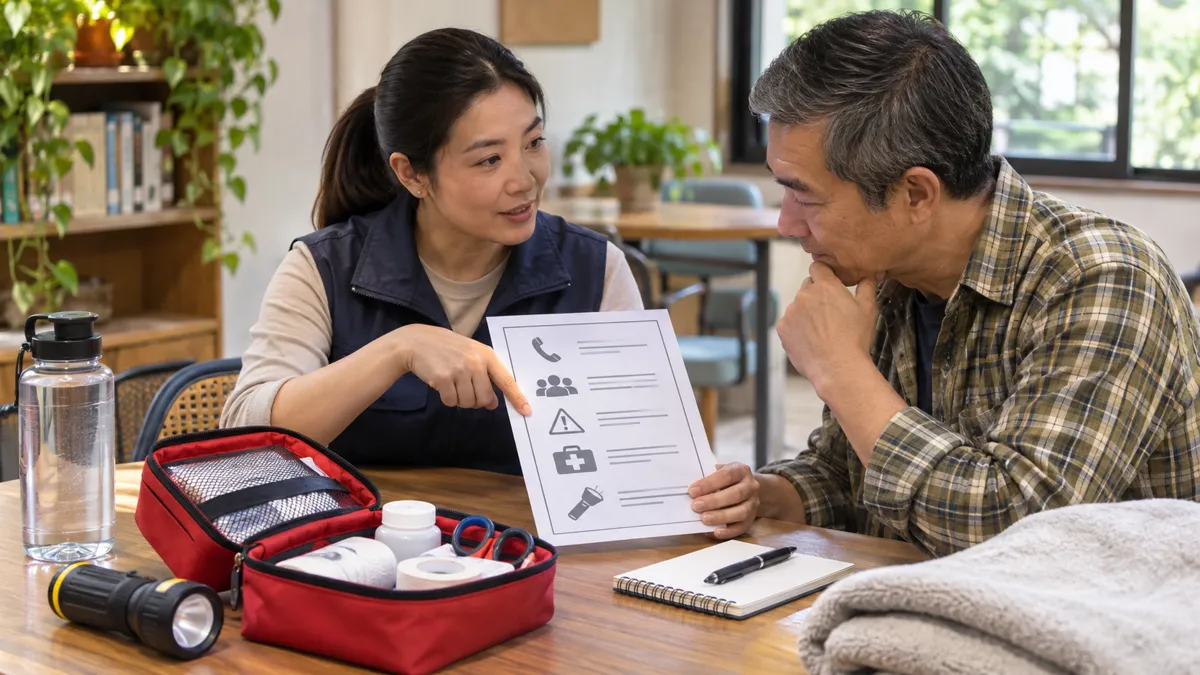
A neighbourhood may have skills and resources to share, but their availability should not be presumed. Ask for voluntary commitments, check everyone’s boundaries and coordinate the project with local structures.
- Voluntary contacts with people who wish to be contacted or helped, without unnecessary collection or dissemination of sensitive information.
- Locally available skills (first aid, mechanics, medical skills, languages))
- Sharing of mutualizable equipment (generator, first aid equipment, water supplies))
- Definition of assembly points and communication protocols in case of failure of the usual systems
The Plan, Protect, Participate approach can serve as a grid to classify tasks: knowing the risks, preparing protective measures and organizing voluntary mutual assistance. It does not confer any official status or first aid qualification.
Frequently asked questions
Is preparedness a form of distrust towards institutions?
No - and the confusion between the two often hinders the spread of a culture of foresight. Preparedness starts from the observation that collective resources, even well organized, are structurally limited during large-scale events. It aims to reduce pressure on these resources by increasing household autonomy in the early hours of a crisis – not replacing them. Institutional frameworks for civil security, in Quebec as elsewhere, explicitly recognize this complementary role of individual and community preparedness.
What is the difference between a prepper and a prepared citizen?
The terms have a variety of uses. For PrépaCivile, the important thing is the approach: know the risks, predict the needs, use reliable sources and respect the role of public services. A label does not prove the skill or the actual level of preparation.
Where to start if you want to build resilience in your neighbourhood?
The first step is relational, not logistical: knowing who lives nearby, what skills are available in the immediate vicinity, and who might need help during a crisis. This informal mapping precedes and makes everything else possible. The second step is to identify local emergency resources - municipal centres, alert protocols, emergency plans available online - before they are needed. Formalized citizens’ committees can then emerge from these relational bases, in connection with existing municipal structures.
Do academic research really support the value of individual preparation?
The Canadian Family Planning Tools and the Quebec Councils recommend concrete actions before the emergency. No plan cancels the risk; its interest is to make decisions and resources more accessible.
Is preparedness realistic for low-income households?
The preparation must take into account the real means. Some resources are free, but equipment, training, transportation and housing have costs. Start with contacts, local risks and an inventory of what’s available; find out about accessible aids and training.
To read next
Verglas in Quebec: what 1998, 2023 and 2026 teach us
Three decades of freezing storms in Quebec - concrete lessons for individual and collective preparation.
To read next
Family Continuity Plan
How to adapt the Business Continuity Plan (BCP) concept to the household scale – a concrete foundation for family resilience.
To read next
Community Resilience: Preparing Your Neighborhood
The practical foundations for structuring a network of local resilience - before the crisis.