
In this article
Only seven months ago, our world plunged into darkness, and yet, it looks like another life, another time. For many, this period marks the coming of the Apocalypse, the darkest cataclysm ever seen in our modern era. But in our home, we simply call it ‘Change'. My mother, with her quiet wisdom, insists that change does not mean the end, that words have the power to shape our perception. And, even if the term varies, a truth remains: the day when the lights were extinguished marked an irreversible bifurcation in the course of our existence, a radical turning point redefining every aspect of our daily life.
Our days, once distinct and colourful, have turned into a monotonous, indistinct sequence, woven from the same fabric of inevitable routines. The school, this place of life and learning, is more than a distant memory. Now it is in the crucible of our home that my mother takes on the role of teacher, near the wood stove whose door remains closed. A small lamp illuminates our books on the table, well away from hot surfaces. We thus save our precious candles while keeping sufficient clarity for the words of the books to awaken before our eyes.
Never would I have imagined that the gym classes or meals at the school cafeteria I would miss so much. Nostalgia often grabs me, bringing me back to these moments shared with other children, laughing around a table, complaining about the food, or to hang out in classes where boredom seemed to me the worst enemy. With the wisdom that this new reality brought, I realize how precious these moments were. If I had known what boredom really meant, I would have embraced every second of my childish carelessness, savoring every bite of food that I didn't have to grow with my own hands.
The school has become a distant memory, replaced by the imperative of providing for our basic needs. Under the burning sun, I become a gardener, watching over the earth that feeds us. My mother, with her cane, finds in me her legs, her support. My days take place between the neighboring woods, where I look for what can feed or help, and the freezing moments when I collect wood to keep us warm. Every day, our survival anchors in these simple but vital tasks, occupying each minute bathed in light, in a world where comfort of former days is more than an echo.
Terrifying reports reach us from cities transformed into mazes of despair. Survivors describe streets ruled by hunger and thirst, with no hope of rescue. Violence, the bitter fruit of fear and desperation, has erupted in concrete canyons abandoned by officers who returned to their families. The fortunate left early, escaping the sudden descent into anarchy. Those who remain face constant threats from robbers and darker dangers still. ‘Worse things, too,’ the adults murmur, their words heavy with implication. From our retreat beyond the city, I feel quiet gratitude for the isolation that shields us from those horrors.
Our home nests in the heart of a small village, surrounded by a large yard where a robust apple tree sits. The swing of my childhood turned into a frame for an improvised greenhouse, and what was once a simple garden is now a nourishing field. My mother's eccentricities, once fun with her chickens and her herb garden, now turn out to be a visionary wisdom. We depend on every fruit, every vegetable that germinates under our care. The water of our well, so different in taste from that which once flowed from taps, has become our most precious treasure, more valuable than gold, as my mother often says.
In this new world, exchange has become our currency. Our neighbors come, carrying their needs and offers. Eggs, apples, precious seeds from our garden become barter objects. The man from the nearby house, with his pale-haired wife and his children with bubbling energy, regularly brings us firewood, paid in eight eggs weekly. The venison became a usual dish on our table; my mother exchanged her know-how and some of our most precious jars for this wild game, offered by an old local hunter. Each transaction is a small pact of survival, a bond woven in the solidarity of our reborn community.
Our humble home, hidden by a curtain of trees, is a haven of peace in this reeling world. Invisible from the road, it nests discreetly, a well-kept secret. My mother sees her small size as a blessing; less large, it needs less wood to keep us warm during the cold nights. I, who am in charge of the daily collection of wood, can only agree with her. In my young imagination, the task of gathering even more wood for a larger house seems insurmountable.
This routine, previously monotonous, has recently been upset. Last week, everything changed, because it was the week before Christmas. A glimmer of excitement has pierced our daily life, bringing with it a wind of change and a thrill of anticipation, breaking the monotony of our life in this transformed world.
This Christmas stands in striking contrast to those of my young years. Far from the glittering fir trees, surrounded by mountains of gifts with shimmering packaging, this year is marked by an unprecedented simplicity. Gone are the parties and unbridled races for superfluous gifts, offered by obligation rather than by heart. Farewell to the latest technological innovations, commercial melodies resonating in crowded malls, where every look through a window was a call to consumption.
Shops, once temples of materialism, are now empty shells, vestiges of a vanished world. Every useful object has been taken away for a long time, leaving behind the echo of a past era.
And yet, despite this stripped decor, Christmas remains a waiting spark, a suspended moment. In this clean atmosphere, it is redesigned, less noisy, but perhaps more authentic, recalling that the essence of this festival transcends ornaments and glitter.
My mother, aware of the school's weariness in me, decreed a break in our night learning sessions. In recent weeks, our vigils in front of the crackling fire have been dedicated to the creation of gifts, a sweet echo to the holiday season. Far are the days when we strolled through the alleys of the shops, hesitant between threads of shimmering colors. This year, I turned an old sweater, too large and slightly damaged, into a warm scarf for my mother.
For the children of the neighbors, I gave free rein to my creativity by drawing small illustrations – a mischievous kitten, a playful puppy – framed in modest frames of twigs, bringing a touch of joy in their austere rooms. For the Gagnons’ seven-year-old daughter, I made a little book, recreating from memory the story of the Three Little Pigs, every carefully drawn letter, every carefully drawn image.
As for the man of the forest, Roger, who in my mind remains ‘the man who hunts', I participated with my mother in the creation of a warm hat, adorned with ‘R' embroidered to customize this present. Each gift, though modest, is infused with a personal touch, a love and care thread woven through the difficulties of our transformed reality.
In our little neighborhood, many, like me, have roots stretching far beyond these silent streets. Family reunions, once punctuated by distant travels, now belong to the past. The absence of fuel has narrowed our world: we only go where our feet can carry us. This year, distance imposes a Christmas without my grandparents, a first in my young life. Their fate, in this troubled world, remains a mystery that I fear never to elucidate.
Despite the heaviness of my responsibilities in this new era, the child in me fights against sleep on Christmas Eve, carried by a tip of excitement mixed with apprehension. At the age of 11, I stand at the frontier of childhood and adulthood, drawn between the innocence of a past and the weight of a demanding present.
* * *
The ringing of the bells gets me out of my sleep. Bells here? I wake up suddenly, the blankets slipping to the ground in my haste.
Get up, sleeper, it's Christmas!
Rushing from my room, I am overwhelmed by this magical sensation, unique at Christmas dawn, which makes my heart beat with childish excitement.
There, in the dim light, stands my mother, her smile radiating the room, a steaming cup in each hand. One for her, filled with coffee, and the other, to my astonishment, containing cocoa. Unimaginable luxury!
“How did you find hot chocolate?” I ask in amazement, savoring this first intoxicating sip.
A magic wand from Santa Claus, she replies playfully, ringing the bell again. Her laugh warms up the air, and in this moment, the magic of Christmas seems more alive than ever.
My Christmas stocking, once full of surprises, have a new simplicity this year. It is not swollen to the extreme, but every little bump on its surface awakens in me a feeling of gratitude and curiosity. Inside, I discover modest but meaningful treasures. A strangely familiar ball of wool recalls an old sweater that I had outgrown years ago. An apple, the fruit of our own tree, has been transformed into a confectionery, coated with a sweet icing and preserved in an old bread bag.
And there, carefully wrapped in a clean fabric, hides a mysterious gift. When I unfold the cloth, I find a hair clip, meticulously decorated by my mother. She used a piece of iron wire and pearls recovered from a broken fancy jewel, creating a small piece of reclaimed jewellery. I put it immediately in my hair, a simple gesture that adds a touch of beauty to this particular morning. Each object, though modest, carries in it a part of love and ingenuity, illuminating this Christmas with a special light.
Our Christmas tree, a vestige before Change, stands proudly despite the absence of its glittering lights. This artificial tree, once lush and bright, retains its splendour thanks to the assortment of familiar ornaments, silent witnesses of Christmases past. At its base rests a large bag a little bumpy, promise of modest but significant surprises for me, and next to it, two small packages, carefully packed, that I prepared for my mother.
With a joyful anticipation, I invite her to open the first of her presents. In her eyes is reflected the glimmer of excitement, an echo of Christmas mornings from a past era, but still alive in our hearts.
The wonder illuminates my mother's face when she discovers the word "AMOUR", carefully assembled with twigs that I picked in the woods and tied with garden twine. Each letter, shaped with my hands, is a symbol of the unwavering affection that binds us. With eagerness, she finds the perfect place for this message of love on the shelf, where it stands proudly. Her warm embrace and radiant smile fill me with deep and sincere joy.
Then comes my turn to be surprised. I plunge my hand into the big bag to pull out a purple winter coat. Stunned, I admire this unexpected gift, a luxury in our pared-down reality.
With a playful smile, my mother reveals her secret: "I exchanged eggs and some apples with the Gagnons. Their daughter grew up, and Mrs. Gagnon had kept that coat too small for her. It should fit you now."In her words, I perceive the subtlety of our post-change existence: every exchange is an act of mutual assistance, a small miracle of generosity in a world where every gesture counts.
Then we need to find someone who might need my old coat, I say, thoughtful. Indeed, I grew up, my wrists extending a good three inches beyond the sleeves. Change cannot stop nature; I continued to stretch towards heaven, even in this transformed world.
My mother then unpacks the last gift, the scarf that I patiently knit from the holed sweater. She drapes her neck with a smile, instantly appreciating its warmth and unique character.
I was thinking about Christmas last year, where a mountain of gifts was waiting for me, contrasting strongly with this year's simplicity. Yet, by sipping this improvised cocoa, by gently touching the worn fabric of the purple coat, I feel inexplicably more filled than ever. This Christmas, without the glitter and excess, is full of real meaning, sincere joy drawn from simplicity and love.
* * *
The preparation for Christmas dinner is in full swing. My mother, with her own wisdom, reminds us that our neighbors have become our new family. In this troubled world, love and self-help are not just words, but our lifeline. The old hunter, a silent pillar of our community, contributed to our feast with a turkey, which we slowly cook on our wood stove, seasoned with garlic and onions from our own garden. Although it does not resemble the golden turkeys of previous years, its attractive smell promises an unforgettable feast.
The pine branches draped with snow, which I picked up in the woods, decorate the outer edge of our window. My mother left them outside, away from the stove and the flames, so that we could admire the beauty of it without cluttering our modest room. They remind us of the simple beauty of winter.
The table is decorated with carefully prepared dishes: apple compote, the fruit of my mother's labor and the generous gifts of our apple tree; a rustic stuffing concocted from leftovers of bread and biscuits; and a pumpkin, picked in the dark of our cellar, accompanied by a generous pot of potatoes. Each dish, a testimony of our resilience and ingenuity, transforms this Christmas into a celebration of life and community, even in such uncertain times.
The arrival of our neighbours turns our house into a warm meeting place. Everyone brings what he can, enriching our table with their contributions. In these times of famine, where every meal is measured and every precious bite, this shared generosity is a real treasure.
The Gagnons, whose generosity offered us the purple coat, bring peppermint sticks, found in their box of Christmas decorations. Stale but still tasty, these sweets seem to be the most exquisite I've ever tasted. Every lick is a little moment of happiness, a rare luxury in our daily lives. The man who hunts, our discreet benefactor, is the artisan of the turkey that sits on our table. Tim and Libby, our neighbours next door, arrive with their children and a basket of biscuits, an absolute rarity since they have the only oven still functional in the neighborhood. These carefully prepared cookies may well be the last of these for a long time.
For the first time since what seems like an eternity, my day is devoted only to play. Adults take turns preparing the rest of the meal and watching the fire, while sharing discussions. We, the children, escape in a world of snow, under their eyes, far from the worries of a world without electricity or modern heat. In these moments, we are only children, laughing under the flakes, our hands shaping snowballs and building ephemeral fortresses. For a moment, the weight of the world fades away, allowing us to enjoy the carefreeness of childhood.
At the time of dinner, we gather for a feast such as we have not enjoyed for a long time. Around the table, we enjoy each dish with an appetite that can only be shared. We eat up to abundance, a rare luxury in these times of frugality.
The room is bathed in a warm light, the candles sparkling gently and the wood stove radiating with heat. In this soft glow, Mr. Gagnon made a statement. His grave and melodious voice gives life to the Christmas story, an ancestral story that seems even more poignant now. Then come Tim and Libby, who share the story of the Grinch, a fun reminder of the spirit of Christmas.
But the most enchanting moment of the evening is undoubtedly when the Christmas songs begin. Our voices rise up in chorus, mixing the old melodies with the magic of the moment. There is no recorded music, no orchestra, but in our simplicity we find a deep and sincere harmony. The songs follow each other, a thread weaving our community more closely together, a joyful and powerful reminder that, despite everything, the spirit of Christmas remains.
In our improvised shelter, music becomes the heartbeat of our Christmas. Without instruments other than our own voices, we sing together the familiar melodies of Christmas (in My Village), Santa Claus Who Comes to Us, Christmas Night and Santa's Letter. Each song is sung with more fervor than the previous one, no one wanting to put an end to this magic, because with it would end this evening out of time. The children, one by one, succumb to sleep, full, their cheeks rosy with warmth and joy.
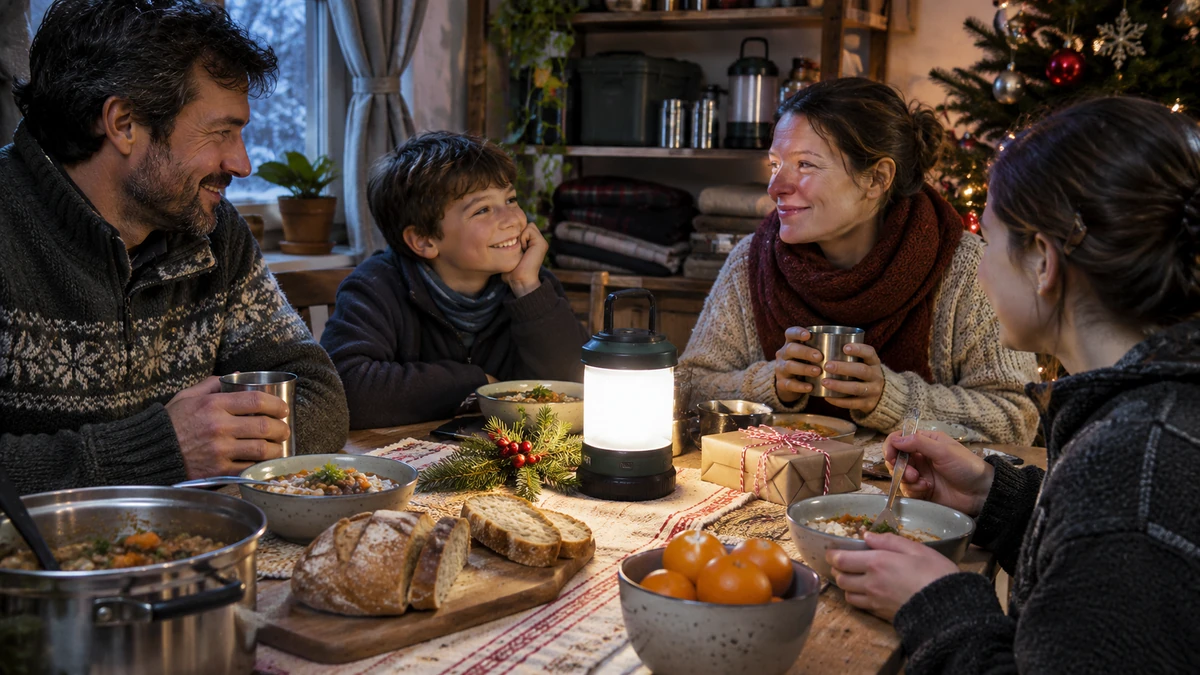
Sitting on the floor, leaning on my mother's chair, I am wrapped in the soothing voices of our friends and neighbours. They resonate around me, sweet and comforting. Despite the austerity of our situation, with candles only for light and as the main gift a used coat, this Christmas has a taste of fullness. It's a celebration of life, a suspended moment where the daily battle for survival is wiped out in front of the beauty of the shared moment. This Christmas, simple but sincere, seems to be the most beautiful of all, a moving reminder of what is truly sacred and precious.
What this story invites us to preserve
The tale does not promise that a garden, a well or barter would be enough to make a family independent. In a real situation, well water must be assessed according to the circumstances, food stored and cooked safely, and any combustion appliances used in accordance with its installation requirements and instructions. The presence of a child and a person with reduced mobility also requires support, care and alternatives. The warmth of the story lies mainly in people who help each other and the possibility for a child to find play and reassurance.