
In this article
Conifer needles are of interest to picking enthusiasts for their aromas and traditional uses. This does not make it possible to consider all conifers as edible nor an infusion as a reliable supply of vitamin C. For a home, the first preparation remains a varied diet, adapted provisions and access to health advice.
Understand the interest and limits
Observing a tree, learning its name and understanding its surroundings are useful outdoor skills. The food use requires additional verification: the exact species, the part taken, its condition and its use must be documented. A common name like “pine” or “fir” is not enough. An application, a photograph or a perfume does not constitute a certain identification.
Nutrient levels vary by species, season and preparation. This article does not give a guaranteed amount of vitamin C, therapeutic dose or method of prevention of scurvy. An infusion is not a substitute for proper nutrition or treatment.
Pine, fir, spruce: learn without concluding too quickly
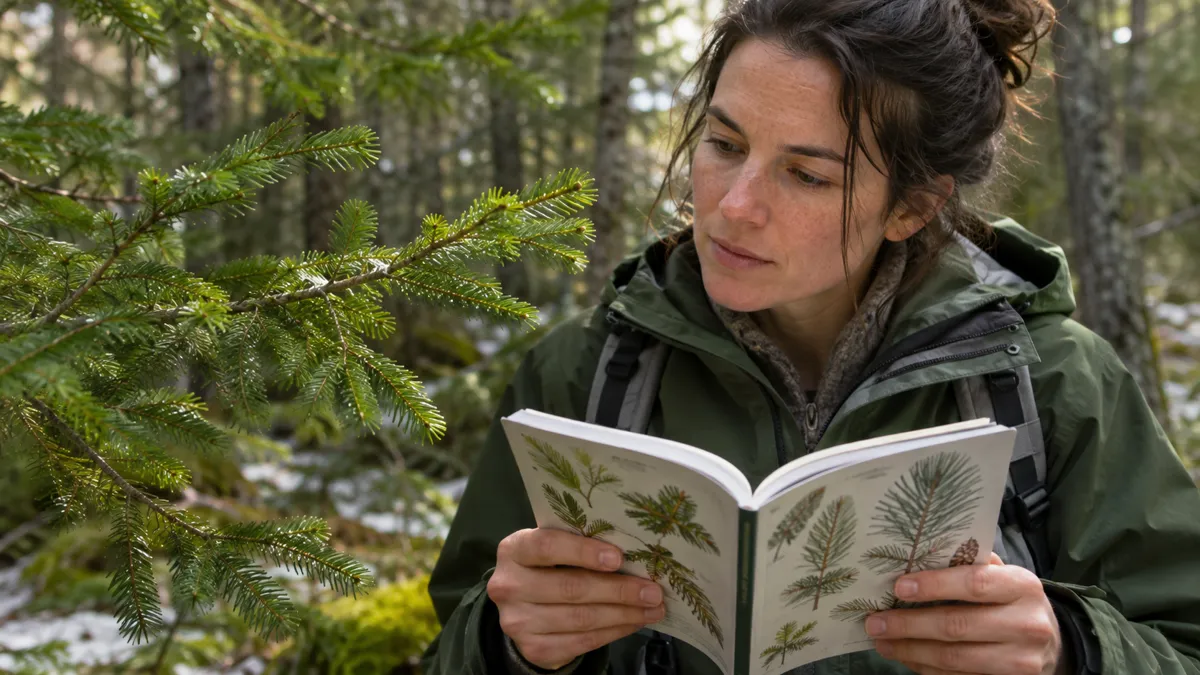
Pines usually carry their needles in bundles; fir trees and spruces carry them individually. These observations guide learning, but are not enough to decide to consume. Use a detailed regional botanical guide and have the identification confirmed by a competent person. A general cover illustration should never be used as an identification key.
The yew, of the genus Taxus, can cause serious intoxication. Confusion with another needle plant is possible. The absence of red fruits does not constitute proof of safety. Do not taste a plant to identify it and do not assume that cooking neutralizes its toxic substances.
Infusion: distinguishing tradition and recommendation
The Missouri Poison Center advises against the intentional consumption of conifer needles and in particular recalls the risks associated with volatile oils and yew. A period of infusion, rinsing or filtering does not correct an identification error.
If you want to deepen a traditional use, do it in a framed learning, with a precise reference for the species and the use. For a daily drink or a family reserve, choose an identified food product intended for infusion instead.
Responsible harvesting and provenance
Before any collection, check the authorization of the owner and the rules of the park or protected area. Remove decorative or treated trees, industrial areas and road approaches. Remove the young trees carefully and without damaging them. A seemingly clean provenance does not replace botanical identification.
Do not improvise a shelf life common to all needles. Humidity, contamination and storage conditions differ. The promises of a week in the refrigerator or twelve months in the freezer are therefore not taken as guarantees.
Situations that require you to abstain
Do not offer wild preparation to a child, during pregnancy or breastfeeding, or to someone with a health problem or treatment without proper professional advice. The “natural” statement does not prove safety. Do not substitute a plant for a prescribed medicine.
In case of ingestion of an unknown or potentially toxic plant, quickly contact the poison control center in your territory and keep a description or sample without reexposing yourself. Call for help in the presence of severe symptoms. Do not cause vomiting and do not give homemade preparation to “neutralize” the product.
Practical issues
Can I identify a tree with this page?
No. The markers presented introduce the subject; they do not constitute a complete botanical key or an authorization for consumption.
Does an infusion replace foods rich in vitamin C?
Nope. Instead, plan a varied food supply adapted to the needs of the household. An unmeasured nutritional value should not be used as the basis for a health plan.
What first useful action?
Participate in a supervised identification trip, check the collection rules and choose a reliable regional botanical source, before considering a food use.
Sources and Limitations
- Missouri Poison Center - Pine Needles Risks and Distinctions with the IF.
- Ontario Poison Centre - Plants Prevention of plant-related poisoning.