
In this article
Becoming more autonomous is about reducing certain dependencies and dealing better with those that remain. This progression can begin in an apartment, with a limited budget: maintain its business, prepare simple meals, organize a reserve and know the resources of the neighborhood. It does not require living off-grid or producing everything yourself.
Choosing a dependency to reduce
Start with a difficulty encountered in ordinary life: impossible runs for a few days, simple object thrown because of lack of know how to repair it, too heavy energy bill or lack of solution when the phone discharges. A useful improvement today is more likely to be maintained.
Note the need, the means already available and a feasible action. For example: prepare two meals with the ingredients of the pantry, learn how to stitch a simple closure or organize the information of an insurance. Measure the result rather than the number of equipment purchased.
Produce a small portion of your food
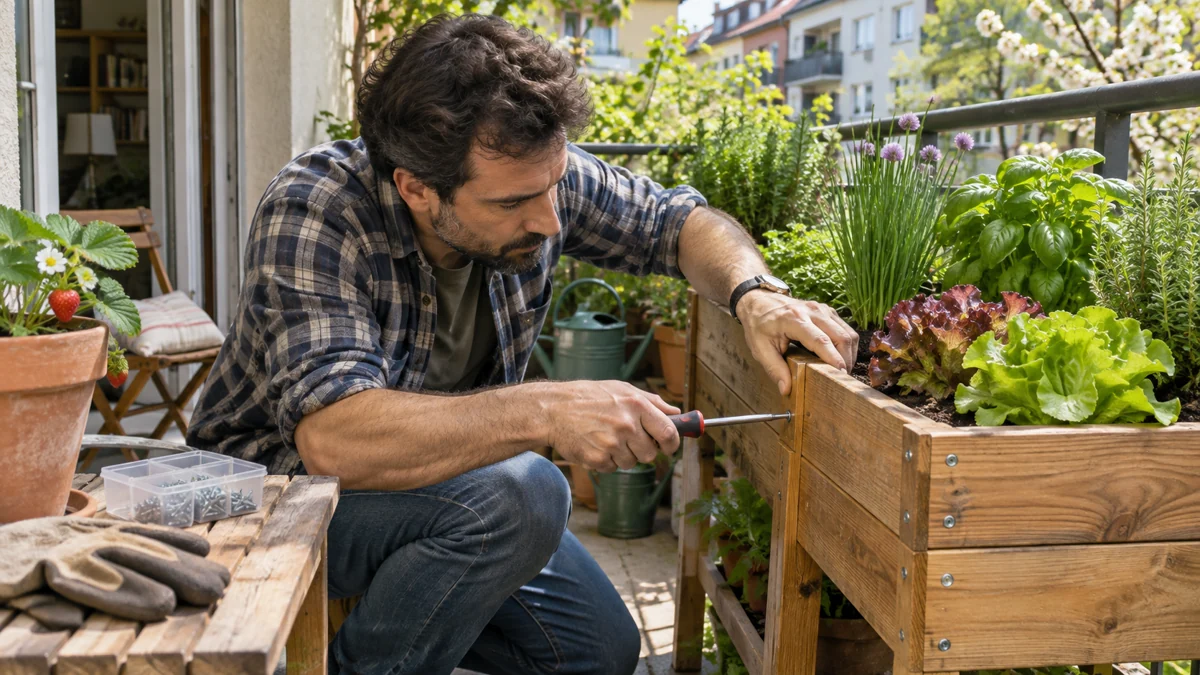
A tray of herbs or a few lettuces allow you to learn watering, light and growing cycles. Start with species adapted to the space and climate. Yields vary: a productive balcony completes purchases, but does not guarantee home power.
Containers should drain, remain stable and not overload a structure. Check the building rules before installing a vegetable garden on a balcony. Access to water and the ability to take care of it during absences count as much as seeds.
Choose the seeds according to cultivation and use. Some varieties allow for faithful breeding, others require knowledge about pollination and selection. Keep a small notebook of seedlings and results, without assuming that all harvested seeds will yield the same plant.
Keep with a proven method
Food self-reliance often starts with using what you buy. Rotate supplies, record dates and adapt quantities to the meals you actually eat. Preserve surplus food using an appropriate method: refrigeration, freezing, drying or a validated canning process suited to the food.
A jar clamp or funnel makes handling easier; these accessories do not replace a safe storage process. Low-acid foods require special precautions. Do not adapt a recipe, time or method of treatment to intuition.
Gaining energy autonomy without improvising
First, reduce the need for efficient lighting, device maintenance and priority uses. For a phone or a small rechargeable lamp, an external battery can be a practical addition. Check its useful capacity, its outputs and its compatibility with the devices concerned.
A grid-connected solar installation does not necessarily provide power during a failure. A backup power supply requires a suitable design and, depending on the work, a qualified professional. The power calculator helps to structure needs; it does not validate an electrical installation.
Learn to maintain rather than accumulate
Choose a simple skill: basic sewing, sharpening authorized by the manufacturer, repairing a piece of furniture or maintaining a bike. Work on an object without a security issue before intervening on something a person depends on. Electrical works, gas and certain mechanical elements require a specific qualification.
A small sewing kit can repair a pocket or hem. It becomes useful when you know its content and the consumables are adapted to the fabrics used.
Keeping ambitions adapted to the home
Breeding or beekeeping involves obligations, ongoing care, space and costs. Check the local rules, the necessary knowledge and the solution in case of absence before committing. Rainwater can be used for authorised horticultural purposes; it does not automatically replace a drinking water supply.
Also develop your ability to move at your own pace, ask for help and share skills. Physical limitation requires adaptation, not dangerous testing. The autonomy of a home is built with reliable people and services.
Your next action: Remember an improvement for the next thirty days, set a small budget and plan a trial. Then re-evaluate the time saved, costs and limits observed.