
In this article
- In brief
- A family-centred life, long before the birth
- The image of the father: role model, aspiration, responsibility
- The birth: when the plan meets reality
- Preparedness and fatherhood: two logics that meet
- What fatherhood teaches about resilience
- Passing it on: the heart of fatherhood
- Building a child’s arrival into your emergency plan
- An ongoing adventure
- Frequently asked questions
Becoming a father is rarely what you imagined. Not entirely different, not entirely the same. It is an adventure that begins well before the birth, changes you deeply and comes with no reliable instruction manual.
This is not a parenting guide. It is a personal reflection on what fatherhood surprisingly shares with citizen preparedness: the art of planning ahead without ever controlling everything. Toward the end, it also offers a few practical pointers for building a child’s arrival into your household emergency plan.
In brief
In brief. Fatherhood and preparedness rely on the same reflexes: anticipating, adapting, staying calm, leaning on a network and passing things on. A plan helps, but it does not replace the ability to respond when reality departs from it. A resilient household is not a perfect household: it is one that can get through hard times without falling apart.
A family-centred life, long before the birth
From the early 2000s, the idea of starting a family was central. Sharing a life, raising children, building something lasting: these were not abstract hopes. They shaped choices, priorities and the way the future was imagined.
That desire for a stable environment, for a resilient home, echoes a logic many people involved in citizen preparedness will recognize: we do not build only for ourselves. We build for those who depend on us and for those who will come after.
The great adventure was not waiting in faraway places or extreme situations. It was waiting in everyday life: in the role of father that would redefine everything.
The image of the father: role model, aspiration, responsibility
In many children’s minds, the father is a guardian figure. A protector, a guide, a storyteller. Someone who makes the world a little less unpredictable and a little safer. This image, formed in childhood, deeply influences how we approach fatherhood ourselves. We want to live up to that model, while knowing we cannot simply copy it: every generation, every family and every child is different.
Wanting to be a good father often starts with understanding what we received, and what we wish we had received. This reflection is not a weakness. It is a form of clear-eyed preparation, much like assessing your own vulnerabilities before building a plan.
Aspiring to be a present, attentive father, able to teach and to amaze, to protect and to play, to guide without smothering: these intentions are not naive. They are the starting point of an active stance toward fatherhood.
The birth: when the plan meets reality
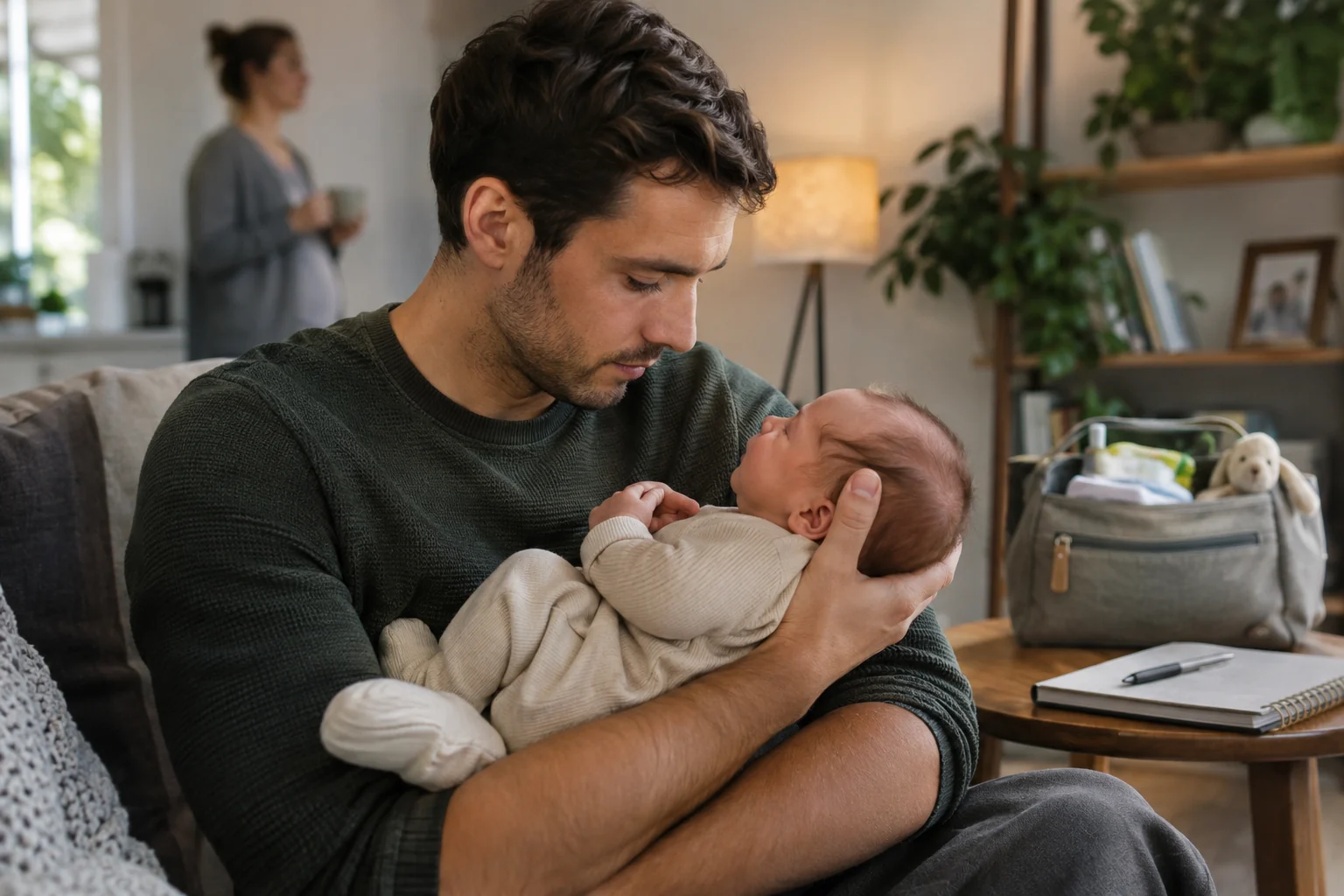
On August 19, 2016, Logan’s birth marked the concrete beginning of that role. As often happens with important events, there was a plan: every step anticipated, every scenario considered. And as often happens, reality went beyond anything imagined, not in a negative way, but in a way that was more intense, more alive and more unpredictable.
This is one of the fundamental lessons of preparedness: a plan is not a guarantee. It is a framework. What matters is the ability to stay calm, adapt and act wisely when events drift away from the expected scenario.
| What we anticipate | What we live through |
|---|---|
| A clear plan, defined steps, assigned roles | An intensity nothing really prepares you for |
| Prepared logistics: bag, route, contacts | Surprises in timing, travel or how things unfold |
| The feeling of being ready | Simultaneous, contradictory and deep emotions |
| An ideal scenario | The ability to be there, no matter what |
Holding your child for the first time is a moment that resists any perfect description. Joy, wonder, surprise, and a touch of vertigo at the scale of what is beginning. This mix of emotions does not mean you were unprepared. It simply shows that some realities can only be fully understood by living them.
A child’s birth is the moment when all preparations find their meaning, and their limits.
Preparedness and fatherhood: two logics that meet
Citizen preparedness rests on a few simple principles: anticipating difficult situations, building skills, reducing vulnerability and keeping the ability to act even when conditions are not ideal. To some extent, the same principles apply to fatherhood.
- Anticipate without controlling everything. Prepare the space, resources and routines, while accepting that a child, like any real situation, has surprises in store.
- Adapt in real time. Every child is different. What worked yesterday may not work tomorrow. The ability to adjust is more useful than a rigid plan.
- Stay calm under pressure. Hard nights, illnesses, growth spurts: a parent’s emotional stability is a resource in its own right.
- Invest in the long term. The self-reliance, resilience and values passed on to a child are not built in a day. They build up through ordinary gestures over years.
- Accept uncertainty. No parent can guarantee that everything will go well. Honest preparedness includes this irreducible share of the unexpected.
| Preparedness principle | What it becomes in fatherhood |
|---|---|
| Assess your risks | Know your child’s needs at each age and the weak points of daily life (sleep, health, childcare) |
| Build supplies | Keep a margin for your child’s basic needs, without overstocking |
| Develop skills | Learn paediatric first aid, how to manage a fever, basic safety habits |
| Build a network | Partner, extended family, friends, neighbours, trusted childcare |
| Practise | Rehearse simple routines: emergency exit, emergency number, meeting place |
Fatherhood cannot be entirely improvised, but it can never be fully mastered either. The most useful stance lies between these two extremes: prepared, yet open to the unexpected.
What fatherhood teaches about resilience
We often talk about resilience in the context of collective crises: power outages, storms, economic disruption. But resilience also starts at home, in how we face everyday challenges with our children.
Becoming a father means learning to handle accumulated fatigue without losing your way. It means developing a patience no book can teach. It means understanding that the most important resources are not always material: calm, presence and consistency have a value nothing can replace.
It also means learning to recognize your limits, and to ask for help when needed. Resilience is not solitude. It relies on a network: a partner, extended family, friends, the community. That is exactly what community resilience describes on a larger scale.
A resilient household is not a perfect household. It is one that can get through difficulties without falling apart, keeping enough consistency for everyone to feel safe.
Passing it on: the heart of fatherhood
Fatherhood is, at its core, an act of passing things on. We pass on values, ways of seeing the world, practical skills and an attitude toward adversity.
From a preparedness perspective, this takes a concrete form: teaching a child to observe their surroundings, to understand risks without fearing them, to grow more independent step by step and to trust their judgment while recognizing its limits. The goal is not to raise a child to be suspicious or anxious, but to give them tools to navigate an imperfect world with good judgment and self-confidence.
- Curiosity. Encourage questions, value exploration, do not discourage uncertainty.
- Resourcefulness. Offer situations where the child can solve problems at their own level, without an adult always stepping in.
- Managing emotions. Naming feelings, going through hard moments rather than avoiding them, looking back on events calmly.
- A sense of responsibility. Age-appropriate chores, gradual involvement in household life, understanding that actions have consequences.
- Trust in others. Knowing when to ask for help, recognizing trusted people, understanding the value of solidarity.
General milestones: every child moves at their own pace.
- Safety and routinesA stable, reassuring setting; the adult carries the preparedness.
- First reflexesKnow their full name, address, a parent’s number and when to call 911 (112 in Europe).
- Taking partPack their own small bag, join an evacuation drill, know the meeting place.
- Independence and supportFirst aid, handling a power outage, helping younger children and neighbours.
General educational milestones, to adapt to each child’s maturity.
To put this into practice, the five activities to involve children in preparedness and a family backpacking trip offer simple, playful opportunities.
Building a child’s arrival into your emergency plan
A child’s arrival also changes the household emergency plan. Needs grow, travel gets more complicated and priorities shift. A few simple adjustments are often enough:
- Update the 72-hour kit with the baby’s own needs: diapers, wipes, infant formula if the baby is not breastfed, safe water to prepare it, spare clothes and a blanket.
- Plan for medication and documents: health record, health insurance card, prescriptions, contact details for the paediatrician or family doctor.
- Review the evacuation plan: who takes the child, with which car seat or carrier, and to which meeting place.
- Name backup people: one or two trusted people who could pick up the child if the parents are held up elsewhere. A family emergency guide helps record this information.
- Think about separation: as the child grows, preparing them for a family separation in an emergency becomes a topic to raise calmly.
In Quebec. The Québec Parental Insurance Plan (QPIP) provides paternity benefit weeks reserved for the father or second parent, in addition to shareable weeks. Check current durations on the QPIP website.
In France. Paternity and childcare leave is 25 calendar days, added to the 3 days of birth leave. Conditions are detailed on service-public.fr.
The first weeks are also a good time to take stock. The preparedness assessment helps spot what your household is missing, and the PrépaCivile tools help estimate water and food supplies for a growing family.
An ongoing adventure
Fatherhood is not a state you reach. It is an ongoing process of adjustments, questioning, moments of doubt and moments of clarity. Each stage of a child’s life redefines the father’s role.
What worked at three no longer works at ten. What mattered in adolescence no longer matters in adulthood. The ability to grow with your child, to keep the bond without trying to control, may be one of the most demanding skills fatherhood requires.
Being a father means accepting that you will never be completely done learning. It is one of the rare adventures that never really ends, and that is precisely what makes it so rich.
And you, fathers and fathers-to-be: how did you experience this transition? How do you reconcile your sense of preparedness and your values with everyday family life? Every experience is different, and much of the richness of fatherhood lies in that diversity. To talk about it at home without tension, see also how to get your family on board with preparedness without trying to convince them.
Frequently asked questions
Do you need a different emergency plan when expecting a child?
Not a different plan, but an adjusted one. Add the baby’s needs to the 72-hour kit, plan how to carry the child in an evacuation and name trusted people who could step in.
At what age should you start talking about preparedness with a child?
As soon as the child understands simple instructions, around age 4 or 5, you can teach their address, a parent’s number and the role of 911. The key is to stay concrete and reassuring, without frightening them.
How can you avoid passing anxiety on to your children?
Present preparedness as a skill, like swimming or crossing the street, rather than as a reaction to a threat. Short, playful drills followed by a calm debrief work better than long explanations.
Can a single parent apply these principles?
Yes. The network of backup people becomes even more important. The article on single-parent households in an emergency explains how to organize that support.