
In this article
- Plan drinking water from the start without delaying other emergencies
- Factors substantially affecting water needs:
- Common dehydration signs
- Care and medication: maintaining continuity and recognizing needs for help
- Following weeks: maintaining suitable food and replenishment options
- Three complementary avenues according to means and territory
- Want to learn more about prolonged disruption?
- A family emergency kit should include:
- Optional equipment examples
You have reached safety and hours become days. How do you organize needs when some services are slow to return? This deserves planning without assuming no help will come or every disaster will lead to social collapse.
After initial sheltering, households need to follow instructions, reassess accommodation and organize resources. This guide extends discussion of the first seconds, minutes and hours into subsequent days and weeks. It is neither a medical protocol nor a universal survival calendar: priorities depend on hazards, people and service availability. A companion guide may provide context, but every event needs a current assessment.
The first three days: check safety and cover immediate needs
After a disaster, decisions concern shelter, care, water, food, sleep and communications. An urgent need takes precedence over a fixed order: serious injury or unsafe housing cannot wait for an inventory. An accessible kit covering the first 72 hours may help alongside a plan and support network. Three days is an initial planning horizon, not a restoration promise or a deadline beyond which anyone is doomed.
Plan drinking water from the start without delaying other emergencies
The historical figure of 16 ounces daily, less than half a litre, must not be presented as a safe minimum. No single volume guarantees everyone’s survival. For a PrépaCivile reserve, initially allow two litres per person per day for drinking plus two for food preparation and minimal hygiene, then adjust to needs. This logistical scenario is not a medical prescription. Illness, heat and exertion may alter needs; a prescribed fluid restriction needs professional advice. Prioritize already safe drinking water and respect health advisories.
Factors substantially affecting water needs:
- Age and particular needs: infants, children and some older adults may be especially vulnerable to dehydration. Ability to communicate thirst, drink access and concurrent illness also matter. Plan assistance and age-specific recommendations; do not automatically apply an adult volume to a baby. Behaviour changes or reduced urination deserve prompt attention.
- Exertion: sweating and surrounding conditions influence losses. Sharing tasks, planning breaks and limiting heat exposure may reduce strain. Do not reserve water only for those carrying loads: others may also have substantial needs. Household reserves must suit everyone without treating physical effort as an absolute priority criterion.
- Illness: vomiting and diarrhoea may cause water and mineral losses. Seek rehydration advice suited to age and health; oral rehydration solution may be appropriate. An outage does not automatically mean all medical help is absent: retain contacts and seek care when signs require it.
Common dehydration signs
Knowing some signs can help a response without diagnosing the cause alone. Nausea without vomiting does not itself mean major fluid loss. Monitor intake, urination and overall condition, using public-health recommendations and professional advice. Confusion, marked drowsiness or inability to drink cannot be managed merely by reminding someone to drink more.
For children and babies, signs to watch include:
- Dry mouth and tongue
- Crying without tears
- Fewer wet diapers than usual; no urine for six hours in a baby is among serious signs described by Quebec guidance. Do not wait that long if the condition worries you.
- Eyes or fontanelle appearing sunken alongside other changes requiring prompt assessment; appearance alone is not conclusive.
- Irritability, unusual drowsiness or substantially reduced activity: seek assessment according to severity rather than assuming ordinary fatigue.
Adult signs include:
- Dark, infrequent urination
- Lethargy
- Dizziness, confusion or feeling faint: these may need urgent care and must not automatically be attributed to dehydration.
- Excessive thirst
Moderate or severe dehydration signs require urgent assessment according to Government of Quebec recommendations. The list is not a self-diagnosis tool and must not delay care when someone is deteriorating.
Care and medication: maintaining continuity and recognizing needs for help
Care does not begin only on day three: it follows needs from the start. Historical claims that infections cause two deaths in three, or most people would not survive three days without wound treatment, lack identifiable supporting data here and are not retained as facts. Plan first aid supplies, suitable training and contact with services. Discuss treatment continuity, storage and permitted renewal with the pharmacist or treating professional. A manual may supplement information but cannot replace necessary care for pregnancy, fractures, infection or radiation exposure. Do not improvise treatment from a general guide.
Respect medication dates and storage conditions and ask the pharmacist when uncertain. Stability studies on selected lots under controlled conditions do not justify using every household medicine ten years after expiry. Do not automatically favour powders over gels or liquids: choice depends on the drug, prescription and requirements, particularly after reconstitution or opening. Rotate authorized supplies and return expired medication to a pharmacy according to local arrangements. Preparedness aims at safe treatment continuity rather than accumulating products of presumed effectiveness.
Following weeks: maintaining suitable food and replenishment options
Food is a need from the beginning, not only from the third week. Longer term, rotating supplies, distribution channels and possibly personal production may diversify options. The three historical avenues below—storing, knowing natural resources and growing—do not guarantee food and need not all be mastered by every household. Physical work, cold and medical needs may change intake. Plan sufficiently varied, appropriate meals rather than assuming a few macronutrients or an outdoor technique suffice. Food assistance and operating shops remain legitimate resources.
Three complementary avenues according to means and territory
- Gradually build supplies of familiar foods: commercial canned goods, dry products and simple meals. MREs and freeze-dried foods are options, not essentials. Cold vegetable storage requires suitable conditions; it does not replace a cold chain for perishables. Start with existing food, avoid purchases that undermine the budget and learn rotation. The resource “How to store food effectively” may develop the method after its link is checked.
- Knowing natural resources does not make hunting, trapping or foraging accessible to everyone or immediately productive. They require skills, permissions, season and suitable territory. Never consume an uncertainly identified plant or mushroom, or assume rules disappear during a disaster. Catches and harvests remain uncertain; they do not replace initial reserves or assistance and supply channels.
- Growing: a garden may contribute food and learning according to climate, soil, water, space and available time. Stored seed does not create an immediate harvest. Plan the season, tools, varieties and preservation options before relying on yield. A community garden or small crop may be useful without making a complete self-sufficient installation obligatory for every household.
Want to learn more about prolonged disruption?
Planning prolonged disruption must include services, rights, mutual help and collective recovery rather than promising a future without institutions. A scenario series may prompt questions but is neither a prediction nor proof that its answers suffice. Check linked-resource availability and use current instructions for the actual event.
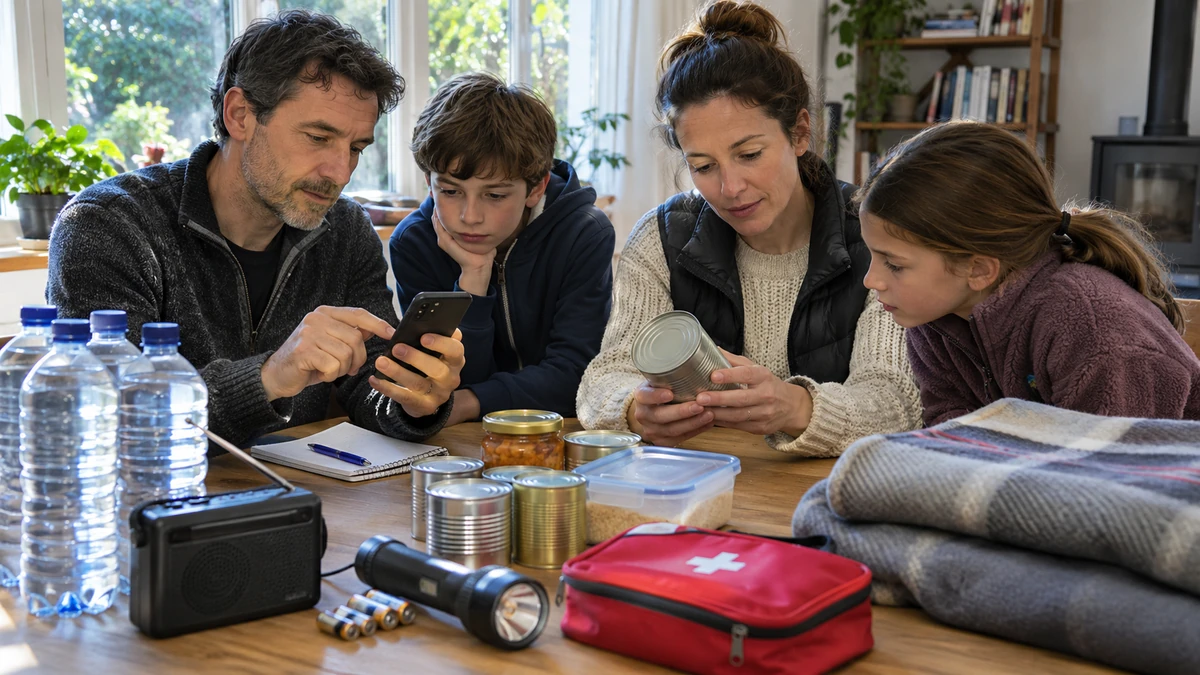
A family emergency kit should include:
- Drinking water: an initial four-litre-per-person daily scenario for drinking, food and minimal hygiene, adjusted as needed; plan safe replenishment too.
- A three-day supply of non-perishable food
- Clothes and blankets
- Personal medication and useful information: authorized quantities, storage, prescriptions and contacts according to professional advice.
- First aid kit
- A battery or rechargeable radio with tested local reception and backup power; hand-crank charging is optional, not mandatory.
- Tarp and tape suited to a defined use if useful to the plan; do not create an airtight space that compromises ventilation or appliance safety.
- Torch or headlamp with genuinely available batteries or charging; solar and hand-crank options do not guarantee sufficient operating time.
- Prioritize flameless lighting; historical candles require supervision and separation from combustibles and do not suit every location.
- Protected ignition source for safe, authorized uses only; its presence does not justify an improvised indoor fire.
- Personal hygiene supplies
- Tools suited to actual tasks; a knife, axe or saw is not required in every urban kit and must be transported and used safely and lawfully.
- A small cash reserve where possible and varied payment methods; barter goods do not replace essential needs.
- Important documents
Verified guidance: dehydration — Government of Quebec; safe medication use — Health Canada. Treatment advice remains individualized.
Two items for putting these ideas into practice
Plan two separate functions: receiving local information and keeping a compatible phone charged.
Affiliate links: as an Amazon Associate, PrépaCivile earns from qualifying purchases. These examples are optional. Check the model, package contents and terms. Use equipment you already own first.
Radio for local information
Check bands and locally received stations. North American weather features are not a universal alert service in France.
Canada — Amazon.ca
 Sangean MMR-88 AM/FM/Météo, Alerte Radio, Solaire/Manivelle/USB/Lampe de poche, Sirène, Chargeur SmartphoneView on Amazon.ca
France — Amazon.fr
 Sangean MMR-88 Radio portable Numérique Noir, Jaune - Radios portables (Portable, Numérique, AM,FM,MW, 87,5 - 108 MHz, 522 - 1710 kHz, 0,4 W)View on Amazon.fr
Power bank for a compatible phone
Check connectors and cable. This is not backup power for a medical device.
 Anker Chargeur portable USB-C 10 000 mAh 30 W
 Anker Zolo Batterie externe 10000 mAh 30 W avec câble USB-C