
In this article
- Check the rules and purpose of the exercise
- Choose a location that does not require transformation
- Understanding Limited Protection
- Installing a lightweight structure according to his instructions
- Check water, access and secondary risks
- Preparing an opportunity to give up
- Leaving the site properly
- Sources and benchmarks
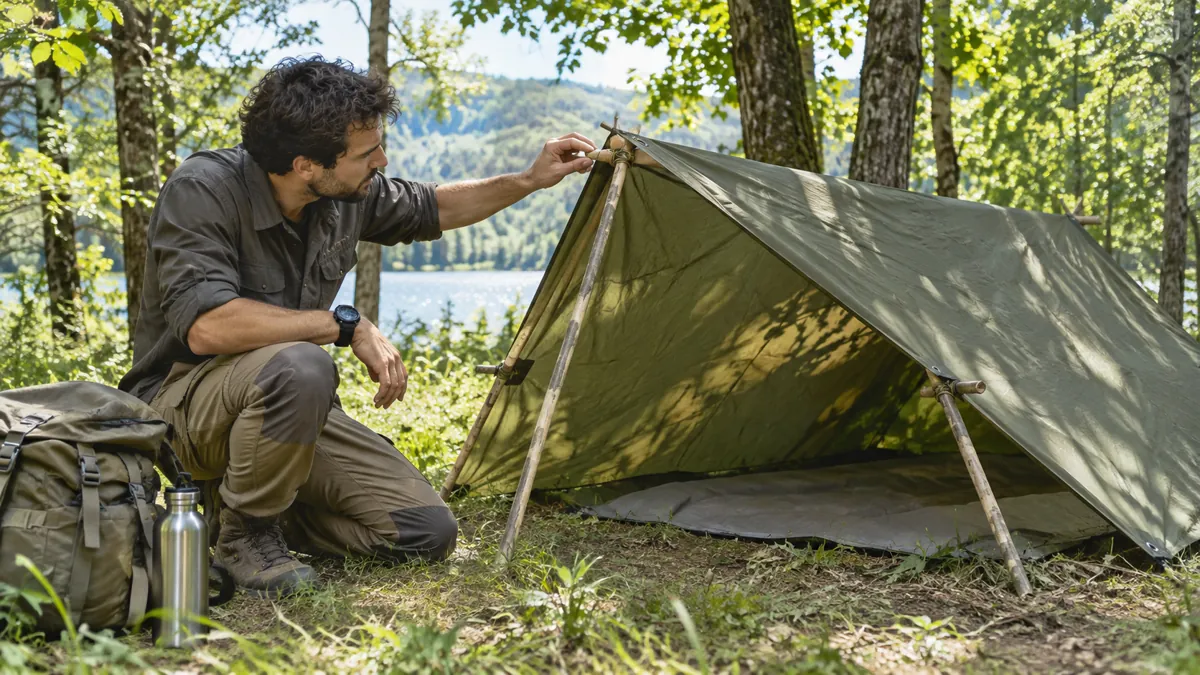
A lean is an open sloping shelter on one side. A light version with a tarpaulin can be studied in an authorized outdoor setting and in ordinary conditions. It does not guarantee protection against all weather conditions and does not replace suitable equipment or a return solution.
Check the rules and purpose of the exercise
Before any installation, check the authorization to camp and use the site. The rules of parks, public lands and owners may prohibit levies or constructions. The presence of wood on the ground does not automatically give the right to move it.
To start, choose a training and a light tarpaulin designed for use, with its installation equipment. The goal is to understand orientation, fixations and drainage without cutting vegetation or building a heavy structure.
Choose a location that does not require transformation
Avoid unstable branches, runoff areas, brittle banks and passages. Also look at the wind and the manager’s instructions. A pleasant place in dry weather can receive water during a rain.
Use an authorized and durable surface. Do not dig trenches or move vegetation to make a site. If the site is not suitable, change the option rather than multiplying the changes.
Understanding Limited Protection
The inclination directs the water to one side, but a change in wind can expose the opening. A tarpaulin alone does not provide the insulation of the bed or an appropriate solution to the cold.
Provide the mattress, clothing and equipment adapted to the weather. If conditions exceed your skill or equipment, use a safer solution. A successful test on a summer day does not validate a shelter for a winter night.
Installing a lightweight structure according to his instructions
Use the intended attachment points and suitable supports, without damaging the bark. Refer to the tarpaulin instructions and practical training to choose bindings. Do not leave a heavy pole hanging over the occupied area.
Anchors and ropes must not cut a path or create a risk of falling. Keep tools stowed away and people away from live items. Do not test strength by placing yourself under an unstable structure.
Check water, access and secondary risks
Make sure that the flow does not go to the bed and that the opening remains accessible. Check the fixation points and tension according to the instructions, especially after a change in conditions.
Do not cook or light a fire under the tarpaulin. Respect the fire bans. A combustion heater or appliance does not automatically make a shelter usable; it can create risks of fire and poisoning.
Preparing an opportunity to give up
The exercise must include a duration, a means of communication and a fallback solution. Inform a relative of the activity and the planned return according to the context. Do not isolate yourself without suitable means to make the situation more realistic.
If the shelter is no longer suitable, go to the prepared solution before fatigue and conditions complicate the movement. The ability to interrupt an essay is part of learning.
Leaving the site properly
Remove the equipment, ropes and waste. Respect the manager’s instructions for the facilities present; do not modify an existing structure simply because you find it on site.
The practice should leave the environment intact as much as possible. Note the points to improve in the material or training. A video or text provides cues, not a structure validation or a guarantee of survival.