
In this article
A delayed trip, power outage or adverse weather can change an ordinary day. The daily equipment reflects a foresight approach: gather some useful resources, know how to use them and keep them accessible. Many people already have a first base with their phone, keys, usual medications or a work bag. The preparation consists in examining this base and completing it as needed, without pretending to anticipate all the tests.
Your day-to-day equipment reflects your organization and how you approach the unexpected. A light and discreet set can bring together objects that meet several needs: find information, communicate, illuminate a passage or make a small repair. Its value depends less on its appearance than on the adequacy between the resources transported, the skills of the bearer and the conditions actually encountered.
Adopting and refining this equipment is a gradual process. For a beginner, it is a question of identifying what is really missing in his usual bag. For an already organized person, the challenge may be to check the functions, replace a little used object or lighten the load. Every choice wins by having an understandable purpose. This attention to detail supports autonomy and resilience without imposing an identity, a level of expenditure or an obligation to own specialized equipment.
The equipment of everyday life also concerns ordinary life: facilitate a journey, wait more comfortably or keep means of communication. Preparing does not guarantee to avoid an emergency and does not allow to judge the people who are victims. The approach consists of having a few additional answers, recognizing the limits of the material and reconsidering its choices when the context changes.
Short distance different from Short duration
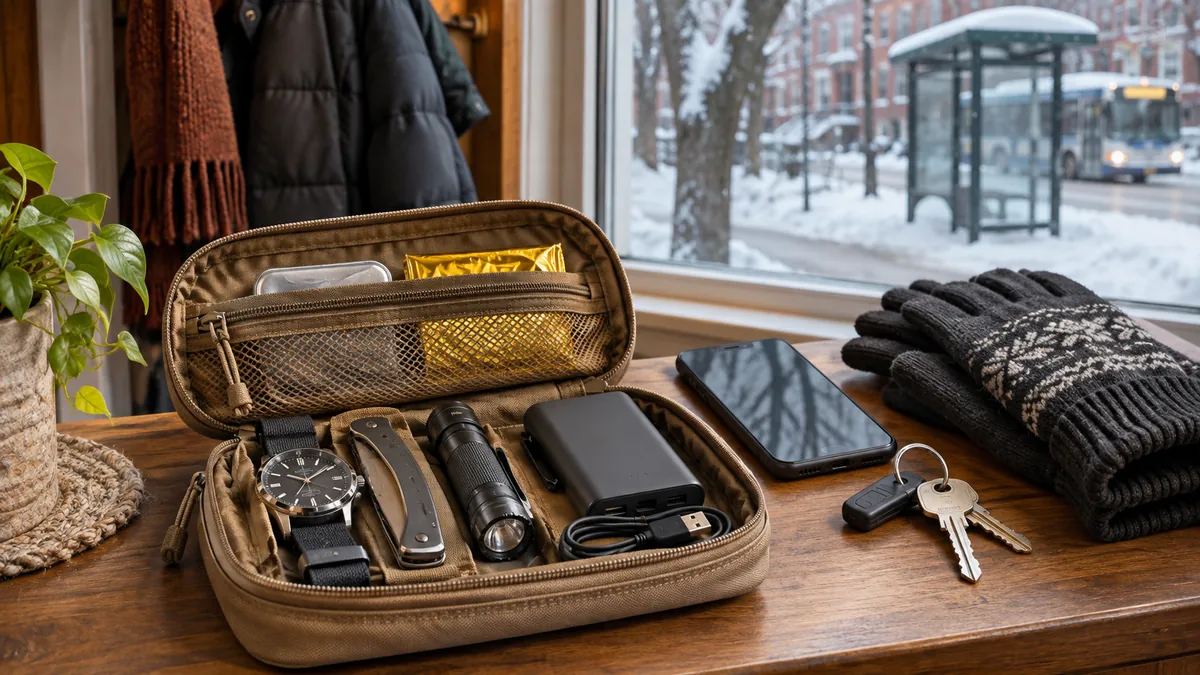
Short distance does not mean short duration. A usually fast ride can be lengthened by snow, closed streets or interrupted transportation. In a city like Montreal, a heavy snowfall can change the conditions of a trip. The example of 50 cm serves here as an illustrative scenario, not a meteorological assessment of an identified event. Anticipate waiting time, cold weather and detours rather than just miles.
To illustrate the gap between distance and duration, let’s imagine a strong accumulation of snow in Montreal. A 50 cm hypothesis allows discussion of snow clearing, congested sidewalks and disturbed transportation: it is here a planning scenario, not a meteorological measurement attributed to a specific night. A familiar journey can become longer or temporarily impassable. Providing clothing, communication and alternatives is more useful than just counting miles.
This scenario recalls the interest of reasoning in terms of duration and possible obstacles: a detour, a break in service and a wait in the cold change the needs of a trip. A suitable outfit, water supply, snack, lighting and a means of communication can be useful. The equipment mainly accompanies the decision to wait in the shelter, to change its itinerary or to give up the trip according to the instructions.
A strategic choice
Composing your everyday equipment is like confronting a theoretical path to its real conditions. A map and a distance do not describe traffic jams, blocked streets, detours or dangers that can make a regular route more difficult. The chosen equipment must therefore accompany alternatives: wait in the shelter, change the route, reach a safe point or ask for help. A well-filled bag does not make a dangerous itinerary acceptable.
Each element taken should meet an identified need rather than an accumulation of scenarios without limit. A lamp, a water supply or accessible coordinates can complete the plane of the movement. Examine the plausible contingencies and means already available on the journey. This reflection makes it possible to organize a useful and transportable kit, without considering its content as a protection against any uncertainty.
Choosing the objects of your daily equipment is also a practical confidence exercise: knowing where the lamp is, the contacts and the means of payment reduces certain difficulties. In case of traffic jam, impassable street or unexpected danger, choose a safe detour or an adapted waiting place. The bag alone does not ensure a safe passage; the ability to adapt and ask for help matters as much as its content.
Daily Equipment
Everyday life can give the impression of stability, but a snowstorm, an extended power outage, a flood or an act of violence can disrupt habits. Their likelihood and consequences vary depending on the location and situation. It is not necessary to live in worry to recognize this possibility: identifying the relevant risks and preparing some concrete answers is a more useful approach than imagining a permanent threat.
When a disturbance occurs, prepared objects can help maintain certain functions: lighting up, reaching out to a loved one, finding information, or performing a small repair. These means are neither a shield nor a guarantee of recovery. They complement the instructions, skills and mutual assistance. Their interest is to reduce certain practical difficulties, without opposing the so-called prepared people to those who need assistance.
Technology and safety features do not remove all hazards. Recognising this vulnerability allows one to examine one’s needs without seeking absolute autonomy. Carefully chosen equipment can improve comfort and action possibilities, but it must remain adapted to the person, the journey and the load it can actually carry. It complements a reliable plan and contacts; it does not replace them.
Adapting your equipment means giving you more means to respond to an unexpected. It is not a promise to never be surprised. You can commit to yourself and your loved ones to prepare some concrete answers, know your limits and ask for help when necessary. Tools complement information, skills and relationships; they do not guarantee to overcome all situations.
The tools selected can be used for several purposes: a multi-functional tool helps to open a package or to carry out a small repair, while a lamp can illuminate a path and signal a presence. Do not assume that a knife allows you to get out of a damaged vehicle: a device for this task, its limits and the necessary training must be evaluated separately. Avoid putting yourself at risk to use a tool.
Preparing your equipment is a foresight exercise: what essential needs would appear during a delay, a breakdown or an interrupted trip? This question helps to choose objects, information and fallback solutions. It does not mean that a bag can hold everything that would be needed in the most difficult situations; the plan and the help available remain important.
A well-prepared equipment reflects a concrete commitment to his needs and those of his loved ones. The extra weight must remain justified by useful, known and tested functions. Rather than relying on an object that is supposed to be indispensable in all circumstances, check what actually served, what requires maintenance, and what could be replaced with a simpler solution or accessible help.
But what about the bag for everyday equipment?
Everyday equipment is not reserved for security professionals. A person who organizes his purse with phone, usual medicines, water and means of payment already applies this logic, just like a person who uses pockets, a bag or a backpack. The container and the organization matter more than a label or genre. The goal is to easily find what you really need.
Everyday equipment is about personal adaptation, not gender. A handbag, a compact backpack or a professional briefcase can meet different needs. The demands of work, travel and the environment guide the choice of container and storage. Functionality is measured by the ease of finding and using objects, not the label of the bag or the identity of its wearer.
The preparation can start with objects already available and progress according to the means of each. It aims to give more opportunities to manage a delay, a small difficulty or an emergency, without promising to remove uncertainty. Adapted equipment remains a personal resource, to be maintained and revised, regardless of who wears it.
Diversity
Identities, roles, habits and constraints influence the composition of this equipment. Useful differences to consider include travel, work, health, family responsibilities, mobility and climate. Personal preferences matter, but gender alone does not allow one to infer a person’s needs or skills.
Some people prefer to keep the phone and keys in a pocket; others use a purse for water, documents and everyday items. These options are not gender related. For personal safety, focus on communication, lighting and avoidance. In Canada, aerosols designed for use against people are prohibited weapons. A bear tag is not an authorization to use it against a person.
The diversity of equipment thus reflects different needs and exposures, to be examined person by person. Two members of the same household may have different priorities depending on their schedule, their journeys or the people they accompany. A personalized approach is more useful than inferring risks from the bearer's gender alone.
Taking into account journeys, responsibilities, health and preferences, it is possible to compose equipment more adapted to their users. This does not create a ranking between people or between bags. Two different solutions can be relevant in different contexts. Personalization consists of checking the necessary functions and the actual constraints, rather than inferring the needs of a category of carriers.
Finally
Unusual situations can highlight the limits of ordinary equipment: an urban crisis, a natural disaster or a prolonged interruption are not managed as a small delay. Everyday equipment should be thought of as a transportable complement, not as a solution capable of solving everything. When resources are insufficient, family planning, drop-off locations, available services and organized help become more important.
Your everyday equipment gathers several functions in a transportable format. Its interest lies in the ability to adapt: the same object can be used during an ordinary journey, a wait or a break in service. In a disaster, networks, businesses and travel can be disrupted unevenly. The equipment then helps to maintain certain personal means, without guaranteeing an immediate return to normality or replacing organized assistance.
This approach can support resilience and ingenuity, beyond just the contents of the bag. It invites you to anticipate, choose, test and revise. It is still impossible to predict all times and conditions, but you can improve your ability to adapt. This progressive work does not require any equipment or anticipation of all scenarios: it requires realistic choices and regularly reconsidered.
And you, what are the essential elements that you would choose for your everyday equipment in order to face the unforeseen of everyday life and emergency situations?
Flashlight
To see, read and circulate in a safe place. Check the power supply of the exact model and carry the corresponding batteries. The offers may have different variations depending on the territory.

NEBO Newton Lampe de poche LED puissante | Lampe de poche compacte étanche alimentée par piles AA | Gris tempête | Disponible en 500, 1000, 1500 lumens
Visit on Amazon.ca — NEBO Newton Lampe de poche LED puissante | Lampe de poche compacte étanche alimentée par piles AA | Gris tempête | Disponible en 500, 1000, 1500 lumens
NEBO Newton 500 - Lampe Torche - Lampe de poche étanche à LED - Alimentation par pile AA avec socle magnétique
View on Amazon.co.uk — NEBO Newton 500 - Torch Lamp - Waterproof LED Flashlight - AA battery power supply with magnetic baseEDC Portable Alloy Tweezer – Mini Survival Tool Camping Travel
Example to compare according to your real need. The Canada and France variants may differ: check dimensions, capacity, power supply and delivery conditions.

EDC Pince à épiler portable en alliage – Mini outil de voyage de camping
Visit on Amazon.ca — EDC Portable Alloy Tweezer - Mini Camping Travel Tool
Uncle Bill Sliver Gripper Pince à épiler sur porte-clés
View on Amazon.co.uk — Uncle Bill Sliver Gripper tweezers on keychainVIPERADE VE18 EDC pouch for men, EDC storage pouch, 3 slots with 2 zipped pockets, EDC pouch for multifunction tools (XPAC-soft black)
Example to compare according to your real need. The Canada and France variants may differ: check dimensions, capacity, power supply and delivery conditions.

VIPERADE VE18 EDC Organiseur de poche pour homme – 3 emplacements avec 2 poches zippées, pochette à outils multifonctions
Visit on Amazon.ca — VIPERADE VE18 EDC Men's Pocket Organizer - 3 slots with 2 zipped pockets, multi-function tool pouch
VIPERADE VE18 EDC Organisateur De Sac à Outils pour Usage Quotidien Multitool Pochette De Protection pour EDC Gear Lampe De Poche Couteau Stylo Notebook(Vert + Kaki)
View on Amazon.co.uk — VIPERADE VE18 EDC Tool Bag Organizer for Daily Use Multitool Protective Pouch for EDC Gear Pocket Lamp Knife Notebook Pen(Green + Khaki)